Questões de Vestibular Sobre inglês
Foram encontradas 6.367 questões


Leia o texto a seguir para responder à questão.
How to Minecraft
Create! Explore! Survive! The basics for getting into the game! Minecraft is a game about placing blocks and having adventures. It's a survival experience about staying alive in your own fantastic world, that's also a creative space to build almost anything you can imagine!
We know Minecraft can be intimidating to newcomers, so we've assembled this simple guide to get you started. Trust us, you'll be a miner expert in no time!
[…]
Starting Out and Survival Tips!
Select Singleplayer in the Main Menu, then Create New World. You'll see this:
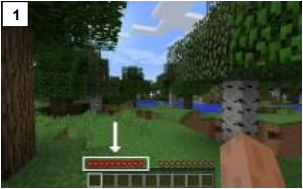
The health bar (the hearty looking one). Don't let it drop to zero. Otherwise, it's game over!
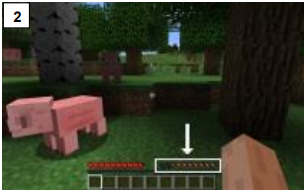
The food bar (the tasty looking one). When it's full, your health will regenerate, so keep snacking!
[…]
The secrets to survival are having a steady supply of food and staying safe from monsters. Luckily, building a shelter is easy. Your hand is your first mining tool, so use it to hit trees or dirt until they turn into blocks. These blocks will appear in your toolbar, and you can then place them right in front of you.

Build your shelter, making sure there’s no way for monsters to get in! Later, you'll be able to build doors, windows, etc., but for now, focus on surviving! Most monsters come out at night, so stay inside until sunrise and you'll be safe. Animals are everywhere and only take a few attacks to finish off. They’ll drop meat which restores health. There's also apples, melons and other veggie options to be found if you're vegetarian […]. Hmmm, you've got a point.
The first shelter you build will likely look like this, er, 'cosy' one here. Hey, we all start somewhere!
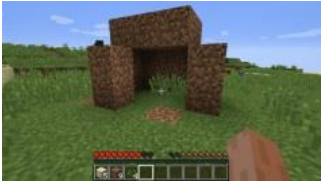
[…]
Fonte: https://www.minecraft.net/en-us/article/how-minecraft. Acesso em: 25 mar. 2025.(Adaptado).
Leia o texto a seguir para responder à questão.
How to Minecraft
Create! Explore! Survive! The basics for getting into the game! Minecraft is a game about placing blocks and having adventures. It's a survival experience about staying alive in your own fantastic world, that's also a creative space to build almost anything you can imagine!
We know Minecraft can be intimidating to newcomers, so we've assembled this simple guide to get you started. Trust us, you'll be a miner expert in no time!
[…]
Starting Out and Survival Tips!
Select Singleplayer in the Main Menu, then Create New World. You'll see this:
The health bar (the hearty looking one). Don't let it drop to zero. Otherwise, it's game over!
The food bar (the tasty looking one). When it's full, your health will regenerate, so keep snacking!
[…]
The secrets to survival are having a steady supply of food and staying safe from monsters. Luckily, building a shelter is easy. Your hand is your first mining tool, so use it to hit trees or dirt until they turn into blocks. These blocks will appear in your toolbar, and you can then place them right in front of you.
Build your shelter, making sure there’s no way for monsters to get in! Later, you'll be able to build doors, windows, etc., but for now, focus on surviving! Most monsters come out at night, so stay inside until sunrise and you'll be safe. Animals are everywhere and only take a few attacks to finish off. They’ll drop meat which restores health. There's also apples, melons and other veggie options to be found if you're vegetarian […]. Hmmm, you've got a point.
The first shelter you build will likely look like this, er, 'cosy' one here. Hey, we all start somewhere!
[…]
Fonte: https://www.minecraft.net/en-us/article/how-minecraft. Acesso em: 25 mar. 2025.(Adaptado).
Leia o cartoon a seguir para responder à questão
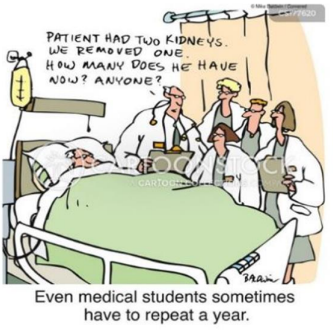
Disponível em: https://www.cartoonstock.com/directory/m/medical_student. Acesso em: 7 maio 2025.
The cartoon shows that
Leia o texto a seguir, que é o trecho inicial de um artigo publicado na internet.

(https://grain.com, 21.10.2024. Adaptado.)
O texto
Leia o texto para responder à questão.
In my research recently published in an open access journal, I used a popular language model, GPT-4 by OpenAI, to create simple summaries of scientific papers. These summaries generated by artificial intelligence (AI) used simpler language and more common words, like “job” instead of “occupation”, than summaries written by the researchers who had done the work.
In one experiment, I found that readers of the AI-generated summaries had a better understanding of the science than readers of the human-written summaries. A second experiment investigated what effects the simpler summaries might have on people’s perceptions of the scientists who performed the research. In this experiment, participants rated the scientists whose work was described in the simpler texts as more credible than the scientists whose work was described in the more complex texts.
Have you ever read about a scientific discovery and felt like it was written in a foreign language? New scientific information is probably hard to understand — especially if you try to read a science article in a research journal. In an era where understanding science is crucial for informed decision- -making, the abilities to comprehend and communicate complex ideas are more important than ever. Trust in science has been declining for years, and one contributing factor may be the challenge of understanding scientific jargon.
As AI continues to evolve, its role in science communication may expand, especially if using generative AI becomes more commonplace. Simple science descriptions are preferable to and more beneficial than complex ones, and AI tools can help. But scientists could also achieve the same goals by working harder to minimize jargon and communicate clearly — no AI necessary.
(David Markowitz. https://theconversation.com, 30.10.2024. Adaptado.)
Leia o texto para responder à questão.
In my research recently published in an open access journal, I used a popular language model, GPT-4 by OpenAI, to create simple summaries of scientific papers. These summaries generated by artificial intelligence (AI) used simpler language and more common words, like “job” instead of “occupation”, than summaries written by the researchers who had done the work.
In one experiment, I found that readers of the AI-generated summaries had a better understanding of the science than readers of the human-written summaries. A second experiment investigated what effects the simpler summaries might have on people’s perceptions of the scientists who performed the research. In this experiment, participants rated the scientists whose work was described in the simpler texts as more credible than the scientists whose work was described in the more complex texts.
Have you ever read about a scientific discovery and felt like it was written in a foreign language? New scientific information is probably hard to understand — especially if you try to read a science article in a research journal. In an era where understanding science is crucial for informed decision- -making, the abilities to comprehend and communicate complex ideas are more important than ever. Trust in science has been declining for years, and one contributing factor may be the challenge of understanding scientific jargon.
As AI continues to evolve, its role in science communication may expand, especially if using generative AI becomes more commonplace. Simple science descriptions are preferable to and more beneficial than complex ones, and AI tools can help. But scientists could also achieve the same goals by working harder to minimize jargon and communicate clearly — no AI necessary.
(David Markowitz. https://theconversation.com, 30.10.2024. Adaptado.)
Leia o texto para responder à questão.
In my research recently published in an open access journal, I used a popular language model, GPT-4 by OpenAI, to create simple summaries of scientific papers. These summaries generated by artificial intelligence (AI) used simpler language and more common words, like “job” instead of “occupation”, than summaries written by the researchers who had done the work.
In one experiment, I found that readers of the AI-generated summaries had a better understanding of the science than readers of the human-written summaries. A second experiment investigated what effects the simpler summaries might have on people’s perceptions of the scientists who performed the research. In this experiment, participants rated the scientists whose work was described in the simpler texts as more credible than the scientists whose work was described in the more complex texts.
Have you ever read about a scientific discovery and felt like it was written in a foreign language? New scientific information is probably hard to understand — especially if you try to read a science article in a research journal. In an era where understanding science is crucial for informed decision- -making, the abilities to comprehend and communicate complex ideas are more important than ever. Trust in science has been declining for years, and one contributing factor may be the challenge of understanding scientific jargon.
As AI continues to evolve, its role in science communication may expand, especially if using generative AI becomes more commonplace. Simple science descriptions are preferable to and more beneficial than complex ones, and AI tools can help. But scientists could also achieve the same goals by working harder to minimize jargon and communicate clearly — no AI necessary.
(David Markowitz. https://theconversation.com, 30.10.2024. Adaptado.)
Leia o texto para responder à questão.
In my research recently published in an open access journal, I used a popular language model, GPT-4 by OpenAI, to create simple summaries of scientific papers. These summaries generated by artificial intelligence (AI) used simpler language and more common words, like “job” instead of “occupation”, than summaries written by the researchers who had done the work.
In one experiment, I found that readers of the AI-generated summaries had a better understanding of the science than readers of the human-written summaries. A second experiment investigated what effects the simpler summaries might have on people’s perceptions of the scientists who performed the research. In this experiment, participants rated the scientists whose work was described in the simpler texts as more credible than the scientists whose work was described in the more complex texts.
Have you ever read about a scientific discovery and felt like it was written in a foreign language? New scientific information is probably hard to understand — especially if you try to read a science article in a research journal. In an era where understanding science is crucial for informed decision- -making, the abilities to comprehend and communicate complex ideas are more important than ever. Trust in science has been declining for years, and one contributing factor may be the challenge of understanding scientific jargon.
As AI continues to evolve, its role in science communication may expand, especially if using generative AI becomes more commonplace. Simple science descriptions are preferable to and more beneficial than complex ones, and AI tools can help. But scientists could also achieve the same goals by working harder to minimize jargon and communicate clearly — no AI necessary.
(David Markowitz. https://theconversation.com, 30.10.2024. Adaptado.)
Hebbian Plasticity and Mental Health
Hebbian plasticity is not just about learning new skills like riding a bike — it also helps your brain stay healthy. In some conditions, such as depression or post‑traumatic stress disorder (PTSD), the problematic symptoms can be caused by the poor function of certain brain connections. Imagine if the pathways between important parts of your brain were weak or broken. When brain pathways are weak, it can be harder to think clearly, concentrate, or feel happy. When a person experiences stress or trauma, Hebbian plasticity can also accidentally strengthen harmful connections. This happens because the brain is trying to protect itself, but sometimes it ends up strengthening neural pathways that make a person more vulnerable to negative emotions or stress responses. Fortunately, learning how to strengthen “positive” neural pathways, such as those involved in healthy coping strategies, physical activity, or resilience, can help restore balance, improving people’s moods and overall mental wellbeing.
Available at: https://kids.frontiersin.org/articles/10.3389/ frym.2025.1425512. Accessed on: March 1st, 2025.
The adjective coping in the sentence “Fortunately, learning how to strengthen ‘positive’ neural pathways, such as those involved in healthy coping strategies, physical activity, or resilience [...].” is closest in meaning to
INSTRUCTION: Read the following text to answer the question.
Neuroplasticity: How the brain changes with learning
You cannot learn something without storing it in some form of memory for future use. From neuroscience, we know that memories are encoded by physical changes in the brain. In other words, your brain changes physically whenever you learn anything, and your brain continues to be moulded by experience and learning throughout your life.
Executive summary
• Your brain is never fixed but continues to change with learning and experience throughout your life.
• Most learning in the brain involves rewiring or making and strengthening connections between neurons, the cells of your brain most crucial for learning.
• In most regions of the brain, the only neurons you will have throughout all of your life are already present at birth. Your brain does continue to grow new neurons in at least one very small but potentially important area for learning, but this is very new research and the role of these new neurons for learning is not yet known.
• Neuroplasticity is important for all learning – much of the neuroscience research on neuroplasticity is related to how the brain recovers from injury or damage – but some of the same principles apply to how the brain changes with learning throughout all of life.
Learning and memory and changes in the brain
Let us start with a simple logical argument, to dispel myths and show that logically, of course, your brain is changing with learning:
Learning and memory are necessarily closely linked. You cannot learn something without storing it in some form of memory for use in the future, either for recall as new knowledge or improvement in skills. From neuroscience, we know that memories are encoded by physical changes in the brain (although we still debate exactly what it is that changes and how). Your brain therefore changes physically whenever anything is learnt, and so your experiences and learning throughout all of life change and mould your brain.
There is a common brain myth or popular perception that the brain becomes fully developed sometime in early childhood, implying that nothing further changes, and that further changes in the brain with development in childhood and adolescence are somehow biologically determined, leading to a fully developed state at adulthood.
In reality, the way your brain develops is determined both by your genetics and by your learning and experiences. Biological does not mean predetermined. Your brain is shaped by your experiences and is never fixed but continues to change along with learning across the lifespan.
Available at: https://solportal.ibe-unesco.org/articles/neuroplasticityhow-the-brain-changes-with-learning/. Accessed on: March 1st, 2025.
INSTRUCTION: Read the following text to answer the question.
Neuroplasticity: How the brain changes with learning
You cannot learn something without storing it in some form of memory for future use. From neuroscience, we know that memories are encoded by physical changes in the brain. In other words, your brain changes physically whenever you learn anything, and your brain continues to be moulded by experience and learning throughout your life.
Executive summary
• Your brain is never fixed but continues to change with learning and experience throughout your life.
• Most learning in the brain involves rewiring or making and strengthening connections between neurons, the cells of your brain most crucial for learning.
• In most regions of the brain, the only neurons you will have throughout all of your life are already present at birth. Your brain does continue to grow new neurons in at least one very small but potentially important area for learning, but this is very new research and the role of these new neurons for learning is not yet known.
• Neuroplasticity is important for all learning – much of the neuroscience research on neuroplasticity is related to how the brain recovers from injury or damage – but some of the same principles apply to how the brain changes with learning throughout all of life.
Learning and memory and changes in the brain
Let us start with a simple logical argument, to dispel myths and show that logically, of course, your brain is changing with learning:
Learning and memory are necessarily closely linked. You cannot learn something without storing it in some form of memory for use in the future, either for recall as new knowledge or improvement in skills. From neuroscience, we know that memories are encoded by physical changes in the brain (although we still debate exactly what it is that changes and how). Your brain therefore changes physically whenever anything is learnt, and so your experiences and learning throughout all of life change and mould your brain.
There is a common brain myth or popular perception that the brain becomes fully developed sometime in early childhood, implying that nothing further changes, and that further changes in the brain with development in childhood and adolescence are somehow biologically determined, leading to a fully developed state at adulthood.
In reality, the way your brain develops is determined both by your genetics and by your learning and experiences. Biological does not mean predetermined. Your brain is shaped by your experiences and is never fixed but continues to change along with learning across the lifespan.
Available at: https://solportal.ibe-unesco.org/articles/neuroplasticityhow-the-brain-changes-with-learning/. Accessed on: March 1st, 2025.
INSTRUCTION: Read the following text to answer the question.
Neuroplasticity: How the brain changes with learning
You cannot learn something without storing it in some form of memory for future use. From neuroscience, we know that memories are encoded by physical changes in the brain. In other words, your brain changes physically whenever you learn anything, and your brain continues to be moulded by experience and learning throughout your life.
Executive summary
• Your brain is never fixed but continues to change with learning and experience throughout your life.
• Most learning in the brain involves rewiring or making and strengthening connections between neurons, the cells of your brain most crucial for learning.
• In most regions of the brain, the only neurons you will have throughout all of your life are already present at birth. Your brain does continue to grow new neurons in at least one very small but potentially important area for learning, but this is very new research and the role of these new neurons for learning is not yet known.
• Neuroplasticity is important for all learning – much of the neuroscience research on neuroplasticity is related to how the brain recovers from injury or damage – but some of the same principles apply to how the brain changes with learning throughout all of life.
Learning and memory and changes in the brain
Let us start with a simple logical argument, to dispel myths and show that logically, of course, your brain is changing with learning:
Learning and memory are necessarily closely linked. You cannot learn something without storing it in some form of memory for use in the future, either for recall as new knowledge or improvement in skills. From neuroscience, we know that memories are encoded by physical changes in the brain (although we still debate exactly what it is that changes and how). Your brain therefore changes physically whenever anything is learnt, and so your experiences and learning throughout all of life change and mould your brain.
There is a common brain myth or popular perception that the brain becomes fully developed sometime in early childhood, implying that nothing further changes, and that further changes in the brain with development in childhood and adolescence are somehow biologically determined, leading to a fully developed state at adulthood.
In reality, the way your brain develops is determined both by your genetics and by your learning and experiences. Biological does not mean predetermined. Your brain is shaped by your experiences and is never fixed but continues to change along with learning across the lifespan.
Available at: https://solportal.ibe-unesco.org/articles/neuroplasticityhow-the-brain-changes-with-learning/. Accessed on: March 1st, 2025.
Abstract
Learning and memory happen because of a special brain process called Hebbian plasticity. This process makes the connections between brain cells, called neurons, stronger when the neurons work together. These stronger connections help us think, learn new skills, and remember things. Scientists are studying how Hebbian plasticity works and using tools like transcranial magnetic stimulation (TMS) to change these brain cell connections without the need for surgery. By understanding Hebbian plasticity, researchers hope to find better ways to help people learn, improve memory, and even treat brain‑related problems like depression or memory loss.
Available at: https://kids.frontiersin.org/articles/10.3389/ frym.2025.1425512. Accessed on: March 1st, 2025.
A potential application of understanding Hebbian plasticity, described in the abstract, is
Fonte: https://www.liveworksheets.com › download-pdf.
De acordo com o texto:
Complete o quadro com os respectivos pronomes.


 Conheça nossos planos