Questões de Vestibular
Sobre pronomes | pronouns em inglês
Foram encontradas 159 questões


Michelle Hanson
Learning to play a musical instrument at any point in life is good for the brain. Who cares if I sound like a 'sick cow'?

It's exciting to know that I have done something right and rewarding – taking up the cello in my 60s. A new study from St. Andrew's University proves it. Taking up a musical instrument, even late in life, is good for the brain, and “can slow, stop, or even reverse, age or illness-related decline in mental functions". Hurrah!
My efforts have been rewarded, because starting the cello was a bit of a struggle, physically and mentally. Back then, my mother was alive, and rather critical: “You sound like a sick cow," she would cry out in a tormented way, but I persisted, joined an orchestra, and now here I am, with a bigger frontal cortex area than I might have otherwise had, and able to “adjust my behaviour more effectively in conflict-rich situations".
The more you practise the better, suggests the research. Good. It will spur me on, sick cow or not. Because I desperately need to keep my brain in order. Don't we all, if we're going to live to over 100? Last week I went for a walk with an old friend of mine and her dog. She is 92 and browned off.
“How are you?" I asked. “Fed up. I want to die." This was my mother's primary aim once she hit 96. “What do you want for your birthday?" we would ask. “To be dead!", she would say. No wonder. What else did life offer? At least my old friend could walk about. My mother could hardly walk, talk or eat.
If only they had played a musical instrument. You can do it sitting down, on your own, with friends, cheer yourself up, be in control, or wildly emotional. I cannot recommend it highly enough.
Fonte: http://www.theguardian.com/lifeandstyle/2013/sep/ 30/why-i-took-up-cello-in-60s
Glossário
took up: aprendi; struggle: luta/muito esforço; spur me on: encorajar/estimular; browned off: sem entusiasmo


Except it’s neither: the billboard pictured here is real, it’s located in Lima, Peru, and it produces around 100 liters of water a day (about 26 gallons) from nothing more than humidity, a basic fltration system and a little gravitational ingenuity3 .
Let’s talk about Lima for a moment, the largest city in Peru and the ffth largest in all of the Americas, with some 7.6 million people (closer to 9 million when you factor in the surrounding metro area). Because it sits along the southern Pacifc Ocean, the humidity in the city averages 83% (it’s actually closer to 100% in the mornings). But Lima is also part of what’s called a coastal desert: it lies at the northern edge of the Atacama, the driest desert in the world, meaning the city sees perhaps half an inch of precipitation annually (Lima is the second largest desert city in the world after Cairo). Lima thus depends on drainage from the Andes as well as runof from glacier melt - both sources on the decline because of climate change. (...)
1Five Man Electrical Band: nome de um grupo de rock canadense.
2gimmick: algo que não é sério, usado para atrair a atenção das pessoas temporariamente, especialmente para fazê-las comprar algo.
3ingenuity: habilidade de pensar em novos meios inteligentes de se fazer algo.
We may take advantage of this pause in the narrative to make certain statements. Orlando had become a woman – there is no denying it. But in every other respect, Orlando remained precisely as he had been. The change of sex, though it altered their future, did nothing whatever to alter their identity. Their faces remained, as their portraits prove, practically the same. His memory – but in future we must, for convention's sake, say 'her' for 'his,' and 'she' for 'he' – her memory then, went back through all the events of her past life without encountering any obstacle. Some slight haziness there may have been, as if a few dark drops had fallen into the clear pool of memory; certain things had become a little dimmed; but that was all. The change seemed to have been accomplished painlessly and completely and in such a way that Orlando herself showed no surprise at it. Many people, taking this into account, and holding that such a change of sex is against nature, have been at great pains to prove that Orlando had always been a woman, that Orlando is at this moment a man. Let biologists and psychologists determine. It is enough for us to state the simple fact; Orlando was a man till the age of thirty; when he became a woman and
has remained so ever since.
Woolf, Virginia. Orlando – A Biography. Londres. Granada. 1984.
Virginia Woolf foi uma escritora inglesa do século 20. Neste parágrafo de seu romance Orlando – Uma Biografia, ela

I. o termo “our” (l.2) é um pronome possessivo e refere-se aos leitores.
II. “which” (l.3) é um pronome relativo, na função de sujeito, e refere-se a “daily activities”.
III. os termos “useless” e “unwanted” (l.5) são formados por afixação.
IV. os modais “can” (l.5) e “may” (l.12) expressam a mesma ideia: possibilidade.
V. os marcadores discursivos “or” (l.3), “and” (l.5) e “but” (l.12) expressam, respectivamente, proporcionalidade, adição e condição.
A alternativa em que todas as afirmativas são verdadeiras é a:
Texto
When superyacht chic meets hybrid technology
By Eoghan Macguire, for CNNAutor


(Disponível em: <http://edition.cnn.com/2012/05/15/tech/hybrid-superyacht/index.html?hpt=itr_tl>
According to the text it is correct to affirm that
the words “emissions” (line 8), “consumption”
(line 9), “production” (line 16), “completion” (line
18), and “performance” (line 36) are all nouns
which respectively derive from the words “emit”,
“consume”, “product”, “complete”, “perform” and
“maintain” which are all verbs.
Texto
Human Rights
BBC Learning English News Word
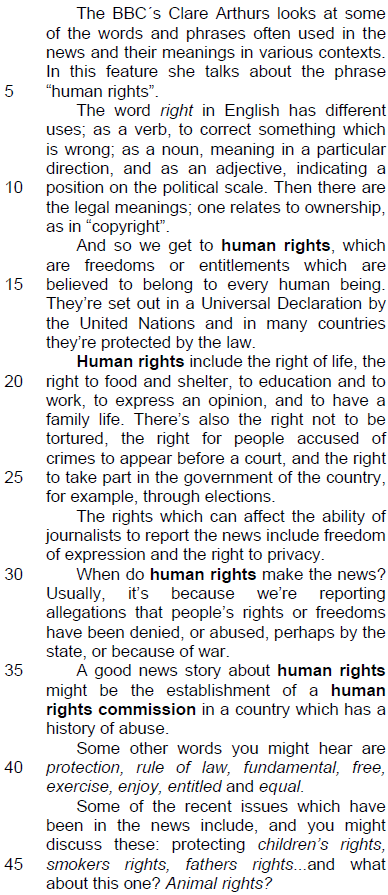
(Texto adaptado. Disponível em:
http://downloads.bbc.co.uk/worldservice/learningenglish/n
ewswords/100211_nw_human_rights_text.pdf
Acessado em: 16/05/2012)
Em relação ao vocabulário do texto, é correto afirmar que
the word “which” (line 13) refers to human
rights.
Texto
Human Rights
BBC Learning English News Word
(Texto adaptado. Disponível em:
http://downloads.bbc.co.uk/worldservice/learningenglish/n
ewswords/100211_nw_human_rights_text.pdf
Acessado em: 16/05/2012)
Em relação ao vocabulário do texto, é correto afirmar que
“one” (line 11) is used as a pronoun.

Judge the items from 19 through 27 based on to the text above.

Judge the items that follow according to the text above.



 Conheça nossos planos