Questões de Vestibular Sobre pronomes | pronouns em inglês

Foram encontradas 153 questões

Ano: 2016 Banca: IFF Órgão: IFF Prova: IF-TO - 2016 - IFF - Processo Seletivo e Vestibular - TO |
Q1338287 Inglês
Nas frases a seguir, observe os sujeitos em destaque. Em seguida, verifique qual a sequência correta dos pronomes pessoais que podem substituí-los.
I- My cousin and my sister are students.
II- John likes to swim.
III- Mary buys a dictionary every year.
IV- Peter and I travel to the beach.
V- My cat drinks milk every day.
Assinale a alternativa correta.
Alternativas
Ano: 2016 Banca: UFVJM-MG Órgão: UFVJM-MG Prova: UFVJM-MG - 2016 - UFVJM-MG - Vestibular - 1º Etapa |
Q1274291 Inglês

Refugee team to compete at Olympics in Rio

Fonte: http://www.bbc.co.uk/newsround/35724130 Acesso: 07/03/2016

No trecho “instead of their own country´s flag or national anthem” (linhas 4 e 5), o pronome possessivo “their” refere-se
Alternativas
Ano: 2016 Banca: IF-RR Órgão: IF-RR Prova: IF-RR - 2016 - IF-RR - Vestibular - Primeiro Semestre |
Q1274276 Inglês
Facebook and Google Are Going To War Against Hate Speech
Offending posts will be deleted within 24 hours

   Facebook, Twitter, Google, and Microsoft have agreed to work with European officials to crack down on hateful speech published on their respective platforms. Each company has agreed to review potentially problematic posts and remove offending content within 24 hours. 
   “The recent terror attacks have reminded us of the urgent need to address illegal online hate speech,” Vĕra Jourová, EU Commissioner for Justice, Consumers and Gender Equality, said in a joint statement from the European Commission and the participating companies. “Social media is unfortunately one of the tools that terrorist groups use to radicalize young people and racist use to spread violence and hatred.”
     The new partnership comes after Facebook, Twitter, and Google agreed to erase hate speech from their platforms within 24 hours in Germany, an attempt to address racism following the refugee crisis. That agreement, which Reuters reported last year, also made it easier for individual users to report hateful speech.
     Under the new code of conduct, technology companies will have clear rules in place for reviewing content that may be deemed malicious or hateful. The document also says the companies should be responsible for educating their users on the types of content that are disallowed.
      Tech companies assure that the recently announced code of conduct won’t interfere with freedom of speech. “We remain committed to letting the Tweets flow,” Karen White, Twitter’s head of public policy for Europe, said in the statement. “However, there is a clear distinction between freedom of expression and conduct that incites violence and hate.”
(Time Magazine, May 31, 2016)

Glossary: hate speech – discurso de ódio; to agree: concordar; to erase: apagar; partnership – parceria. 
O pronome THEIR destacado no terceiro parágrafo refere-se a:
Alternativas
Ano: 2016 Banca: IF Sudeste - MG Órgão: IF Sudeste - MG Prova: IF Sudeste - MG - 2016 - IF Sudeste - MG - Vestibular - Primeiro Semestre |
Q1272602 Inglês

Read the following passage, paying attention to the words numbered 1-5

Gene Wilder’s passing away, the eternal Willy Wonka


Gene Wilder, (1) who established himself as one of America’s foremost comic actors with his delightfully neurotic performances in three films directed by Mel Brooks; his eccentric star turn in the family classic “Willy Wonka and the Chocolate Factory”; and (2) his winning chemistry with Richard Pryor in the box-office smash “Stir Crazy,” died early Monday morning at his home in Stamford, Conn. He was 83. With his haunted blue eyes and an empathy born of his own history of psychic distress, he aspired to touch audiences much as Charlie Chaplin had. The Chaplin film “City Lights,” he said, had “made the biggest impression on me as an actor; (3) it was funny, then sad, then both at the same time”. Mr. Wilder was an accomplished stage actor as well as a screenwriter, a novelist and the director of four movies in (4) which he starred. (He directed, he once said, “in order to protect what I wrote, which I wrote in order to act.”) But he was best known for playing roles on the big screen that might have been ripped from the pages of the Diagnostic and Statistical Manual of Mental Disorders. He made his movie debut in 1967 in Arthur Penn’s celebrated crime drama, “Bonnie and Clyde,” in which he was memorably hysterical as an undertaker kidnapped by the notorious Depression-era bank robbers played by Faye Dunaway and Warren Beatty. He was even more hysterical, and even more memorable, a year later in “The Producers,” the first film by Mr. Brooks, (5) who later turned it into a Broadway hit. Available at: <http://www.nytimes.com/2016/08/30/movies/gene-wilder-dead.html?_r=0>. Accessed on: 20 ago. 2016 As far as textual cohesion is concerned, analyze the following statements about the text above. I – The pronoun “who” (in 1) refers forward to “America’s foremost comic actors”. II – The pronoun “his” (in 2) refers back to the subject “Richard Pryor”. III – The pronoun “it” (in 3) refers back to either “Chaplin” or “actor”, resulting in ambiguity. IV – The pronoun “which” (in 4) refers back to “Mr. Wilder”. V – The pronoun “who” (in 5) can be replaced by “which”, without any problem.
After analyzing items I-V, check the CORRECT option.

Alternativas
Ano: 2016 Banca: IF Sudeste - MG Órgão: IF Sudeste - MG Prova: IF Sudeste - MG - 2016 - IF Sudeste - MG - Vestibular - Primeiro Semestre |
Q1272599 Inglês
Read the following excerpt from a newspaper, ignoring the gaps numbered (1-5). After that, choose the CORRECT alternative.
Published in 1981, Todd Strasser’s The Wave recounts a true incident that took place in a history class at a Palo Alto, California, high school in 1969. The teacher of the class, Ron Jones, (1)__________ is fictionally renamed Ben Ross in the book, actually formulated the experiment described in the narrative in an effort to help his students understand how the Holocaust could have happened without the mass condemnation of the German people. What begins as a simple class project quickly takes on a life of its own, (2) __________, as students conform mindlessly to the experimental system, and others are pressured ruthlessly to join in. Group dynamics and peer influence bordering on coercion create a sinister atmosphere of fear and mistrust, The Wave spontaneously takes on the characteristics of a cult. The event disrupts an entire school (3) __________ raises a plethora of dark questions concerning responsibility, freedom, and group dynamics. Ron Jones calls it “one of the most frightening events ever experienced in the classroom.” As a novelization of a teleplay by Johnny Dawkins, based on a short story by Ron Jones, Strasser’s book (4) __________ not have attracted an abundance of criticism as a literary entity in itself, (5) __________ The Wave clearly holds an important place in the canon of young adult literature. (…) Available at: <http://www.enotes.com/topics/the-wave/critical-essays>. Accessed on: 20 set. 2016
Choose the CORRECT alternative..
Alternativas
Ano: 2016 Banca: FCM Órgão: UEMG Prova: FCM - 2016 - UEMG - Vestibular |
Q924611 Inglês
How a young student’s innovative idea hopes to boost response times for EMTs

By Woody Brown on June 1, 2015

    Drones have been at the forefront of the national conversation for years now. As the components needed to create them grow smaller and more affordable, many companies and organizations have started exploring the potential that drones could have to improve our daily lives. Whether by delivering a product with unprecedented speed or taking photographs and video from new heights, drones have many capabilities, most of which we have yet to discover. One young man, however, has envisioned a new way to use drones that could save thousands of lives.
    One of the greatest obstacles facing first responders and emergency medical technicians [EMTs] when it comes to the difficult business of saving lives is time. Think of your daily commute: people in the United States spend an average of 25.5 minutes traveling one-way to work every day. In bumperto-bumper traffic, blaring sirens and flashing lights are often not enough to clear a fast path for an ambulance to reach someone in need. During cardiac arrest, there are, at most, a few minutes to save a person’s life. After that, the mortality rate rises steeply. With stakes this high, every second counts.
    Alec Momont, a graduate student in engineering at Delft University of Technology in the Netherlands, recognized this problem and saw a way to significantly reduce deaths that result from delayed emergency care. What if ambulances could fly? Or rather, what if we could make a drone that functioned like a stripped-down, lightweight automatic external defibrillator [AED]? AEDs, which can be found in schools, sports arenas and many government buildings, are significantly more effective than cardiopulmonary resuscitation [CPR] at preventing fatalities resulting from cardiac arrest. CPR can be helpful, but an AED is better, and very few people have AEDs in their cars or homes.
    As his master’s degree project, Momont built a prototype of this lifesaving drone. It contained an AED, a microphone and speakers. The average travel time, according to him, could be cut by 90 percent. Here’s how it works: In the event of cardiac arrest, a paramedic would respond to a call by flying the drone at a speed of 60 mph to the scene of the emergency. The paramedic would then give instructions to someone near the victim, who would position the AED. Once in place, the AED would operate automatically. The paramedic would be able to see through the camera whether or not the pads on the AED have been correctly positioned, and how the victim responds.
    A dramatized video released by Momont’s university demonstrates all of this functionality. In it, a young woman calls emergency services in a panic because her father has had a heart attack. A calm-voiced EMT answers and guides her through the surprisingly simple process of finding and using the drone. Fewer than two minutes after she makes the call, her father sits up and hugs her.
    The ambulance drone can increase the chances of surviving cardiac arrest from eight percent to 80 percent, Momont says in the video. The drone’s ability to travel as the crow flies frees it from infrastructural limitations that currently impede road-bound ambulances. “Using advanced production techniques such as 3D printed microstructures and carbon fiber frame construction, we were able to achieve a very lightweight design,” Momont says. “The result is an integrated solution that is clear in its orientation and friendly in appearance.”
    Momont’s aim is to rapidly expand the existing framework of emergency services by constructing many of these drones over the next five years. Expenses are low: each drone is relatively cheap to make, about $18,600. By comparison, a typical ambulance costs more than $100,000, and a ride in one usually costs more than $1,000.
    The ambulance drones can even fly autonomously (though legislation in many countries does not permit this yet). Several emergency service providers have already expressed interest. If the technology continues to receive financial support from other parties in the healthcare industry, Momont’s dream could very easily become a reality.
    We live in a world where drones have, so far, been used mostly in armed conflict. Momont, however, has a different vision. In the near future that he describes, tens of thousands of needless deaths will be prevented with his ingenious invention. That is certainly welcome news, especially in the United States, which deals with skyrocketing numbers of heart-related ailments and disabilities. “Let’s use drones for a good purpose,” Momont says. “Let us use drones to save lives.”

Adapted from: <http://www.verizonwireless.com/news/article/2015/05/ambulance-dronescould-save-thousands-of-lives.html>. Access on: 03 Oct. 2016.
Mark T (true) and F (false) for the correlations between pronouns and their referents in the text.
a) ( ) it (paragraph 5) – video. b) ( ) who (paragraph 4) – victim. c) ( ) them (paragraph 1) – drones. d) ( ) which (paragraph 1) – capabilities.
The correct sequence is
Alternativas
Ano: 2016 Banca: PUC - RS Órgão: PUC - RS Prova: PUC - RS - 2016 - PUC - RS - Vestibular - Segundo Semestre - 2º Dia |
Q809538 Inglês

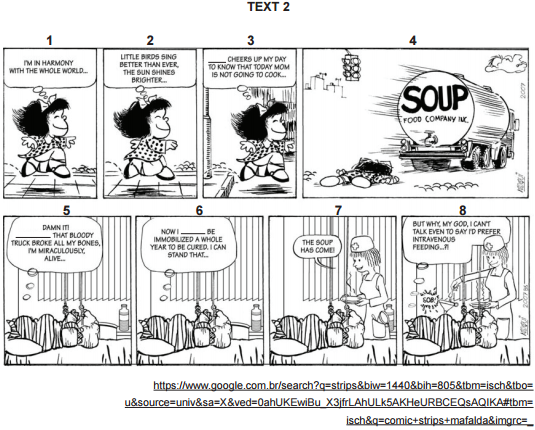
In picture 3, the pronoun “that” could have been omitted without a change in meaning. Mark the alternative in which “that” can NOT be omitted.

Alternativas
Ano: 2016 Banca: VUNESP Órgão: UNESP Prova: VUNESP - 2016 - UNESP - Vestibular - Primeiro Semestre |
Q809331 Inglês
Assinale a alternativa que completa corretamente a lacuna numerada no texto.
Alternativas
Ano: 2016 Banca: UNESPAR Órgão: UNESPAR Prova: UNESPAR - 2016 - UNESPAR - Vestibular - 1º Dia - Grupos 1, 2, 3 e 4 |
Q749841 Inglês

Question based on Text.


Adapted from: <http://www.theguardian.com/global-development-professionals-network/2015/oct/13/fighting-corruptionzombies-development-anti-corruption >.Access on: 03/11/2015.

The elements in bold, on the second paragraph, respectively refer to:
Alternativas
Ano: 2016 Banca: PUC - RJ Órgão: PUC - RJ Prova: PUC - RJ - 2016 - PUC - RJ - Vestibular - 1º Dia Grupo 2 |
Q736274 Inglês
In terms of reference, it is correct to affirm that
Alternativas
Q728569 Inglês
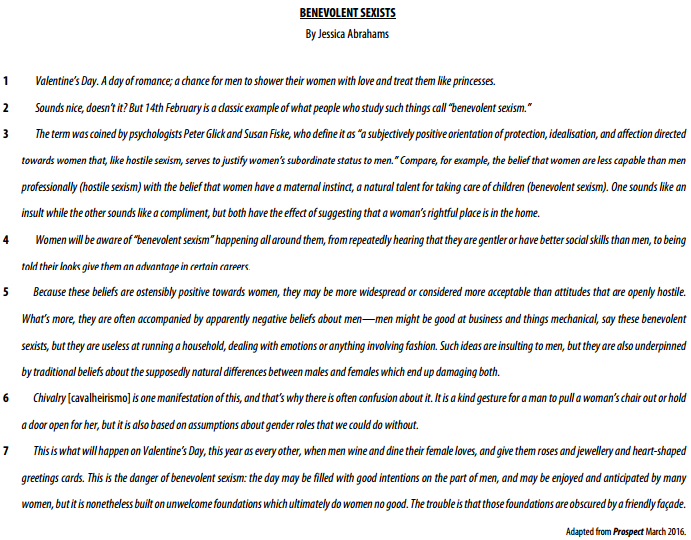
In paragraph 5, “they” in the phrase “…they are useless at running a household…” most likely refers to
Alternativas
Ano: 2015 Banca: UEG Órgão: UEG Prova: UEG - 2015 - UEG - Vestibular |
Q1783223 Inglês

Leia o texto a seguir para responder à questão.


Migrant or Refugee? There Is a Difference, With Legal Implications


In the first half of this year alone, at least 137,000 men, women and children crossed the Mediterranean Sea to reach the shores of Europe, according to the United Nations. Thousands are traveling across the Balkans now. However, are they refugee or migrants? Does it make any difference? In search for these answers, let’s read the interview.


Q. Does it matter what you call them?

A. Yes. The terms “migrant” and “refugee” are sometimes used interchangeably, but there is a crucial legal difference between the two.


Q. Who is a refugee?

A. Briefly, a refugee is a person who has fled his or her country to escape war or persecution, and can prove it.


Q. What does the distinction mean for European countries?

A. Refugees are entitled to basic protections under the 1951 convention and other international agreements. Once in Europe, refugees can apply for political asylum or another protected status, sometimes temporary. By law, refugees cannot be sent back to countries where their lives would be in danger. “One of the most fundamental principles laid down in international law is that refugees should not be expelled or returned to situations where their life and freedom would be under threat,” the refugee agency said in a statement on Thursday.


Q. Who is a migrant?

A. Anyone moving from one country to another is considered a migrant unless he or she is specifically fleeing war or persecution. Migrants may be fleeing dire poverty, or may be well-off and merely seeking better opportunities, or may be migrating to join relatives who have gone before them. There is an emerging debate about whether migrants fleeing their homes because of the effects of climate change – the desertification of the Sahel region, for example, or the sinking of coastal islands in Bangladesh – ought to be reclassified as refugees.


Q. Are migrants treated differently from refugees?

A. Countries are free to deport migrants who arrive without legal papers, which they cannot do with refugees under the 1951 convention. So it is not surprising that many politicians in Europe prefer to refer to everyone fleeing to the continent as migrants.


Disponível em: <https://www.nytimes.com/2015/08/28/world/migrants-refugees-europe-syria.html?_r=0>.  Acesso em: 15 set. 2015.


Considerando os aspectos estruturais do texto, tem-se o seguinte:
Alternativas
Ano: 2015 Banca: FCC Órgão: UNINOVE Prova: FCC - 2015 - UNINOVE - Processo Seletivo Medicina - Conhecimentos Gerais |
Q1782400 Inglês
No trecho final do quarto parágrafo “This is a serious concern”, o termo em destaque se refere
Alternativas
Ano: 2015 Banca: FADBA Órgão: Fadba Prova: FADBA - 2015 - Fadba - Vestibular - Segundo Semestre |
Q1387312 Inglês
Leia o texto abaixo para a questão.


Friendship Day History
    There is not much literature on Friendship Day history as we celebrate today. However, there are numerous folktales and several instance in mythological legends that shows that friends and friendship have been valued since the beginning of civilized world. As an intrinsically social creature, men love to make friends to further this process of socialization.

History of Friendship Day in US
    Considering the valuable role friends play in our life it was deemed to fit to have a day dedicated to friends and friendship. The United States Congress, in 1935, proclaimed first Sunday of August as the National Friendship Day. Since then, celebration of National Friendship Day became an annual event. The noble idea of honoring the beautiful relationship of friendship caught on with the people and soon Friendship Day became a hugely popular festival. Following the popularity and success of Friendship Day in US, several other countries adopted the tradition of dedicating a day to friends. Today, Friendship Day is enthusiastically celebrated by several countries across the world including India. In 1997, the United Nations named Winnie - the Pooh as the world's Ambassador of Friendship.

Importance of Friendship in Bible
The Bible, the primary text of the western civilization, reflects upon friendship as the bond that forms the foundation to human faith, trust and companionship. Following verses from the bible aptly portray the importance of friends:

"Ask and it will be given to you; seek and you will find; knock and the door will be opened to you.”
Matthew 7:7

“Greater love hath no man than this that a man lay down his life for his friends.”
John 15:13-15
http://www.friendshipday.org/friendship-day-history.html ≥ Acesso em 09/06/2015
Marque a alternativa que melhor completa as frases com os pronomes respectivamente corretos.

I – I cut ____________ with a pair of scissors. II – Did you talk to __________ yesterday? III – Susan falls in love with Paul. She really likes____________. IV – Is this ___________? V – We bought new things at the mall last night. By the way, _________ shoes are the same color.
Alternativas
Ano: 2015 Banca: FADBA Órgão: Fadba Prova: FADBA - 2015 - Fadba - Vestibular - Segundo Semestre |
Q1387305 Inglês
Marque a alternativa cujas respostas melhor completa as frases abaixo.

I – ….. are their names? They’re Melissa and Andrew. II – ….. is my bag? On the table. III – ….. is it difficult? It is so easy. IV – …… did you do that? Because I wanted it. V – ….. was your last vacation? It was on January.
Alternativas
Ano: 2015 Banca: FATEC Órgão: FATEC Prova: FATEC - 2015 - FATEC - Vestibular - Primeiro Semestre |
Q1265095 Inglês

Learn ‘n’ go

How quickly can people learn new skills?

Jan 25th 2014 – from the print edition


      In 2012, Erik Brynjolfsson and Andrew McAfee took a ride in one of Google’s driverless cars. The car’s performance, they report, was flawless, boring and, above all, “weird”. Only a few years earlier, “We were sure that computers would not be able to drive cars.” Only humans, they thought, could make sense of the countless, shifting patterns of driving a car – with oncoming1 traffic, changing lights and wayward2 jaywalkers3 .

      Machines have mastered driving. And not just driving. In ways that are only now becoming apparent, the authors argue, machines can forecast home prices, design beer bottles, teach at universities, grade exams and do countless other things better and more cheaply than humans. (…)

      This will have one principal good consequence, and one bad. The good is bounty4 . Households will spend less on groceries, utilities and clothing; the deaf will be able to hear, the blind to see. The bad is spread5 . The gap is growing between the lucky few whose abilities and skills are enhanced6 by technology, and the far more numerous middle-skilled people competing for the remaining7 jobs that machines cannot do, such as folding towels and waiting at tables. (…) People should develop skills that complement, rather than compete with computers, such as idea generation and complex communication. (…)

<http://tinyurl.com/m2zmazg>Acesso em: 27.07.2015. Adaptado.

Glossário

1oncoming: iminente; próximo.

2wayward: desobediente; instável.

3jaywalker: pedestre imprudente.

4bounty: recompensa.

5spread: propagação; extensão.

6enhanced: aprimorado(a).

7remaining: remanescente.

O pronome relativo whose, em negrito no terceiro parágrafo, refere-se a
Alternativas
Ano: 2015 Banca: PUC - RJ Órgão: PUC - RJ Prova: PUC - RJ - 2015 - PUC - RJ - Vestibular - 1º Dia Grupo 1, 3 e 4 |
Q637538 Inglês

By Becky Oskin, Senior Writer. Adapted from http://www. livescience.com/49262-indian-ocean-tsunami-anniversary. html. December 26, 2014.  

The relative pronoun which (line 76), in the fragment “which is relayed by satellite to warning centers”, makes reference to
Alternativas
Ano: 2015 Banca: NC-UFPR Órgão: UFPR Prova: NC-UFPR - 2015 - UFPR - Vestibular - 1º Fase |
Q591450 Inglês
Forget Texting While Driving: AT&T Survey reveals drivers do a lot more with their smartphones
By Menchie Mendoza, Tech Times | May 20, 10:10 AM 


    Drivers who continue to use their smartphones while driving are not only distracted when they call and text. Apart from calling and texting, drivers are also browsing the Internet, tweeting, video chatting, taking selfies and sending email with their devices, according to a study by AT&T.
    The research was conducted as part of the carrier's "It Can Wait" campaign launched in 2010. It hopes to increase awareness of the dangers posed by using smartphones while one is behind the wheel. The study polled 2,067 U.S. residents ages 16-65 who use their smartphone and drive once or more per day.
    Seventy percent of those surveyed admit they use their smartphones for a number of activities while they are driving: 61 percent say they text and 33 percent send email while they are behind the wheel. Posting or interacting on social media is also one of the most common activities that drivers engage in. Using Facebook ranks first on the list, with 27 percent of drivers logging in while driving. Other social media channels that keep drivers "multitasking" include Instagram and Twitter (14 percent) and Snapchat (11 percent).
    The results also show that there is a deeper problem involved when people use social media while driving. Among those surveyed, 22 percent blame their addiction to social media.
    Other revelations show 62 percent keep their smartphones within easy reach, and that 30 percent of those who post to Twitter while driving do it "all the time". Drivers also don't seem to run out of other activities using their smartphones since most apps are now easily accessed with just a simple tap. Because of this, 28 percent of drivers browse the web; 17 percent take selfies (or groupies); and 10 percent video chat.
    "One in 10 say they do video chat while driving", said Lori Lee, AT&T's senior VP for global marketing. "I don't even have words for that". AT&T plans to expand the "It Can Wait" campaign in order to add more focus on the topic of texting while driving by including other driving distractions that result from using the smartphones. "When we launched 'It Can Wait' five years ago, we pleaded with people to realize that no text is worth a life", said Lee. "The same applies to other smartphone activities that people are doing while driving. For the sake of you and those around you, please keep your eyes on the road, not on your phone". AT&T will also launch a nationwide virtual reality tour in summer in order to spread the word that driving and using a smartphone don't and will never mix.


Adapted from <http://www.techtimes.com/>
The word “they", in boldface and italics, last paragraph, refers to:
Alternativas
Ano: 2015 Banca: UCS Órgão: UCS Prova: UCS - 2015 - UCS - Vestibular - Língua Inglesa |
Q588402 Inglês

INSTRUÇÃO: A questão refere-se ao texto abaixo.

                      Victoria and Albert: how a royal love changed culture

                                                                                                           By Lucinda Hawksley 


Disponível em: <http://www.bbc.com/culture/story/20150623-victoria-albert-cultural-impact>.

Acesso em: 3 ago. 15. (Parcial e adaptado.)

Com base no texto, analise as proposições a seguir, quanto à sua veracidade (V) ou falsidade (F). O pronome.
( ) his (linha 28) refere-se a Albert (linha 27).
( ) they (linha 31) refere-se a artists (linha 30).
( ) whose (linha 35) refere-se a The queen (linha 34).
Assinale a alternativa que preenche correta e respectivamente os parênteses, de cima para baixo.
Alternativas
Q583436 Inglês
In paragraph 5, “it” in the sentence “A few saw it differently” most likely refers to which of the following?
Alternativas
Respostas
61: D
62: C
63: B
64: E
65: E
66: C
67: B
68: E
69: E
70: D
71: D
72: B
73: D
74: B
75: C
76: E
77: D
78: D
79: C
80: C
