Questões de Vestibular
Sobre interpretação de texto | reading comprehension em inglês
Foram encontradas 5.175 questões


Ano: 2017
Banca:
PUC - RJ
Órgão:
PUC - RJ
Prova:
PUC - RJ - 2017 - PUC - RJ - Vestibular - 3° Dia - Inglês |
Q1263550
Inglês
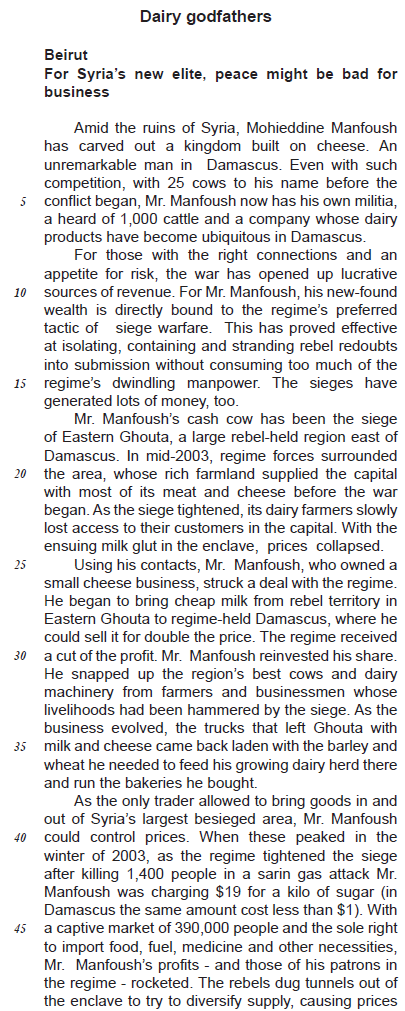
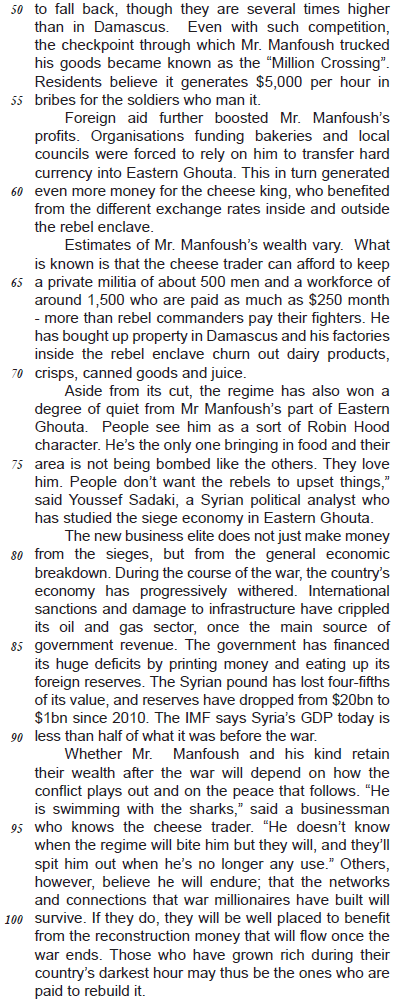
According to paragraph 4 (lines 25-37), the deal Mr.
Manfoush made with the Syrian regime included
Ano: 2017
Banca:
PUC - RJ
Órgão:
PUC - RJ
Prova:
PUC - RJ - 2017 - PUC - RJ - Vestibular - 3° Dia - Inglês |
Q1263549
Inglês
Based on the information presented in paragraph 3 (lines
17-24), one can say that all the issues below contributed to
Mr. Manfoush’s wealth from 2003 onwards, EXCEPT the
Ano: 2017
Banca:
PUC - RJ
Órgão:
PUC - RJ
Prova:
PUC - RJ - 2017 - PUC - RJ - Vestibular - 3° Dia - Inglês |
Q1263548
Inglês
The fragment “This has proved effective at isolating,
containing and stranding rebel redoubts into submission
without consuming too much of the regime’s dwindling
manpower. The sieges have generated lots of money, too”
(lines 12 -16) is structured by
Ano: 2017
Banca:
PUC - RJ
Órgão:
PUC - RJ
Prova:
PUC - RJ - 2017 - PUC - RJ - Vestibular - 3° Dia - Inglês |
Q1263547
Inglês
In the subtitle of the text “For Syria’s new elite, peace might be bad for business” the implied idea is that peace is
Ano: 2017
Banca:
PUC - RJ
Órgão:
PUC - RJ
Prova:
PUC - RJ - 2017 - PUC - RJ - Vestibular - 3° Dia - Inglês |
Q1263546
Inglês
The main objective of the text is to
Ano: 2017
Banca:
PUC - SP
Órgão:
PUC - SP
Prova:
PUC - SP - 2017 - PUC - SP - Vestibular - Primeiro Semestre |
Q1263374
Inglês
De acordo com os parágrafos 4 a 6, algumas das
ações tomadas pelos pais de Endrew, em razão de
sua insatisfação com a escola pública em que o
filho estudava, foram:
Ano: 2017
Banca:
PUC - SP
Órgão:
PUC - SP
Prova:
PUC - SP - 2017 - PUC - SP - Vestibular - Primeiro Semestre |
Q1263373
Inglês
De acordo com o terceiro parágrafo, é CORRETO
afirmar que, nos Estados Unidos,
Ano: 2017
Banca:
UNEMAT
Órgão:
UNEMAT
Prova:
UNEMAT - 2017 - UNEMAT - Vestibular - Segundo Semestre |
Q1262634
Inglês
ANOTHER TWO BRAZIL DAMS ‘AT RISK OF
COLLAPSING’
Brazilian mining company Samarco says two dams it
uses to hold waste from iron production are
damaged and at risk of collapsing
One of the company’s reservoir burst earlier this month, flooding dozens of homes in the southeastern state of Minas Gerais. Eleven people were killed and 12 are missing presumed dead. Emergency work to try to avoid another breach will begin immediately and will last up to 90 days, the company said. The company initially said that two of its dams – Fundao e Germano – had burst on 5 November. But it has now clarified that only the Fundao reservoir collapsed. Germano and another nearby dam, Santarem, are still standing but are at risk, said Samarco’s Infrastructure Director Kleber Terra.
‘First instalment’ Samarco is owned by mining giants Vale, from Brazil, and Anglo-Australian company BHP Billiton. It agreed on Monday to pay the Brazilian government 1bn reais (…) compensation. The money will be used to cover the initial clean-up and to offer some compensation to the victims and their families. Disponível em: http://www.bbc.com/news/world-latin-america-3485 1895. Acesso em 25 nov. 2015.
Assinale a alternativa que corresponde às informações contidas no texto.
One of the company’s reservoir burst earlier this month, flooding dozens of homes in the southeastern state of Minas Gerais. Eleven people were killed and 12 are missing presumed dead. Emergency work to try to avoid another breach will begin immediately and will last up to 90 days, the company said. The company initially said that two of its dams – Fundao e Germano – had burst on 5 November. But it has now clarified that only the Fundao reservoir collapsed. Germano and another nearby dam, Santarem, are still standing but are at risk, said Samarco’s Infrastructure Director Kleber Terra.
‘First instalment’ Samarco is owned by mining giants Vale, from Brazil, and Anglo-Australian company BHP Billiton. It agreed on Monday to pay the Brazilian government 1bn reais (…) compensation. The money will be used to cover the initial clean-up and to offer some compensation to the victims and their families. Disponível em: http://www.bbc.com/news/world-latin-america-3485 1895. Acesso em 25 nov. 2015.
Assinale a alternativa que corresponde às informações contidas no texto.
Ano: 2017
Banca:
UNEMAT
Órgão:
UNEMAT
Prova:
UNEMAT - 2017 - UNEMAT - Vestibular - Segundo Semestre |
Q1262633
Inglês
LIQUID LOVE: ON THE FRAILTY OF HUMAN BONDS
[…]
The tone of Liquid Love isn’t elegiacal, or not often. Rather, Bauman’s book is a hymn to what he calls our liquid modern society. (…) The work of the liquid modern is likewise never done, but it takes much more imagination. Bauman finds his hero working everywhere – jabbering into mobile phones, addictively texting, leaping from one chat room to another, internet dating (whose key appeal, Bauman notes, is that you can always delete a dating without pain or peril). The liquid modern is forever at work, forever replacing quality of relationship with quantity. What’s the significance of all this anxious work? For Bauman the medium is not the message - the new gadgets we use hardly determine who we are. Nor are the messages that people send each other significant in themselves; rather, the message is the circulation of messages. The sense of belonging or security that the liquid modern creates consists in being cocooned in a web of messages. That way, we hope, the vexing problem of freedom and security will disappear. We text, argues Bauman, therefore we are. “We belong,” he writes, “to the even flow of words and unfinished sentences (abbreviated, to be sure, truncated to speed up the circulation). We belong to talking, not what talking about…So stop talking – and you are out. Silence equals exclusion.” (…) It is the fear of silence and the exclusion it implies makes us anxious that our ingeniously assembled security will fall apart. (…)
Disponível em http://www.theguardian.com/books/2003/apr/19/hi ghereducation.news. Acesso em nov. 2015.
Assinale a alternativa que corresponde às informações contidas no texto.
The tone of Liquid Love isn’t elegiacal, or not often. Rather, Bauman’s book is a hymn to what he calls our liquid modern society. (…) The work of the liquid modern is likewise never done, but it takes much more imagination. Bauman finds his hero working everywhere – jabbering into mobile phones, addictively texting, leaping from one chat room to another, internet dating (whose key appeal, Bauman notes, is that you can always delete a dating without pain or peril). The liquid modern is forever at work, forever replacing quality of relationship with quantity. What’s the significance of all this anxious work? For Bauman the medium is not the message - the new gadgets we use hardly determine who we are. Nor are the messages that people send each other significant in themselves; rather, the message is the circulation of messages. The sense of belonging or security that the liquid modern creates consists in being cocooned in a web of messages. That way, we hope, the vexing problem of freedom and security will disappear. We text, argues Bauman, therefore we are. “We belong,” he writes, “to the even flow of words and unfinished sentences (abbreviated, to be sure, truncated to speed up the circulation). We belong to talking, not what talking about…So stop talking – and you are out. Silence equals exclusion.” (…) It is the fear of silence and the exclusion it implies makes us anxious that our ingeniously assembled security will fall apart. (…)
Disponível em http://www.theguardian.com/books/2003/apr/19/hi ghereducation.news. Acesso em nov. 2015.
Assinale a alternativa que corresponde às informações contidas no texto.
Q1261958
Inglês
Read the text.
The Key to Weight Loss Is Diet Quality, Not Quantity, a New Study Finds
Anyone who has ever been on a diet knows that the standard prescription for weight loss is to reduce the amount of calories you consume. But a new study, published Tuesday in JAMA, may turn that advice on its head. It found that people who cut back on added sugar, refined grains and highly processed foods while concentrating on eating plenty of vegetables and whole foods — without worrying about counting calories or limiting portion sizes — lost significant amounts of weight over the course of a year. The strategy worked for people whether they followed diets that were mostly low in fat or mostly low in carbohydrates. And their success did not appear to be influenced by their genetics or their insulin-response to carbohydrates, a finding that casts doubt on the increasingly popular idea that different diets should be recommended to people based on their DNA makeup or on their tolerance for carbs or fat. https://www.nytimes.com/2018/02/20/well/eat/counting-calories-weight-loss-diet-dieting-low-carb-lowfat.html?rref=collection%2Fsectioncollection%2Fhealth&action=click&contentCollection=health®ion=rank&module=package&version= highlights&contentPlacement=1&pgtype=sectionfront
Assinale a alternativa que apresenta um exemplo de itens de um diário alimentar de alguém que seguiu os achados do novo estudo citado no texto.
The Key to Weight Loss Is Diet Quality, Not Quantity, a New Study Finds
Anyone who has ever been on a diet knows that the standard prescription for weight loss is to reduce the amount of calories you consume. But a new study, published Tuesday in JAMA, may turn that advice on its head. It found that people who cut back on added sugar, refined grains and highly processed foods while concentrating on eating plenty of vegetables and whole foods — without worrying about counting calories or limiting portion sizes — lost significant amounts of weight over the course of a year. The strategy worked for people whether they followed diets that were mostly low in fat or mostly low in carbohydrates. And their success did not appear to be influenced by their genetics or their insulin-response to carbohydrates, a finding that casts doubt on the increasingly popular idea that different diets should be recommended to people based on their DNA makeup or on their tolerance for carbs or fat. https://www.nytimes.com/2018/02/20/well/eat/counting-calories-weight-loss-diet-dieting-low-carb-lowfat.html?rref=collection%2Fsectioncollection%2Fhealth&action=click&contentCollection=health®ion=rank&module=package&version= highlights&contentPlacement=1&pgtype=sectionfront
Assinale a alternativa que apresenta um exemplo de itens de um diário alimentar de alguém que seguiu os achados do novo estudo citado no texto.
Q1261957
Inglês
Read the text.
World Obesity Day: Which countries have the biggest weight problem?
More than 603 million adults and 107 million children (out of a global population of around 7.5 billion) are obese, according to a report published earlier this year from the Institute of Health Metrics and Evaluation, based at the University of Washington in Seattle. That represents around five per cent of all children and 12 per cent of all adults. But which nations have the highest levels of obesity? Telegraph Travel took data from the CIA's World Factbook and, contrary to what some may believe, it is not the US that tops the chart, but rather American Samoa - an unincorporated territory of the US in the South Pacific - where a whopping 74.6 per cent are considered to be obese. A slew of other South Pacific nations follow, including Nauru, Tonga, Samoa, Palau and Kiribati. In fact, Kuwait is the only country outside the region to feature in the top 10. There is a clear obesity problem in the South Pacific, with the weight of adults is increasing at four times the global average. Some have claimed the islanders are genetically predisposed to putting on weight, while a 2014 report suggested that colonial settlers, who taught them Western ways of eating - frying fish, for example, rather than eating it raw - are to blame. http://www.telegraph.co.uk/travel/maps-and-graphics/the-most-obese-fattest-countries-in-the-world/
Assinale a alternativa que apresenta a causa fundamental apresentada pelo autor do texto para o aumento da obesidade.
World Obesity Day: Which countries have the biggest weight problem?
More than 603 million adults and 107 million children (out of a global population of around 7.5 billion) are obese, according to a report published earlier this year from the Institute of Health Metrics and Evaluation, based at the University of Washington in Seattle. That represents around five per cent of all children and 12 per cent of all adults. But which nations have the highest levels of obesity? Telegraph Travel took data from the CIA's World Factbook and, contrary to what some may believe, it is not the US that tops the chart, but rather American Samoa - an unincorporated territory of the US in the South Pacific - where a whopping 74.6 per cent are considered to be obese. A slew of other South Pacific nations follow, including Nauru, Tonga, Samoa, Palau and Kiribati. In fact, Kuwait is the only country outside the region to feature in the top 10. There is a clear obesity problem in the South Pacific, with the weight of adults is increasing at four times the global average. Some have claimed the islanders are genetically predisposed to putting on weight, while a 2014 report suggested that colonial settlers, who taught them Western ways of eating - frying fish, for example, rather than eating it raw - are to blame. http://www.telegraph.co.uk/travel/maps-and-graphics/the-most-obese-fattest-countries-in-the-world/
Assinale a alternativa que apresenta a causa fundamental apresentada pelo autor do texto para o aumento da obesidade.
Q1261956
Inglês
Read the text.
'I Was Hooked': Bodybuilder Rich Piana Defended His 27 Years of Steroid Use Before His Shocking Death at 46
Before his death, bodybuilder Rich Piana was outspoken about his near 30 years of steroid usage despite admitting time and time again that the drug “can kill you.”The former Mr. California’s death was confirmed Friday morning in a Facebook post by his estranged wife Sara Piana — just two weeks after TMZ Sports reported he was placed in a medically induced coma after passing out in his Florida home, where 20 bottles of testosterone were reportedly found by police. With an Instagram following of 1.2 million users and hundreds and thousands of viewers following his YouTube channel, Piana had a large audience of fans — many of which were young men, who would flock to bodybuilding and fitness conventions to meet the 46-year-old star. But though Piana was open about his drug use, he maintained that he was “not bragging” or encouraging steroid use in others. Instead, Piana claimed he used his platform to educate those who were going to use them on how to use the drugs “properly.” http://people.com/bodies/rich-piana-death-steroid-use-quotes/
Assinale a alternativa que apresenta o propósito comunicativo do texto
'I Was Hooked': Bodybuilder Rich Piana Defended His 27 Years of Steroid Use Before His Shocking Death at 46
Before his death, bodybuilder Rich Piana was outspoken about his near 30 years of steroid usage despite admitting time and time again that the drug “can kill you.”The former Mr. California’s death was confirmed Friday morning in a Facebook post by his estranged wife Sara Piana — just two weeks after TMZ Sports reported he was placed in a medically induced coma after passing out in his Florida home, where 20 bottles of testosterone were reportedly found by police. With an Instagram following of 1.2 million users and hundreds and thousands of viewers following his YouTube channel, Piana had a large audience of fans — many of which were young men, who would flock to bodybuilding and fitness conventions to meet the 46-year-old star. But though Piana was open about his drug use, he maintained that he was “not bragging” or encouraging steroid use in others. Instead, Piana claimed he used his platform to educate those who were going to use them on how to use the drugs “properly.” http://people.com/bodies/rich-piana-death-steroid-use-quotes/
Assinale a alternativa que apresenta o propósito comunicativo do texto
Q1261955
Inglês
Read the text.
Varicose veins: Here's what you can do about them
Varicose veins is a term commonly used to describe visible leg veins. But true varicose veins are dilated and very prominent. Small varicose veins may not be a problem, but as varicose veins worsen they become distended and tortuous (full of twists and turns) and can cause the legs to feel heavy and ache. Swelling of the feet and ankles is an early sign of impaired function of the valves in our veins that keep the blood flowing, and severe varicose veins can be very painful. There's good evidence varicose veins have a genetic link and are also associated with a history of deep vein thrombosis (blood clots that obstruct the veins). It's not possible to prevent varicose veins from forming, but simple actions can improve blood circulation in the feet and legs, and stop varicose veins from getting worse. Try to elevate your legs when sitting, resting and sleeping; reduce weight if you are overweight or obese; and wear lower-heeled shoes to work calf muscles. Treatments for varicose veins depend on the severity of symptoms, aesthetics and the risk of complications. Treatment may include compression stockings, lifestyle changes or a range of surgical options. http://www.abc.net.au/news/2017-12-06/varicose-veins-heres-what-you-can-do-about-them/9232812
Analise as assertivas que seguem.
I. Nem toda veia visível é uma varicose. II. Não há cirurgias que eliminem varizes. III. Os cientistas têm certeza de que as varizes decorrem de herança genética. IV. Ações que auxiliem na circulação podem evitar que as varizes piorem. V. A prevenção ainda é o mais indicado quando se trata de varizes.
De acordo com o texto, está(ão) CORRETA(S) somente:
Varicose veins: Here's what you can do about them
Varicose veins is a term commonly used to describe visible leg veins. But true varicose veins are dilated and very prominent. Small varicose veins may not be a problem, but as varicose veins worsen they become distended and tortuous (full of twists and turns) and can cause the legs to feel heavy and ache. Swelling of the feet and ankles is an early sign of impaired function of the valves in our veins that keep the blood flowing, and severe varicose veins can be very painful. There's good evidence varicose veins have a genetic link and are also associated with a history of deep vein thrombosis (blood clots that obstruct the veins). It's not possible to prevent varicose veins from forming, but simple actions can improve blood circulation in the feet and legs, and stop varicose veins from getting worse. Try to elevate your legs when sitting, resting and sleeping; reduce weight if you are overweight or obese; and wear lower-heeled shoes to work calf muscles. Treatments for varicose veins depend on the severity of symptoms, aesthetics and the risk of complications. Treatment may include compression stockings, lifestyle changes or a range of surgical options. http://www.abc.net.au/news/2017-12-06/varicose-veins-heres-what-you-can-do-about-them/9232812
Analise as assertivas que seguem.
I. Nem toda veia visível é uma varicose. II. Não há cirurgias que eliminem varizes. III. Os cientistas têm certeza de que as varizes decorrem de herança genética. IV. Ações que auxiliem na circulação podem evitar que as varizes piorem. V. A prevenção ainda é o mais indicado quando se trata de varizes.
De acordo com o texto, está(ão) CORRETA(S) somente:
Q1261954
Inglês
Read the text.
China’s myopia epidemic: why a simple solution is being ignored
“Myopia rates have shot up in the last two decades,” Shanghai ophthalmologist Xu Xun says, as we speak in a conference room at the treatment centre. “According to our statistics, between 10 per cent and 20 per cent of primary school pupils start classes with myopia. Then the percentage rises to up to 50 per cent for secondary school students. In university, 90 per cent are short-sighted.” The growing prevalence of myopia is not only a Chinese problem, but it is an especially East Asian one. According to a study published in The Lancet medical journal in 2012, by Ian Morgan, of the Australian National University, South Korea leads the pack, with 96 per cent of young adults (below the age 20) having myopia; and the rate for Seoul is even higher. In Taiwan, 85 per cent of young adults are myopic, according to the study, and in Singapore, the figure is 82 per cent. But why are Asian children particularly prone to myopia? Although the question tends to create a heated discussion among doctors, Xu doesn’t hesitate when answering. “First of all, it’s not genetic. We’ve done many studies and that is something we are sure of. “It’s a quite recent phenomenon. In the 1960s, only 20 per cent of the Chinese population was short-sighted. We can argue checks were not so common at that time, but the gap is still large. And genetic changes take much longer to shape. Plus, myopia is mostly prevalent in urban areas, while the rates in the countryside are noticeably lower.” http://www.scmp.com/magazines/post-magazine/long-reads/article/2085125/chinas-myopia-epidemic-why-simple-solution-being
De acordo com o texto, é CORRETO afirmar que
China’s myopia epidemic: why a simple solution is being ignored
“Myopia rates have shot up in the last two decades,” Shanghai ophthalmologist Xu Xun says, as we speak in a conference room at the treatment centre. “According to our statistics, between 10 per cent and 20 per cent of primary school pupils start classes with myopia. Then the percentage rises to up to 50 per cent for secondary school students. In university, 90 per cent are short-sighted.” The growing prevalence of myopia is not only a Chinese problem, but it is an especially East Asian one. According to a study published in The Lancet medical journal in 2012, by Ian Morgan, of the Australian National University, South Korea leads the pack, with 96 per cent of young adults (below the age 20) having myopia; and the rate for Seoul is even higher. In Taiwan, 85 per cent of young adults are myopic, according to the study, and in Singapore, the figure is 82 per cent. But why are Asian children particularly prone to myopia? Although the question tends to create a heated discussion among doctors, Xu doesn’t hesitate when answering. “First of all, it’s not genetic. We’ve done many studies and that is something we are sure of. “It’s a quite recent phenomenon. In the 1960s, only 20 per cent of the Chinese population was short-sighted. We can argue checks were not so common at that time, but the gap is still large. And genetic changes take much longer to shape. Plus, myopia is mostly prevalent in urban areas, while the rates in the countryside are noticeably lower.” http://www.scmp.com/magazines/post-magazine/long-reads/article/2085125/chinas-myopia-epidemic-why-simple-solution-being
De acordo com o texto, é CORRETO afirmar que
Q1261545
Inglês
Texto associado
Are video games the next big college sport?
New kinds of competitors are joining student athletes at colleges and universities around the
country. But not everyone agrees that these video game players are taking part in a sport. Sports are
an established part of college life and a source of income for some schools. The football stadium at
the University of Michigan in Ann Arbor, for example, holds over 107,000 people. It is one of the
largest sports stadiums in the world!
Like most traditional college sports, video game competitions involve two or more teams of students
officially representing their schools. Team members wear clothing with their names and school
colors. They even have coaches giving them advice on how best to win.
However, there is no running or jumping or hitting other players. In fact, these new events are
different from any traditional athletic activity. They are called esports, and they take place not in
the real world, but in computers or other video game systems.
Professional video game competitions have been popular around the world for years. Teams and
individuals compete for prize money and awards in strategic military combat games like Starcraft
and one-on-one fighting games like Street Fighter.
Fonte: adaptado de < https://app.engoo.com/daily-news/article/are-video-games-the-next-big-collegesport/xAFD2HW1EeePT98egCHuDw
Mark the CORRECT alternative, according to the text.
Q1261544
Inglês
Texto associado
Are video games the next big college sport?
New kinds of competitors are joining student athletes at colleges and universities around the
country. But not everyone agrees that these video game players are taking part in a sport. Sports are
an established part of college life and a source of income for some schools. The football stadium at
the University of Michigan in Ann Arbor, for example, holds over 107,000 people. It is one of the
largest sports stadiums in the world!
Like most traditional college sports, video game competitions involve two or more teams of students
officially representing their schools. Team members wear clothing with their names and school
colors. They even have coaches giving them advice on how best to win.
However, there is no running or jumping or hitting other players. In fact, these new events are
different from any traditional athletic activity. They are called esports, and they take place not in
the real world, but in computers or other video game systems.
Professional video game competitions have been popular around the world for years. Teams and
individuals compete for prize money and awards in strategic military combat games like Starcraft
and one-on-one fighting games like Street Fighter.
Fonte: adaptado de < https://app.engoo.com/daily-news/article/are-video-games-the-next-big-collegesport/xAFD2HW1EeePT98egCHuDw
De acordo com o texto, escolha a alternativa INCORRETA.
Q1261543
Inglês
Texto associado
What Parents Can Do to Nurture Good Writers
Steve Graham, a professor at Arizona State University’s Teachers College, has been researching how young
people learn to write for more than 30 years. He is a co-author of numerous books on writing instruction,
including “Powerful Writing Strategies for All Students.”
How does reading at home help children become better writers?
is really critical, but it’s not enough. We don’t have much evidence that if you just read more, you’ll
be a better writer. But analyzing text does make a difference. So when we read to kids, we can also have
conversations with them about the author’s craft. How did this author make this place seem real in terms of
description? What words did they use? How did they present this idea or this argument?
Should a parent correct a child’s writing, or just be encouraging?
Sometimes when kids come to you to share what they’re writing, they’re not coming for feedback. They are
coming for affirmation. It’s really important we emphasize first and foremost what we really like about it.
And if you’re going to give feedback, just pick one or two things. English teachers — and parents are guilty
of this, too — sometimes overwhelm kids with more feedback than they can absorb all at once. The other
thing that’s really important, particularly for parents, is to remember that they don’t own this piece. It’s their
child’s.
What should parents look for to assess the writing instruction at their child’s school?
After about third grade, very little time is devoted to explicit writing instruction. It’s like we’ve imagined
that kids have acquired what they need to know to be good writers by then! In middle and high school, the
most common activities are fill-in-the-blanks on worksheets, writing single sentences, making lists or writing
a paragraph summary. When you start talking about persuasive essays or an informative paper, those things
occur infrequently in English class and even less so in social studies and science.
So the first questions are: “Is my kid writing at school, and was he given writing assignments to work on at
home? Do those require writing more extended thoughts for the purposes of analysis and interpretation?”
That’s what they need to be able to do for college.
Fonte: adaptado de < https://www.nytimes.com/2017/08/02/education/edlife/parents-children-writing.html>
No texto, o autor afirma que
Q1261542
Inglês
Texto associado
What Parents Can Do to Nurture Good Writers
Steve Graham, a professor at Arizona State University’s Teachers College, has been researching how young
people learn to write for more than 30 years. He is a co-author of numerous books on writing instruction,
including “Powerful Writing Strategies for All Students.”
How does reading at home help children become better writers?
is really critical, but it’s not enough. We don’t have much evidence that if you just read more, you’ll
be a better writer. But analyzing text does make a difference. So when we read to kids, we can also have
conversations with them about the author’s craft. How did this author make this place seem real in terms of
description? What words did they use? How did they present this idea or this argument?
Should a parent correct a child’s writing, or just be encouraging?
Sometimes when kids come to you to share what they’re writing, they’re not coming for feedback. They are
coming for affirmation. It’s really important we emphasize first and foremost what we really like about it.
And if you’re going to give feedback, just pick one or two things. English teachers — and parents are guilty
of this, too — sometimes overwhelm kids with more feedback than they can absorb all at once. The other
thing that’s really important, particularly for parents, is to remember that they don’t own this piece. It’s their
child’s.
What should parents look for to assess the writing instruction at their child’s school?
After about third grade, very little time is devoted to explicit writing instruction. It’s like we’ve imagined
that kids have acquired what they need to know to be good writers by then! In middle and high school, the
most common activities are fill-in-the-blanks on worksheets, writing single sentences, making lists or writing
a paragraph summary. When you start talking about persuasive essays or an informative paper, those things
occur infrequently in English class and even less so in social studies and science.
So the first questions are: “Is my kid writing at school, and was he given writing assignments to work on at
home? Do those require writing more extended thoughts for the purposes of analysis and interpretation?”
That’s what they need to be able to do for college.
Fonte: adaptado de < https://www.nytimes.com/2017/08/02/education/edlife/parents-children-writing.html>
Mark the INCORRECT alternative.
Q1261541
Inglês
Texto associado
What Parents Can Do to Nurture Good Writers
Steve Graham, a professor at Arizona State University’s Teachers College, has been researching how young
people learn to write for more than 30 years. He is a co-author of numerous books on writing instruction,
including “Powerful Writing Strategies for All Students.”
How does reading at home help children become better writers?
is really critical, but it’s not enough. We don’t have much evidence that if you just read more, you’ll
be a better writer. But analyzing text does make a difference. So when we read to kids, we can also have
conversations with them about the author’s craft. How did this author make this place seem real in terms of
description? What words did they use? How did they present this idea or this argument?
Should a parent correct a child’s writing, or just be encouraging?
Sometimes when kids come to you to share what they’re writing, they’re not coming for feedback. They are
coming for affirmation. It’s really important we emphasize first and foremost what we really like about it.
And if you’re going to give feedback, just pick one or two things. English teachers — and parents are guilty
of this, too — sometimes overwhelm kids with more feedback than they can absorb all at once. The other
thing that’s really important, particularly for parents, is to remember that they don’t own this piece. It’s their
child’s.
What should parents look for to assess the writing instruction at their child’s school?
After about third grade, very little time is devoted to explicit writing instruction. It’s like we’ve imagined
that kids have acquired what they need to know to be good writers by then! In middle and high school, the
most common activities are fill-in-the-blanks on worksheets, writing single sentences, making lists or writing
a paragraph summary. When you start talking about persuasive essays or an informative paper, those things
occur infrequently in English class and even less so in social studies and science.
So the first questions are: “Is my kid writing at school, and was he given writing assignments to work on at
home? Do those require writing more extended thoughts for the purposes of analysis and interpretation?”
That’s what they need to be able to do for college.
Fonte: adaptado de < https://www.nytimes.com/2017/08/02/education/edlife/parents-children-writing.html>
A partir do texto acima, assinale a alternativa que contém a ideia central do texto.
Q1261540
Inglês
Texto associado
How does Hurricane Harvey compare with Katrina? Here’s what we know
Although it is still unfolding, Harvey, now a tropical storm, evokes comparisons to Hurricane Katrina in
2005. Here’s a quick rundown of what we know about similarities and differences between the two.
• The Cities
Katrina: Before the storm, New Orleans was a small city of about 455,000 people that lay in large part
below sea level, ostensibly protected by a system of levee walls. Its population never fully recovered from
the evacuation and destruction and remains below 400,000.
Harvey: Houston is a sprawling, car-dependent, low-lying but not below sea level city. It has a population
of more than two million people, with a system of bayous and waterways to manage flooding.
• The Storms
Katrina: It made landfall near the Louisiana/Mississippi border on Aug. 29, 2005, as a Category 3 storm
and measured 350 miles across. However, the relatively low classification, was deceptive because Katrina
produced the highest storm surge ever recorded in the U.S.
Harvey: It made landfall in Rockport, Tex., on Friday as a Category 4 storm, measuring 200 miles across,
but was quickly downgraded. As of Monday, it was expected to linger for days, causing the National Weather
Service to warn, “This event is unprecedented and all impacts are unknown.”
• Deaths and Damage
Katrina: One of the deadliest hurricanes ever to strike the U.S., Katrina was responsible for 1,833 deaths,
and some bodies were untouched for days. The storm inflicted more than $100 billion in damage, with most
of it caused by wind, storm surge and the failure of the levees.
Harvey: Local officials have reported at least 10 deaths in Texas since the storm began, but heavy rains and
flooding are expected to continue at least through Friday. Most of the damage could be caused by flooding.
As for the economy, the Gulf region’s capacity as an oil and gas does not appear to have been seriously
compromised.
• Assistance
Katrina: The storm displaced over a million people and damaged or destroyed 275,000 homes. Almost a
million households received individual assistance from the Federal Emergency Management Agency.
Harvey: We don’t know yet how many people will be forced out of their homes. But the vast majority of
homes in Harvey’s path are not insured against flooding, according to figures from the National Flood
Insurance Program. It is estimated that 450,000 people were likely to seek federal aid.
Fonte: adaptado de < https://www.nytimes.com/2017/08/28/us/hurricane-katrina-harvey.html>
Mark the INCORRECT alternative, according to the text.

 Conheça nossos planos