Questões de Concurso
Para letras
Foram encontradas 301.972 questões
Resolva questões gratuitamente!
Junte-se a mais de 4 milhões de concurseiros!


Ano: 2026
Banca:
Ápice Consultoria
Órgão:
Prefeitura de Itatuba - PB
Prova:
Ápice Consultoria - 2026 - Prefeitura de Itatuba - PB - Professor B1 - Inglês |
Q4137711
Inglês
Analise as afirmações sobre as estratégias de
leitura e assinale (V) para as verdadeiras e (F)
para as falsas.
( ) Ao consultar a lista telefônica de um hotel ou o índice de um livro técnico em inglês, o leitor utiliza prioritariamente a técnica de Scanning.
( ) Ler a sinopse de um artigo acadêmico apenas para decidir se ele é relevante para uma pesquisa é um exemplo clássico de aplicação de Skimming.
( ) O reconhecimento de cognatos não pode ser entendido como estratégia de leitura, mas como um recurso que expande o vocabulário na língua alvo.
( ) Todas as técnicas exigem que o leitor possua um vocabulário bilíngue extensivo, pois o desconhecimento de palavras isoladas inviabiliza o sucesso dessas estratégias de varredura rápida.
Após análise, conclui-se que a sequência correta é:
( ) Ao consultar a lista telefônica de um hotel ou o índice de um livro técnico em inglês, o leitor utiliza prioritariamente a técnica de Scanning.
( ) Ler a sinopse de um artigo acadêmico apenas para decidir se ele é relevante para uma pesquisa é um exemplo clássico de aplicação de Skimming.
( ) O reconhecimento de cognatos não pode ser entendido como estratégia de leitura, mas como um recurso que expande o vocabulário na língua alvo.
( ) Todas as técnicas exigem que o leitor possua um vocabulário bilíngue extensivo, pois o desconhecimento de palavras isoladas inviabiliza o sucesso dessas estratégias de varredura rápida.
Após análise, conclui-se que a sequência correta é:
Ano: 2026
Banca:
Ápice Consultoria
Órgão:
Prefeitura de Itatuba - PB
Prova:
Ápice Consultoria - 2026 - Prefeitura de Itatuba - PB - Professor B1 - Português |
Q4137690
Português
Texto associado
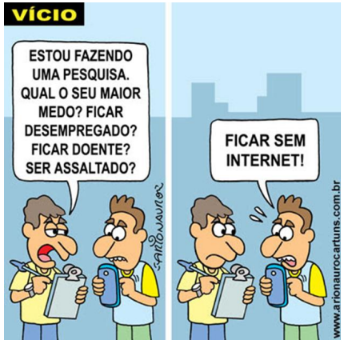
Observe a imagem a seguir para responder a questão:
Fonte: http://www.arionaurocartuns.com.br/2016/09/charge-viciocelular-internet.html Acesso em 11 de maio de 2026.
Analise as assertivas seguintes sobre a
charge.
I. O texto pertence ao gênero charge, caracterizado pela articulação entre linguagem verbal e não verbal com finalidade crítica e humorística.
II. A expressão “ficar sem internet” evidencia uso figurado da linguagem, aproximando-se semanticamente de uma situação de privação extrema.
III. A construção “qual o seu maior medo?” admite, na norma-padrão, a forma “qual é o seu maior medo?”, sem prejuízo sintático ou semântico relevante.
IV. A linguagem utilizada no texto afasta-se totalmente da oralidade e aproxima-se exclusivamente do registro técnico-formal.
Após análise, conclui-se que estão corretas as assertivas:
I. O texto pertence ao gênero charge, caracterizado pela articulação entre linguagem verbal e não verbal com finalidade crítica e humorística.
II. A expressão “ficar sem internet” evidencia uso figurado da linguagem, aproximando-se semanticamente de uma situação de privação extrema.
III. A construção “qual o seu maior medo?” admite, na norma-padrão, a forma “qual é o seu maior medo?”, sem prejuízo sintático ou semântico relevante.
IV. A linguagem utilizada no texto afasta-se totalmente da oralidade e aproxima-se exclusivamente do registro técnico-formal.
Após análise, conclui-se que estão corretas as assertivas:
Ano: 2026
Banca:
Ápice Consultoria
Órgão:
Prefeitura de Itatuba - PB
Prova:
Ápice Consultoria - 2026 - Prefeitura de Itatuba - PB - Professor B1 - Português |
Q4137689
Português
Texto associado
Observe a imagem a seguir para responder a questão:
Fonte: http://www.arionaurocartuns.com.br/2016/09/charge-viciocelular-internet.html Acesso em 11 de maio de 2026.
Considerando a charge, analise as assertivas
a seguir.
I. O texto mobiliza conhecimentos extratextuais relacionados ao uso excessivo da internet e à dependência tecnológica contemporânea.
II. O humor decorre parcialmente da inversão de expectativa entre problemas socialmente graves e um medo associado ao conforto digital.
III. O emprego reiterado de perguntas no primeiro quadrinho contribui para a construção de uma progressão argumentativa.
IV. A ausência de pontuação no segundo quadrinho compromete a coerência textual e impede a compreensão do efeito humorístico.
Após análise, conclui-se que estão corretas:
I. O texto mobiliza conhecimentos extratextuais relacionados ao uso excessivo da internet e à dependência tecnológica contemporânea.
II. O humor decorre parcialmente da inversão de expectativa entre problemas socialmente graves e um medo associado ao conforto digital.
III. O emprego reiterado de perguntas no primeiro quadrinho contribui para a construção de uma progressão argumentativa.
IV. A ausência de pontuação no segundo quadrinho compromete a coerência textual e impede a compreensão do efeito humorístico.
Após análise, conclui-se que estão corretas:
Ano: 2026
Banca:
Ápice Consultoria
Órgão:
Prefeitura de Itatuba - PB
Prova:
Ápice Consultoria - 2026 - Prefeitura de Itatuba - PB - Professor B1 - Português |
Q4137688
Português
Texto associado
Observe a imagem a seguir para responder a questão:
Fonte: http://www.arionaurocartuns.com.br/2016/09/charge-viciocelular-internet.html Acesso em 11 de maio de 2026.
Considerando a norma-padrão da língua
portuguesa e o funcionamento textual-discursivo
dos elementos linguísticos presentes na charge,
assinale a alternativa correta.
Ano: 2026
Banca:
Ápice Consultoria
Órgão:
Prefeitura de Itatuba - PB
Prova:
Ápice Consultoria - 2026 - Prefeitura de Itatuba - PB - Professor B1 - Português |
Q4137687
Português
Texto associado
Observe a imagem a seguir para responder a questão:
Fonte: http://www.arionaurocartuns.com.br/2016/09/charge-viciocelular-internet.html Acesso em 11 de maio de 2026.
No primeiro quadrinho, a sequência “ficar
desempregado? ficar doente? ser assaltado?”
produz determinado efeito argumentativo. Sobre
esse recurso, assinale a alternativa correta.
Ano: 2026
Banca:
Ápice Consultoria
Órgão:
Prefeitura de Itatuba - PB
Prova:
Ápice Consultoria - 2026 - Prefeitura de Itatuba - PB - Professor B1 - Português |
Q4137686
Português
Texto associado
Observe a imagem a seguir para responder a questão:
Fonte: http://www.arionaurocartuns.com.br/2016/09/charge-viciocelular-internet.html Acesso em 11 de maio de 2026.
O texto da tira constrói seu efeito de humor e
crítica social principalmente por meio da:
Ano: 2026
Banca:
Ápice Consultoria
Órgão:
Prefeitura de Itatuba - PB
Prova:
Ápice Consultoria - 2026 - Prefeitura de Itatuba - PB - Professor B1 - Português |
Q4137685
Português
Texto associado
Leia o texto a seguir para responder à questão.
Brain rot: vício em telas e o “apodrecimento”
do cérebro
O membro da Comissão Organizadora do XV
Congresso Paulista de Neurologia fala sobre o longo
tempo gasto em telas e em conteúdos
não estimulantes
“Brain rot” foi eleita a expressão mais
procurada do último ano, de acordo com o
Dicionário Oxford. Ao pé da letra, o significado é
“cérebro apodrecido” e está relacionado às
consequências do vício em telas – principalmente
entre crianças e adolescentes – ao consumir
conteúdos pouco desafiadores e superficiais. Os
efeitos desta condição são graves e preocupantes,
já que estão diretamente atrelados ao
desenvolvimento de transtornos mentais e
prejudicam as interações sociais dos indivíduos.
Nesta edição, a Revista da APM conversou com o
neurologista Marcel Simis, membro da Comissão
Organizadora do XV Congresso Paulista de
Neurologia, para esclarecer alguns pontos
fundamentais sobre o tema. Ele demonstra como
o brain rot pode potencializar distúrbios já
existentes, de que forma se desenvolve, como
evitar a condição e como tratá-la. Confira a seguir.
Como se caracteriza o brain rot e quais são os
seus efeitos?
Brain rot foi eleita a palavra do ano de 2024
pela Oxford University Press, mas é importante destacar que este não é um termo e nem um
diagnóstico médico, já que não está incluído no
DSM-5, que é o Manual Diagnóstico Estatístico
dos Transtornos Mentais, e nem no CID10, que é
o Manual das Doenças, então é um termo que não
é um diagnóstico clínico. Porém, é um termo
interessante que, inclusive, serve como importante
alerta para a sociedade, porque está associado ao
consumo excessivo de materiais e conteúdos online que são considerados triviais ou pouco
desafiadores para a atividade cognitiva cerebral.
Então, em tese, o termo coloca como se
fosse um “apodrecimento cerebral” por uma
exposição excessiva de conteúdos on-line que
não geram maior engajamento mental ou maior
atividade intelectual. No entanto, temos que tomar
cuidado em dizer a expressão “apodrecimento
cerebral”, porque, para alguns, pode soar que
verdadeiramente acontece dos neurônios e das
células cerebrais morrerem e apodrecerem, e não
é isso. É até um termo que eu, pessoalmente, não
gosto, por passar uma ideia como se fosse um
dano estrutural dos neurônios que, na verdade,
não acontece desta maneira. Todavia, embora
não aconteça o dano estrutural, é algo, sim,
preocupante, visto que o excesso de exposição a
este tipo de conteúdo on-line pode trazer prejuízos
para a vida da pessoa.
Como o brain rot pode potencializar
transtornos já existentes, como ansiedade,
depressão e síndrome do pânico?
Já existem estudos mostrando que a
exposição excessiva a telas e diferentes
conteúdos on-line está relacionada com a
depressão, ansiedade, estresse e alteração na
qualidade do sono. É interessante que não gera
um dano neuronal, mas gera uma disfunção de
circuitos neuronais. Um circuito que comumente é
relatado, e há artigos científicos sobre o assunto,
é um circuito dopaminérgico, ou seja, o que está
relacionado com aspectos de recompensa e de
reforço, que são associados à motivação, à
vontade de perseguir algum objetivo. No caso,
esse tipo de exposição a, por exemplo, vídeos
curtos em aplicativos como YouTube e TikTok,
entre outros, faz com que a pessoa fique engajada
naquela atividade por muito tempo, buscando, então, essa rápida recompensa. Assim,
bagunçando e desregulando o circuito
dopaminérgico, a pessoa desenvolve algo
semelhante mesmo a um vício dessa atividade online. É essa desregulação dos circuitos que
predispõe a transtornos mentais nas pessoas que
têm esse uso excessivo de telas.
Há algum tratamento para conseguir reverter
esta situação? Quais as possibilidades?
A boa notícia é que isso é tratável, então
são alterações reversíveis. Na questão da criança
é mais preocupante, porque não se sabe o quanto
esse tipo de alteração pode ser duradoura ao
longo da vida. Mas, já se sabe que muito desse
processo é reversível, então com a pessoa
deixando de ficar exposta à tela, essas alterações
de circuitos dopaminérgicos, entre outros circuitos
neuronais, tendem a se reestabelecer e aí reverte
esse processo. Então, como tratar? É reduzindo,
e muito, o tempo de exposição a esse tipo de
conteúdo. Esse seria o principal tratamento, se
fiscalizar e os pais fiscalizarem as crianças e os
adolescentes em relação a esse conteúdo e,
realmente, retirar, evitar essa exposição
abrangente a celulares, tablets, televisões e
computadores.
Fonte: Matéria publicada na edição 749 (Março/Abril de 2025) da
Revista da APM. Disponível em: https://www.apm.org.br/brain-rotvicio-em-telas-e-o-apodrecimento-do-cerebro/ Acesso em 14 de
maio de 2026.
O texto pode ser caracterizado
predominantemente como:
Ano: 2026
Banca:
Ápice Consultoria
Órgão:
Prefeitura de Itatuba - PB
Prova:
Ápice Consultoria - 2026 - Prefeitura de Itatuba - PB - Professor B1 - Português |
Q4137684
Português
Texto associado
Leia o texto a seguir para responder à questão.
Brain rot: vício em telas e o “apodrecimento”
do cérebro
O membro da Comissão Organizadora do XV
Congresso Paulista de Neurologia fala sobre o longo
tempo gasto em telas e em conteúdos
não estimulantes
“Brain rot” foi eleita a expressão mais
procurada do último ano, de acordo com o
Dicionário Oxford. Ao pé da letra, o significado é
“cérebro apodrecido” e está relacionado às
consequências do vício em telas – principalmente
entre crianças e adolescentes – ao consumir
conteúdos pouco desafiadores e superficiais. Os
efeitos desta condição são graves e preocupantes,
já que estão diretamente atrelados ao
desenvolvimento de transtornos mentais e
prejudicam as interações sociais dos indivíduos.
Nesta edição, a Revista da APM conversou com o
neurologista Marcel Simis, membro da Comissão
Organizadora do XV Congresso Paulista de
Neurologia, para esclarecer alguns pontos
fundamentais sobre o tema. Ele demonstra como
o brain rot pode potencializar distúrbios já
existentes, de que forma se desenvolve, como
evitar a condição e como tratá-la. Confira a seguir.
Como se caracteriza o brain rot e quais são os
seus efeitos?
Brain rot foi eleita a palavra do ano de 2024
pela Oxford University Press, mas é importante destacar que este não é um termo e nem um
diagnóstico médico, já que não está incluído no
DSM-5, que é o Manual Diagnóstico Estatístico
dos Transtornos Mentais, e nem no CID10, que é
o Manual das Doenças, então é um termo que não
é um diagnóstico clínico. Porém, é um termo
interessante que, inclusive, serve como importante
alerta para a sociedade, porque está associado ao
consumo excessivo de materiais e conteúdos online que são considerados triviais ou pouco
desafiadores para a atividade cognitiva cerebral.
Então, em tese, o termo coloca como se
fosse um “apodrecimento cerebral” por uma
exposição excessiva de conteúdos on-line que
não geram maior engajamento mental ou maior
atividade intelectual. No entanto, temos que tomar
cuidado em dizer a expressão “apodrecimento
cerebral”, porque, para alguns, pode soar que
verdadeiramente acontece dos neurônios e das
células cerebrais morrerem e apodrecerem, e não
é isso. É até um termo que eu, pessoalmente, não
gosto, por passar uma ideia como se fosse um
dano estrutural dos neurônios que, na verdade,
não acontece desta maneira. Todavia, embora
não aconteça o dano estrutural, é algo, sim,
preocupante, visto que o excesso de exposição a
este tipo de conteúdo on-line pode trazer prejuízos
para a vida da pessoa.
Como o brain rot pode potencializar
transtornos já existentes, como ansiedade,
depressão e síndrome do pânico?
Já existem estudos mostrando que a
exposição excessiva a telas e diferentes
conteúdos on-line está relacionada com a
depressão, ansiedade, estresse e alteração na
qualidade do sono. É interessante que não gera
um dano neuronal, mas gera uma disfunção de
circuitos neuronais. Um circuito que comumente é
relatado, e há artigos científicos sobre o assunto,
é um circuito dopaminérgico, ou seja, o que está
relacionado com aspectos de recompensa e de
reforço, que são associados à motivação, à
vontade de perseguir algum objetivo. No caso,
esse tipo de exposição a, por exemplo, vídeos
curtos em aplicativos como YouTube e TikTok,
entre outros, faz com que a pessoa fique engajada
naquela atividade por muito tempo, buscando, então, essa rápida recompensa. Assim,
bagunçando e desregulando o circuito
dopaminérgico, a pessoa desenvolve algo
semelhante mesmo a um vício dessa atividade online. É essa desregulação dos circuitos que
predispõe a transtornos mentais nas pessoas que
têm esse uso excessivo de telas.
Há algum tratamento para conseguir reverter
esta situação? Quais as possibilidades?
A boa notícia é que isso é tratável, então
são alterações reversíveis. Na questão da criança
é mais preocupante, porque não se sabe o quanto
esse tipo de alteração pode ser duradoura ao
longo da vida. Mas, já se sabe que muito desse
processo é reversível, então com a pessoa
deixando de ficar exposta à tela, essas alterações
de circuitos dopaminérgicos, entre outros circuitos
neuronais, tendem a se reestabelecer e aí reverte
esse processo. Então, como tratar? É reduzindo,
e muito, o tempo de exposição a esse tipo de
conteúdo. Esse seria o principal tratamento, se
fiscalizar e os pais fiscalizarem as crianças e os
adolescentes em relação a esse conteúdo e,
realmente, retirar, evitar essa exposição
abrangente a celulares, tablets, televisões e
computadores.
Fonte: Matéria publicada na edição 749 (Março/Abril de 2025) da
Revista da APM. Disponível em: https://www.apm.org.br/brain-rotvicio-em-telas-e-o-apodrecimento-do-cerebro/ Acesso em 14 de
maio de 2026.
No trecho “Já existem estudos mostrando que
a exposição excessiva a telas e diferentes
conteúdos on-line está relacionada com a
depressão...”, a oração introduzida por “que”
exerce função de:
Ano: 2026
Banca:
Ápice Consultoria
Órgão:
Prefeitura de Itatuba - PB
Prova:
Ápice Consultoria - 2026 - Prefeitura de Itatuba - PB - Professor B1 - Português |
Q4137683
Português
Texto associado
Leia o texto a seguir para responder à questão.
Brain rot: vício em telas e o “apodrecimento”
do cérebro
O membro da Comissão Organizadora do XV
Congresso Paulista de Neurologia fala sobre o longo
tempo gasto em telas e em conteúdos
não estimulantes
“Brain rot” foi eleita a expressão mais
procurada do último ano, de acordo com o
Dicionário Oxford. Ao pé da letra, o significado é
“cérebro apodrecido” e está relacionado às
consequências do vício em telas – principalmente
entre crianças e adolescentes – ao consumir
conteúdos pouco desafiadores e superficiais. Os
efeitos desta condição são graves e preocupantes,
já que estão diretamente atrelados ao
desenvolvimento de transtornos mentais e
prejudicam as interações sociais dos indivíduos.
Nesta edição, a Revista da APM conversou com o
neurologista Marcel Simis, membro da Comissão
Organizadora do XV Congresso Paulista de
Neurologia, para esclarecer alguns pontos
fundamentais sobre o tema. Ele demonstra como
o brain rot pode potencializar distúrbios já
existentes, de que forma se desenvolve, como
evitar a condição e como tratá-la. Confira a seguir.
Como se caracteriza o brain rot e quais são os
seus efeitos?
Brain rot foi eleita a palavra do ano de 2024
pela Oxford University Press, mas é importante destacar que este não é um termo e nem um
diagnóstico médico, já que não está incluído no
DSM-5, que é o Manual Diagnóstico Estatístico
dos Transtornos Mentais, e nem no CID10, que é
o Manual das Doenças, então é um termo que não
é um diagnóstico clínico. Porém, é um termo
interessante que, inclusive, serve como importante
alerta para a sociedade, porque está associado ao
consumo excessivo de materiais e conteúdos online que são considerados triviais ou pouco
desafiadores para a atividade cognitiva cerebral.
Então, em tese, o termo coloca como se
fosse um “apodrecimento cerebral” por uma
exposição excessiva de conteúdos on-line que
não geram maior engajamento mental ou maior
atividade intelectual. No entanto, temos que tomar
cuidado em dizer a expressão “apodrecimento
cerebral”, porque, para alguns, pode soar que
verdadeiramente acontece dos neurônios e das
células cerebrais morrerem e apodrecerem, e não
é isso. É até um termo que eu, pessoalmente, não
gosto, por passar uma ideia como se fosse um
dano estrutural dos neurônios que, na verdade,
não acontece desta maneira. Todavia, embora
não aconteça o dano estrutural, é algo, sim,
preocupante, visto que o excesso de exposição a
este tipo de conteúdo on-line pode trazer prejuízos
para a vida da pessoa.
Como o brain rot pode potencializar
transtornos já existentes, como ansiedade,
depressão e síndrome do pânico?
Já existem estudos mostrando que a
exposição excessiva a telas e diferentes
conteúdos on-line está relacionada com a
depressão, ansiedade, estresse e alteração na
qualidade do sono. É interessante que não gera
um dano neuronal, mas gera uma disfunção de
circuitos neuronais. Um circuito que comumente é
relatado, e há artigos científicos sobre o assunto,
é um circuito dopaminérgico, ou seja, o que está
relacionado com aspectos de recompensa e de
reforço, que são associados à motivação, à
vontade de perseguir algum objetivo. No caso,
esse tipo de exposição a, por exemplo, vídeos
curtos em aplicativos como YouTube e TikTok,
entre outros, faz com que a pessoa fique engajada
naquela atividade por muito tempo, buscando, então, essa rápida recompensa. Assim,
bagunçando e desregulando o circuito
dopaminérgico, a pessoa desenvolve algo
semelhante mesmo a um vício dessa atividade online. É essa desregulação dos circuitos que
predispõe a transtornos mentais nas pessoas que
têm esse uso excessivo de telas.
Há algum tratamento para conseguir reverter
esta situação? Quais as possibilidades?
A boa notícia é que isso é tratável, então
são alterações reversíveis. Na questão da criança
é mais preocupante, porque não se sabe o quanto
esse tipo de alteração pode ser duradoura ao
longo da vida. Mas, já se sabe que muito desse
processo é reversível, então com a pessoa
deixando de ficar exposta à tela, essas alterações
de circuitos dopaminérgicos, entre outros circuitos
neuronais, tendem a se reestabelecer e aí reverte
esse processo. Então, como tratar? É reduzindo,
e muito, o tempo de exposição a esse tipo de
conteúdo. Esse seria o principal tratamento, se
fiscalizar e os pais fiscalizarem as crianças e os
adolescentes em relação a esse conteúdo e,
realmente, retirar, evitar essa exposição
abrangente a celulares, tablets, televisões e
computadores.
Fonte: Matéria publicada na edição 749 (Março/Abril de 2025) da
Revista da APM. Disponível em: https://www.apm.org.br/brain-rotvicio-em-telas-e-o-apodrecimento-do-cerebro/ Acesso em 14 de
maio de 2026.
No fragmento: “bagunçando e desregulando o
circuito dopaminérgico”, o uso do verbo
“bagunçar” contribui para:
Ano: 2026
Banca:
Ápice Consultoria
Órgão:
Prefeitura de Itatuba - PB
Prova:
Ápice Consultoria - 2026 - Prefeitura de Itatuba - PB - Professor B1 - Português |
Q4137682
Português
Texto associado
Leia o texto a seguir para responder à questão.
Brain rot: vício em telas e o “apodrecimento”
do cérebro
O membro da Comissão Organizadora do XV
Congresso Paulista de Neurologia fala sobre o longo
tempo gasto em telas e em conteúdos
não estimulantes
“Brain rot” foi eleita a expressão mais
procurada do último ano, de acordo com o
Dicionário Oxford. Ao pé da letra, o significado é
“cérebro apodrecido” e está relacionado às
consequências do vício em telas – principalmente
entre crianças e adolescentes – ao consumir
conteúdos pouco desafiadores e superficiais. Os
efeitos desta condição são graves e preocupantes,
já que estão diretamente atrelados ao
desenvolvimento de transtornos mentais e
prejudicam as interações sociais dos indivíduos.
Nesta edição, a Revista da APM conversou com o
neurologista Marcel Simis, membro da Comissão
Organizadora do XV Congresso Paulista de
Neurologia, para esclarecer alguns pontos
fundamentais sobre o tema. Ele demonstra como
o brain rot pode potencializar distúrbios já
existentes, de que forma se desenvolve, como
evitar a condição e como tratá-la. Confira a seguir.
Como se caracteriza o brain rot e quais são os
seus efeitos?
Brain rot foi eleita a palavra do ano de 2024
pela Oxford University Press, mas é importante destacar que este não é um termo e nem um
diagnóstico médico, já que não está incluído no
DSM-5, que é o Manual Diagnóstico Estatístico
dos Transtornos Mentais, e nem no CID10, que é
o Manual das Doenças, então é um termo que não
é um diagnóstico clínico. Porém, é um termo
interessante que, inclusive, serve como importante
alerta para a sociedade, porque está associado ao
consumo excessivo de materiais e conteúdos online que são considerados triviais ou pouco
desafiadores para a atividade cognitiva cerebral.
Então, em tese, o termo coloca como se
fosse um “apodrecimento cerebral” por uma
exposição excessiva de conteúdos on-line que
não geram maior engajamento mental ou maior
atividade intelectual. No entanto, temos que tomar
cuidado em dizer a expressão “apodrecimento
cerebral”, porque, para alguns, pode soar que
verdadeiramente acontece dos neurônios e das
células cerebrais morrerem e apodrecerem, e não
é isso. É até um termo que eu, pessoalmente, não
gosto, por passar uma ideia como se fosse um
dano estrutural dos neurônios que, na verdade,
não acontece desta maneira. Todavia, embora
não aconteça o dano estrutural, é algo, sim,
preocupante, visto que o excesso de exposição a
este tipo de conteúdo on-line pode trazer prejuízos
para a vida da pessoa.
Como o brain rot pode potencializar
transtornos já existentes, como ansiedade,
depressão e síndrome do pânico?
Já existem estudos mostrando que a
exposição excessiva a telas e diferentes
conteúdos on-line está relacionada com a
depressão, ansiedade, estresse e alteração na
qualidade do sono. É interessante que não gera
um dano neuronal, mas gera uma disfunção de
circuitos neuronais. Um circuito que comumente é
relatado, e há artigos científicos sobre o assunto,
é um circuito dopaminérgico, ou seja, o que está
relacionado com aspectos de recompensa e de
reforço, que são associados à motivação, à
vontade de perseguir algum objetivo. No caso,
esse tipo de exposição a, por exemplo, vídeos
curtos em aplicativos como YouTube e TikTok,
entre outros, faz com que a pessoa fique engajada
naquela atividade por muito tempo, buscando, então, essa rápida recompensa. Assim,
bagunçando e desregulando o circuito
dopaminérgico, a pessoa desenvolve algo
semelhante mesmo a um vício dessa atividade online. É essa desregulação dos circuitos que
predispõe a transtornos mentais nas pessoas que
têm esse uso excessivo de telas.
Há algum tratamento para conseguir reverter
esta situação? Quais as possibilidades?
A boa notícia é que isso é tratável, então
são alterações reversíveis. Na questão da criança
é mais preocupante, porque não se sabe o quanto
esse tipo de alteração pode ser duradoura ao
longo da vida. Mas, já se sabe que muito desse
processo é reversível, então com a pessoa
deixando de ficar exposta à tela, essas alterações
de circuitos dopaminérgicos, entre outros circuitos
neuronais, tendem a se reestabelecer e aí reverte
esse processo. Então, como tratar? É reduzindo,
e muito, o tempo de exposição a esse tipo de
conteúdo. Esse seria o principal tratamento, se
fiscalizar e os pais fiscalizarem as crianças e os
adolescentes em relação a esse conteúdo e,
realmente, retirar, evitar essa exposição
abrangente a celulares, tablets, televisões e
computadores.
Fonte: Matéria publicada na edição 749 (Março/Abril de 2025) da
Revista da APM. Disponível em: https://www.apm.org.br/brain-rotvicio-em-telas-e-o-apodrecimento-do-cerebro/ Acesso em 14 de
maio de 2026.
No trecho: “Porém, é um termo interessante
que, inclusive, serve como importante alerta para
a sociedade...”, o conectivo “porém” estabelece
relação de:´
Ano: 2026
Banca:
Ápice Consultoria
Órgão:
Prefeitura de Itatuba - PB
Prova:
Ápice Consultoria - 2026 - Prefeitura de Itatuba - PB - Professor B1 - Português |
Q4137681
Português
Texto associado
Leia o texto a seguir para responder à questão.
Brain rot: vício em telas e o “apodrecimento”
do cérebro
O membro da Comissão Organizadora do XV
Congresso Paulista de Neurologia fala sobre o longo
tempo gasto em telas e em conteúdos
não estimulantes
“Brain rot” foi eleita a expressão mais
procurada do último ano, de acordo com o
Dicionário Oxford. Ao pé da letra, o significado é
“cérebro apodrecido” e está relacionado às
consequências do vício em telas – principalmente
entre crianças e adolescentes – ao consumir
conteúdos pouco desafiadores e superficiais. Os
efeitos desta condição são graves e preocupantes,
já que estão diretamente atrelados ao
desenvolvimento de transtornos mentais e
prejudicam as interações sociais dos indivíduos.
Nesta edição, a Revista da APM conversou com o
neurologista Marcel Simis, membro da Comissão
Organizadora do XV Congresso Paulista de
Neurologia, para esclarecer alguns pontos
fundamentais sobre o tema. Ele demonstra como
o brain rot pode potencializar distúrbios já
existentes, de que forma se desenvolve, como
evitar a condição e como tratá-la. Confira a seguir.
Como se caracteriza o brain rot e quais são os
seus efeitos?
Brain rot foi eleita a palavra do ano de 2024
pela Oxford University Press, mas é importante destacar que este não é um termo e nem um
diagnóstico médico, já que não está incluído no
DSM-5, que é o Manual Diagnóstico Estatístico
dos Transtornos Mentais, e nem no CID10, que é
o Manual das Doenças, então é um termo que não
é um diagnóstico clínico. Porém, é um termo
interessante que, inclusive, serve como importante
alerta para a sociedade, porque está associado ao
consumo excessivo de materiais e conteúdos online que são considerados triviais ou pouco
desafiadores para a atividade cognitiva cerebral.
Então, em tese, o termo coloca como se
fosse um “apodrecimento cerebral” por uma
exposição excessiva de conteúdos on-line que
não geram maior engajamento mental ou maior
atividade intelectual. No entanto, temos que tomar
cuidado em dizer a expressão “apodrecimento
cerebral”, porque, para alguns, pode soar que
verdadeiramente acontece dos neurônios e das
células cerebrais morrerem e apodrecerem, e não
é isso. É até um termo que eu, pessoalmente, não
gosto, por passar uma ideia como se fosse um
dano estrutural dos neurônios que, na verdade,
não acontece desta maneira. Todavia, embora
não aconteça o dano estrutural, é algo, sim,
preocupante, visto que o excesso de exposição a
este tipo de conteúdo on-line pode trazer prejuízos
para a vida da pessoa.
Como o brain rot pode potencializar
transtornos já existentes, como ansiedade,
depressão e síndrome do pânico?
Já existem estudos mostrando que a
exposição excessiva a telas e diferentes
conteúdos on-line está relacionada com a
depressão, ansiedade, estresse e alteração na
qualidade do sono. É interessante que não gera
um dano neuronal, mas gera uma disfunção de
circuitos neuronais. Um circuito que comumente é
relatado, e há artigos científicos sobre o assunto,
é um circuito dopaminérgico, ou seja, o que está
relacionado com aspectos de recompensa e de
reforço, que são associados à motivação, à
vontade de perseguir algum objetivo. No caso,
esse tipo de exposição a, por exemplo, vídeos
curtos em aplicativos como YouTube e TikTok,
entre outros, faz com que a pessoa fique engajada
naquela atividade por muito tempo, buscando, então, essa rápida recompensa. Assim,
bagunçando e desregulando o circuito
dopaminérgico, a pessoa desenvolve algo
semelhante mesmo a um vício dessa atividade online. É essa desregulação dos circuitos que
predispõe a transtornos mentais nas pessoas que
têm esse uso excessivo de telas.
Há algum tratamento para conseguir reverter
esta situação? Quais as possibilidades?
A boa notícia é que isso é tratável, então
são alterações reversíveis. Na questão da criança
é mais preocupante, porque não se sabe o quanto
esse tipo de alteração pode ser duradoura ao
longo da vida. Mas, já se sabe que muito desse
processo é reversível, então com a pessoa
deixando de ficar exposta à tela, essas alterações
de circuitos dopaminérgicos, entre outros circuitos
neuronais, tendem a se reestabelecer e aí reverte
esse processo. Então, como tratar? É reduzindo,
e muito, o tempo de exposição a esse tipo de
conteúdo. Esse seria o principal tratamento, se
fiscalizar e os pais fiscalizarem as crianças e os
adolescentes em relação a esse conteúdo e,
realmente, retirar, evitar essa exposição
abrangente a celulares, tablets, televisões e
computadores.
Fonte: Matéria publicada na edição 749 (Março/Abril de 2025) da
Revista da APM. Disponível em: https://www.apm.org.br/brain-rotvicio-em-telas-e-o-apodrecimento-do-cerebro/ Acesso em 14 de
maio de 2026.
De acordo com o texto, o termo “brain rot”:
Ano: 2026
Banca:
FUNDATEC
Órgão:
Prefeitura de São Martinho - RS
Prova:
FUNDATEC - 2026 - Prefeitura de São Martinho - RS - Doméstica, Merendeira, Operador de Máquinas e Operário |
Q4137535
Português

Qual pontuação substitui corretamente a figura  na linha 10?
na linha 10?
Ano: 2026
Banca:
FUNDATEC
Órgão:
Prefeitura de São Martinho - RS
Prova:
FUNDATEC - 2026 - Prefeitura de São Martinho - RS - Doméstica, Merendeira, Operador de Máquinas e Operário |
Q4137534
Português
No trecho a seguir, retirado do texto, qual palavra é classificada como substantivo?
“Quem espera uma fruta ácida pode estranhar”.
“Quem espera uma fruta ácida pode estranhar”.
Ano: 2026
Banca:
FUNDATEC
Órgão:
Prefeitura de São Martinho - RS
Prova:
FUNDATEC - 2026 - Prefeitura de São Martinho - RS - Doméstica, Merendeira, Operador de Máquinas e Operário |
Q4137533
Português
Considerando os trechos a seguir, retirados do texto, assinale a alternativa que
apresenta um verbo flexionado no tempo pretérito (passado).
Ano: 2026
Banca:
FUNDATEC
Órgão:
Prefeitura de São Martinho - RS
Prova:
FUNDATEC - 2026 - Prefeitura de São Martinho - RS - Doméstica, Merendeira, Operador de Máquinas e Operário |
Q4137532
Português
Assinale a alternativa que apresenta uma palavra com encontro consonantal, como
em “creme”.
Ano: 2026
Banca:
FUNDATEC
Órgão:
Prefeitura de São Martinho - RS
Prova:
FUNDATEC - 2026 - Prefeitura de São Martinho - RS - Doméstica, Merendeira, Operador de Máquinas e Operário |
Q4137531
Português
Assinale a alternativa que apresenta uma palavra oxítona (com a última sílaba mais
forte).
Ano: 2026
Banca:
FUNDATEC
Órgão:
Prefeitura de São Martinho - RS
Prova:
FUNDATEC - 2026 - Prefeitura de São Martinho - RS - Doméstica, Merendeira, Operador de Máquinas e Operário |
Q4137530
Português
Qual das seguintes palavras é escrita com “ç”, do mesmo modo que “açúcar”?
Ano: 2026
Banca:
FUNDATEC
Órgão:
Prefeitura de São Martinho - RS
Prova:
FUNDATEC - 2026 - Prefeitura de São Martinho - RS - Doméstica, Merendeira, Operador de Máquinas e Operário |
Q4137529
Português
A palavra “carboidratos” tem quantas sílabas?
Ano: 2026
Banca:
FUNDATEC
Órgão:
Prefeitura de São Martinho - RS
Prova:
FUNDATEC - 2026 - Prefeitura de São Martinho - RS - Doméstica, Merendeira, Operador de Máquinas e Operário |
Q4137528
Português
Assinale a alternativa que apresenta a correta separação silábica da palavra
“energética”
Ano: 2026
Banca:
FUNDATEC
Órgão:
Prefeitura de São Martinho - RS
Prova:
FUNDATEC - 2026 - Prefeitura de São Martinho - RS - Doméstica, Merendeira, Operador de Máquinas e Operário |
Q4137527
Português
Assinale a alternativa que apresenta palavras retiradas do texto em ordem alfabética.

 Conheça nossos planos