Questões de Concurso
Para perito criminal
Foram encontradas 4.108 questões
Resolva questões gratuitamente!
Junte-se a mais de 4 milhões de concurseiros!
UNEARTHED: REMAINS OF THE EARLIEST KNOWN TSUNAMI VICTIM
By Charles Choi | October 25, 2017 1:00 pm
Paragraph 1 Tsunamis have claimed hundreds of thousands of lives in the past two decades. Now a new study finds that a 6,000-year-old skull may come from the earliest known victim of these killer waves.
Paragraph 2 The partial human skull was discovered in 1929 buried in a mangrove swamp outside the small town of Aitape Papua New Guinea, about 500 miles north of Australia. Scientists originally thought it belonged to an ancient extinct human species, Homo erectus. However, subsequent research dated it to about 5,000 or 6,000 years in age, suggesting that it instead belonged to a modern human.
A Rare Specimen
Paragraph 3 The skull is one of just two examples of ancient human remains found in Papua New Guinea after more than a century of work there. As such, archaeologists wanted to learn more about this skull to elucidate how people settled this region.
Paragraph 4 The scientists went back to where this skull was found and sampled the soil in which it was discovered. They focused on details such as sediment grain size and composition.
Paragraph 5 In the sediment, the researchers discovered a range of microscopic organisms from the ocean known as diatoms. These were similar to ones found in the soil after a 1998 tsunami killed more than 2,000 people in Papua New Guinea — for instance, their shells of silica were broken, likely by extremely powerful forces.
Paragraph 6 These diatom shells, combined with the chemical compositions and the size ranges of the grains, all suggest that a tsunami occurred when the skull was buried. The researchers suggested the catastrophe either directly killed the person or ripped open their grave.
Paragraph 7 Tsunamis, which are giant waves caused by earthquakes, volcanic eruptions or underwater landslides, are some of the deadliest natural disasters known. The 2004 tsunami in the Indian Ocean killed more than 230,000 people, a higher death toll than any fire or hurricane.
Paragraph 8 The site where the skull was found is currently about 7.5 miles away from the coast. Still, the researchers noted that back when whoever the skull belonged to was alive, sea levels were higher, and the area would have been just behind the shoreline.
Paragraph 9 The waves of the tsunami that hit Papua New Guinea in 1998 reached more than 50 feet high and penetrated up to three miles inland. “If the event we have identified resulted from a similar process, it could have also resulted in extremely high waves,” study co-lead author Mark Golitko, an archaeologist at the University of Notre Dame in Indiana and the Field Museum in Chicago.
Paragraph 10 These results show “that coastal populations have been vulnerable to such events for thousands of years,” Golitko said. “People have managed to live with such unpredictable and destructive occurrences, but it highlights how vulnerable people living near the sea can be. Given the far larger populations that live along coastlines today, the potential impacts are far more severe now.”
Paragraph 11 Golitko plans to return to the area over the next few years “to further study the frequency of such events, how the environment changed over time, and how people have coped with the environmental challenges of living in that environment.” He and his colleagues detailed their findings Wednesday in the journal PLOS O.
Retrieved and adapted from:
UNEARTHED: REMAINS OF THE EARLIEST KNOWN TSUNAMI VICTIM
By Charles Choi | October 25, 2017 1:00 pm
Paragraph 1 Tsunamis have claimed hundreds of thousands of lives in the past two decades. Now a new study finds that a 6,000-year-old skull may come from the earliest known victim of these killer waves.
Paragraph 2 The partial human skull was discovered in 1929 buried in a mangrove swamp outside the small town of Aitape Papua New Guinea, about 500 miles north of Australia. Scientists originally thought it belonged to an ancient extinct human species, Homo erectus. However, subsequent research dated it to about 5,000 or 6,000 years in age, suggesting that it instead belonged to a modern human.
A Rare Specimen
Paragraph 3 The skull is one of just two examples of ancient human remains found in Papua New Guinea after more than a century of work there. As such, archaeologists wanted to learn more about this skull to elucidate how people settled this region.
Paragraph 4 The scientists went back to where this skull was found and sampled the soil in which it was discovered. They focused on details such as sediment grain size and composition.
Paragraph 5 In the sediment, the researchers discovered a range of microscopic organisms from the ocean known as diatoms. These were similar to ones found in the soil after a 1998 tsunami killed more than 2,000 people in Papua New Guinea — for instance, their shells of silica were broken, likely by extremely powerful forces.
Paragraph 6 These diatom shells, combined with the chemical compositions and the size ranges of the grains, all suggest that a tsunami occurred when the skull was buried. The researchers suggested the catastrophe either directly killed the person or ripped open their grave.
Paragraph 7 Tsunamis, which are giant waves caused by earthquakes, volcanic eruptions or underwater landslides, are some of the deadliest natural disasters known. The 2004 tsunami in the Indian Ocean killed more than 230,000 people, a higher death toll than any fire or hurricane.
Paragraph 8 The site where the skull was found is currently about 7.5 miles away from the coast. Still, the researchers noted that back when whoever the skull belonged to was alive, sea levels were higher, and the area would have been just behind the shoreline.
Paragraph 9 The waves of the tsunami that hit Papua New Guinea in 1998 reached more than 50 feet high and penetrated up to three miles inland. “If the event we have identified resulted from a similar process, it could have also resulted in extremely high waves,” study co-lead author Mark Golitko, an archaeologist at the University of Notre Dame in Indiana and the Field Museum in Chicago.
Paragraph 10 These results show “that coastal populations have been vulnerable to such events for thousands of years,” Golitko said. “People have managed to live with such unpredictable and destructive occurrences, but it highlights how vulnerable people living near the sea can be. Given the far larger populations that live along coastlines today, the potential impacts are far more severe now.”
Paragraph 11 Golitko plans to return to the area over the next few years “to further study the frequency of such events, how the environment changed over time, and how people have coped with the environmental challenges of living in that environment.” He and his colleagues detailed their findings Wednesday in the journal PLOS O.
Retrieved and adapted from:
UNEARTHED: REMAINS OF THE EARLIEST KNOWN TSUNAMI VICTIM
By Charles Choi | October 25, 2017 1:00 pm
Paragraph 1 Tsunamis have claimed hundreds of thousands of lives in the past two decades. Now a new study finds that a 6,000-year-old skull may come from the earliest known victim of these killer waves.
Paragraph 2 The partial human skull was discovered in 1929 buried in a mangrove swamp outside the small town of Aitape Papua New Guinea, about 500 miles north of Australia. Scientists originally thought it belonged to an ancient extinct human species, Homo erectus. However, subsequent research dated it to about 5,000 or 6,000 years in age, suggesting that it instead belonged to a modern human.
A Rare Specimen
Paragraph 3 The skull is one of just two examples of ancient human remains found in Papua New Guinea after more than a century of work there. As such, archaeologists wanted to learn more about this skull to elucidate how people settled this region.
Paragraph 4 The scientists went back to where this skull was found and sampled the soil in which it was discovered. They focused on details such as sediment grain size and composition.
Paragraph 5 In the sediment, the researchers discovered a range of microscopic organisms from the ocean known as diatoms. These were similar to ones found in the soil after a 1998 tsunami killed more than 2,000 people in Papua New Guinea — for instance, their shells of silica were broken, likely by extremely powerful forces.
Paragraph 6 These diatom shells, combined with the chemical compositions and the size ranges of the grains, all suggest that a tsunami occurred when the skull was buried. The researchers suggested the catastrophe either directly killed the person or ripped open their grave.
Paragraph 7 Tsunamis, which are giant waves caused by earthquakes, volcanic eruptions or underwater landslides, are some of the deadliest natural disasters known. The 2004 tsunami in the Indian Ocean killed more than 230,000 people, a higher death toll than any fire or hurricane.
Paragraph 8 The site where the skull was found is currently about 7.5 miles away from the coast. Still, the researchers noted that back when whoever the skull belonged to was alive, sea levels were higher, and the area would have been just behind the shoreline.
Paragraph 9 The waves of the tsunami that hit Papua New Guinea in 1998 reached more than 50 feet high and penetrated up to three miles inland. “If the event we have identified resulted from a similar process, it could have also resulted in extremely high waves,” study co-lead author Mark Golitko, an archaeologist at the University of Notre Dame in Indiana and the Field Museum in Chicago.
Paragraph 10 These results show “that coastal populations have been vulnerable to such events for thousands of years,” Golitko said. “People have managed to live with such unpredictable and destructive occurrences, but it highlights how vulnerable people living near the sea can be. Given the far larger populations that live along coastlines today, the potential impacts are far more severe now.”
Paragraph 11 Golitko plans to return to the area over the next few years “to further study the frequency of such events, how the environment changed over time, and how people have coped with the environmental challenges of living in that environment.” He and his colleagues detailed their findings Wednesday in the journal PLOS O.
Retrieved and adapted from:
UNEARTHED: REMAINS OF THE EARLIEST KNOWN TSUNAMI VICTIM
By Charles Choi | October 25, 2017 1:00 pm
Paragraph 1 Tsunamis have claimed hundreds of thousands of lives in the past two decades. Now a new study finds that a 6,000-year-old skull may come from the earliest known victim of these killer waves.
Paragraph 2 The partial human skull was discovered in 1929 buried in a mangrove swamp outside the small town of Aitape Papua New Guinea, about 500 miles north of Australia. Scientists originally thought it belonged to an ancient extinct human species, Homo erectus. However, subsequent research dated it to about 5,000 or 6,000 years in age, suggesting that it instead belonged to a modern human.
A Rare Specimen
Paragraph 3 The skull is one of just two examples of ancient human remains found in Papua New Guinea after more than a century of work there. As such, archaeologists wanted to learn more about this skull to elucidate how people settled this region.
Paragraph 4 The scientists went back to where this skull was found and sampled the soil in which it was discovered. They focused on details such as sediment grain size and composition.
Paragraph 5 In the sediment, the researchers discovered a range of microscopic organisms from the ocean known as diatoms. These were similar to ones found in the soil after a 1998 tsunami killed more than 2,000 people in Papua New Guinea — for instance, their shells of silica were broken, likely by extremely powerful forces.
Paragraph 6 These diatom shells, combined with the chemical compositions and the size ranges of the grains, all suggest that a tsunami occurred when the skull was buried. The researchers suggested the catastrophe either directly killed the person or ripped open their grave.
Paragraph 7 Tsunamis, which are giant waves caused by earthquakes, volcanic eruptions or underwater landslides, are some of the deadliest natural disasters known. The 2004 tsunami in the Indian Ocean killed more than 230,000 people, a higher death toll than any fire or hurricane.
Paragraph 8 The site where the skull was found is currently about 7.5 miles away from the coast. Still, the researchers noted that back when whoever the skull belonged to was alive, sea levels were higher, and the area would have been just behind the shoreline.
Paragraph 9 The waves of the tsunami that hit Papua New Guinea in 1998 reached more than 50 feet high and penetrated up to three miles inland. “If the event we have identified resulted from a similar process, it could have also resulted in extremely high waves,” study co-lead author Mark Golitko, an archaeologist at the University of Notre Dame in Indiana and the Field Museum in Chicago.
Paragraph 10 These results show “that coastal populations have been vulnerable to such events for thousands of years,” Golitko said. “People have managed to live with such unpredictable and destructive occurrences, but it highlights how vulnerable people living near the sea can be. Given the far larger populations that live along coastlines today, the potential impacts are far more severe now.”
Paragraph 11 Golitko plans to return to the area over the next few years “to further study the frequency of such events, how the environment changed over time, and how people have coped with the environmental challenges of living in that environment.” He and his colleagues detailed their findings Wednesday in the journal PLOS O.
Retrieved and adapted from:
UNEARTHED: REMAINS OF THE EARLIEST KNOWN TSUNAMI VICTIM
By Charles Choi | October 25, 2017 1:00 pm
Paragraph 1 Tsunamis have claimed hundreds of thousands of lives in the past two decades. Now a new study finds that a 6,000-year-old skull may come from the earliest known victim of these killer waves.
Paragraph 2 The partial human skull was discovered in 1929 buried in a mangrove swamp outside the small town of Aitape Papua New Guinea, about 500 miles north of Australia. Scientists originally thought it belonged to an ancient extinct human species, Homo erectus. However, subsequent research dated it to about 5,000 or 6,000 years in age, suggesting that it instead belonged to a modern human.
A Rare Specimen
Paragraph 3 The skull is one of just two examples of ancient human remains found in Papua New Guinea after more than a century of work there. As such, archaeologists wanted to learn more about this skull to elucidate how people settled this region.
Paragraph 4 The scientists went back to where this skull was found and sampled the soil in which it was discovered. They focused on details such as sediment grain size and composition.
Paragraph 5 In the sediment, the researchers discovered a range of microscopic organisms from the ocean known as diatoms. These were similar to ones found in the soil after a 1998 tsunami killed more than 2,000 people in Papua New Guinea — for instance, their shells of silica were broken, likely by extremely powerful forces.
Paragraph 6 These diatom shells, combined with the chemical compositions and the size ranges of the grains, all suggest that a tsunami occurred when the skull was buried. The researchers suggested the catastrophe either directly killed the person or ripped open their grave.
Paragraph 7 Tsunamis, which are giant waves caused by earthquakes, volcanic eruptions or underwater landslides, are some of the deadliest natural disasters known. The 2004 tsunami in the Indian Ocean killed more than 230,000 people, a higher death toll than any fire or hurricane.
Paragraph 8 The site where the skull was found is currently about 7.5 miles away from the coast. Still, the researchers noted that back when whoever the skull belonged to was alive, sea levels were higher, and the area would have been just behind the shoreline.
Paragraph 9 The waves of the tsunami that hit Papua New Guinea in 1998 reached more than 50 feet high and penetrated up to three miles inland. “If the event we have identified resulted from a similar process, it could have also resulted in extremely high waves,” study co-lead author Mark Golitko, an archaeologist at the University of Notre Dame in Indiana and the Field Museum in Chicago.
Paragraph 10 These results show “that coastal populations have been vulnerable to such events for thousands of years,” Golitko said. “People have managed to live with such unpredictable and destructive occurrences, but it highlights how vulnerable people living near the sea can be. Given the far larger populations that live along coastlines today, the potential impacts are far more severe now.”
Paragraph 11 Golitko plans to return to the area over the next few years “to further study the frequency of such events, how the environment changed over time, and how people have coped with the environmental challenges of living in that environment.” He and his colleagues detailed their findings Wednesday in the journal PLOS O.
Retrieved and adapted from:
Atenção: Nesta prova, considera-se uso correto da Língua Portuguesa o que está de acordo com a norma padrão escrita.
Leia o texto a seguir para responder a questão sobre seu conteúdo.
DIÁLOGO DE SURDOS
Por: Sírio Possenti. Publicado em 09 mai 2016. Adaptado de:
http://www.cienciahoje.org.br/noticia/v/ler/id/4821/n/dialogo_de_surdos
Acesso em 30 out 2017.
A expressão corrente trata de situações em que dois lados (ou mais) falam e ninguém se entende. Na verdade, esta é uma visão um pouco simplificada das coisas. De fato, quando dois lados polemizam, dificilmente olham para as mesmas coisas (ou para as mesmas palavras). Cada lado interpreta o outro de uma forma que este acha estranha e vice-versa.
Dominique Maingueneau (em Gênese dos discursos, São Paulo, Parábola) deu tratamento teórico à questão (um tratamento empírico pode ser encontrado em muitos espaços, quase diariamente). [...]
Suponhamos dois discursos, A e B. Se polemizam, B nunca diz que A diz A, mas que diz “nãoB”. E vice-versa. O interessante é que nunca se encontra “nãoB” no discurso de A, sempre se encontra A; mas B não “pode” ver isso, porque trairia sua identidade doutrinária, ideológica.
Um bom exemplo é o que acontece frequentemente no debate sobre variedades do português. Se um linguista diz que não há “erro” em uma fala popular, como em “as elite” (que a elite escreve burramente “a zelite”, quando deveria escrever “as elite”), seus opositores não dirão que os linguistas descrevem o fato como uma variante, mostrando que segue uma regra, mas que “aceitam tudo”, que “aceitam o erro”. O simulacro consiste no fato de que as palavras dos oponentes não são as dos linguistas (não cabe discutir quem tem razão, mas verificar que os dois não se entendem).
Uma variante da incompreensão é que cada lado fala de coisas diferentes.
Atualmente, há uma polêmica sobre se há golpe ou não há golpe. Simplificando um pouco, os que dizem que há golpe se apegam ao fato de que os dois crimes atribuídos à presidenta não seriam crimes. Os que acham que não há golpe dizem que o processo está seguindo as regras definidas pelo Supremo.
Um bom sintoma é a pergunta recorrente feita aos ministros do Supremo pelos repórteres: a pergunta não é “a pedalada é um crime?” (uma questão mérito), mas “impeachment é golpe?”. Esta pergunta permite que o ministro responda que não, pois o impedimento está previsto na Constituição.
Juca Kfouri fez uma boa comparação com futebol: a expulsão de um jogador, ou o pênalti, está prevista(o), o que não significa que qualquer expulsão é justa ou que toda falta é pênalti...
A teoria de Maingueneau joga água na fervura dos que acreditam que a humanidade pode se entender (o que faltaria é adotar uma língua comum, quem sabe o esperanto). Ledo engano: as pessoas não se entendem é falando a mesma língua.
Até hoje, ninguém venceu uma disputa intelectual (ideológica) no debate. Quando venceu, foi com o exército, com a maioria dos eleitores ou dos... deputados.
Sírio Possenti
Departamento de Linguística
Universidade Estadual de Campinas
Leia as proposições a seguir com atenção ao emprego dos pronomes, de acordo com a norma padrão:
I. Informou-me que daria-me explicações mais tarde.
II. Não nos informou sobre o que nos faria perder a vaga.
III. Refeririam-se aos problemas já analisados?
IV. Dessa forma, far-se-ão novas consultas.
Estão corretas quantas das proposições? Assinale a alternativa que contenha essa resposta:
Atenção: Nesta prova, considera-se uso correto da Língua Portuguesa o que está de acordo com a norma padrão escrita.
Leia o texto a seguir para responder a questão sobre seu conteúdo.
DIÁLOGO DE SURDOS
Por: Sírio Possenti. Publicado em 09 mai 2016. Adaptado de:
http://www.cienciahoje.org.br/noticia/v/ler/id/4821/n/dialogo_de_surdos
Acesso em 30 out 2017.
A expressão corrente trata de situações em que dois lados (ou mais) falam e ninguém se entende. Na verdade, esta é uma visão um pouco simplificada das coisas. De fato, quando dois lados polemizam, dificilmente olham para as mesmas coisas (ou para as mesmas palavras). Cada lado interpreta o outro de uma forma que este acha estranha e vice-versa.
Dominique Maingueneau (em Gênese dos discursos, São Paulo, Parábola) deu tratamento teórico à questão (um tratamento empírico pode ser encontrado em muitos espaços, quase diariamente). [...]
Suponhamos dois discursos, A e B. Se polemizam, B nunca diz que A diz A, mas que diz “nãoB”. E vice-versa. O interessante é que nunca se encontra “nãoB” no discurso de A, sempre se encontra A; mas B não “pode” ver isso, porque trairia sua identidade doutrinária, ideológica.
Um bom exemplo é o que acontece frequentemente no debate sobre variedades do português. Se um linguista diz que não há “erro” em uma fala popular, como em “as elite” (que a elite escreve burramente “a zelite”, quando deveria escrever “as elite”), seus opositores não dirão que os linguistas descrevem o fato como uma variante, mostrando que segue uma regra, mas que “aceitam tudo”, que “aceitam o erro”. O simulacro consiste no fato de que as palavras dos oponentes não são as dos linguistas (não cabe discutir quem tem razão, mas verificar que os dois não se entendem).
Uma variante da incompreensão é que cada lado fala de coisas diferentes.
Atualmente, há uma polêmica sobre se há golpe ou não há golpe. Simplificando um pouco, os que dizem que há golpe se apegam ao fato de que os dois crimes atribuídos à presidenta não seriam crimes. Os que acham que não há golpe dizem que o processo está seguindo as regras definidas pelo Supremo.
Um bom sintoma é a pergunta recorrente feita aos ministros do Supremo pelos repórteres: a pergunta não é “a pedalada é um crime?” (uma questão mérito), mas “impeachment é golpe?”. Esta pergunta permite que o ministro responda que não, pois o impedimento está previsto na Constituição.
Juca Kfouri fez uma boa comparação com futebol: a expulsão de um jogador, ou o pênalti, está prevista(o), o que não significa que qualquer expulsão é justa ou que toda falta é pênalti...
A teoria de Maingueneau joga água na fervura dos que acreditam que a humanidade pode se entender (o que faltaria é adotar uma língua comum, quem sabe o esperanto). Ledo engano: as pessoas não se entendem é falando a mesma língua.
Até hoje, ninguém venceu uma disputa intelectual (ideológica) no debate. Quando venceu, foi com o exército, com a maioria dos eleitores ou dos... deputados.
Sírio Possenti
Departamento de Linguística
Universidade Estadual de Campinas
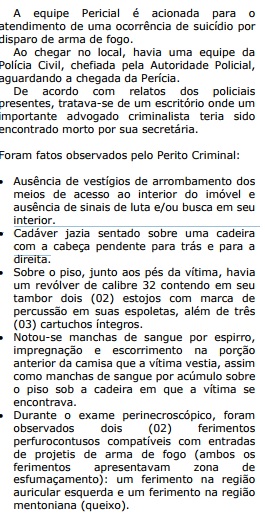
A Equipe de Remoção do Departamento Médico-Legal (DML), formada por um Técnico em Perícias e um Motorista, recebe um chamado para remoção de um cadáver do sexo masculino encontrado em avançado estado de decomposição, sem sinais aparentes de violência.
Chegando ao local da ocorrência, a residência da vítima, a equipe do DML é informada pelos policiais presentes que vizinhos teriam solicitado a presença de uma equipe para verificar a origem do forte odor de putrefação. A equipe da Polícia Civil teria encontrado o apartamento trancado pelo lado de dentro e teria solicitado que o síndico abrisse a porta, uma vez que ele possuía uma cópia da chave. O síndico, por sua vez, teria informado aos policiais que a vítima seria um senhor de aproximadamente 73 anos que morava sozinho e possuía histórico de problemas cardíacos e depressão.
A equipe do DML verificou que a vítima se encontrava em decúbito ventral sobre a cama com a cabeça voltada para baixo, sobre o travesseiro, o corpo estava esverdeado, bastante inchado e exalava forte odor fétido.
Ao remover o cadáver, os técnicos encontraram sob a região do tórax da vítima um revólver de calibre 38 e observaram a presença de um ferimento perfurocontuso na região mentoniana (queixo) compatível com a entrada de projétil de arma de fogo.
O Decreto Estadual nº 45.476/2008 institui, no Âmbito da Administração Pública Direta e Indireta do Estado do Rio Grande do Sul, o Código de Conduta da Alta Administração, o Código de Ética dos Servidores Públicos Civis do Poder Executivo Estadual, cria a Comissão de Ética Pública e dá outras providências. Com base nessa norma, analise as assertivas a seguir:
I. O exercício das funções junto à Comissão de Ética Pública é considerado prestação de serviço público relevante, podendo ensejar o pagamento de remuneração.
II. A Comissão de Ética Pública será integrada por cinco cidadãos de reconhecida idoneidade moral, reputação ilibada e experiência na Administração Pública, designados pelo Governador do Estado para mandato de dois anos, permitida uma recondução.
III. Consideram-se agentes públicos da alta administração, para efeito deste Decreto, os Secretários de Estado e seus respectivos Secretários Adjuntos, e os dirigentes dos órgãos e Entidades da Administração Pública Estadual.
IV. Concluído o processo de apuração de prática que infrinja o Código de Conduta da Alta Administração Estadual ou o Código de Ética dos Servidores Públicos Civis do Poder Executivo Estadual, proferirá a Comissão de Ética Pública decisão conclusiva e fundamentada, aprovada por deliberação da maioria dos seus membros.
Quais estão corretas?
Considere o amplificador operacional da figura abaixo. Sendo V1 = 1V, V2 = 5V, R1 = 10kΩ e R2 = 20 KΩ, qual é a tensão de saída V0?