Questões de Concurso
Para professor - inglês
Foram encontradas 31.244 questões
Resolva questões gratuitamente!
Junte-se a mais de 4 milhões de concurseiros!


Ano: 2024
Banca:
FUNCERN
Órgão:
Prefeitura de Guamaré - RN
Prova:
FUNCERN - 2024 - Prefeitura de Guamaré - RN - Professor Ensino Fundamental - Inglês |
Q2392601
Inglês
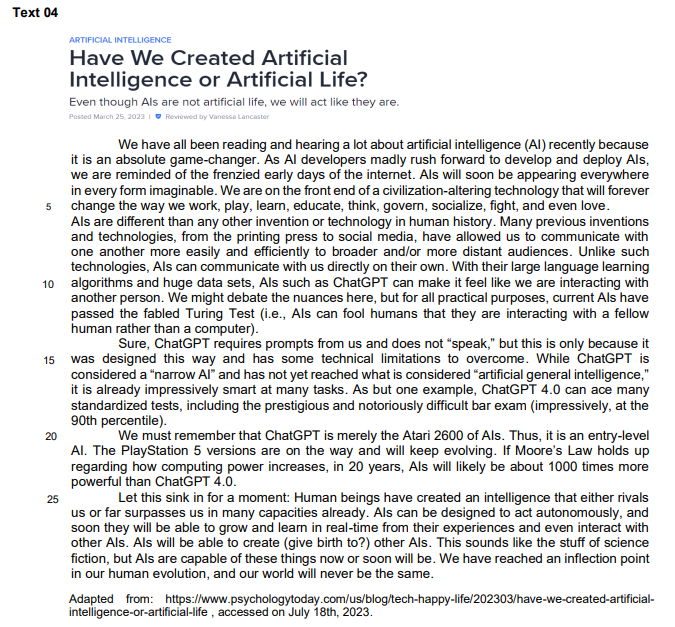
The question in the title of the article “Have we created Artificial Intelligence ou Artificial Life?” is in:
Ano: 2024
Banca:
FUNCERN
Órgão:
Prefeitura de Guamaré - RN
Prova:
FUNCERN - 2024 - Prefeitura de Guamaré - RN - Professor Ensino Fundamental - Inglês |
Q2392600
Inglês
Text 04 can best be summarized by:
Ano: 2024
Banca:
FUNCERN
Órgão:
Prefeitura de Guamaré - RN
Prova:
FUNCERN - 2024 - Prefeitura de Guamaré - RN - Professor Ensino Fundamental - Inglês |
Q2392599
Inglês
In “Unlike such technologies, AIs can communicate with us directly on their own. With their large language
learning algorithms and huge data sets, AIs such as ChatGPT can make it feel like we are interacting with
another person.”, “unlike” could be properly replaced by:
Ano: 2024
Banca:
FUNCERN
Órgão:
Prefeitura de Guamaré - RN
Prova:
FUNCERN - 2024 - Prefeitura de Guamaré - RN - Professor Ensino Fundamental - Inglês |
Q2392598
Inglês
“Sink in” in “Let this sink in for a moment: Human beings have created an intelligence that either rivals us
or far surpasses us in many capacities already.” means, in Portuguese:
Ano: 2024
Banca:
FUNCERN
Órgão:
Prefeitura de Guamaré - RN
Prova:
FUNCERN - 2024 - Prefeitura de Guamaré - RN - Professor Ensino Fundamental - Inglês |
Q2392597
Inglês
In “As AI developers madly rush forward to develop and deploy AIs, we are reminded of the frenzied early
days of the internet.”, we may find:
Ano: 2024
Banca:
FUNCERN
Órgão:
Prefeitura de Guamaré - RN
Prova:
FUNCERN - 2024 - Prefeitura de Guamaré - RN - Professor Ensino Fundamental - Inglês |
Q2392596
Inglês
Texto associado
Text 03 – Idioms and proverbs
Adapted from https://thefluentlife.com/content/difference-between-idioms-proverbs-meaning-examples/ ,
accessed on July 18th.
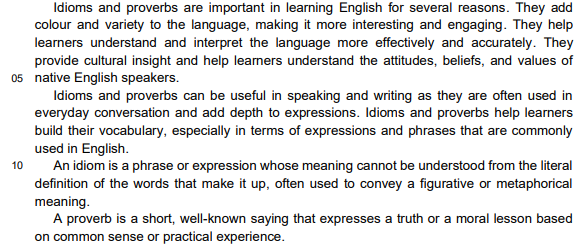
Still based on text 03, from idioms and proverbs we can say:
Ano: 2024
Banca:
FUNCERN
Órgão:
Prefeitura de Guamaré - RN
Prova:
FUNCERN - 2024 - Prefeitura de Guamaré - RN - Professor Ensino Fundamental - Inglês |
Q2392595
Inglês
Texto associado
Text 03 – Idioms and proverbs
Adapted from https://thefluentlife.com/content/difference-between-idioms-proverbs-meaning-examples/ ,
accessed on July 18th.
In “They help learners understand and interpret the language more effectively and accurately.”, we can
replace accurately for:
Ano: 2024
Banca:
FUNCERN
Órgão:
Prefeitura de Guamaré - RN
Prova:
FUNCERN - 2024 - Prefeitura de Guamaré - RN - Professor Ensino Fundamental - Inglês |
Q2392594
Inglês
Texto associado
Text 03 – Idioms and proverbs
Adapted from https://thefluentlife.com/content/difference-between-idioms-proverbs-meaning-examples/ ,
accessed on July 18th.
From what is briefly explained in text 03, the image below (Picture 01) represents:
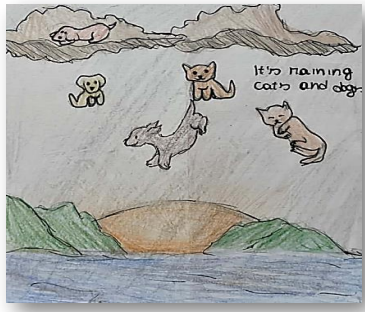
(Picture 01 – Illustrastion done by students in a language classroom).
Ano: 2024
Banca:
FUNCERN
Órgão:
Prefeitura de Guamaré - RN
Prova:
FUNCERN - 2024 - Prefeitura de Guamaré - RN - Professor Ensino Fundamental - Inglês |
Q2392593
Inglês
Texto associado
Text 03 – Idioms and proverbs
Adapted from https://thefluentlife.com/content/difference-between-idioms-proverbs-meaning-examples/ ,
accessed on July 18th.
In “An idiom is a phrase or expression whose meaning cannot be understood from the literal definition of
the words that make it up, often used to convey a figurative or metaphorical meaning.”, the term “whose”
is working as:
Ano: 2024
Banca:
FUNCERN
Órgão:
Prefeitura de Guamaré - RN
Prova:
FUNCERN - 2024 - Prefeitura de Guamaré - RN - Professor Ensino Fundamental - Inglês |
Q2392592
Inglês
Texto associado
“This approach is based on the active involvement of the learner in speaking and listening to the foreign
language in realistic everyday situations. No use is made of the learner’s mother tongue; learners are
encouraged to think in the foreign language, and not to translate into or out of it. A great deal of emphasis is
placed on good pronunciation, often introducing students to phonetic transcription before they see the standard
orthography. Formal grammatical rules and terminology are avoided.”
(Adapted from “Teaching Methods”, The Cambridge Encyclopedia of Language, 3rd ed. David Crystal. P.394.)
The text excerpt above briefly describes:
Ano: 2024
Banca:
FUNCERN
Órgão:
Prefeitura de Guamaré - RN
Prova:
FUNCERN - 2024 - Prefeitura de Guamaré - RN - Professor Ensino Fundamental - Inglês |
Q2392591
Inglês
Texto associado
Text 02 - (Types of social practices) Linguistics
The language spoken is one of the characteristics that most differentiate us from other animals on the planet.
According to the experts, its appearance was one of the main causes of our development as a species; This
is because the use of the language caused our brain to increase in capacity.
Therefore, linguistic social practices are a fundamental part of each culture. They include elements such as
the language spoken, expressions and phrases made, or the importance given to certain words.
[...]
Social practices of language
Within all types of social practices that exist some of the most influencing a given society are those that have
to do with their linguistic expression.
Due to the way in which language modifies the brain and the individual experience of people, the social
practices of language take on great importance when it comes to understanding the customs and ways of
seeing the world proper to a given society.
Even several studies have shown that bilingual people change their personality depending on the language
they are speaking. So, what are the social practices of language?
These are ways of interacting that include both spoken and written language, in addition to all those activities
that surround the communication process through it. Depending on the context in which we find ourselves and
what we want to transmit, these practices will be different.
Also adapted from: https://www.lifepersona.com/social-practices-types-and-practices-of-language, accessed on July
17th, 2023.
In “Within all types of social practices that exist some of the most influencing a given society are those that
have to do with their linguistic expression.”, the word “a” refers to:
Ano: 2024
Banca:
FUNCERN
Órgão:
Prefeitura de Guamaré - RN
Prova:
FUNCERN - 2024 - Prefeitura de Guamaré - RN - Professor Ensino Fundamental - Inglês |
Q2392590
Inglês
Texto associado
Text 02 - (Types of social practices) Linguistics
The language spoken is one of the characteristics that most differentiate us from other animals on the planet.
According to the experts, its appearance was one of the main causes of our development as a species; This
is because the use of the language caused our brain to increase in capacity.
Therefore, linguistic social practices are a fundamental part of each culture. They include elements such as
the language spoken, expressions and phrases made, or the importance given to certain words.
[...]
Social practices of language
Within all types of social practices that exist some of the most influencing a given society are those that have
to do with their linguistic expression.
Due to the way in which language modifies the brain and the individual experience of people, the social
practices of language take on great importance when it comes to understanding the customs and ways of
seeing the world proper to a given society.
Even several studies have shown that bilingual people change their personality depending on the language
they are speaking. So, what are the social practices of language?
These are ways of interacting that include both spoken and written language, in addition to all those activities
that surround the communication process through it. Depending on the context in which we find ourselves and
what we want to transmit, these practices will be different.
Also adapted from: https://www.lifepersona.com/social-practices-types-and-practices-of-language, accessed on July
17th, 2023.
From text 02, we visibly understand that:
Ano: 2024
Banca:
FUNCERN
Órgão:
Prefeitura de Guamaré - RN
Prova:
FUNCERN - 2024 - Prefeitura de Guamaré - RN - Professor Ensino Fundamental - Inglês |
Q2392589
Inglês
Texto associado
Text 01 - Social Practices: Types and Practices of Language.
The social practices
They are habits and ways of doing things that are established in a society and are practiced in the same way
by all its inhabitants. These practices differ from one culture to another and, therefore, behaving in the same
way in two different societies can lead to misunderstandings.
Because they are only implicit agreements about the way of doing things, no social practice is correct or
incorrect. The adaptation of the social practices will have to do with the place and the moment in which they
are carried out; for that reason it does not make sense to think that the practices of another society are wrong.
Social practices are built over the years and are modified as time passes. Therefore, what is common in today's
society has nothing to do with the way in which it was correct to behave several decades ago. This means that
social practices are not immutable either, but are always subject to change.
(...)
Adapted from: https://www.lifepersona.com/social-practices-types-and-practices-of-language, accessed on July 17th
,
2023.
In “These practices differ from one culture to another and, therefore, behaving in the same way in two
different societies can lead to misunderstandings.”, the word “misundertandings” brings an affix that:
Ano: 2024
Banca:
FUNCERN
Órgão:
Prefeitura de Guamaré - RN
Prova:
FUNCERN - 2024 - Prefeitura de Guamaré - RN - Professor Ensino Fundamental - Inglês |
Q2392588
Inglês
Texto associado
Text 01 - Social Practices: Types and Practices of Language.
The social practices
They are habits and ways of doing things that are established in a society and are practiced in the same way
by all its inhabitants. These practices differ from one culture to another and, therefore, behaving in the same
way in two different societies can lead to misunderstandings.
Because they are only implicit agreements about the way of doing things, no social practice is correct or
incorrect. The adaptation of the social practices will have to do with the place and the moment in which they
are carried out; for that reason it does not make sense to think that the practices of another society are wrong.
Social practices are built over the years and are modified as time passes. Therefore, what is common in today's
society has nothing to do with the way in which it was correct to behave several decades ago. This means that
social practices are not immutable either, but are always subject to change.
(...)
Adapted from: https://www.lifepersona.com/social-practices-types-and-practices-of-language, accessed on July 17th
,
2023.
The phrasal verb “carried out” in “The adaptation of the social practices will have to do with the place and
the moment in which they are carried out; (...)” can be properly replaced by:
Ano: 2024
Banca:
FUNCERN
Órgão:
Prefeitura de Guamaré - RN
Prova:
FUNCERN - 2024 - Prefeitura de Guamaré - RN - Professor Ensino Fundamental - Inglês |
Q2392587
Inglês
Texto associado
Text 01 - Social Practices: Types and Practices of Language.
The social practices
They are habits and ways of doing things that are established in a society and are practiced in the same way
by all its inhabitants. These practices differ from one culture to another and, therefore, behaving in the same
way in two different societies can lead to misunderstandings.
Because they are only implicit agreements about the way of doing things, no social practice is correct or
incorrect. The adaptation of the social practices will have to do with the place and the moment in which they
are carried out; for that reason it does not make sense to think that the practices of another society are wrong.
Social practices are built over the years and are modified as time passes. Therefore, what is common in today's
society has nothing to do with the way in which it was correct to behave several decades ago. This means that
social practices are not immutable either, but are always subject to change.
(...)
Adapted from: https://www.lifepersona.com/social-practices-types-and-practices-of-language, accessed on July 17th
,
2023.
According to what is written in text 01, it is correct to say that:
Ano: 2024
Banca:
FUNCERN
Órgão:
Prefeitura de Guamaré - RN
Provas:
FUNCERN - 2024 - Prefeitura de Guamaré - RN - Procurador do Munícipio
|
FUNCERN - 2024 - Prefeitura de Guamaré - RN - Psicólogo |
FUNCERN - 2024 - Prefeitura de Guamaré - RN - Auditor Fiscal de Tributos |
FUNCERN - 2024 - Prefeitura de Guamaré - RN - Assessor Jurídico Municipal |
FUNCERN - 2024 - Prefeitura de Guamaré - RN - Médico - Otorrinolaringologia |
FUNCERN - 2024 - Prefeitura de Guamaré - RN - Médico - Psiquiatria |
FUNCERN - 2024 - Prefeitura de Guamaré - RN - Médico - Reumatologia |
FUNCERN - 2024 - Prefeitura de Guamaré - RN - Médico - Saúde da Família |
FUNCERN - 2024 - Prefeitura de Guamaré - RN - Médico Veterinário |
FUNCERN - 2024 - Prefeitura de Guamaré - RN - Nutricionista |
FUNCERN - 2024 - Prefeitura de Guamaré - RN - Terapeuta Ocupacional |
FUNCERN - 2024 - Prefeitura de Guamaré - RN - Enfermeiro - Hospitalar/UPA |
FUNCERN - 2024 - Prefeitura de Guamaré - RN - Cirurgião Dentista - Periodontista |
FUNCERN - 2024 - Prefeitura de Guamaré - RN - Farmacêutico - Bioquímico |
FUNCERN - 2024 - Prefeitura de Guamaré - RN - Médico do Trabalho |
FUNCERN - 2024 - Prefeitura de Guamaré - RN - Cirurgião Dentista - Programa Saúde Bucal |
FUNCERN - 2024 - Prefeitura de Guamaré - RN - Cirurgião Dentista - Endodontia |
FUNCERN - 2024 - Prefeitura de Guamaré - RN - Cirurgião Dentista - Odontopediatra |
FUNCERN - 2024 - Prefeitura de Guamaré - RN - Cirurgião Dentista - Cirurgia e Traumatologia Buco-Maxilo-Facial |
FUNCERN - 2024 - Prefeitura de Guamaré - RN - Cirurgião Dentista - Para Necessidades Especiais |
FUNCERN - 2024 - Prefeitura de Guamaré - RN - Enfermeiro - Saúde da Família |
FUNCERN - 2024 - Prefeitura de Guamaré - RN - Fisioterapeuta |
FUNCERN - 2024 - Prefeitura de Guamaré - RN - Fonoaudiólogo |
FUNCERN - 2024 - Prefeitura de Guamaré - RN - Professor Ensino Fundamental - Educação Física |
FUNCERN - 2024 - Prefeitura de Guamaré - RN - Médico - Angiologia |
FUNCERN - 2024 - Prefeitura de Guamaré - RN - Médico - Cardiologia |
FUNCERN - 2024 - Prefeitura de Guamaré - RN - Médico - Clínica Médica |
FUNCERN - 2024 - Prefeitura de Guamaré - RN - Médico - Dermatologia |
FUNCERN - 2024 - Prefeitura de Guamaré - RN - Médico - Gastroenterologia |
FUNCERN - 2024 - Prefeitura de Guamaré - RN - Médico - Geriatria |
FUNCERN - 2024 - Prefeitura de Guamaré - RN - Médico - Mastologia |
FUNCERN - 2024 - Prefeitura de Guamaré - RN - Médico - Neurologia |
FUNCERN - 2024 - Prefeitura de Guamaré - RN - Médico - Oftalmologia |
FUNCERN - 2024 - Prefeitura de Guamaré - RN - Médico - Ortopedia e Traumatologia |
FUNCERN - 2024 - Prefeitura de Guamaré - RN - Professor Ensino Fundamental - Inglês |
FUNCERN - 2024 - Prefeitura de Guamaré - RN - Professor Ensino Fundamental - Artes |
FUNCERN - 2024 - Prefeitura de Guamaré - RN - Professor Magistério Fundamental - Anos Finais e EJA - Matemática |
FUNCERN - 2024 - Prefeitura de Guamaré - RN - Professor Magistério Fundamental - Anos Finais e EJA - História |
FUNCERN - 2024 - Prefeitura de Guamaré - RN - Professor Magistério Fundamental - Anos Finais e EJA - Ciências |
FUNCERN - 2024 - Prefeitura de Guamaré - RN - Professor Magistério Fundamental - Anos Finais e EJA - Geografia |
FUNCERN - 2024 - Prefeitura de Guamaré - RN - Professor Magistério Fundamental - Anos Finais e EJA - Inglês |
FUNCERN - 2024 - Prefeitura de Guamaré - RN - Professor Magistério Fundamental - Anos Finais e EJA - Ensino de Arte |
FUNCERN - 2024 - Prefeitura de Guamaré - RN - Professor Magistério Fundamental - Anos Finais e EJA - Educação Física |
FUNCERN - 2024 - Prefeitura de Guamaré - RN - Professor Magistério Fundamental - Anos Finais e EJA - Química |
FUNCERN - 2024 - Prefeitura de Guamaré - RN - Professor Magistério Fundamental - Anos Finais e EJA - Intérprete de Libras |
FUNCERN - 2024 - Prefeitura de Guamaré - RN - Professor de Educação Infantil - Pedagogo |
FUNCERN - 2024 - Prefeitura de Guamaré - RN - Assistente Social |
Q2386136
Raciocínio Lógico
Se Nita é paulista, então Neto não é potiguar. Ou Neto é potiguar, ou José é paraibano. Se Maria não é
cearense, Nita é paulista. Ora, nem José é paraibano e nem Assis é carioca. Logo,
Ano: 2024
Banca:
FUNCERN
Órgão:
Prefeitura de Guamaré - RN
Provas:
FUNCERN - 2024 - Prefeitura de Guamaré - RN - Procurador do Munícipio
|
FUNCERN - 2024 - Prefeitura de Guamaré - RN - Psicólogo |
FUNCERN - 2024 - Prefeitura de Guamaré - RN - Auditor Fiscal de Tributos |
FUNCERN - 2024 - Prefeitura de Guamaré - RN - Assessor Jurídico Municipal |
FUNCERN - 2024 - Prefeitura de Guamaré - RN - Médico - Otorrinolaringologia |
FUNCERN - 2024 - Prefeitura de Guamaré - RN - Médico - Psiquiatria |
FUNCERN - 2024 - Prefeitura de Guamaré - RN - Médico - Reumatologia |
FUNCERN - 2024 - Prefeitura de Guamaré - RN - Médico - Saúde da Família |
FUNCERN - 2024 - Prefeitura de Guamaré - RN - Médico Veterinário |
FUNCERN - 2024 - Prefeitura de Guamaré - RN - Nutricionista |
FUNCERN - 2024 - Prefeitura de Guamaré - RN - Terapeuta Ocupacional |
FUNCERN - 2024 - Prefeitura de Guamaré - RN - Enfermeiro - Hospitalar/UPA |
FUNCERN - 2024 - Prefeitura de Guamaré - RN - Cirurgião Dentista - Periodontista |
FUNCERN - 2024 - Prefeitura de Guamaré - RN - Farmacêutico - Bioquímico |
FUNCERN - 2024 - Prefeitura de Guamaré - RN - Médico do Trabalho |
FUNCERN - 2024 - Prefeitura de Guamaré - RN - Cirurgião Dentista - Programa Saúde Bucal |
FUNCERN - 2024 - Prefeitura de Guamaré - RN - Cirurgião Dentista - Endodontia |
FUNCERN - 2024 - Prefeitura de Guamaré - RN - Cirurgião Dentista - Odontopediatra |
FUNCERN - 2024 - Prefeitura de Guamaré - RN - Cirurgião Dentista - Cirurgia e Traumatologia Buco-Maxilo-Facial |
FUNCERN - 2024 - Prefeitura de Guamaré - RN - Cirurgião Dentista - Para Necessidades Especiais |
FUNCERN - 2024 - Prefeitura de Guamaré - RN - Enfermeiro - Saúde da Família |
FUNCERN - 2024 - Prefeitura de Guamaré - RN - Fisioterapeuta |
FUNCERN - 2024 - Prefeitura de Guamaré - RN - Fonoaudiólogo |
FUNCERN - 2024 - Prefeitura de Guamaré - RN - Professor Ensino Fundamental - Educação Física |
FUNCERN - 2024 - Prefeitura de Guamaré - RN - Médico - Angiologia |
FUNCERN - 2024 - Prefeitura de Guamaré - RN - Médico - Cardiologia |
FUNCERN - 2024 - Prefeitura de Guamaré - RN - Médico - Clínica Médica |
FUNCERN - 2024 - Prefeitura de Guamaré - RN - Médico - Dermatologia |
FUNCERN - 2024 - Prefeitura de Guamaré - RN - Médico - Gastroenterologia |
FUNCERN - 2024 - Prefeitura de Guamaré - RN - Médico - Geriatria |
FUNCERN - 2024 - Prefeitura de Guamaré - RN - Médico - Mastologia |
FUNCERN - 2024 - Prefeitura de Guamaré - RN - Médico - Neurologia |
FUNCERN - 2024 - Prefeitura de Guamaré - RN - Médico - Oftalmologia |
FUNCERN - 2024 - Prefeitura de Guamaré - RN - Médico - Ortopedia e Traumatologia |
FUNCERN - 2024 - Prefeitura de Guamaré - RN - Professor Ensino Fundamental - Inglês |
FUNCERN - 2024 - Prefeitura de Guamaré - RN - Professor Ensino Fundamental - Artes |
FUNCERN - 2024 - Prefeitura de Guamaré - RN - Professor Magistério Fundamental - Anos Finais e EJA - Matemática |
FUNCERN - 2024 - Prefeitura de Guamaré - RN - Professor Magistério Fundamental - Anos Finais e EJA - História |
FUNCERN - 2024 - Prefeitura de Guamaré - RN - Professor Magistério Fundamental - Anos Finais e EJA - Ciências |
FUNCERN - 2024 - Prefeitura de Guamaré - RN - Professor Magistério Fundamental - Anos Finais e EJA - Geografia |
FUNCERN - 2024 - Prefeitura de Guamaré - RN - Professor Magistério Fundamental - Anos Finais e EJA - Inglês |
FUNCERN - 2024 - Prefeitura de Guamaré - RN - Professor Magistério Fundamental - Anos Finais e EJA - Ensino de Arte |
FUNCERN - 2024 - Prefeitura de Guamaré - RN - Professor Magistério Fundamental - Anos Finais e EJA - Educação Física |
FUNCERN - 2024 - Prefeitura de Guamaré - RN - Professor Magistério Fundamental - Anos Finais e EJA - Química |
FUNCERN - 2024 - Prefeitura de Guamaré - RN - Professor Magistério Fundamental - Anos Finais e EJA - Intérprete de Libras |
FUNCERN - 2024 - Prefeitura de Guamaré - RN - Professor de Educação Infantil - Pedagogo |
FUNCERN - 2024 - Prefeitura de Guamaré - RN - Assistente Social |
Q2386135
Raciocínio Lógico
Rafa foi até o Mercadinho Guama-box e levou sua bolsa de moedas para pagar as compras. O quadro
abaixo apresenta a quantidade de moedas que ela tinha dentro da bolsa.
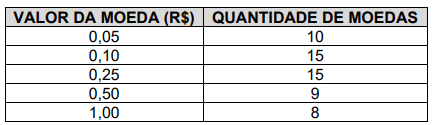
O valor total da compra deu R$ 15,30 e Rafa decidiu pagar com a menor quantidade de moedas possível. Nesse caso, a quantidade de moedas utilizada por ela para pagar a compra foi
O valor total da compra deu R$ 15,30 e Rafa decidiu pagar com a menor quantidade de moedas possível. Nesse caso, a quantidade de moedas utilizada por ela para pagar a compra foi
Ano: 2024
Banca:
FUNCERN
Órgão:
Prefeitura de Guamaré - RN
Provas:
FUNCERN - 2024 - Prefeitura de Guamaré - RN - Procurador do Munícipio
|
FUNCERN - 2024 - Prefeitura de Guamaré - RN - Psicólogo |
FUNCERN - 2024 - Prefeitura de Guamaré - RN - Auditor Fiscal de Tributos |
FUNCERN - 2024 - Prefeitura de Guamaré - RN - Assessor Jurídico Municipal |
FUNCERN - 2024 - Prefeitura de Guamaré - RN - Médico - Otorrinolaringologia |
FUNCERN - 2024 - Prefeitura de Guamaré - RN - Médico - Psiquiatria |
FUNCERN - 2024 - Prefeitura de Guamaré - RN - Médico - Reumatologia |
FUNCERN - 2024 - Prefeitura de Guamaré - RN - Médico - Saúde da Família |
FUNCERN - 2024 - Prefeitura de Guamaré - RN - Médico Veterinário |
FUNCERN - 2024 - Prefeitura de Guamaré - RN - Nutricionista |
FUNCERN - 2024 - Prefeitura de Guamaré - RN - Terapeuta Ocupacional |
FUNCERN - 2024 - Prefeitura de Guamaré - RN - Enfermeiro - Hospitalar/UPA |
FUNCERN - 2024 - Prefeitura de Guamaré - RN - Cirurgião Dentista - Periodontista |
FUNCERN - 2024 - Prefeitura de Guamaré - RN - Farmacêutico - Bioquímico |
FUNCERN - 2024 - Prefeitura de Guamaré - RN - Médico do Trabalho |
FUNCERN - 2024 - Prefeitura de Guamaré - RN - Cirurgião Dentista - Programa Saúde Bucal |
FUNCERN - 2024 - Prefeitura de Guamaré - RN - Cirurgião Dentista - Endodontia |
FUNCERN - 2024 - Prefeitura de Guamaré - RN - Cirurgião Dentista - Odontopediatra |
FUNCERN - 2024 - Prefeitura de Guamaré - RN - Cirurgião Dentista - Cirurgia e Traumatologia Buco-Maxilo-Facial |
FUNCERN - 2024 - Prefeitura de Guamaré - RN - Cirurgião Dentista - Para Necessidades Especiais |
FUNCERN - 2024 - Prefeitura de Guamaré - RN - Enfermeiro - Saúde da Família |
FUNCERN - 2024 - Prefeitura de Guamaré - RN - Fisioterapeuta |
FUNCERN - 2024 - Prefeitura de Guamaré - RN - Fonoaudiólogo |
FUNCERN - 2024 - Prefeitura de Guamaré - RN - Professor Ensino Fundamental - Educação Física |
FUNCERN - 2024 - Prefeitura de Guamaré - RN - Médico - Angiologia |
FUNCERN - 2024 - Prefeitura de Guamaré - RN - Médico - Cardiologia |
FUNCERN - 2024 - Prefeitura de Guamaré - RN - Médico - Clínica Médica |
FUNCERN - 2024 - Prefeitura de Guamaré - RN - Médico - Dermatologia |
FUNCERN - 2024 - Prefeitura de Guamaré - RN - Médico - Gastroenterologia |
FUNCERN - 2024 - Prefeitura de Guamaré - RN - Médico - Geriatria |
FUNCERN - 2024 - Prefeitura de Guamaré - RN - Médico - Mastologia |
FUNCERN - 2024 - Prefeitura de Guamaré - RN - Médico - Neurologia |
FUNCERN - 2024 - Prefeitura de Guamaré - RN - Médico - Oftalmologia |
FUNCERN - 2024 - Prefeitura de Guamaré - RN - Médico - Ortopedia e Traumatologia |
FUNCERN - 2024 - Prefeitura de Guamaré - RN - Professor Ensino Fundamental - Inglês |
FUNCERN - 2024 - Prefeitura de Guamaré - RN - Professor Ensino Fundamental - Artes |
FUNCERN - 2024 - Prefeitura de Guamaré - RN - Professor Magistério Fundamental - Anos Finais e EJA - Matemática |
FUNCERN - 2024 - Prefeitura de Guamaré - RN - Professor Magistério Fundamental - Anos Finais e EJA - História |
FUNCERN - 2024 - Prefeitura de Guamaré - RN - Professor Magistério Fundamental - Anos Finais e EJA - Ciências |
FUNCERN - 2024 - Prefeitura de Guamaré - RN - Professor Magistério Fundamental - Anos Finais e EJA - Geografia |
FUNCERN - 2024 - Prefeitura de Guamaré - RN - Professor Magistério Fundamental - Anos Finais e EJA - Inglês |
FUNCERN - 2024 - Prefeitura de Guamaré - RN - Professor Magistério Fundamental - Anos Finais e EJA - Ensino de Arte |
FUNCERN - 2024 - Prefeitura de Guamaré - RN - Professor Magistério Fundamental - Anos Finais e EJA - Educação Física |
FUNCERN - 2024 - Prefeitura de Guamaré - RN - Professor Magistério Fundamental - Anos Finais e EJA - Química |
FUNCERN - 2024 - Prefeitura de Guamaré - RN - Professor Magistério Fundamental - Anos Finais e EJA - Intérprete de Libras |
FUNCERN - 2024 - Prefeitura de Guamaré - RN - Professor de Educação Infantil - Pedagogo |
FUNCERN - 2024 - Prefeitura de Guamaré - RN - Assistente Social |
Q2386134
Raciocínio Lógico
Se somarmos todos os servidores que ocupam o cargo de Auxiliar de Serviços Gerais (ASG) de três
secretarias de Guamaré/RN e dividirmos em grupos de 3 ou de 5 ou de 7 pessoas, sempre restarão 4
ASGs. Com o concurso público que está em andamento no município, a prefeitura planeja que o total de
ASGs, somada as três secretarias, chegue a 150. Isso ocorrerá, se e somente se, forem contratados um
número de novos ASGs igual a
Ano: 2024
Banca:
FUNCERN
Órgão:
Prefeitura de Guamaré - RN
Provas:
FUNCERN - 2024 - Prefeitura de Guamaré - RN - Procurador do Munícipio
|
FUNCERN - 2024 - Prefeitura de Guamaré - RN - Psicólogo |
FUNCERN - 2024 - Prefeitura de Guamaré - RN - Auditor Fiscal de Tributos |
FUNCERN - 2024 - Prefeitura de Guamaré - RN - Assessor Jurídico Municipal |
FUNCERN - 2024 - Prefeitura de Guamaré - RN - Médico - Otorrinolaringologia |
FUNCERN - 2024 - Prefeitura de Guamaré - RN - Médico - Psiquiatria |
FUNCERN - 2024 - Prefeitura de Guamaré - RN - Médico - Reumatologia |
FUNCERN - 2024 - Prefeitura de Guamaré - RN - Médico - Saúde da Família |
FUNCERN - 2024 - Prefeitura de Guamaré - RN - Médico Veterinário |
FUNCERN - 2024 - Prefeitura de Guamaré - RN - Nutricionista |
FUNCERN - 2024 - Prefeitura de Guamaré - RN - Terapeuta Ocupacional |
FUNCERN - 2024 - Prefeitura de Guamaré - RN - Enfermeiro - Hospitalar/UPA |
FUNCERN - 2024 - Prefeitura de Guamaré - RN - Cirurgião Dentista - Periodontista |
FUNCERN - 2024 - Prefeitura de Guamaré - RN - Farmacêutico - Bioquímico |
FUNCERN - 2024 - Prefeitura de Guamaré - RN - Médico do Trabalho |
FUNCERN - 2024 - Prefeitura de Guamaré - RN - Cirurgião Dentista - Programa Saúde Bucal |
FUNCERN - 2024 - Prefeitura de Guamaré - RN - Cirurgião Dentista - Endodontia |
FUNCERN - 2024 - Prefeitura de Guamaré - RN - Cirurgião Dentista - Odontopediatra |
FUNCERN - 2024 - Prefeitura de Guamaré - RN - Cirurgião Dentista - Cirurgia e Traumatologia Buco-Maxilo-Facial |
FUNCERN - 2024 - Prefeitura de Guamaré - RN - Cirurgião Dentista - Para Necessidades Especiais |
FUNCERN - 2024 - Prefeitura de Guamaré - RN - Enfermeiro - Saúde da Família |
FUNCERN - 2024 - Prefeitura de Guamaré - RN - Fisioterapeuta |
FUNCERN - 2024 - Prefeitura de Guamaré - RN - Fonoaudiólogo |
FUNCERN - 2024 - Prefeitura de Guamaré - RN - Professor Ensino Fundamental - Educação Física |
FUNCERN - 2024 - Prefeitura de Guamaré - RN - Médico - Angiologia |
FUNCERN - 2024 - Prefeitura de Guamaré - RN - Médico - Cardiologia |
FUNCERN - 2024 - Prefeitura de Guamaré - RN - Médico - Clínica Médica |
FUNCERN - 2024 - Prefeitura de Guamaré - RN - Médico - Dermatologia |
FUNCERN - 2024 - Prefeitura de Guamaré - RN - Médico - Gastroenterologia |
FUNCERN - 2024 - Prefeitura de Guamaré - RN - Médico - Geriatria |
FUNCERN - 2024 - Prefeitura de Guamaré - RN - Médico - Mastologia |
FUNCERN - 2024 - Prefeitura de Guamaré - RN - Médico - Neurologia |
FUNCERN - 2024 - Prefeitura de Guamaré - RN - Médico - Oftalmologia |
FUNCERN - 2024 - Prefeitura de Guamaré - RN - Médico - Ortopedia e Traumatologia |
FUNCERN - 2024 - Prefeitura de Guamaré - RN - Professor Ensino Fundamental - Inglês |
FUNCERN - 2024 - Prefeitura de Guamaré - RN - Professor Ensino Fundamental - Artes |
FUNCERN - 2024 - Prefeitura de Guamaré - RN - Professor Magistério Fundamental - Anos Finais e EJA - Matemática |
FUNCERN - 2024 - Prefeitura de Guamaré - RN - Professor Magistério Fundamental - Anos Finais e EJA - História |
FUNCERN - 2024 - Prefeitura de Guamaré - RN - Professor Magistério Fundamental - Anos Finais e EJA - Ciências |
FUNCERN - 2024 - Prefeitura de Guamaré - RN - Professor Magistério Fundamental - Anos Finais e EJA - Geografia |
FUNCERN - 2024 - Prefeitura de Guamaré - RN - Professor Magistério Fundamental - Anos Finais e EJA - Inglês |
FUNCERN - 2024 - Prefeitura de Guamaré - RN - Professor Magistério Fundamental - Anos Finais e EJA - Ensino de Arte |
FUNCERN - 2024 - Prefeitura de Guamaré - RN - Professor Magistério Fundamental - Anos Finais e EJA - Educação Física |
FUNCERN - 2024 - Prefeitura de Guamaré - RN - Professor Magistério Fundamental - Anos Finais e EJA - Química |
FUNCERN - 2024 - Prefeitura de Guamaré - RN - Professor Magistério Fundamental - Anos Finais e EJA - Intérprete de Libras |
FUNCERN - 2024 - Prefeitura de Guamaré - RN - Professor de Educação Infantil - Pedagogo |
FUNCERN - 2024 - Prefeitura de Guamaré - RN - Assistente Social |
Q2386133
Raciocínio Lógico
Ao realizar uma questão de lógica, Marta deparou-se com as seguintes afirmações:
I. R e S são proposições simples;
II. As proposições estão representadas na fórmula:
¬R^(¬S → R) → ¬(R ^ ¬S)
III. A tabela-verdade que representa a fórmula é:

Ano: 2024
Banca:
FUNCERN
Órgão:
Prefeitura de Guamaré - RN
Provas:
FUNCERN - 2024 - Prefeitura de Guamaré - RN - Procurador do Munícipio
|
FUNCERN - 2024 - Prefeitura de Guamaré - RN - Psicólogo |
FUNCERN - 2024 - Prefeitura de Guamaré - RN - Auditor Fiscal de Tributos |
FUNCERN - 2024 - Prefeitura de Guamaré - RN - Assessor Jurídico Municipal |
FUNCERN - 2024 - Prefeitura de Guamaré - RN - Médico - Otorrinolaringologia |
FUNCERN - 2024 - Prefeitura de Guamaré - RN - Médico - Psiquiatria |
FUNCERN - 2024 - Prefeitura de Guamaré - RN - Médico - Reumatologia |
FUNCERN - 2024 - Prefeitura de Guamaré - RN - Médico - Saúde da Família |
FUNCERN - 2024 - Prefeitura de Guamaré - RN - Médico Veterinário |
FUNCERN - 2024 - Prefeitura de Guamaré - RN - Nutricionista |
FUNCERN - 2024 - Prefeitura de Guamaré - RN - Terapeuta Ocupacional |
FUNCERN - 2024 - Prefeitura de Guamaré - RN - Enfermeiro - Hospitalar/UPA |
FUNCERN - 2024 - Prefeitura de Guamaré - RN - Cirurgião Dentista - Periodontista |
FUNCERN - 2024 - Prefeitura de Guamaré - RN - Farmacêutico - Bioquímico |
FUNCERN - 2024 - Prefeitura de Guamaré - RN - Médico do Trabalho |
FUNCERN - 2024 - Prefeitura de Guamaré - RN - Cirurgião Dentista - Programa Saúde Bucal |
FUNCERN - 2024 - Prefeitura de Guamaré - RN - Cirurgião Dentista - Endodontia |
FUNCERN - 2024 - Prefeitura de Guamaré - RN - Cirurgião Dentista - Odontopediatra |
FUNCERN - 2024 - Prefeitura de Guamaré - RN - Cirurgião Dentista - Cirurgia e Traumatologia Buco-Maxilo-Facial |
FUNCERN - 2024 - Prefeitura de Guamaré - RN - Cirurgião Dentista - Para Necessidades Especiais |
FUNCERN - 2024 - Prefeitura de Guamaré - RN - Enfermeiro - Saúde da Família |
FUNCERN - 2024 - Prefeitura de Guamaré - RN - Fisioterapeuta |
FUNCERN - 2024 - Prefeitura de Guamaré - RN - Fonoaudiólogo |
FUNCERN - 2024 - Prefeitura de Guamaré - RN - Professor Ensino Fundamental - Educação Física |
FUNCERN - 2024 - Prefeitura de Guamaré - RN - Médico - Angiologia |
FUNCERN - 2024 - Prefeitura de Guamaré - RN - Médico - Cardiologia |
FUNCERN - 2024 - Prefeitura de Guamaré - RN - Médico - Clínica Médica |
FUNCERN - 2024 - Prefeitura de Guamaré - RN - Médico - Dermatologia |
FUNCERN - 2024 - Prefeitura de Guamaré - RN - Médico - Gastroenterologia |
FUNCERN - 2024 - Prefeitura de Guamaré - RN - Médico - Geriatria |
FUNCERN - 2024 - Prefeitura de Guamaré - RN - Médico - Mastologia |
FUNCERN - 2024 - Prefeitura de Guamaré - RN - Médico - Neurologia |
FUNCERN - 2024 - Prefeitura de Guamaré - RN - Médico - Oftalmologia |
FUNCERN - 2024 - Prefeitura de Guamaré - RN - Médico - Ortopedia e Traumatologia |
FUNCERN - 2024 - Prefeitura de Guamaré - RN - Professor Ensino Fundamental - Inglês |
FUNCERN - 2024 - Prefeitura de Guamaré - RN - Professor Ensino Fundamental - Artes |
FUNCERN - 2024 - Prefeitura de Guamaré - RN - Professor Magistério Fundamental - Anos Finais e EJA - Matemática |
FUNCERN - 2024 - Prefeitura de Guamaré - RN - Professor Magistério Fundamental - Anos Finais e EJA - História |
FUNCERN - 2024 - Prefeitura de Guamaré - RN - Professor Magistério Fundamental - Anos Finais e EJA - Ciências |
FUNCERN - 2024 - Prefeitura de Guamaré - RN - Professor Magistério Fundamental - Anos Finais e EJA - Geografia |
FUNCERN - 2024 - Prefeitura de Guamaré - RN - Professor Magistério Fundamental - Anos Finais e EJA - Inglês |
FUNCERN - 2024 - Prefeitura de Guamaré - RN - Professor Magistério Fundamental - Anos Finais e EJA - Ensino de Arte |
FUNCERN - 2024 - Prefeitura de Guamaré - RN - Professor Magistério Fundamental - Anos Finais e EJA - Educação Física |
FUNCERN - 2024 - Prefeitura de Guamaré - RN - Professor Magistério Fundamental - Anos Finais e EJA - Química |
FUNCERN - 2024 - Prefeitura de Guamaré - RN - Professor Magistério Fundamental - Anos Finais e EJA - Intérprete de Libras |
FUNCERN - 2024 - Prefeitura de Guamaré - RN - Professor de Educação Infantil - Pedagogo |
FUNCERN - 2024 - Prefeitura de Guamaré - RN - Assistente Social |
Q2386132
Raciocínio Lógico
A sequência de letras e números, a seguir, obedece a uma determinada regra de criação.
9X 49T 121P ?
Sendo assim, o quarto elemento da sequência será

 Conheça nossos planos