Selecionar segmento
Estude com questões de diferentes segmentos
Atenção: Isso limpará todos os campos já preenchidos no filtro!
Foram encontradas 30.978 questões
Resolva questões gratuitamente!
Junte-se a mais de 4 milhões de concurseiros!


Q4348466
Pedagogia
Read the statements about Project-Based Learning
(PBL) and mark T (True) or F (False).
( ) PBL organizes learning around meaningful questions or problems that engage students with the key concepts of a subject.
( ) In PBL, projects should follow a fixed plan from beginning to end, avoiding changes during the learning process.
( ) PBL culminates in the development of products or solutions that address the driving question or challenge.
( ) PBL encourages the use of technology, project management, and self-management skills throughout the learning process.
( ) In PBL, assessment focuses mainly on the final product, while the learning process plays a secondary role.
Choose the alternative that presents the correct sequence from top to bottom.
( ) PBL organizes learning around meaningful questions or problems that engage students with the key concepts of a subject.
( ) In PBL, projects should follow a fixed plan from beginning to end, avoiding changes during the learning process.
( ) PBL culminates in the development of products or solutions that address the driving question or challenge.
( ) PBL encourages the use of technology, project management, and self-management skills throughout the learning process.
( ) In PBL, assessment focuses mainly on the final product, while the learning process plays a secondary role.
Choose the alternative that presents the correct sequence from top to bottom.
Q4348465
Pedagogia
From a critical perspective on educational technology
and digital literacy in language education, Large
Language Models (LLMs) are often promoted under the
premise of "personalized learning." However, their
implementation within the classroom carries significant
socio-ideological and pedagogical implications that
redefine the role of the language teacher.
Considering the impact of Artificial Intelligence (AI) on language variation, textual standardization, and material curation, the language teacher must act as a
Considering the impact of Artificial Intelligence (AI) on language variation, textual standardization, and material curation, the language teacher must act as a
Q4348464
Linguística
Recognizing the structure and vocabulary of a text is
not sufficient for true comprehension. To fully understand
a text, it must display both cohesion and coherence.
These two properties work together to ensure that the
writer's purpose, line of reasoning, and linguistic
expressions are effectively unified to make meaning.
Based on the concepts of textual cohesion and coherence, choose the correct statement.
Based on the concepts of textual cohesion and coherence, choose the correct statement.
Q4348463
Inglês
According to Leffa and Irala (2014), the historical
evolution of additional language teaching can be
understood through three major shifts in how language
is conceptualized. Over time, pedagogical practices
have shifted their primary focus, transitioning from
abstract formal structures to communicative purposes,
and ultimately to the socio-political role of discourse in
society.
Associate the three language teaching emphases listed in the first column with their corresponding descriptions or classroom examples in the second column.
(1) Emphasis on the system
(2) Emphasis on the function
(3) Emphasis on ideology
( ) Language is viewed as a list of lexical units and syntactic rules used to form sentences, focusing primarily on translation and decontextualized grammatical structures.
( ) Language is understood as a way of acting upon the world to achieve specific goals, with pedagogical practices focusing on communicative actions and competencies.
( ) Language is seen as an instrument of social action that constitutes the subject, serving either to reproduce inequality or to promote social change and critical reflection.
( ) Classroom activities engage students in memorizing vocabulary lists, conjugating verbs in isolation, and completing fill-in-the-blank exercises.
( ) Classroom activities focus on specific communicative objectives such as introducing oneself, asking for help, or refusing an invitation.
Choose the alternative that presents the correct sequence from top to bottom.
Associate the three language teaching emphases listed in the first column with their corresponding descriptions or classroom examples in the second column.
(1) Emphasis on the system
(2) Emphasis on the function
(3) Emphasis on ideology
( ) Language is viewed as a list of lexical units and syntactic rules used to form sentences, focusing primarily on translation and decontextualized grammatical structures.
( ) Language is understood as a way of acting upon the world to achieve specific goals, with pedagogical practices focusing on communicative actions and competencies.
( ) Language is seen as an instrument of social action that constitutes the subject, serving either to reproduce inequality or to promote social change and critical reflection.
( ) Classroom activities engage students in memorizing vocabulary lists, conjugating verbs in isolation, and completing fill-in-the-blank exercises.
( ) Classroom activities focus on specific communicative objectives such as introducing oneself, asking for help, or refusing an invitation.
Choose the alternative that presents the correct sequence from top to bottom.
Q4348462
Pedagogia
The integration of digital technologies into contemporary
classrooms requires an educational model that goes
beyond technical skills. Within this scenario, Media
Literacy and the strategic use of DICTs (Digital
Information and Communication Technologies) aim to
empower students not only as functional users of
digital technologies, but as active, critical, and ethical
participants in the global information ecosystem.
Considering the learning objectives of media literacy and the pedagogical use of DICTs, it is correct to state that these practices should enable students to
Considering the learning objectives of media literacy and the pedagogical use of DICTs, it is correct to state that these practices should enable students to
Q4348461
Pedagogia
Schools have a social function in contributing to
citizenship education, meaning that ready-made
methodologies cannot address the complex reality of
basic education. Graham Crookes (2013) explains that
while there is no single recipe for teaching, specific
principles can help teachers develop strategies to
promote a critical, democratic, and emancipatory
perspective in the additional language classroom.
Associate the key concepts from Critical Pedagogy listed in the first column with their respective descriptions in the second column.
(1) Context
(2) Negotiated Curriculum
(3) Dialogue
(4) Students’ Reality
( ) The educational practice of bringing elements of the learners’ daily lives and lived experiences into the classroom, ensuring that they find personal meaning and can establish active connections with what they are learning.
( ) The pedagogical understanding of who the learners are, including the specific social backgrounds and environments they are embedded in both inside and outside school, which is fundamental for planning and developing lessons.
( ) The practice of knowledge construction in which speaking and listening are exercised by both teachers and students to understand different perspectives, expand their worldviews, and foster critical reflection through non-hierarchical relations.
( ) The process through which educational content is not established in advance or in isolation from the class, but is instead co-constructed, discussed, and balanced in collaboration with the learners during the educational journey.
Choose the alternative that presents the correct sequence from top to bottom.
Associate the key concepts from Critical Pedagogy listed in the first column with their respective descriptions in the second column.
(1) Context
(2) Negotiated Curriculum
(3) Dialogue
(4) Students’ Reality
( ) The educational practice of bringing elements of the learners’ daily lives and lived experiences into the classroom, ensuring that they find personal meaning and can establish active connections with what they are learning.
( ) The pedagogical understanding of who the learners are, including the specific social backgrounds and environments they are embedded in both inside and outside school, which is fundamental for planning and developing lessons.
( ) The practice of knowledge construction in which speaking and listening are exercised by both teachers and students to understand different perspectives, expand their worldviews, and foster critical reflection through non-hierarchical relations.
( ) The process through which educational content is not established in advance or in isolation from the class, but is instead co-constructed, discussed, and balanced in collaboration with the learners during the educational journey.
Choose the alternative that presents the correct sequence from top to bottom.
Q4348460
Pedagogia
From a sociocultural perspective (Vygotsky, 1978),
human cognition is a dynamic phenomenon that
originates in social activity and is deeply situated in
physical and social contexts. Within this framework,
learning an additional language is not viewed as the
simple internalization of grammatical rules transmitted
from the outside into the learner’s mind. Instead, it is
conceived as an interpsychological phenomenon before
it can become intrapsychological. In other words,
intersubjectivity must necessarily precede intrasubjectivity
in the language learning process.
Considering this sociocultural approach to language acquisition, choose the alternative that correctly characterizes how students learn English in the classroom.
Considering this sociocultural approach to language acquisition, choose the alternative that correctly characterizes how students learn English in the classroom.
Q4348459
Pedagogia
Teaching a foreign language involves providing students with interpretative procedures for meaning-making and distinct world perceptions, regardless of their
level of proficiency. Within this framework, the
teacher acts as an intercultural mediator, encouraging
students to critically reflect on how cultures and identities are socially constructed within unequal power
structures.
Considering the concept of intercultural mediation, choose the alternative that presents a pedagogical practice aligned with this critical perspective.
Considering the concept of intercultural mediation, choose the alternative that presents a pedagogical practice aligned with this critical perspective.
Q4348458
Pedagogia
According to Vygotsky (1987), conceptual development
relies on the dialectical integration between scientific
concepts (formal school instruction) and everyday
concepts (informal social interaction). Therefore,
teaching language rules in isolation does not lead to
development; instead, formal knowledge must connect
to students’ empirical experiences and real-world
applications. Analyze the three statements below
regarding how language learners develop and integrate
scientific and everyday concepts in the classroom.
I - Scientific concepts are not learned through mere words or rote memory; rather, their genuine assimilation by the student depends on their convergence with everyday concepts, which provide real-world meaning to formal structures.
II - Language instruction that isolates scientific concepts from the student’s reality leads to mechanical learning and empty verbalism, producing abstract knowledge that the student is usually unable to apply or connect to real-world situations.
III - Language teaching that relies on everyday concepts allows students to easily transfer their linguistic knowledge to new, unexperienced contexts, as spontaneous learning automatically grants conscious and voluntary control over abstract grammatical rules.
Which statements are aligned with Vygotsky’s view?
I - Scientific concepts are not learned through mere words or rote memory; rather, their genuine assimilation by the student depends on their convergence with everyday concepts, which provide real-world meaning to formal structures.
II - Language instruction that isolates scientific concepts from the student’s reality leads to mechanical learning and empty verbalism, producing abstract knowledge that the student is usually unable to apply or connect to real-world situations.
III - Language teaching that relies on everyday concepts allows students to easily transfer their linguistic knowledge to new, unexperienced contexts, as spontaneous learning automatically grants conscious and voluntary control over abstract grammatical rules.
Which statements are aligned with Vygotsky’s view?
Q4348457
Pedagogia
According to Rajagopalan (2009), up to three-quarters
of global English users are non-native speakers.
Therefore, pedagogical practices must reject the
"native speaker myth" and the pursuit of a "perfect
pronunciation" - concepts that reinforce unequal power
relations. Instead, additional-language classrooms
should value multiple linguistic varieties, prioritizing
intelligibility, identity, and the negotiation of meaning.
Considering pedagogical practices aimed at valuing different linguistic varieties in the classroom, choose the alternative that presents an activity aligned with this perspective.
Considering pedagogical practices aimed at valuing different linguistic varieties in the classroom, choose the alternative that presents an activity aligned with this perspective.
Q4348456
Inglês
Texto associado
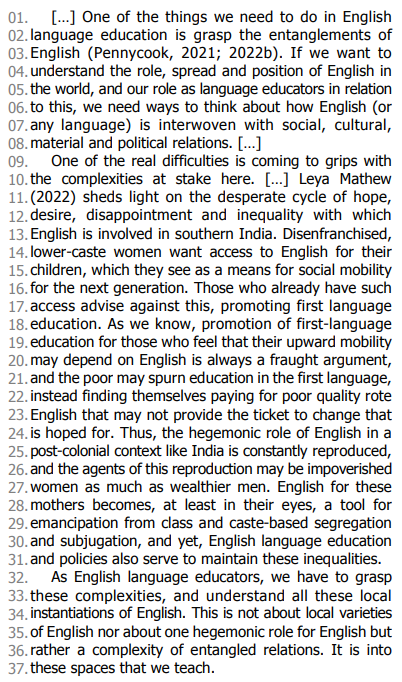
Instruction: Question refer to the
texts below.
(Adapted from: PENNYCOOK, A.; SILVESTRE, V. P. V.; PESSOA, R.
R. Reflections on Critical Applied Linguistics and Decoloniality:
a follow-up conversation with Alastair Pennycook. Calidoscópio, São
Leopoldo, v. 20, n. 2, p. 568–569, 2022. DOI:
10.4013/cld.2022.202.12.)
“These spaces” (l. 37) in “It is into these spaces that
we teach” (l. 36-37) refers to
Q4348455
Inglês
Texto associado
Instruction: Question refer to the
texts below.
(Adapted from: PENNYCOOK, A.; SILVESTRE, V. P. V.; PESSOA, R.
R. Reflections on Critical Applied Linguistics and Decoloniality:
a follow-up conversation with Alastair Pennycook. Calidoscópio, São
Leopoldo, v. 20, n. 2, p. 568–569, 2022. DOI:
10.4013/cld.2022.202.12.)
Pennycook’s description of the entanglements of English
is best explained by which of the following concepts?
Q4348454
Inglês
Texto associado
Instruction: Question refer to the
texts below.
(Adapted from: PENNYCOOK, A.; SILVESTRE, V. P. V.; PESSOA, R.
R. Reflections on Critical Applied Linguistics and Decoloniality:
a follow-up conversation with Alastair Pennycook. Calidoscópio, São
Leopoldo, v. 20, n. 2, p. 568–569, 2022. DOI:
10.4013/cld.2022.202.12.)
In the southern Indian context mentioned by Pennycook,
English is
Q4348453
Inglês
Texto associado
Instruction: Question refer to the
texts below.
(Adapted from: PENNYCOOK, A.; SILVESTRE, V. P. V.; PESSOA, R.
R. Reflections on Critical Applied Linguistics and Decoloniality:
a follow-up conversation with Alastair Pennycook. Calidoscópio, São
Leopoldo, v. 20, n. 2, p. 568–569, 2022. DOI:
10.4013/cld.2022.202.12.)
Pennycook’s main argument is that
Q4348452
Pedagogia
Match each English as an Additional Language (EAL)
methodology/approach with its corresponding
description.
( ) Communicative Language Teaching
( ) Audio-Lingual
( ) Grammar-Translation Method
( ) Critical Pedagogy in EAL
( ) The Direct Method
a. Bans the use of the student’s native language, and focuses on teaching vocabulary and concepts directly through visuals, context, and demonstration rather than translation.
b. Based on behavioral psychology (conditioning). It views language learning as habit formation. Correct verbal habits are reinforced, and mistakes are corrected immediately to prevent bad habits.
c. Examines how language intersects with power, identity, and social justice. It encourages learners to critically analyze socio-political issues and use English to challenge inequality.
d. Prioritizes meaningful interaction, real-world communication, and fluency over grammatical perfection. Classrooms rely heavily on role-playing and authentic materials.
e. Focuses heavily on the explicit study of grammatical rules, vocabulary memorization, and translating literary texts between the native language and English.
Which sequence is correct from top to bottom?
( ) Communicative Language Teaching
( ) Audio-Lingual
( ) Grammar-Translation Method
( ) Critical Pedagogy in EAL
( ) The Direct Method
a. Bans the use of the student’s native language, and focuses on teaching vocabulary and concepts directly through visuals, context, and demonstration rather than translation.
b. Based on behavioral psychology (conditioning). It views language learning as habit formation. Correct verbal habits are reinforced, and mistakes are corrected immediately to prevent bad habits.
c. Examines how language intersects with power, identity, and social justice. It encourages learners to critically analyze socio-political issues and use English to challenge inequality.
d. Prioritizes meaningful interaction, real-world communication, and fluency over grammatical perfection. Classrooms rely heavily on role-playing and authentic materials.
e. Focuses heavily on the explicit study of grammatical rules, vocabulary memorization, and translating literary texts between the native language and English.
Which sequence is correct from top to bottom?
Q4348451
Inglês
Read the following statements about Michael Byram’s
(1997) Intercultural Communicative Competence (ICC)
model.
I - Savoirs (knowledge) is primarily defined as deep declarative knowledge regarding the core cultural values and historical traditions specific to the target-language country, disregarding social groups and processes.
II - Savoir comprendre (skills of interpreting and relating) requires a learner to interpret a document or event from another culture, explain it, and relate it to documents or events from their own culture, without relying on real-time interaction with a target-culture interlocutor.
III - Savoir s’engager (critical cultural awareness) posits that language teachers should remain politically neutral and guide students to evaluate cultural practices using purely subjective, personal moral codes.
IV - The primary distinction between savoir comprendre and savoir apprendre/faire is that the former operates on existing knowledge and documents, whereas the latter involves acquiring new cultural knowledge and operating it in real-time constraints of social interaction.
V - According to Byram, a speaker who possesses high linguistic competence (fluency, native-like accent, advanced syntax) automatically fulfills the prerequisites for Intercultural Communicative Competence (ICC).
Which statements are correct?
I - Savoirs (knowledge) is primarily defined as deep declarative knowledge regarding the core cultural values and historical traditions specific to the target-language country, disregarding social groups and processes.
II - Savoir comprendre (skills of interpreting and relating) requires a learner to interpret a document or event from another culture, explain it, and relate it to documents or events from their own culture, without relying on real-time interaction with a target-culture interlocutor.
III - Savoir s’engager (critical cultural awareness) posits that language teachers should remain politically neutral and guide students to evaluate cultural practices using purely subjective, personal moral codes.
IV - The primary distinction between savoir comprendre and savoir apprendre/faire is that the former operates on existing knowledge and documents, whereas the latter involves acquiring new cultural knowledge and operating it in real-time constraints of social interaction.
V - According to Byram, a speaker who possesses high linguistic competence (fluency, native-like accent, advanced syntax) automatically fulfills the prerequisites for Intercultural Communicative Competence (ICC).
Which statements are correct?
Q4348450
Filosofia
Instruction: Question refer to the texts below.
“Identities can be held together by narratives, in short, without essences: you don’t get to be called ‘English’ because there’s an essence this label follows; you’re English because our rules determine that you are entitled to the label—that you are connected in the right way with a place called England. […] The story of the golden nugget suggests that we can’t help caring about the traditions of ‘the West’ because they are ours: in fact, the opposite is true. They are ours only if we care about them. A culture of liberty, tolerance, and rational inquiry: that would be a good idea. But these values represent choices to make, not tracks laid down by a Western destiny.”
(Adapted from: APPIAH, Kwame Anthony. The lies that bind: rethinking identity. New York: Liveright Publishing Corporation, 2018. p. 151-159)
Based on Kwame Anthony Appiah’s excerpts, which statement best reflects the author’s understanding of identity?
“Identities can be held together by narratives, in short, without essences: you don’t get to be called ‘English’ because there’s an essence this label follows; you’re English because our rules determine that you are entitled to the label—that you are connected in the right way with a place called England. […] The story of the golden nugget suggests that we can’t help caring about the traditions of ‘the West’ because they are ours: in fact, the opposite is true. They are ours only if we care about them. A culture of liberty, tolerance, and rational inquiry: that would be a good idea. But these values represent choices to make, not tracks laid down by a Western destiny.”
(Adapted from: APPIAH, Kwame Anthony. The lies that bind: rethinking identity. New York: Liveright Publishing Corporation, 2018. p. 151-159)
Based on Kwame Anthony Appiah’s excerpts, which statement best reflects the author’s understanding of identity?
Q4348449
Inglês
Texto associado
Question refer to the text below.
Instruction: Question refer to the texts below.
“Identities can be held together by narratives, in short, without essences: you don’t get to be called ‘English’ because there’s an essence this label follows; you’re English because our rules determine that you are entitled to the label—that you are connected in the right way with a place called England. […] The story of the golden nugget suggests that we can’t help caring about the traditions of ‘the West’ because they are ours: in fact, the opposite is true. They are ours only if we care about them. A culture of liberty, tolerance, and rational inquiry: that would be a good idea. But these values represent choices to make, not tracks laid down by a Western destiny.”
(Adapted from: APPIAH, Kwame Anthony. The lies that bind: rethinking identity. New York: Liveright Publishing Corporation, 2018. p. 151-159)
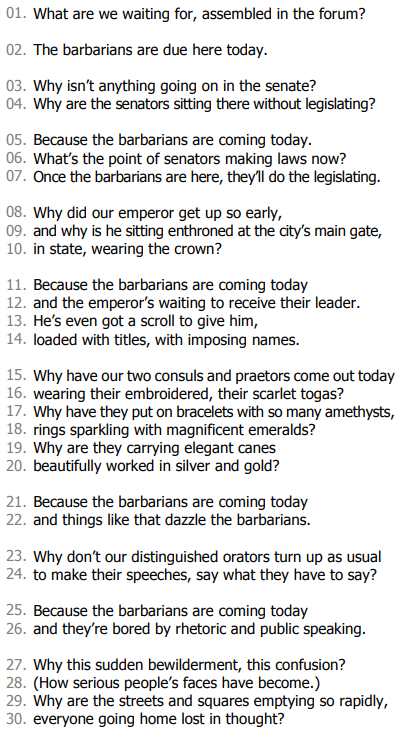
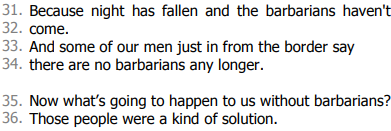
Which statement is NOT consistent with Appiah’s interpretation of Cavafy’s poem “Waiting for the Barbarians” mentioned above?
“Identities can be held together by narratives, in short, without essences: you don’t get to be called ‘English’ because there’s an essence this label follows; you’re English because our rules determine that you are entitled to the label—that you are connected in the right way with a place called England. […] The story of the golden nugget suggests that we can’t help caring about the traditions of ‘the West’ because they are ours: in fact, the opposite is true. They are ours only if we care about them. A culture of liberty, tolerance, and rational inquiry: that would be a good idea. But these values represent choices to make, not tracks laid down by a Western destiny.”
(Adapted from: APPIAH, Kwame Anthony. The lies that bind: rethinking identity. New York: Liveright Publishing Corporation, 2018. p. 151-159)
Which statement is NOT consistent with Appiah’s interpretation of Cavafy’s poem “Waiting for the Barbarians” mentioned above?
Q4348448
Inglês
Texto associado
Question refer to the text
below.
“Waiting for the Barbarians” by C.P. Cavafy
In English grammar, the words ending in “-ing” have
different uses. Match these functions to a corresponding
example in bold from the poem.
(1) Continuous verbs
(2) Gerunds acting as nouns
(3) Adjectives
( ) “Why are the senators sitting there without legislating?” (l. 4)
( ) “Once the barbarians are here, they’ll do the legislating” (l. 7)
( ) “Why have they put on bracelets with so many amethysts, rings sparkling with magnificent emeralds?” (l. 17-18)
( ) “Now what’s going to happen to us without barbarians?” (l. 35)
( ) “loaded with titles, with imposing names.” (l. 14)
( ) “and they’re bored by rhetoric and public speaking” (l. 26)
Select the alternative with the correct sequence from top to bottom.
(1) Continuous verbs
(2) Gerunds acting as nouns
(3) Adjectives
( ) “Why are the senators sitting there without legislating?” (l. 4)
( ) “Once the barbarians are here, they’ll do the legislating” (l. 7)
( ) “Why have they put on bracelets with so many amethysts, rings sparkling with magnificent emeralds?” (l. 17-18)
( ) “Now what’s going to happen to us without barbarians?” (l. 35)
( ) “loaded with titles, with imposing names.” (l. 14)
( ) “and they’re bored by rhetoric and public speaking” (l. 26)
Select the alternative with the correct sequence from top to bottom.
Q4348447
Inglês
Texto associado
Question refer to the text
below.
“Waiting for the Barbarians” by C.P. Cavafy
What CANNOT be implied from the poem?

 Conheça nossos planos