Foram encontradas 31.045 questões

Resolva questões gratuitamente!

Junte-se a mais de 4 milhões de concurseiros!

Q3946988 Inglês
        Digital technologies have transformed the way English is taught and learned, offering educators and students more dynamic and flexible ways to engage with language. According to recent research, tools such as computer-assisted instruction, mobile devices, and online multimedia platforms enable both teachers and learners to access a wide variety of resources — from interactive exercises, videos, and audio recordings to adaptive learning modules. 


        These tools facilitate exposure to real language input, allow for repetition and individual pacing, and help learners practise all four language skills (listening, speaking, reading, writing) beyond the constraints of the traditional classroom schedule. 


        Moreover, the integration of technology in English-language instruction tends to increase student motivation and engagement. Studies report that when classrooms incorporate digital media and interactive tasks, students often show greater participation, interest, and willingness to communicate — factors that contribute to better learning outcomes.


        In contexts where technology offers immediate feedback or allows for collaborative online work, learners also benefit from more autonomy and personalized learning paths, which can boost confidence and foster a more learner-centered environment. 


       However, effective technology integration depends on thoughtful planning, teacher training, and pedagogical balance. The literature warns that simply having access to digital tools does not guarantee improved learning; educators must design meaningful tasks, adapt materials appropriately, and support learners' needs. 


          Furthermore, in settings where access to devices or internet is limited, or where teachers lack sufficient training, the potential benefits may not be realized — which underlines the importance of institutional support and professional development for successful implementation. 


Source: Günüç, S. (2023). Technology Integration in English Language Teaching and Learning. International Journal of Language Learning and Applied Linguistics. Nishat Tasneem (2024). The Impact of Technology-Enhanced EFL Reading Classes on Learners' Performances and Participations. International Journal of English Learning and Applied Linguistics.

In the sentence “Studies report that when classrooms incorporate digital media and interactive tasks, students often show greater participation, interest, and willingness to communicate”, the word “incorporate” is closest in meaning to:
Alternativas
Q3946987 Inglês
        Digital technologies have transformed the way English is taught and learned, offering educators and students more dynamic and flexible ways to engage with language. According to recent research, tools such as computer-assisted instruction, mobile devices, and online multimedia platforms enable both teachers and learners to access a wide variety of resources — from interactive exercises, videos, and audio recordings to adaptive learning modules. 


        These tools facilitate exposure to real language input, allow for repetition and individual pacing, and help learners practise all four language skills (listening, speaking, reading, writing) beyond the constraints of the traditional classroom schedule. 


        Moreover, the integration of technology in English-language instruction tends to increase student motivation and engagement. Studies report that when classrooms incorporate digital media and interactive tasks, students often show greater participation, interest, and willingness to communicate — factors that contribute to better learning outcomes.


        In contexts where technology offers immediate feedback or allows for collaborative online work, learners also benefit from more autonomy and personalized learning paths, which can boost confidence and foster a more learner-centered environment. 


       However, effective technology integration depends on thoughtful planning, teacher training, and pedagogical balance. The literature warns that simply having access to digital tools does not guarantee improved learning; educators must design meaningful tasks, adapt materials appropriately, and support learners' needs. 


          Furthermore, in settings where access to devices or internet is limited, or where teachers lack sufficient training, the potential benefits may not be realized — which underlines the importance of institutional support and professional development for successful implementation. 


Source: Günüç, S. (2023). Technology Integration in English Language Teaching and Learning. International Journal of Language Learning and Applied Linguistics. Nishat Tasneem (2024). The Impact of Technology-Enhanced EFL Reading Classes on Learners' Performances and Participations. International Journal of English Learning and Applied Linguistics.

Based on the information in the text, what can be inferred about the role of technology in English-language teaching?


Alternativas
Q3946986 Inglês
        Digital technologies have transformed the way English is taught and learned, offering educators and students more dynamic and flexible ways to engage with language. According to recent research, tools such as computer-assisted instruction, mobile devices, and online multimedia platforms enable both teachers and learners to access a wide variety of resources — from interactive exercises, videos, and audio recordings to adaptive learning modules. 


        These tools facilitate exposure to real language input, allow for repetition and individual pacing, and help learners practise all four language skills (listening, speaking, reading, writing) beyond the constraints of the traditional classroom schedule. 


        Moreover, the integration of technology in English-language instruction tends to increase student motivation and engagement. Studies report that when classrooms incorporate digital media and interactive tasks, students often show greater participation, interest, and willingness to communicate — factors that contribute to better learning outcomes.


        In contexts where technology offers immediate feedback or allows for collaborative online work, learners also benefit from more autonomy and personalized learning paths, which can boost confidence and foster a more learner-centered environment. 


       However, effective technology integration depends on thoughtful planning, teacher training, and pedagogical balance. The literature warns that simply having access to digital tools does not guarantee improved learning; educators must design meaningful tasks, adapt materials appropriately, and support learners' needs. 


          Furthermore, in settings where access to devices or internet is limited, or where teachers lack sufficient training, the potential benefits may not be realized — which underlines the importance of institutional support and professional development for successful implementation. 


Source: Günüç, S. (2023). Technology Integration in English Language Teaching and Learning. International Journal of Language Learning and Applied Linguistics. Nishat Tasneem (2024). The Impact of Technology-Enhanced EFL Reading Classes on Learners' Performances and Participations. International Journal of English Learning and Applied Linguistics.

According to the text, what is one key benefit of integrating digital technologies into English-language teaching?


Alternativas
Q3946985 Inglês

            Perisylvian polymicrogyria (PMG) is a malformation of cortical development in which the cortex around the Sylvian fissures shows excessive small gyri and abnormal cortical lamination. This regional form of PMG is among the commonest patterns seen on MRI and may vary from focal posterior perisylvian involvement to extensive bilateral disease that (Magnetic Resonance Imaging) extends beyond the perisylvian region. Imaging typically demonstrates a thickened, irregular cortical ribbon with shallow sulci and an irregular gray–white matter junction, which is best characterized using high-resolution MRI.


            Clinically, perisylvian PMG—especially when bilateral—is frequently associated with oromotor dysfunction (dysarthria, feeding and swallowing difficulties), language impairments, cognitive delay, and epilepsy; severity correlates with the extent and symmetry of cortical involvement. The condition is genetically and etiologically heterogeneous: cases may be sporadic, associated with prenatal injury (for example infectious or vascular insults), or linked to chromosomal and single-gene variants in some familial forms. Management focuses on symptomatic therapies (speech/feeding therapy, epilepsy control) and genetic/neurological evaluation when appropriate.


Source: Barkovich, A. J., Guerrini, R., Kuzniecky, R. I., Jackson, G. D., & Dobyns, W. B. (2010). Current concepts of polymicrogyria. Neuroradiology. Leventer, R. J., Jansen, A., Pilz, D. T., et al. (2010). Clinical and imaging heterogeneity of polymicrogyria. Brain.
In the sentence “Clinically, perisylvian PMG—especially when bilateral—is frequently associated with oromotor dysfunction, language impairments, cognitive delay, and epilepsy; severity correlates with the extent and symmetry of cortical involvement.”, which connective would best replace the semicolon to preserve the logical relationship between the two clauses?
Alternativas
Q3946984 Inglês

            Perisylvian polymicrogyria (PMG) is a malformation of cortical development in which the cortex around the Sylvian fissures shows excessive small gyri and abnormal cortical lamination. This regional form of PMG is among the commonest patterns seen on MRI and may vary from focal posterior perisylvian involvement to extensive bilateral disease that (Magnetic Resonance Imaging) extends beyond the perisylvian region. Imaging typically demonstrates a thickened, irregular cortical ribbon with shallow sulci and an irregular gray–white matter junction, which is best characterized using high-resolution MRI.


            Clinically, perisylvian PMG—especially when bilateral—is frequently associated with oromotor dysfunction (dysarthria, feeding and swallowing difficulties), language impairments, cognitive delay, and epilepsy; severity correlates with the extent and symmetry of cortical involvement. The condition is genetically and etiologically heterogeneous: cases may be sporadic, associated with prenatal injury (for example infectious or vascular insults), or linked to chromosomal and single-gene variants in some familial forms. Management focuses on symptomatic therapies (speech/feeding therapy, epilepsy control) and genetic/neurological evaluation when appropriate.


Source: Barkovich, A. J., Guerrini, R., Kuzniecky, R. I., Jackson, G. D., & Dobyns, W. B. (2010). Current concepts of polymicrogyria. Neuroradiology. Leventer, R. J., Jansen, A., Pilz, D. T., et al. (2010). Clinical and imaging heterogeneity of polymicrogyria. Brain.

In the sentence “The condition is genetically and etiologically heterogeneous: cases may be sporadic, associated with prenatal injury, or linked to chromosomal and single-gene variants in some familial forms.”, what does the word “cases” refer to?
Alternativas
Q3946983 Inglês

            Perisylvian polymicrogyria (PMG) is a malformation of cortical development in which the cortex around the Sylvian fissures shows excessive small gyri and abnormal cortical lamination. This regional form of PMG is among the commonest patterns seen on MRI and may vary from focal posterior perisylvian involvement to extensive bilateral disease that (Magnetic Resonance Imaging) extends beyond the perisylvian region. Imaging typically demonstrates a thickened, irregular cortical ribbon with shallow sulci and an irregular gray–white matter junction, which is best characterized using high-resolution MRI.


            Clinically, perisylvian PMG—especially when bilateral—is frequently associated with oromotor dysfunction (dysarthria, feeding and swallowing difficulties), language impairments, cognitive delay, and epilepsy; severity correlates with the extent and symmetry of cortical involvement. The condition is genetically and etiologically heterogeneous: cases may be sporadic, associated with prenatal injury (for example infectious or vascular insults), or linked to chromosomal and single-gene variants in some familial forms. Management focuses on symptomatic therapies (speech/feeding therapy, epilepsy control) and genetic/neurological evaluation when appropriate.


Source: Barkovich, A. J., Guerrini, R., Kuzniecky, R. I., Jackson, G. D., & Dobyns, W. B. (2010). Current concepts of polymicrogyria. Neuroradiology. Leventer, R. J., Jansen, A., Pilz, D. T., et al. (2010). Clinical and imaging heterogeneity of polymicrogyria. Brain.

According to the text, which statement best describes perisylvian polymicrogyria?
Alternativas
Q3944476 Inglês
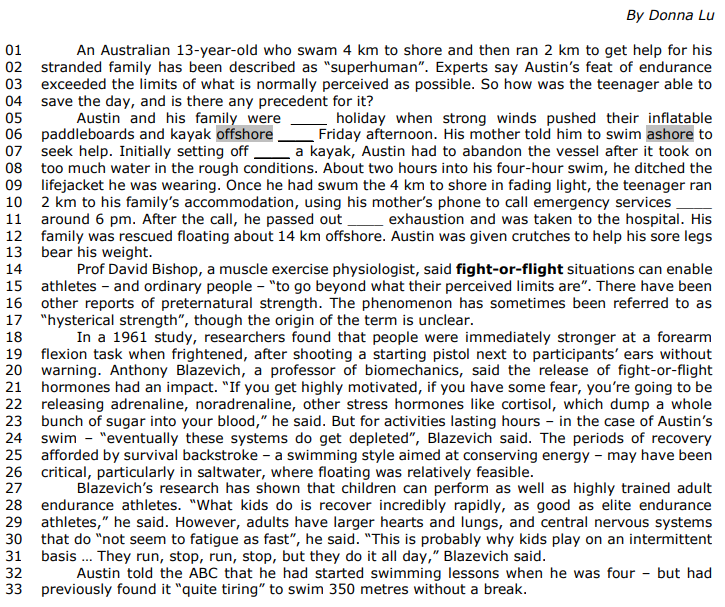
An ‘amazing feat’: how was a 13-year-old boy able to swim for four hours to save his family?


(Fight-or-flight: used to describe the reaction that people have to a dangerous situation, that makes them either stay and deal with it, or run away) (Available at: https://www.theguardian.com/australia-news/2026/feb/05/austin-appelbee-13-year-old-boyswims-four-hours-rescue-save-family-western-australia – text specially adapted for this test).
In the context of the text, the word “endurance” (l. 28) most nearly means:
Alternativas
Q3944475 Inglês
An ‘amazing feat’: how was a 13-year-old boy able to swim for four hours to save his family?


(Fight-or-flight: used to describe the reaction that people have to a dangerous situation, that makes them either stay and deal with it, or run away) (Available at: https://www.theguardian.com/australia-news/2026/feb/05/austin-appelbee-13-year-old-boyswims-four-hours-rescue-save-family-western-australia – text specially adapted for this test).
Analyze the statements below about the text and mark T, if true, or F, if false.

( ) In the sentence “An Australian 13-year-old who swam 4 km to shore” (l. 01), the relative pronoun “who” could be replaced by “that” without changing the meaning.
( ) The sentence “In a 1961 study, researchers found that people were immediately stronger” (l. 18) could be rewritten using the present perfect tense without any change in meaning.
( ) In the sentence “Once he had swum the 4 km to shore in fading light” (l. 09), the verb tense used expresses an action completed before another action in the past.
( ) In the sentence “His family was rescued floating about 14 km offshore” (l. 11-12), the verb form indicates an action performed by the subject “his family”.

The correct order of filling in the parentheses, from top to bottom, is:
Alternativas
Q3944474 Inglês
An ‘amazing feat’: how was a 13-year-old boy able to swim for four hours to save his family?


(Fight-or-flight: used to describe the reaction that people have to a dangerous situation, that makes them either stay and deal with it, or run away) (Available at: https://www.theguardian.com/australia-news/2026/feb/05/austin-appelbee-13-year-old-boyswims-four-hours-rescue-save-family-western-australia – text specially adapted for this test).
Mark the alternative that presents the rewriting of the sentence below without changing its meaning.

“However, adults have larger hearts and lungs, and central nervous systems that do ‘not seem to fatigue as fast’, he said.” (l. 29-30).
Alternativas
Q3944473 Inglês
An ‘amazing feat’: how was a 13-year-old boy able to swim for four hours to save his family?


(Fight-or-flight: used to describe the reaction that people have to a dangerous situation, that makes them either stay and deal with it, or run away) (Available at: https://www.theguardian.com/australia-news/2026/feb/05/austin-appelbee-13-year-old-boyswims-four-hours-rescue-save-family-western-australia – text specially adapted for this test).
In the context of the text, the highlighted words “offshore” and “ashore” (l. 06) mean, respectively: 
Alternativas
Q3944472 Inglês
An ‘amazing feat’: how was a 13-year-old boy able to swim for four hours to save his family?


(Fight-or-flight: used to describe the reaction that people have to a dangerous situation, that makes them either stay and deal with it, or run away) (Available at: https://www.theguardian.com/australia-news/2026/feb/05/austin-appelbee-13-year-old-boyswims-four-hours-rescue-save-family-western-australia – text specially adapted for this test).
Mark the alternative that fills in, correctly and respectively, the blanks in the second paragraph.
Alternativas
Q3944471 Inglês
An ‘amazing feat’: how was a 13-year-old boy able to swim for four hours to save his family?


(Fight-or-flight: used to describe the reaction that people have to a dangerous situation, that makes them either stay and deal with it, or run away) (Available at: https://www.theguardian.com/australia-news/2026/feb/05/austin-appelbee-13-year-old-boyswims-four-hours-rescue-save-family-western-australia – text specially adapted for this test).
In the sentence “But for activities lasting hours – in the case of Austin’s swim – ‘eventually these systems do get depleted’” (l. 23-24), the expression “these systems” refers to:
Alternativas
Q3944470 Inglês
An ‘amazing feat’: how was a 13-year-old boy able to swim for four hours to save his family?


(Fight-or-flight: used to describe the reaction that people have to a dangerous situation, that makes them either stay and deal with it, or run away) (Available at: https://www.theguardian.com/australia-news/2026/feb/05/austin-appelbee-13-year-old-boyswims-four-hours-rescue-save-family-western-australia – text specially adapted for this test).
Which information is NOT mentioned in the text?
Alternativas
Q3944469 Inglês
An ‘amazing feat’: how was a 13-year-old boy able to swim for four hours to save his family?


(Fight-or-flight: used to describe the reaction that people have to a dangerous situation, that makes them either stay and deal with it, or run away) (Available at: https://www.theguardian.com/australia-news/2026/feb/05/austin-appelbee-13-year-old-boyswims-four-hours-rescue-save-family-western-australia – text specially adapted for this test).
The main purpose of the text is to:
Alternativas
Q3944468 Inglês
An ‘amazing feat’: how was a 13-year-old boy able to swim for four hours to save his family?


(Fight-or-flight: used to describe the reaction that people have to a dangerous situation, that makes them either stay and deal with it, or run away) (Available at: https://www.theguardian.com/australia-news/2026/feb/05/austin-appelbee-13-year-old-boyswims-four-hours-rescue-save-family-western-australia – text specially adapted for this test).
Which statement is true according to the text?
Alternativas
Q3944467 Inglês
An ‘amazing feat’: how was a 13-year-old boy able to swim for four hours to save his family?


(Fight-or-flight: used to describe the reaction that people have to a dangerous situation, that makes them either stay and deal with it, or run away) (Available at: https://www.theguardian.com/australia-news/2026/feb/05/austin-appelbee-13-year-old-boyswims-four-hours-rescue-save-family-western-australia – text specially adapted for this test).
According to the text, what mainly explains how the teenager managed to save his family? 
Alternativas
Q3944466 Pedagogia
Estimulada por diferentes regulamentações que norteiam a educação brasileira e por estudos sobre o tema, a escola tem como um de seus desafios a prática inclusiva voltada à acessibilidade curricular. Nessa perspectiva, assinale a alternativa que apresenta a ação que melhor contempla esse objetivo.
Alternativas
Q3944465 Pedagogia
De forma geral, as diretrizes educacionais brasileiras orientam o estímulo ao pensamento crítico, científico e criativo. Assim, a proposta defendida por Pedro Demo (2015) em “Educar pela Pesquisa” cresce em importância no cenário educacional. Nesse contexto, sobre o educar pela pesquisa, é INCORRETO afirmar que: 
Alternativas
Q3944464 Pedagogia
A partir das contribuições de Erich Jantsch (1972) e Hilton Japiassu (1976), além de outros autores que desenvolveram ideias sobre planejamento de projetos educativos, o nível de interação entre as disciplinas define o modelo de organização curricular. Nesse contexto, relacione a Coluna 1 à Coluna 2, associando os conceitos às suas respectivas características.

Coluna 1
1. Pluridisciplinaridade.
2. Transdisciplinaridade.
3. Interdisciplinaridade.
4. Multidisciplinaridade.

Coluna 2
( ) Promove cooperação e diálogo entre duas ou mais disciplinas, gerando reciprocidade e enriquecimento mútuo, sem abolir as fronteiras disciplinares.
( ) Há uma justaposição de disciplinas que parecem ter uma relação e um tema em comum, mas não há alteração no método de cada matéria. Há uma complementaridade, mas sem interação.
( ) O conhecimento vai além das disciplinas. As fronteiras desaparecem e o saber é visto de forma global e sistêmica.
( ) Várias disciplinas abordam o tema ao mesmo tempo, mas de forma isolada. Não há cooperação ou planejamento em conjunto.
( ) Busca a unidade do conhecimento. Foca a complexidade do mundo real, no qual o conhecimento é um todo indivisível. Os grandes dilemas éticos globais, por exemplo, não pertencem a nenhuma ciência específica.

A ordem correta de preenchimento dos parênteses, de cima para baixo, é: 

Alternativas
Q3944463 Pedagogia
Assinale a alternativa que contempla uma prática docente condizente com os objetivos de promoção da cidadania digital, o respeito, a ética e o pensamento crítico diante da tecnologia. 
Alternativas
Respostas
2461: A
2462: E
2463: B
2464: D
2465: C
2466: C
2467: B
2468: A
2469: A
2470: B
2471: D
2472: C
2473: E
2474: C
2475: E
2476: C
2477: A
2478: E
2479: E
2480: C