Foram encontradas 24.416 questões
Resolva questões gratuitamente!
Junte-se a mais de 4 milhões de concurseiros!


A avaliação deve ser vista como um processo contínuo e integral ao processo de ensinoaprendizagem.
II. A avaliação somativa tem como principal objetivo classificar os alunos em aprovados e reprovados.
III. A avaliação diagnóstica deve ser realizada apenas no início do ano letivo.
IV. A avaliação formativa deve ser utilizada para punir os alunos que não alcançarem os objetivos propostos.
I. O ECA garante o direito à liberdade, ao respeito e à dignidade como pessoas humanas em processo de desenvolvimento, mas restringe esses direitos em casos de atos infracionais.
II. A criança e o adolescente têm direito à educação, sendo o ensino fundamental obrigatório e gratuito, inclusive para aqueles que não tiveram acesso na idade própria.
III. É dever do Estado assegurar à criança e ao adolescente, sem discriminação, o acesso à cultura, ao esporte e ao lazer, porém, a participação em atividades artísticas e culturais é facultativa.
IV.O ECA proíbe qualquer forma de castigo físico ou tratamento cruel ou degradante, inclusive por parte dos pais ou responsáveis, mas permite o uso moderado de castigos como forma de correção.
V. A criança e o adolescente têm direito à profissionalização e à aprendizagem de um ofício, sendo permitida a sua admissão em qualquer tipo de trabalho, desde que não haja prejuízo à sua formação.
. A inteligência, segundo Piaget, é o mecanismo pelo qual o indivíduo se adapta ao ambiente, por meio de processos de assimilação e acomodação.
II. O desenvolvimento cognitivo é linear e ocorre de forma contínua, sem a necessidade de saltos qualitativos entre os estágios.
III. No período operatório concreto, a criança desenvolve habilidades de abstração e resolve problemas hipotéticos. IV. A teoria de Piaget defende que o conhecimento se constrói a partir da interação entre o indivíduo e o ambiente.
Assinale a sequência correta.
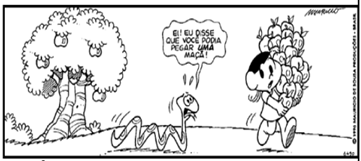
Em relação ao período apresentado no balão acima, isenta-se a afirmativa:
Identify the subordinate clause in the following sentence from the text and choose the correct conjunction that introduces it:
"As St Pierre notes, however, the physical impact is only one aspect of the condition."
How to be a good flirt, according to science
By William Park, BBC
Some people seem to be naturally gifted flirters, while many say it's a skill that holds them back. What sets the good and bad flirters apart and can you learn to be better at it?
In a crowded bar on a busy Friday night, one customer sits alone, waiting for their friend. The bartender, noticing the lonely patron, starts making small talk, asking about their day and making them feel welcome. Soon, the pair are hitting it off, the minutes fly by and the friend's tardy timekeeping is forgotten.
The bartender is charming, and the flirtatious conversation from this chance encounter puts the customer at ease. The customer is enjoying the attention – and why not?
"When someone flirts with you, you feel valued, and your perception of your desirability increases," says Gurit Birnbaum, a professor of psychology at Reichman University in Israel. In other words, being flirted with feels good. But can it also be good for you?
In the bar scenario, our bartender is unaware that the customer is in a relationship already. (Birnbaum points out that even if someone is in a relationship, flirting with others is to be expected. "With time, people tend to fantasise about other people. That's normal – it means nothing bad about the relationship.")
Yet there is something stranger about this blossoming interaction at a bar. While it might be the sort of interaction that could be taking place right now somewhere in the world, on this occasion, the bartender is computer generated and the whole interaction is taking place in virtual reality. It is occurring in a world dreamed up by Birnbaum.
Reflecting on the idea that people start to fantasise about others when in long term relationships, Birnbaum wondered whether fantasies could be used to help us regulate our more destructive desires. Would flirting with a virtual bartender make someone in a committed relationship more or less likely to flirt with someone in real life, she wondered?
"I thought that this secure space [virtual reality] may help people control their desires, and help them maintain their current relationships," she says. "I can think about whatever I want, and then I'm done with it. And I don't have to act on those fantasies."
The virtual bartender looks a little uncanny – their movements are stiff and face a bit spooky. ("Virtual reality is much more immersive than what you can see in the video – so don't be disappointed," warns Birnbaum when sending me a screen recording.) They certainly couldn't be mistaken for a real person. But the speech is realistic, and in a five-minute interaction the conversation flows quite authentically.
After removing their headsets, people taking part in Birnbaum's experiment were then presented either with a conventionally attractive interviewer or an attractive stranger, who was actually a researcher posing as someone in need of help. The subjects who had flirted with the virtual bartender said they found the interviewer less attractive and spent less time helping the stranger than those who had a non-flirtatious conversation. It's as though, says Birnbaum, flirting at the virtual bar had inoculated them against a real-life temptation. Subjects also said they desired their real partner more after the flirtatious interaction at the bar.
Flirting with strangers while in a relationship could strengthen the bond between partners, suggests Birnbaum, but warns that this could be a slippery slope. Having a strong understanding of your own and your partner's flirting boundaries is essential, she says. The factors that might tip someone from harmless flirting into cheating can be subtle. "When people are exposed to norms of infidelity, for example if you know that your peers cheat on their partners, you are more likely to do so yourself," she says. This is called "contagious infidelity".
Birnbaum adds that there is a "constellation of personality traits" that make some people more resilient or more prone to infidelity. For example, more narcissistic people or people with attachment insecurities, are more likely to cheat than others. "We have to take into account so many factors in order to predict which seductive experiences would lead to infidelity," says Birnbaum.
While careful flirting might be good, many people consider themselves bad at it. In a poll of almost 7,000 male Reddit users, having poor flirting skills was the fifth most common reason (out of 43) men gave for being single.
Fortunately for those people, it might be possible to learn to be a better flirt. After three hours of flirt training, which involved learning techniques to appear more confident when speaking, a group of adult participants scored higher in flirting ability as well as in extraversion.
Other flirting skills can be learnt, too. Expansive body posture – such as taking a wider stance, facing your interlocutor directly, and raising your head – increases romantic desirability for both men and women, perhaps because we associate taking up space with dominance and being expansive with openness. The effect is true in both a real-life speed dating scenario and online dating profiles. Considering that a brief encounter or a swipe of a photograph can make or break someone's chance of flirting successfully, maximising space might increase the chances of romantic success.
Space maximisation is not something we are necessarily always conscious of doing, says T Joel Wade, a professor of psychology at Bucknell University in the US. "It's not like, oh, there's someone beautiful, let me spread out. It's just a natural behaviour." This nonverbal display of dominance can take the form of spreading out one's body or spreading one's possessions around to show comfort and belonging in a space, he explains.
In a poll of almost 7,000 male Reddit users, having poor flirting skills was the fifth most common reason (out of 43) men gave for being single.
While flirting can generally be an overt act, it can also be covert – actions that you might not necessarily think are flirting at all, explains Maryanne Fisher, a professor of psychology at St Mary's University in Canada. People mostly flirt with nonverbal signals, such as stroking their hair. Such behaviour is called "self-grooming", she says. "It's the idea of making myself more appealing for you."
Differences in flirting techniques are true irrespective of sexual orientation. For example, men, people who described their identity as "masculine", and people who adhere to "masculine" gender roles are more likely to flirt overtly through the things they say and do regardless of who they are attracted to. Whereas, women, "feminine" identifying people and people who describe their gender role ideology as "feminine" are more likely to flirt covertly and nonverbally.
If sexual orientation does not predict flirting styles, existing research, which has largely focused on normative sex roles and gender, may be "adequate to capture experiences of flirtatious behaviour among sexual minority individuals", write Jenn Clark, from the University of British Columbia in Canada, Flora Oswald from Pennsylvania State University in the US and Cory L Pedersen from Kwantlen Polytechnic University in Canada.
Other covert examples of flirting are "tie signs", which can be anything from initiating eye contact, hugging, giggling at jokes, to something that's more germ-related, like sharing food – which we don't typically do with a stranger.
In a non-flirting context, taking a partner's last name in marriage or wearing a wedding ring would be symbols of being tied to someone else. "Tie signs are often performed in a partner's absence to signal that you're taken," says Fisher. They can also be used to signal that someone else is not available. "If you want to signal that your partner is taken, the easiest way to do that is to perform an action. It is easier to put an arm around them than to tell someone else to back off," says Fisher.
But if flirtatious tie-signs are rebuffed, or if they're not very warmly received, these are signals that will tell potential mate poachers about the level of commitment in their romantic interest's existing relationship, and whether they have a chance. And of course, not demonstrating exclusive interest is among the most off-putting flirting behaviours, perhaps because we like to have the undivided attention of our dates.
Subtle examples of flirting can be useful, adds Wade, because the flirter can also quickly shut down an interaction if they need to while having plausible deniability that there ever was romantic interest in the first place.
Generally, men overestimate romantic interest, perhaps mis-perceiving friendliness for attraction, and women underestimate it, which might be where the idea of the "friend zone" comes from. "The so-called false positive rate is so much different for heterosexual men than for heterosexual women," says Fisher. "Smiling, at least in Canadian culture, is a default, right? It's a way to deescalate situations, increase your perception of friendliness. But straight men see women smiling and they think, 'Oh, she's interested in me'."
Some businesses have taken advantage of the over-perception of flirting, says Fisher, by using women in frontof-house roles such as greeters at restaurants. "There have been court cases in the United States where women are saying they're being hit on because they're being told to smile and engage in this forced interaction that is being perceived in a sexual way," she says. And it is disproportionately women who are affected.
So, it's worth asking: Was the virtual bartender really interested in the solo customer, or were they just being a good bartender?
(Adapted from https://www.bbc.com/news)
How to be a good flirt, according to science
By William Park, BBC
Some people seem to be naturally gifted flirters, while many say it's a skill that holds them back. What sets the good and bad flirters apart and can you learn to be better at it?
In a crowded bar on a busy Friday night, one customer sits alone, waiting for their friend. The bartender, noticing the lonely patron, starts making small talk, asking about their day and making them feel welcome. Soon, the pair are hitting it off, the minutes fly by and the friend's tardy timekeeping is forgotten.
The bartender is charming, and the flirtatious conversation from this chance encounter puts the customer at ease. The customer is enjoying the attention – and why not?
"When someone flirts with you, you feel valued, and your perception of your desirability increases," says Gurit Birnbaum, a professor of psychology at Reichman University in Israel. In other words, being flirted with feels good. But can it also be good for you?
In the bar scenario, our bartender is unaware that the customer is in a relationship already. (Birnbaum points out that even if someone is in a relationship, flirting with others is to be expected. "With time, people tend to fantasise about other people. That's normal – it means nothing bad about the relationship.")
Yet there is something stranger about this blossoming interaction at a bar. While it might be the sort of interaction that could be taking place right now somewhere in the world, on this occasion, the bartender is computer generated and the whole interaction is taking place in virtual reality. It is occurring in a world dreamed up by Birnbaum.
Reflecting on the idea that people start to fantasise about others when in long term relationships, Birnbaum wondered whether fantasies could be used to help us regulate our more destructive desires. Would flirting with a virtual bartender make someone in a committed relationship more or less likely to flirt with someone in real life, she wondered?
"I thought that this secure space [virtual reality] may help people control their desires, and help them maintain their current relationships," she says. "I can think about whatever I want, and then I'm done with it. And I don't have to act on those fantasies."
The virtual bartender looks a little uncanny – their movements are stiff and face a bit spooky. ("Virtual reality is much more immersive than what you can see in the video – so don't be disappointed," warns Birnbaum when sending me a screen recording.) They certainly couldn't be mistaken for a real person. But the speech is realistic, and in a five-minute interaction the conversation flows quite authentically.
After removing their headsets, people taking part in Birnbaum's experiment were then presented either with a conventionally attractive interviewer or an attractive stranger, who was actually a researcher posing as someone in need of help. The subjects who had flirted with the virtual bartender said they found the interviewer less attractive and spent less time helping the stranger than those who had a non-flirtatious conversation. It's as though, says Birnbaum, flirting at the virtual bar had inoculated them against a real-life temptation. Subjects also said they desired their real partner more after the flirtatious interaction at the bar.
Flirting with strangers while in a relationship could strengthen the bond between partners, suggests Birnbaum, but warns that this could be a slippery slope. Having a strong understanding of your own and your partner's flirting boundaries is essential, she says. The factors that might tip someone from harmless flirting into cheating can be subtle. "When people are exposed to norms of infidelity, for example if you know that your peers cheat on their partners, you are more likely to do so yourself," she says. This is called "contagious infidelity".
Birnbaum adds that there is a "constellation of personality traits" that make some people more resilient or more prone to infidelity. For example, more narcissistic people or people with attachment insecurities, are more likely to cheat than others. "We have to take into account so many factors in order to predict which seductive experiences would lead to infidelity," says Birnbaum.
While careful flirting might be good, many people consider themselves bad at it. In a poll of almost 7,000 male Reddit users, having poor flirting skills was the fifth most common reason (out of 43) men gave for being single.
Fortunately for those people, it might be possible to learn to be a better flirt. After three hours of flirt training, which involved learning techniques to appear more confident when speaking, a group of adult participants scored higher in flirting ability as well as in extraversion.
Other flirting skills can be learnt, too. Expansive body posture – such as taking a wider stance, facing your interlocutor directly, and raising your head – increases romantic desirability for both men and women, perhaps because we associate taking up space with dominance and being expansive with openness. The effect is true in both a real-life speed dating scenario and online dating profiles. Considering that a brief encounter or a swipe of a photograph can make or break someone's chance of flirting successfully, maximising space might increase the chances of romantic success.
Space maximisation is not something we are necessarily always conscious of doing, says T Joel Wade, a professor of psychology at Bucknell University in the US. "It's not like, oh, there's someone beautiful, let me spread out. It's just a natural behaviour." This nonverbal display of dominance can take the form of spreading out one's body or spreading one's possessions around to show comfort and belonging in a space, he explains.
In a poll of almost 7,000 male Reddit users, having poor flirting skills was the fifth most common reason (out of 43) men gave for being single.
While flirting can generally be an overt act, it can also be covert – actions that you might not necessarily think are flirting at all, explains Maryanne Fisher, a professor of psychology at St Mary's University in Canada. People mostly flirt with nonverbal signals, such as stroking their hair. Such behaviour is called "self-grooming", she says. "It's the idea of making myself more appealing for you."
Differences in flirting techniques are true irrespective of sexual orientation. For example, men, people who described their identity as "masculine", and people who adhere to "masculine" gender roles are more likely to flirt overtly through the things they say and do regardless of who they are attracted to. Whereas, women, "feminine" identifying people and people who describe their gender role ideology as "feminine" are more likely to flirt covertly and nonverbally.
If sexual orientation does not predict flirting styles, existing research, which has largely focused on normative sex roles and gender, may be "adequate to capture experiences of flirtatious behaviour among sexual minority individuals", write Jenn Clark, from the University of British Columbia in Canada, Flora Oswald from Pennsylvania State University in the US and Cory L Pedersen from Kwantlen Polytechnic University in Canada.
Other covert examples of flirting are "tie signs", which can be anything from initiating eye contact, hugging, giggling at jokes, to something that's more germ-related, like sharing food – which we don't typically do with a stranger.
In a non-flirting context, taking a partner's last name in marriage or wearing a wedding ring would be symbols of being tied to someone else. "Tie signs are often performed in a partner's absence to signal that you're taken," says Fisher. They can also be used to signal that someone else is not available. "If you want to signal that your partner is taken, the easiest way to do that is to perform an action. It is easier to put an arm around them than to tell someone else to back off," says Fisher.
But if flirtatious tie-signs are rebuffed, or if they're not very warmly received, these are signals that will tell potential mate poachers about the level of commitment in their romantic interest's existing relationship, and whether they have a chance. And of course, not demonstrating exclusive interest is among the most off-putting flirting behaviours, perhaps because we like to have the undivided attention of our dates.
Subtle examples of flirting can be useful, adds Wade, because the flirter can also quickly shut down an interaction if they need to while having plausible deniability that there ever was romantic interest in the first place.
Generally, men overestimate romantic interest, perhaps mis-perceiving friendliness for attraction, and women underestimate it, which might be where the idea of the "friend zone" comes from. "The so-called false positive rate is so much different for heterosexual men than for heterosexual women," says Fisher. "Smiling, at least in Canadian culture, is a default, right? It's a way to deescalate situations, increase your perception of friendliness. But straight men see women smiling and they think, 'Oh, she's interested in me'."
Some businesses have taken advantage of the over-perception of flirting, says Fisher, by using women in frontof-house roles such as greeters at restaurants. "There have been court cases in the United States where women are saying they're being hit on because they're being told to smile and engage in this forced interaction that is being perceived in a sexual way," she says. And it is disproportionately women who are affected.
So, it's worth asking: Was the virtual bartender really interested in the solo customer, or were they just being a good bartender?
(Adapted from https://www.bbc.com/news)
How to be a good flirt, according to science
By William Park, BBC
Some people seem to be naturally gifted flirters, while many say it's a skill that holds them back. What sets the good and bad flirters apart and can you learn to be better at it?
In a crowded bar on a busy Friday night, one customer sits alone, waiting for their friend. The bartender, noticing the lonely patron, starts making small talk, asking about their day and making them feel welcome. Soon, the pair are hitting it off, the minutes fly by and the friend's tardy timekeeping is forgotten.
The bartender is charming, and the flirtatious conversation from this chance encounter puts the customer at ease. The customer is enjoying the attention – and why not?
"When someone flirts with you, you feel valued, and your perception of your desirability increases," says Gurit Birnbaum, a professor of psychology at Reichman University in Israel. In other words, being flirted with feels good. But can it also be good for you?
In the bar scenario, our bartender is unaware that the customer is in a relationship already. (Birnbaum points out that even if someone is in a relationship, flirting with others is to be expected. "With time, people tend to fantasise about other people. That's normal – it means nothing bad about the relationship.")
Yet there is something stranger about this blossoming interaction at a bar. While it might be the sort of interaction that could be taking place right now somewhere in the world, on this occasion, the bartender is computer generated and the whole interaction is taking place in virtual reality. It is occurring in a world dreamed up by Birnbaum.
Reflecting on the idea that people start to fantasise about others when in long term relationships, Birnbaum wondered whether fantasies could be used to help us regulate our more destructive desires. Would flirting with a virtual bartender make someone in a committed relationship more or less likely to flirt with someone in real life, she wondered?
"I thought that this secure space [virtual reality] may help people control their desires, and help them maintain their current relationships," she says. "I can think about whatever I want, and then I'm done with it. And I don't have to act on those fantasies."
The virtual bartender looks a little uncanny – their movements are stiff and face a bit spooky. ("Virtual reality is much more immersive than what you can see in the video – so don't be disappointed," warns Birnbaum when sending me a screen recording.) They certainly couldn't be mistaken for a real person. But the speech is realistic, and in a five-minute interaction the conversation flows quite authentically.
After removing their headsets, people taking part in Birnbaum's experiment were then presented either with a conventionally attractive interviewer or an attractive stranger, who was actually a researcher posing as someone in need of help. The subjects who had flirted with the virtual bartender said they found the interviewer less attractive and spent less time helping the stranger than those who had a non-flirtatious conversation. It's as though, says Birnbaum, flirting at the virtual bar had inoculated them against a real-life temptation. Subjects also said they desired their real partner more after the flirtatious interaction at the bar.
Flirting with strangers while in a relationship could strengthen the bond between partners, suggests Birnbaum, but warns that this could be a slippery slope. Having a strong understanding of your own and your partner's flirting boundaries is essential, she says. The factors that might tip someone from harmless flirting into cheating can be subtle. "When people are exposed to norms of infidelity, for example if you know that your peers cheat on their partners, you are more likely to do so yourself," she says. This is called "contagious infidelity".
Birnbaum adds that there is a "constellation of personality traits" that make some people more resilient or more prone to infidelity. For example, more narcissistic people or people with attachment insecurities, are more likely to cheat than others. "We have to take into account so many factors in order to predict which seductive experiences would lead to infidelity," says Birnbaum.
While careful flirting might be good, many people consider themselves bad at it. In a poll of almost 7,000 male Reddit users, having poor flirting skills was the fifth most common reason (out of 43) men gave for being single.
Fortunately for those people, it might be possible to learn to be a better flirt. After three hours of flirt training, which involved learning techniques to appear more confident when speaking, a group of adult participants scored higher in flirting ability as well as in extraversion.
Other flirting skills can be learnt, too. Expansive body posture – such as taking a wider stance, facing your interlocutor directly, and raising your head – increases romantic desirability for both men and women, perhaps because we associate taking up space with dominance and being expansive with openness. The effect is true in both a real-life speed dating scenario and online dating profiles. Considering that a brief encounter or a swipe of a photograph can make or break someone's chance of flirting successfully, maximising space might increase the chances of romantic success.
Space maximisation is not something we are necessarily always conscious of doing, says T Joel Wade, a professor of psychology at Bucknell University in the US. "It's not like, oh, there's someone beautiful, let me spread out. It's just a natural behaviour." This nonverbal display of dominance can take the form of spreading out one's body or spreading one's possessions around to show comfort and belonging in a space, he explains.
In a poll of almost 7,000 male Reddit users, having poor flirting skills was the fifth most common reason (out of 43) men gave for being single.
While flirting can generally be an overt act, it can also be covert – actions that you might not necessarily think are flirting at all, explains Maryanne Fisher, a professor of psychology at St Mary's University in Canada. People mostly flirt with nonverbal signals, such as stroking their hair. Such behaviour is called "self-grooming", she says. "It's the idea of making myself more appealing for you."
Differences in flirting techniques are true irrespective of sexual orientation. For example, men, people who described their identity as "masculine", and people who adhere to "masculine" gender roles are more likely to flirt overtly through the things they say and do regardless of who they are attracted to. Whereas, women, "feminine" identifying people and people who describe their gender role ideology as "feminine" are more likely to flirt covertly and nonverbally.
If sexual orientation does not predict flirting styles, existing research, which has largely focused on normative sex roles and gender, may be "adequate to capture experiences of flirtatious behaviour among sexual minority individuals", write Jenn Clark, from the University of British Columbia in Canada, Flora Oswald from Pennsylvania State University in the US and Cory L Pedersen from Kwantlen Polytechnic University in Canada.
Other covert examples of flirting are "tie signs", which can be anything from initiating eye contact, hugging, giggling at jokes, to something that's more germ-related, like sharing food – which we don't typically do with a stranger.
In a non-flirting context, taking a partner's last name in marriage or wearing a wedding ring would be symbols of being tied to someone else. "Tie signs are often performed in a partner's absence to signal that you're taken," says Fisher. They can also be used to signal that someone else is not available. "If you want to signal that your partner is taken, the easiest way to do that is to perform an action. It is easier to put an arm around them than to tell someone else to back off," says Fisher.
But if flirtatious tie-signs are rebuffed, or if they're not very warmly received, these are signals that will tell potential mate poachers about the level of commitment in their romantic interest's existing relationship, and whether they have a chance. And of course, not demonstrating exclusive interest is among the most off-putting flirting behaviours, perhaps because we like to have the undivided attention of our dates.
Subtle examples of flirting can be useful, adds Wade, because the flirter can also quickly shut down an interaction if they need to while having plausible deniability that there ever was romantic interest in the first place.
Generally, men overestimate romantic interest, perhaps mis-perceiving friendliness for attraction, and women underestimate it, which might be where the idea of the "friend zone" comes from. "The so-called false positive rate is so much different for heterosexual men than for heterosexual women," says Fisher. "Smiling, at least in Canadian culture, is a default, right? It's a way to deescalate situations, increase your perception of friendliness. But straight men see women smiling and they think, 'Oh, she's interested in me'."
Some businesses have taken advantage of the over-perception of flirting, says Fisher, by using women in frontof-house roles such as greeters at restaurants. "There have been court cases in the United States where women are saying they're being hit on because they're being told to smile and engage in this forced interaction that is being perceived in a sexual way," she says. And it is disproportionately women who are affected.
So, it's worth asking: Was the virtual bartender really interested in the solo customer, or were they just being a good bartender?
(Adapted from https://www.bbc.com/news)
How to be a good flirt, according to science
By William Park, BBC
Some people seem to be naturally gifted flirters, while many say it's a skill that holds them back. What sets the good and bad flirters apart and can you learn to be better at it?
In a crowded bar on a busy Friday night, one customer sits alone, waiting for their friend. The bartender, noticing the lonely patron, starts making small talk, asking about their day and making them feel welcome. Soon, the pair are hitting it off, the minutes fly by and the friend's tardy timekeeping is forgotten.
The bartender is charming, and the flirtatious conversation from this chance encounter puts the customer at ease. The customer is enjoying the attention – and why not?
"When someone flirts with you, you feel valued, and your perception of your desirability increases," says Gurit Birnbaum, a professor of psychology at Reichman University in Israel. In other words, being flirted with feels good. But can it also be good for you?
In the bar scenario, our bartender is unaware that the customer is in a relationship already. (Birnbaum points out that even if someone is in a relationship, flirting with others is to be expected. "With time, people tend to fantasise about other people. That's normal – it means nothing bad about the relationship.")
Yet there is something stranger about this blossoming interaction at a bar. While it might be the sort of interaction that could be taking place right now somewhere in the world, on this occasion, the bartender is computer generated and the whole interaction is taking place in virtual reality. It is occurring in a world dreamed up by Birnbaum.
Reflecting on the idea that people start to fantasise about others when in long term relationships, Birnbaum wondered whether fantasies could be used to help us regulate our more destructive desires. Would flirting with a virtual bartender make someone in a committed relationship more or less likely to flirt with someone in real life, she wondered?
"I thought that this secure space [virtual reality] may help people control their desires, and help them maintain their current relationships," she says. "I can think about whatever I want, and then I'm done with it. And I don't have to act on those fantasies."
The virtual bartender looks a little uncanny – their movements are stiff and face a bit spooky. ("Virtual reality is much more immersive than what you can see in the video – so don't be disappointed," warns Birnbaum when sending me a screen recording.) They certainly couldn't be mistaken for a real person. But the speech is realistic, and in a five-minute interaction the conversation flows quite authentically.
After removing their headsets, people taking part in Birnbaum's experiment were then presented either with a conventionally attractive interviewer or an attractive stranger, who was actually a researcher posing as someone in need of help. The subjects who had flirted with the virtual bartender said they found the interviewer less attractive and spent less time helping the stranger than those who had a non-flirtatious conversation. It's as though, says Birnbaum, flirting at the virtual bar had inoculated them against a real-life temptation. Subjects also said they desired their real partner more after the flirtatious interaction at the bar.
Flirting with strangers while in a relationship could strengthen the bond between partners, suggests Birnbaum, but warns that this could be a slippery slope. Having a strong understanding of your own and your partner's flirting boundaries is essential, she says. The factors that might tip someone from harmless flirting into cheating can be subtle. "When people are exposed to norms of infidelity, for example if you know that your peers cheat on their partners, you are more likely to do so yourself," she says. This is called "contagious infidelity".
Birnbaum adds that there is a "constellation of personality traits" that make some people more resilient or more prone to infidelity. For example, more narcissistic people or people with attachment insecurities, are more likely to cheat than others. "We have to take into account so many factors in order to predict which seductive experiences would lead to infidelity," says Birnbaum.
While careful flirting might be good, many people consider themselves bad at it. In a poll of almost 7,000 male Reddit users, having poor flirting skills was the fifth most common reason (out of 43) men gave for being single.
Fortunately for those people, it might be possible to learn to be a better flirt. After three hours of flirt training, which involved learning techniques to appear more confident when speaking, a group of adult participants scored higher in flirting ability as well as in extraversion.
Other flirting skills can be learnt, too. Expansive body posture – such as taking a wider stance, facing your interlocutor directly, and raising your head – increases romantic desirability for both men and women, perhaps because we associate taking up space with dominance and being expansive with openness. The effect is true in both a real-life speed dating scenario and online dating profiles. Considering that a brief encounter or a swipe of a photograph can make or break someone's chance of flirting successfully, maximising space might increase the chances of romantic success.
Space maximisation is not something we are necessarily always conscious of doing, says T Joel Wade, a professor of psychology at Bucknell University in the US. "It's not like, oh, there's someone beautiful, let me spread out. It's just a natural behaviour." This nonverbal display of dominance can take the form of spreading out one's body or spreading one's possessions around to show comfort and belonging in a space, he explains.
In a poll of almost 7,000 male Reddit users, having poor flirting skills was the fifth most common reason (out of 43) men gave for being single.
While flirting can generally be an overt act, it can also be covert – actions that you might not necessarily think are flirting at all, explains Maryanne Fisher, a professor of psychology at St Mary's University in Canada. People mostly flirt with nonverbal signals, such as stroking their hair. Such behaviour is called "self-grooming", she says. "It's the idea of making myself more appealing for you."
Differences in flirting techniques are true irrespective of sexual orientation. For example, men, people who described their identity as "masculine", and people who adhere to "masculine" gender roles are more likely to flirt overtly through the things they say and do regardless of who they are attracted to. Whereas, women, "feminine" identifying people and people who describe their gender role ideology as "feminine" are more likely to flirt covertly and nonverbally.
If sexual orientation does not predict flirting styles, existing research, which has largely focused on normative sex roles and gender, may be "adequate to capture experiences of flirtatious behaviour among sexual minority individuals", write Jenn Clark, from the University of British Columbia in Canada, Flora Oswald from Pennsylvania State University in the US and Cory L Pedersen from Kwantlen Polytechnic University in Canada.
Other covert examples of flirting are "tie signs", which can be anything from initiating eye contact, hugging, giggling at jokes, to something that's more germ-related, like sharing food – which we don't typically do with a stranger.
In a non-flirting context, taking a partner's last name in marriage or wearing a wedding ring would be symbols of being tied to someone else. "Tie signs are often performed in a partner's absence to signal that you're taken," says Fisher. They can also be used to signal that someone else is not available. "If you want to signal that your partner is taken, the easiest way to do that is to perform an action. It is easier to put an arm around them than to tell someone else to back off," says Fisher.
But if flirtatious tie-signs are rebuffed, or if they're not very warmly received, these are signals that will tell potential mate poachers about the level of commitment in their romantic interest's existing relationship, and whether they have a chance. And of course, not demonstrating exclusive interest is among the most off-putting flirting behaviours, perhaps because we like to have the undivided attention of our dates.
Subtle examples of flirting can be useful, adds Wade, because the flirter can also quickly shut down an interaction if they need to while having plausible deniability that there ever was romantic interest in the first place.
Generally, men overestimate romantic interest, perhaps mis-perceiving friendliness for attraction, and women underestimate it, which might be where the idea of the "friend zone" comes from. "The so-called false positive rate is so much different for heterosexual men than for heterosexual women," says Fisher. "Smiling, at least in Canadian culture, is a default, right? It's a way to deescalate situations, increase your perception of friendliness. But straight men see women smiling and they think, 'Oh, she's interested in me'."
Some businesses have taken advantage of the over-perception of flirting, says Fisher, by using women in frontof-house roles such as greeters at restaurants. "There have been court cases in the United States where women are saying they're being hit on because they're being told to smile and engage in this forced interaction that is being perceived in a sexual way," she says. And it is disproportionately women who are affected.
So, it's worth asking: Was the virtual bartender really interested in the solo customer, or were they just being a good bartender?
(Adapted from https://www.bbc.com/news)

 Conheça nossos planos