Questões de Concurso
Comentadas para nc-ufpr
Foram encontradas 7.407 questões
Resolva questões gratuitamente!
Junte-se a mais de 4 milhões de concurseiros!


Ano: 2015
Banca:
NC-UFPR
Órgão:
COPEL
Provas:
NC-UFPR - 2015 - COPEL - Técnico Administrativo I
|
NC-UFPR - 2015 - COPEL - Técnico Contábil |
Q563099
Português
O site Hypeness entrevistou Robin Rice, escritora que tem se dedicado a denunciar os padrões de beleza inalcançáveis
veiculados pela mídia e mostrar, através de campanhas, que o que é considerado não padrão também pode ser bonito.
Quanto a um trecho dessa entrevista, numere a coluna da direita, relacionando as respostas com as respectivas
perguntas.
1. Como é que a forma como uma mulher vê o próprio corpo influencia todas as esferas da sua vida?
2. Alguns cartazes da campanha se dirigem também a quem critica a magreza. Estamos fechados em tantos padrões que já não é possível existir sem julgamento? Como nos livramos disso?
3. Mesmo sabendo que as pessoas estão mais conscientes do problema, o conceito de beleza continua a determinar o sucesso e o insucesso das mulheres?
( ) Se elas se permitirem ser derrotadas pelos padrões impossíveis – coisa que a maioria faz –, então sim. Mulheres preocupadas com a sua beleza não aproveitam toda a beleza que as rodeia. Elas não estão arriscando ser vistas e ouvidas, coisa que é muito necessária para um mundo bonito.
( ) Em uma cultura em que o corpo e a beleza são saudados como o “sucesso" mais importante para uma mulher, não há nada que não toque a sua autoimagem e imagem corporal. Está lá quando ela acorda e sai pela porta para ir trabalhar, e lá quando ela volta para casa para se despir e descontrair. Afeta seu orçamento e posição social. Está em toda a parte.
( ) Existe preconceito contra qualquer coisa que não seja perfeita. Quando estamos inseguros, nós julgamos. Essa é a forma de descobrir se estamos realmente em perigo ou não. É natural. Para travar isso, temos de permitir mais segurança, aceitando a beleza em todas as idades, tamanhos e cores de pele.
Assinale a alternativa que apresenta a numeração correta da coluna da direita, de cima para baixo.
1. Como é que a forma como uma mulher vê o próprio corpo influencia todas as esferas da sua vida?
2. Alguns cartazes da campanha se dirigem também a quem critica a magreza. Estamos fechados em tantos padrões que já não é possível existir sem julgamento? Como nos livramos disso?
3. Mesmo sabendo que as pessoas estão mais conscientes do problema, o conceito de beleza continua a determinar o sucesso e o insucesso das mulheres?
( ) Se elas se permitirem ser derrotadas pelos padrões impossíveis – coisa que a maioria faz –, então sim. Mulheres preocupadas com a sua beleza não aproveitam toda a beleza que as rodeia. Elas não estão arriscando ser vistas e ouvidas, coisa que é muito necessária para um mundo bonito.
( ) Em uma cultura em que o corpo e a beleza são saudados como o “sucesso" mais importante para uma mulher, não há nada que não toque a sua autoimagem e imagem corporal. Está lá quando ela acorda e sai pela porta para ir trabalhar, e lá quando ela volta para casa para se despir e descontrair. Afeta seu orçamento e posição social. Está em toda a parte.
( ) Existe preconceito contra qualquer coisa que não seja perfeita. Quando estamos inseguros, nós julgamos. Essa é a forma de descobrir se estamos realmente em perigo ou não. É natural. Para travar isso, temos de permitir mais segurança, aceitando a beleza em todas as idades, tamanhos e cores de pele.
Assinale a alternativa que apresenta a numeração correta da coluna da direita, de cima para baixo.
Q563098
Português
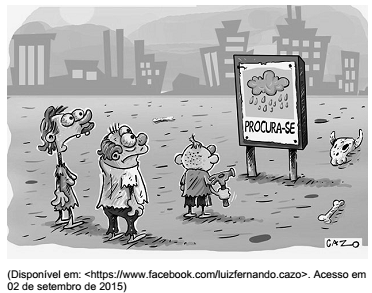
A charge ao lado tematiza um problema que
atingiu os brasileiros recentemente. Assinale a
alternativa que o identifica.
Q563095
Português
Considere as seguintes frases:
1. É possível que outros instrumentos, como o jogo eletrônico, possa substituir o exercício cerebral demandado pela escrita de mão.
2. O problema é de difícil solução, mas ignorar ele, a pretexto de cessar os conflitos e os dissabores, é o caminho para um mundo sem progresso.
3. O impeachment, mesmo com o consenso de que houve erros graves da presidente, não é imediato, nem obrigatório.
Está(ão) conforme a norma padrão a(s) frase(s):
Ano: 2015
Banca:
NC-UFPR
Órgão:
ITAIPU BINACIONAL
Prova:
NC-UFPR - 2015 - ITAIPU BINACIONAL - Computação ou Informática - Sistemas |
Q554701
Engenharia de Software
No que diz respeito à técnica Pontos por Função, a definição “correspondem a transações cujo objetivo é a
apresentação de informações aos usuários, não necessariamente provenientes de arquivos, podendo ocorrer a
geração de dados derivados, atualização de arquivos e a utilização de cálculos/fórmulas" se refere a:
Ano: 2015
Banca:
NC-UFPR
Órgão:
ITAIPU BINACIONAL
Prova:
NC-UFPR - 2015 - ITAIPU BINACIONAL - Computação ou Informática - Sistemas |
Q554700
Engenharia de Software
Sobre artefatos em RUP, considere as seguintes afirmativas:
1. É uma informação que é produzida, modificada ou usada por um processo.
2. Define uma área de responsabilidade.
3. Um artefato pode ser um modelo, um elemento de modelo ou um documento.
Assinale a alternativa correta.
1. É uma informação que é produzida, modificada ou usada por um processo.
2. Define uma área de responsabilidade.
3. Um artefato pode ser um modelo, um elemento de modelo ou um documento.
Assinale a alternativa correta.
Ano: 2015
Banca:
NC-UFPR
Órgão:
ITAIPU BINACIONAL
Prova:
NC-UFPR - 2015 - ITAIPU BINACIONAL - Computação ou Informática - Sistemas |
Q554699
Engenharia de Software
Sobre RUP, considere as seguintes disciplinas:
1. Gerência de configuração.
2. Gerência de projeto.
3. Ambiente.
4. Modelagem de Negócios.
São disciplinas de apoio:
1. Gerência de configuração.
2. Gerência de projeto.
3. Ambiente.
4. Modelagem de Negócios.
São disciplinas de apoio:
Ano: 2015
Banca:
NC-UFPR
Órgão:
ITAIPU BINACIONAL
Prova:
NC-UFPR - 2015 - ITAIPU BINACIONAL - Computação ou Informática - Sistemas |
Q554698
Engenharia de Software
Em um Diagrama de Sequência, de acordo com a UML 2.2, qual operador significa que as mensagens não podem ser
intercaladas com outras mensagens?
Ano: 2015
Banca:
NC-UFPR
Órgão:
ITAIPU BINACIONAL
Prova:
NC-UFPR - 2015 - ITAIPU BINACIONAL - Computação ou Informática - Sistemas |
Q554697
Engenharia de Software
Com relação a Diagrama de Classes em UML 2.2, quando objetos “parte" só podem pertencer a um único objeto “todo"
e têm o seu tempo de vida coincidente com o dele, tem-se:
Ano: 2015
Banca:
NC-UFPR
Órgão:
ITAIPU BINACIONAL
Prova:
NC-UFPR - 2015 - ITAIPU BINACIONAL - Computação ou Informática - Sistemas |
Q554696
Engenharia de Software
Usa-se include, em Casos de Uso, para:
Ano: 2015
Banca:
NC-UFPR
Órgão:
ITAIPU BINACIONAL
Prova:
NC-UFPR - 2015 - ITAIPU BINACIONAL - Computação ou Informática - Sistemas |
Q554694
Engenharia de Software
São componentes de um Diagrama de Fluxo de Dados, segundo Chris Gane:
Ano: 2015
Banca:
NC-UFPR
Órgão:
ITAIPU BINACIONAL
Prova:
NC-UFPR - 2015 - ITAIPU BINACIONAL - Computação ou Informática - Sistemas |
Q554693
Governança de TI
Assinale a alternativa que apresenta a característica de um requisito não funcional que tem como subcaracterística a
maturidade [NBR ISO/IEC 9126-1].
Ano: 2015
Banca:
NC-UFPR
Órgão:
ITAIPU BINACIONAL
Prova:
NC-UFPR - 2015 - ITAIPU BINACIONAL - Computação ou Informática - Sistemas |
Q554692
Banco de Dados
Sobre PostgreSQL, considere as seguintes afirmativas:
1. ~* faz avaliação não sensível a maiúsculas de expressões regulares.
2. A variante não sensível a maiúsculas do LIKE é chamada de ILIKE.
3. Em um índice criado como UNIQUE, a coluna indexada é case-sensitive.
Assinale a alternativa correta.
1. ~* faz avaliação não sensível a maiúsculas de expressões regulares.
2. A variante não sensível a maiúsculas do LIKE é chamada de ILIKE.
3. Em um índice criado como UNIQUE, a coluna indexada é case-sensitive.
Assinale a alternativa correta.
Ano: 2015
Banca:
NC-UFPR
Órgão:
ITAIPU BINACIONAL
Prova:
NC-UFPR - 2015 - ITAIPU BINACIONAL - Computação ou Informática - Sistemas |
Q554691
Banco de Dados
Sobre PostgreSQL Server, considere as seguintes afirmativas:
1. É baseado em threads.
2. Uma sessão de banco de dados (conexão) não pode utilizar mais de uma CPU.
3. Para cada sessão de banco de dados é utilizado um processo do sistema operacional.
Assinale a alternativa correta.
1. É baseado em threads.
2. Uma sessão de banco de dados (conexão) não pode utilizar mais de uma CPU.
3. Para cada sessão de banco de dados é utilizado um processo do sistema operacional.
Assinale a alternativa correta.
Ano: 2015
Banca:
NC-UFPR
Órgão:
ITAIPU BINACIONAL
Prova:
NC-UFPR - 2015 - ITAIPU BINACIONAL - Computação ou Informática - Sistemas |
Q554690
Banco de Dados
Qual é o tamanho, em bytes, que o banco de dados Oracle utiliza para o tipo Date?
Ano: 2015
Banca:
NC-UFPR
Órgão:
ITAIPU BINACIONAL
Prova:
NC-UFPR - 2015 - ITAIPU BINACIONAL - Computação ou Informática - Sistemas |
Q554689
Banco de Dados
Qual é a funcionalidade do Oracle Data Mining que encontra aglomerados de objetos de dados semelhantes em algum
sentido entre si?
Ano: 2015
Banca:
NC-UFPR
Órgão:
ITAIPU BINACIONAL
Prova:
NC-UFPR - 2015 - ITAIPU BINACIONAL - Computação ou Informática - Sistemas |
Q554688
Banco de Dados
Com relação a SQL, numere a coluna da direita de acordo com sua correspondência com a coluna da esquerda.
1. DCL ( ) truncate.
2. DDL ( ) lock table.
3. DML ( ) grant.
4. TCL ( ) rollback.
Assinale a alternativa que apresenta a numeração correta da coluna da direita, de cima para baixo.
1. DCL ( ) truncate.
2. DDL ( ) lock table.
3. DML ( ) grant.
4. TCL ( ) rollback.
Assinale a alternativa que apresenta a numeração correta da coluna da direita, de cima para baixo.
Ano: 2015
Banca:
NC-UFPR
Órgão:
ITAIPU BINACIONAL
Prova:
NC-UFPR - 2015 - ITAIPU BINACIONAL - Computação ou Informática - Sistemas |
Q554687
Banco de Dados
Qual comando SQL retorna todos os clientes cuja cidade começa por qualquer caractere seguido por “uritiba"?
Ano: 2015
Banca:
NC-UFPR
Órgão:
ITAIPU BINACIONAL
Prova:
NC-UFPR - 2015 - ITAIPU BINACIONAL - Computação ou Informática - Sistemas |
Q554686
Banco de Dados
Assinale a alternativa cujo comando está com a sintaxe correta.
Ano: 2015
Banca:
NC-UFPR
Órgão:
ITAIPU BINACIONAL
Prova:
NC-UFPR - 2015 - ITAIPU BINACIONAL - Computação ou Informática - Sistemas |
Q554685
Banco de Dados
No Modelo Relacional, o conceito “toda tupla tem um conjunto de atributos que a identifica de maneira única na
relação" refere-se a:
Ano: 2015
Banca:
NC-UFPR
Órgão:
ITAIPU BINACIONAL
Prova:
NC-UFPR - 2015 - ITAIPU BINACIONAL - Computação ou Informática - Sistemas |
Q554684
Banco de Dados
Seja R um esquema relacional, F o conjunto de DFs que valem em R, X o subconjunto de atributos de R e A um atributo
de R. Considere as seguintes afirmações:
• A ϵ X; isto é, é uma DF trivial, ou
• X é uma superchave, ou
• A é parte de alguma chave para R.
Se, para toda a DF X → A em F, uma dessas afirmações for válida, a forma normal de R será:
• A ϵ X; isto é, é uma DF trivial, ou
• X é uma superchave, ou
• A é parte de alguma chave para R.
Se, para toda a DF X → A em F, uma dessas afirmações for válida, a forma normal de R será:

 Conheça nossos planos