Questões de Concurso
Para educação
Foram encontradas 218.325 questões
Resolva questões gratuitamente!
Junte-se a mais de 4 milhões de concurseiros!


Ano: 2026
Banca:
FAURGS
Órgão:
IF-SC
Prova:
FAURGS - 2026 - IF-SC - Técnico de Laboratório – Área: Automação |
Q4345581
Engenharia de Automação
A norma IEC 61131-3 estabelece diretrizes para o desenvolvimento de programas em controladores lógicos programáveis (CLPs), padronizando diferentes linguagens de programação amplamente empregadas em sistemas automatizados.
Assinale a alternativa que apresenta apenas linguagens de programação padronizadas pela IEC 61131-3.
Assinale a alternativa que apresenta apenas linguagens de programação padronizadas pela IEC 61131-3.
Ano: 2026
Banca:
FAURGS
Órgão:
IF-SC
Prova:
FAURGS - 2026 - IF-SC - Técnico de Laboratório – Área: Automação |
Q4345580
Eletrônica
Antes do início de uma aula prática de automação, um técnico de laboratório foi responsável por verificar o funcionamento de uma bancada composta por um Controlador Lógico Programável (CLP) equipado com módulos de entradas
e saídas digitais e analógicas, duas botoeiras, um sensor indutivo, um transmissor de pressão com saída de 4–20 mA,
um contator para acionamento de um motor e um inversor de frequência com entrada de referência de 0–10 V. Após
a energização da bancada, o técnico verificou que o CLP iniciou normalmente a execução do programa de controle,
monitorando os dispositivos de campo e comandando os atuadores do sistema.
Considerando a arquitetura e o princípio de funcionamento de um CLP, assinale a alternativa correta.
Considerando a arquitetura e o princípio de funcionamento de um CLP, assinale a alternativa correta.
Ano: 2026
Banca:
FAURGS
Órgão:
IF-SC
Prova:
FAURGS - 2026 - IF-SC - Técnico de Laboratório – Área: Automação |
Q4345579
Eletrotécnica
Um técnico de laboratório em automação foi designado para verificar as instalações elétricas de um laboratório utilizado em aulas práticas de acionamentos elétricos. O laboratório é alimentado por um sistema trifásico de baixa tensão,
responsável por energizar bancadas didáticas, motores elétricos e outros equipamentos. Com relação às características das instalações elétricas monofásicas e trifásicas, assinale a alternativa correta.
Ano: 2026
Banca:
FAURGS
Órgão:
IF-SC
Prova:
FAURGS - 2026 - IF-SC - Técnico de Laboratório – Área: Automação |
Q4345578
Eletrotécnica
Durante a manutenção de uma bancada didática destinada ao acionamento de motores elétricos, um técnico de
laboratório em automação consultou o diagrama unifilar de potência representado na figura abaixo para verificar a
sequência dos dispositivos responsáveis pela proteção, manobra e alimentação de um motor trifásico.
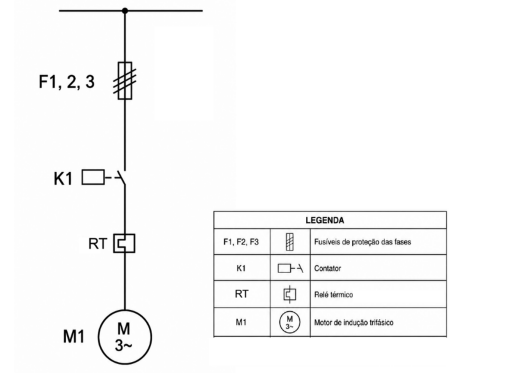
Com base na figura e nas funções dos dispositivos representados, assinale a alternativa que descreve corretamente o circuito de acionamento do motor trifásico.
Com base na figura e nas funções dos dispositivos representados, assinale a alternativa que descreve corretamente o circuito de acionamento do motor trifásico.
Ano: 2026
Banca:
FAURGS
Órgão:
IF-SC
Prova:
FAURGS - 2026 - IF-SC - Técnico de Laboratório – Área: Automação |
Q4345577
Eletrotécnica
Durante a montagem do quadro elétrico de uma bancada didática de um laboratório de automação, um técnico de
laboratório verificou a instalação de um disjuntor termomagnético, um dispositivo diferencial residual (DR) e um
dispositivo de proteção contra surtos (DPS). Antes da energização do sistema, foi solicitado que o técnico verificasse
a função de cada um dos dispositivos de proteção instalados.
Com relação às funções desses dispositivos, assinale a alternativa correta.
Com relação às funções desses dispositivos, assinale a alternativa correta.
Ano: 2026
Banca:
FAURGS
Órgão:
IF-SC
Prova:
FAURGS - 2026 - IF-SC - Técnico de Laboratório – Área: Automação |
Q4345576
Engenharia Elétrica
Durante a manutenção de uma bancada didática de medição de temperatura, um técnico de laboratório em automação
verificou a necessidade de substituir um resistor da placa eletrônica com as seguintes especificações: 100 Ω e potência
máxima de 1 W. Antes da instalação, é necessário determinar os valores máximos de corrente e tensão que podem
ser aplicados ao componente, de modo a evitar a dissipação de potência acima do limite especificado pelo fabricante.
Com base nessas informações, assinale a alternativa que apresenta, correta e respectivamente, a corrente máxima e a tensão máxima que esse resistor pode suportar.
Com base nessas informações, assinale a alternativa que apresenta, correta e respectivamente, a corrente máxima e a tensão máxima que esse resistor pode suportar.
Ano: 2026
Banca:
FAURGS
Órgão:
IF-SC
Prova:
FAURGS - 2026 - IF-SC - Técnico de Laboratório – Área: Automação |
Q4345575
Engenharia Mecânica
Durante a montagem de uma bancada didática de eletropneumática, um técnico de laboratório em automação instalou
o circuito representado na figura abaixo.
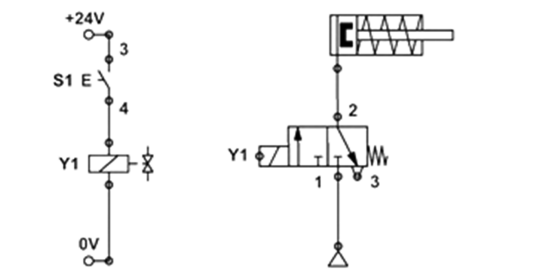
A partir da simbologia da válvula direcional apresentada na figura, assinale a alternativa que identifica, correta e respectivamente, o número de vias, o número de posições, a condição de repouso, o tipo de acionamento e o mecanismo de retorno.
A partir da simbologia da válvula direcional apresentada na figura, assinale a alternativa que identifica, correta e respectivamente, o número de vias, o número de posições, a condição de repouso, o tipo de acionamento e o mecanismo de retorno.
Ano: 2026
Banca:
FAURGS
Órgão:
IF-SC
Prova:
FAURGS - 2026 - IF-SC - Técnico de Laboratório – Área: Automação |
Q4345574
Eletrotécnica
Durante a preparação de uma aula prática sobre circuitos de comando e força para acionamento de motores trifásicos,
foi solicitado que o técnico de laboratório de automação verificasse se o motor disponível poderia ser instalado em
uma bancada de testes. A bancada é alimentada por um sistema trifásico equilibrado, cuja tensão de fase é de 220 V,
medida entre fase e neutro. Para realizar essa análise, o técnico deve considerar as condições de alimentação elétrica
e as informações constantes na placa de identificação apresentada na figura abaixo.
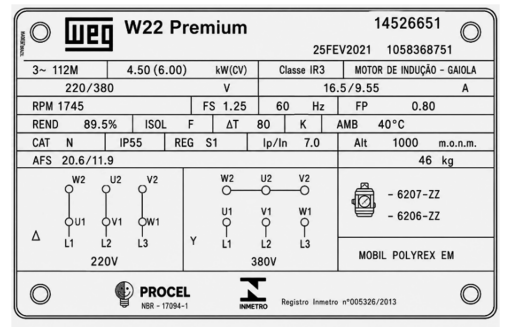
Com base nas condições de alimentação elétrica da bancada e nas informações constantes na placa de identificação, considerando o acionamento do motor por partida direta, assinale a alternativa que apresenta, correta e respectivamente, a ligação elétrica e os parâmetros nominais indicados na placa para condição de alimentação elétrica da bancada.
Com base nas condições de alimentação elétrica da bancada e nas informações constantes na placa de identificação, considerando o acionamento do motor por partida direta, assinale a alternativa que apresenta, correta e respectivamente, a ligação elétrica e os parâmetros nominais indicados na placa para condição de alimentação elétrica da bancada.
Ano: 2026
Banca:
FAURGS
Órgão:
IF-SC
Prova:
FAURGS - 2026 - IF-SC - Técnico de Laboratório – Área: Automação |
Q4345573
Eletrotécnica
Durante a preparação de uma aula prática, foi solicitado a um técnico de laboratório de automação que montasse, em
bancada, o circuito de comando e força para acionamento de um motor trifásico, representado na figura abaixo.
Após a montagem, o sistema deverá ser energizado para verificar seu funcionamento, a operação dos dispositivos
de comando, proteção e sinalização, bem como a lógica de funcionamento prevista no projeto.
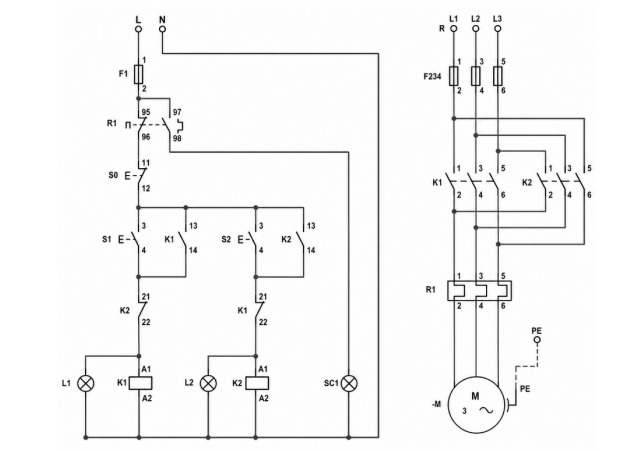
Com base na análise do diagrama elétrico, analise as afirmativas a seguir.
I - O circuito permite acionar um motor de indução trifásico em ambos os sentidos de rotação, por meio da permutação de duas fases no circuito de força, alterando a sequência de fases e, consequentemente, o sentido de giro do motor.
II - O circuito permite o acionamento simultâneo dos contatores K1 e K2, possibilitando a inversão imediata do sentido de rotação do motor, sem necessidade de desenergização prévia do circuito.
III - Os contatores K1 e K2 possuem contatos auxiliares responsáveis pela função de selo (autorretenção), mantendo a bobina energizada após o acionamento da respectiva botoeira de partida.
IV - Em caso de sobrecarga do motor, o relé térmico R1 atua, abrindo o contato 95-96, interrompendo a alimentação do circuito de comando e, simultaneamente, fechando o contato 97-98, acionando a lâmpada de sinalização SC1 para indicar a ocorrência da sobrecarga.
Quais estão corretas?
Com base na análise do diagrama elétrico, analise as afirmativas a seguir.
I - O circuito permite acionar um motor de indução trifásico em ambos os sentidos de rotação, por meio da permutação de duas fases no circuito de força, alterando a sequência de fases e, consequentemente, o sentido de giro do motor.
II - O circuito permite o acionamento simultâneo dos contatores K1 e K2, possibilitando a inversão imediata do sentido de rotação do motor, sem necessidade de desenergização prévia do circuito.
III - Os contatores K1 e K2 possuem contatos auxiliares responsáveis pela função de selo (autorretenção), mantendo a bobina energizada após o acionamento da respectiva botoeira de partida.
IV - Em caso de sobrecarga do motor, o relé térmico R1 atua, abrindo o contato 95-96, interrompendo a alimentação do circuito de comando e, simultaneamente, fechando o contato 97-98, acionando a lâmpada de sinalização SC1 para indicar a ocorrência da sobrecarga.
Quais estão corretas?
Ano: 2026
Banca:
FAURGS
Órgão:
IF-SC
Prova:
FAURGS - 2026 - IF-SC - Técnico de Laboratório – Área: Automação |
Q4345572
Engenharia de Automação
Uma esteira transportadora deve manter velocidade constante durante a movimentação de diferentes cargas. Para
isso, o motor elétrico é acionado por um inversor de frequência comandado por um controlador contínuo que pode
utilizar ações proporcional (P), integral (I) e derivativa (D), isoladamente ou em conjunto. Durante os ensaios, foram
observadas situações como redução da velocidade quando caixas mais pesadas são colocadas sobre a esteira, aumento
momentâneo da velocidade após a retirada da carga e pequenas oscilações antes da estabilização da velocidade no
valor desejado.
Com base nos conceitos de controle contínuo e na atuação das ações (P), (I) e (D), assinale a alternativa correta.
Com base nos conceitos de controle contínuo e na atuação das ações (P), (I) e (D), assinale a alternativa correta.
Ano: 2026
Banca:
FAURGS
Órgão:
IF-SC
Prova:
FAURGS - 2026 - IF-SC - Técnico de Laboratório – Área: Automação |
Q4345571
Engenharia de Automação
Um forno elétrico emprega um controlador liga-desliga (on-off) para manter sua temperatura próxima do valor de
referência estabelecido pelo operador. O sistema utiliza um sensor de temperatura, um controlador eletrônico e uma
resistência elétrica de aquecimento. Para evitar acionamentos excessivos da resistência, foi definido um intervalo
diferencial (histerese) em torno do ponto de ajuste. A figura abaixo apresenta o comportamento típico da temperatura
do forno durante a operação.
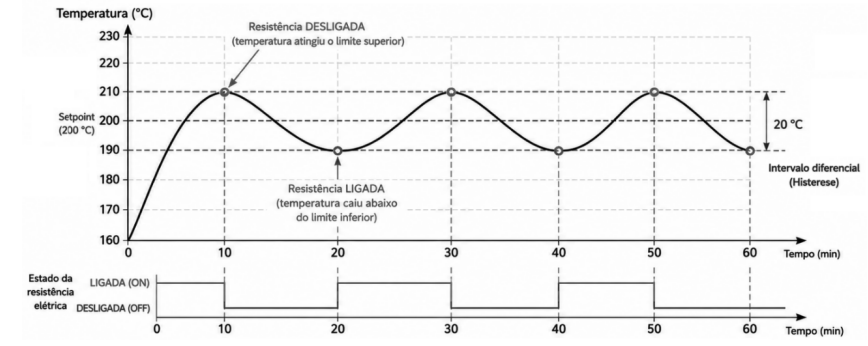
Com base na figura e nos conceitos de controle liga-desliga (on-off), analise as afirmações a seguir.
I - O controle liga-desliga, também denominado controle de duas posições, mantém o elemento atuador apenas em dois estados possíveis: totalmente ligado ou totalmente desligado.
II - O intervalo diferencial (histerese) é introduzido para reduzir a frequência de comutação do atuador diante de pequenas variações da variável controlada, aumentando sua vida útil. Entretanto, sua redução tende a aumentar a precisão do controle, à custa de uma maior frequência de chaveamento do atuador.
III - Em regime permanente, é esperado que a variável controlada oscile continuamente em torno do ponto de ajuste. A amplitude e a frequência dessas oscilações dependem da dinâmica do processo, como sua inércia e tempo de resposta.
IV - O controle liga-desliga é a estratégia mais indicada para processos que exigem elevada estabilidade térmica, pequena variação em torno do setpoint e resposta contínua às mudanças de carga.
Quais estão corretas?
Com base na figura e nos conceitos de controle liga-desliga (on-off), analise as afirmações a seguir.
I - O controle liga-desliga, também denominado controle de duas posições, mantém o elemento atuador apenas em dois estados possíveis: totalmente ligado ou totalmente desligado.
II - O intervalo diferencial (histerese) é introduzido para reduzir a frequência de comutação do atuador diante de pequenas variações da variável controlada, aumentando sua vida útil. Entretanto, sua redução tende a aumentar a precisão do controle, à custa de uma maior frequência de chaveamento do atuador.
III - Em regime permanente, é esperado que a variável controlada oscile continuamente em torno do ponto de ajuste. A amplitude e a frequência dessas oscilações dependem da dinâmica do processo, como sua inércia e tempo de resposta.
IV - O controle liga-desliga é a estratégia mais indicada para processos que exigem elevada estabilidade térmica, pequena variação em torno do setpoint e resposta contínua às mudanças de carga.
Quais estão corretas?
Ano: 2026
Banca:
FAURGS
Órgão:
IF-SC
Prova:
FAURGS - 2026 - IF-SC - Técnico de Laboratório – Área: Automação |
Q4345570
Engenharia de Automação
A figura abaixo apresenta o diagrama esquemático de uma malha fechada utilizada em uma bancada didática para o
controle automático do nível de água de um reservatório. O sistema é composto por um controlador eletrônico, um
inversor de frequência responsável pelo controle da velocidade de uma bomba centrífuga, um transmissor de nível
instalado no reservatório e um sistema de realimentação composto pelo transmissor de nível e pelos sinais de medição.
O operador define previamente o nível desejado (setpoint) e, durante a operação, variações na vazão de saída do
reservatório podem alterar o nível da água. Nessas condições, o controlador ajusta continuamente a velocidade da
bomba, modificando a vazão de entrada, de modo a manter o nível do reservatório próximo ao valor de referência.
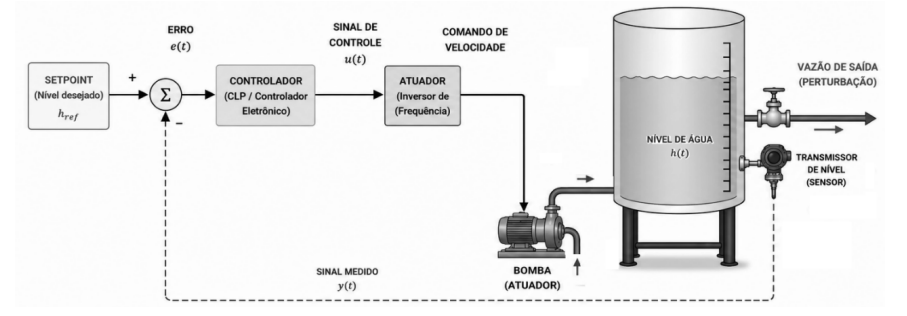
Com base na figura e nos conceitos de controle de processos, analise as afirmações a seguir.
I - O nível de água h (t) representa a variável controlada, enquanto o valor de referência definido pelo operador corresponde ao setpoint do sistema, utilizado para o cálculo do sinal de erro pelo controlador.
II - A ação do controlador modifica o sinal enviado ao inversor de frequência, alterando a velocidade da bomba e, consequentemente, a vazão de entrada no reservatório, que corresponde à variável manipulada da malha.
III - O transmissor de nível fornece continuamente ao controlador o valor medido da variável controlada, caracterizando uma malha fechada com realimentação negativa.
IV - A variação da vazão de saída do reservatório constitui uma perturbação externa. Entretanto, como essa vazão não é medida pelo controlador, ela não interfere na variável controlada enquanto o setpoint permanecer constante.
Quais estão corretas?
Com base na figura e nos conceitos de controle de processos, analise as afirmações a seguir.
I - O nível de água h (t) representa a variável controlada, enquanto o valor de referência definido pelo operador corresponde ao setpoint do sistema, utilizado para o cálculo do sinal de erro pelo controlador.
II - A ação do controlador modifica o sinal enviado ao inversor de frequência, alterando a velocidade da bomba e, consequentemente, a vazão de entrada no reservatório, que corresponde à variável manipulada da malha.
III - O transmissor de nível fornece continuamente ao controlador o valor medido da variável controlada, caracterizando uma malha fechada com realimentação negativa.
IV - A variação da vazão de saída do reservatório constitui uma perturbação externa. Entretanto, como essa vazão não é medida pelo controlador, ela não interfere na variável controlada enquanto o setpoint permanecer constante.
Quais estão corretas?
Q4344895
Arquitetura
De acordo com a Resolução CAU/BR nº 91/2014, o
Registro de Responsabilidade Técnica (RRT) deve ser
__________ em decorrência de rescisão contratual que
interrompa uma atividade técnica em execução; deve
ser _____________ quando nenhuma das atividades
técnicas que o constituem for realizada; e deve ser
_________ quando ficar caracterizado que o arquiteto
e urbanista assumiu, por meio do RRT, a responsabilidade por atividade técnica efetivamente executada por
outro profissional legalmente habilitado.
Assinale a alternativa que completa, correta e respectivamente, as lacunas do texto acima.
Assinale a alternativa que completa, correta e respectivamente, as lacunas do texto acima.
Q4344894
Direito Administrativo
A gestão e a fiscalização de obras públicas exigem a
instrução e a movimentação contínua de processos
administrativos, seja para a aprovação de medições,
seja para a apuração de infrações contratuais. Considerando os preceitos gerais da Lei nº 9.784/1999,
aplicáveis aos servidores federais na condução desses
processos, assinale a alternativa correta.
Q4344893
Direito Administrativo
Na licitação de uma obra de edificação institucional, a
Administração adotou o regime de contratação semiintegrada e forneceu o projeto básico. Embora a obra
não se enquadre como de grande vulto, o edital contém
matriz de alocação de riscos.
Durante a elaboração do projeto executivo, um estudo comparativo apresentado pelo contratado indicou que uma solução diferente daquela prevista no projeto básico simplificaria as futuras rotinas de manutenção, embora não produzisse alteração demonstrável de custo, qualidade ou prazo. A proposta foi submetida à Administração antes de sua incorporação ao projeto executivo.
De acordo com a Lei nº 14.133/2021, assinale a alternativa correta.
Durante a elaboração do projeto executivo, um estudo comparativo apresentado pelo contratado indicou que uma solução diferente daquela prevista no projeto básico simplificaria as futuras rotinas de manutenção, embora não produzisse alteração demonstrável de custo, qualidade ou prazo. A proposta foi submetida à Administração antes de sua incorporação ao projeto executivo.
De acordo com a Lei nº 14.133/2021, assinale a alternativa correta.
Q4344892
Edificações
No âmbito do PBE Edifica, os Requisitos de Avaliação da
Conformidade (RAC), aprovados pela Portaria Inmetro
nº 309/2022, estabelecem as modalidades da Etiqueta
Nacional de Conservação de Energia (ENCE). Considerando as disposições aplicáveis às edificações comerciais,
de serviços e públicas, analise as assertivas a seguir.
I - A ENCE Geral da edificação é obtida quando todos os sistemas individuais são obrigatoriamente avaliados: envoltória, condicionamento de ar, iluminação artificial e aquecimento de água, este último quando aplicável.
II - Na ENCE Parcial, a envoltória completa é obrigatoriamente avaliada, podendo ser emitida para uma parcela da edificação ou quando apenas alguns sistemas forem avaliados.
III - A ENCE Autodeclarada pode ser emitida apenas para edificações novas, em fase de projeto.
IV - Nas edificações de instituições públicas, somente podem ser avaliadas por autodeclaração as áreas concedidas a empresas privadas e cujos sistemas não serão entregues.
Quais estão corretas?
I - A ENCE Geral da edificação é obtida quando todos os sistemas individuais são obrigatoriamente avaliados: envoltória, condicionamento de ar, iluminação artificial e aquecimento de água, este último quando aplicável.
II - Na ENCE Parcial, a envoltória completa é obrigatoriamente avaliada, podendo ser emitida para uma parcela da edificação ou quando apenas alguns sistemas forem avaliados.
III - A ENCE Autodeclarada pode ser emitida apenas para edificações novas, em fase de projeto.
IV - Nas edificações de instituições públicas, somente podem ser avaliadas por autodeclaração as áreas concedidas a empresas privadas e cujos sistemas não serão entregues.
Quais estão corretas?
Q4344891
Legislação Federal
Para a construção de um novo bloco acadêmico em um
instituto federal, o _________ global de referência do
orçamento foi obtido a partir das composições de custos unitários previstas no projeto, adotando-se como
parâmetro máximo a __________ de seus correspondentes no SINAPI. Para instalações específicas cuja definição de custos pelos sistemas de referência se mostrou inviável, a estimativa foi apurada mediante dados
contidos em __________. Concluída a apuração, o orçamento foi consolidado com a aplicação do BDI, excluídos os tributos de natureza ____________ e personalística que oneram o contratado.
Considerando o Decreto Federal nº 7.983/2013, assinale a alternativa que completa, correta e respectivamente, as lacunas do texto acima.
Considerando o Decreto Federal nº 7.983/2013, assinale a alternativa que completa, correta e respectivamente, as lacunas do texto acima.
Q4344890
Direito Administrativo
A equipe de arquitetura de um instituto federal participa do planejamento e da fiscalização da execução de
contratos de obras e serviços de engenharia, inclusive
de seu recebimento. Considerando as disposições da
Lei nº 14.133/2021, assinale a alternativa correta.
Q4344889
Arquitetura
Segundo a ABNT NBR 16747:2020, em que as irregularidades constatadas na inspeção predial devem ser classificadas em anomalias ou falhas, considere as afirmações
abaixo.
I - A anomalia endógena ou construtiva decorre das etapas de projeto e/ou execução.
II - A anomalia exógena decorre de fatores externos à edificação, provocados por terceiros.
III - As falhas caracterizam-se pela perda de desempenho de um elemento, subsistema ou sistema construtivo decorrente do uso, da operação e da manutenção, incluindo o envelhecimento natural e o consequente término da vida útil.
Quais estão corretas?
I - A anomalia endógena ou construtiva decorre das etapas de projeto e/ou execução.
II - A anomalia exógena decorre de fatores externos à edificação, provocados por terceiros.
III - As falhas caracterizam-se pela perda de desempenho de um elemento, subsistema ou sistema construtivo decorrente do uso, da operação e da manutenção, incluindo o envelhecimento natural e o consequente término da vida útil.
Quais estão corretas?
Q4344888
Segurança e Saúde no Trabalho
A Norma Regulamentadora nº 35 (NR-35) estabelece
requisitos e medidas de prevenção para o trabalho em
altura, envolvendo seu planejamento, sua organização
e sua execução.
De acordo com a NR-35, assinale a alternativa correta.
De acordo com a NR-35, assinale a alternativa correta.

 Conheça nossos planos