Questões de Concurso Público Prefeitura de Luiz Alves - SC 2025 para Professor de Língua Inglesa - Edital nº 12
Foram encontradas 40 questões


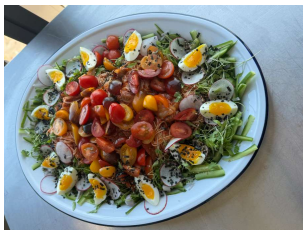
Cold Kimchi Tomato Bibim Noodles
Ingredients
For the sauce
3 tablespoons tomato paste
2 tablespoons gochujang
1 teaspoon kosher salt
1 1/2 tablespoons sesame oil
3 tablespoons apple cider vinegar
3 tablespoons kimchi juice
1 tablespoon honey
1 cup chopped kimchi
For the noodles
150 grams somen noodles
For the toppings
2 Persian cucumbers, sliced into matchsticks
1 shallot, minced
2 cups cherry tomatoes, halved
2 soft-boiled eggs (7 minutes, jammy yolks)
4 radishes, thinly sliced
To finish
Extra sesame oil, for drizzling
2 tablespoons furikake
Handful of cilantro
Directions
•Step 1
"In a medium bowl, whisk together the tomato paste, gochujang, salt, sesame oil, vinegar, kimchi juice, and honey until smooth. Stir in the chopped kimchi until evenly coated."
A translation professor analyzing this instructional text for a Brazilian audience must address the challenge of translating the adverb "evenly" in the phrase "until evenly coated," which modifies the past participle and specifies the manner and distribution quality of the coating action. When considering semantic precision, register appropriateness, and naturalness in Brazilian Portuguese while maintaining the instructional clarity essential for successful recipe execution, the most adequate translation strategy for "until evenly coated" would be______.
Fill in the blank above and select the correct alternative.
Cold Kimchi Tomato Bibim Noodles
Ingredients
For the sauce
3 tablespoons tomato paste
2 tablespoons gochujang
1 teaspoon kosher salt
1 1/2 tablespoons sesame oil
3 tablespoons apple cider vinegar
3 tablespoons kimchi juice
1 tablespoon honey
1 cup chopped kimchi
For the noodles
150 grams somen noodles
For the toppings
2 Persian cucumbers, sliced into matchsticks
1 shallot, minced
2 cups cherry tomatoes, halved
2 soft-boiled eggs (7 minutes, jammy yolks)
4 radishes, thinly sliced
To finish
Extra sesame oil, for drizzling
2 tablespoons furikake
Handful of cilantro
Directions
•Step 1
(__)The verb "drizzle" in the instruction "Drizzle with a little extra sesame oil" belongs to the semantic field of liquid application techniques, denoting controlled pouring of liquid in thin stream, and shares semantic features with verbs like "sprinkle" and "pour," though with distinct manner specifications regarding quantity and distribution pattern.
(__)The compound adjective "soft-boiled" in "2 soft-boiled eggs (7 minutes, jammy yolks)" functions as a hyphenated attributive modifier specifying a cooking method, and its morphological structure combines adjective + past participle to create a specialized culinary term that would be translated into Portuguese as "ovos cozidos moles" or "ovos quentes."
(__)The noun "matchsticks" in "sliced into matchsticks" represents a metaphorical extension through shape similarity, where the lexical item originally denoting small wooden sticks for lighting fires has undergone semantic broadening to describe a cutting technique (julienne) in culinary contexts, demonstrating how concrete nouns can acquire specialized technical meanings in professional domains.
The CORRECT sequence is:
Cold Kimchi Tomato Bibim Noodles
Ingredients
For the sauce
3 tablespoons tomato paste
2 tablespoons gochujang
1 teaspoon kosher salt
1 1/2 tablespoons sesame oil
3 tablespoons apple cider vinegar
3 tablespoons kimchi juice
1 tablespoon honey
1 cup chopped kimchi
For the noodles
150 grams somen noodles
For the toppings
2 Persian cucumbers, sliced into matchsticks
1 shallot, minced
2 cups cherry tomatoes, halved
2 soft-boiled eggs (7 minutes, jammy yolks)
4 radishes, thinly sliced
To finish
Extra sesame oil, for drizzling
2 tablespoons furikake
Handful of cilantro
Directions
•Step 1
An English teacher planning a lesson for Brazilian high school students using this recipe as authentic material wants to analyze the syntactic complexity and verb phrase structures to assess text difficulty level and design appropriate scaffolding activities. Examining sentences like "Bring a pot of water to a rolling boil," "Stir in the chopped kimchi until evenly coated," and "Using tongs, gently mix until each strand is coated," the teacher conducts a syntactic analysis focusing on verb phrase types, clause structures, and non-finite constructions. Regarding the syntactic features that impact text difficulty and pedagogical implications for supporting reading comprehension among intermediate EFL learners, which analysis is syntactically and pedagogically accurate?
(__)The phrase "large-scale performance" presents a translation challenge requiring the translator to consider register, domain-specific vocabulary, and context; a functionally equivalent Brazilian Portuguese translation would be "mostra de grande escala" or "exposição abrangente," prioritizing dynamic equivalence over formal equivalence to ensure target audience comprehension of the exhibition's scope and importance.
(__)The series titles "TransOrganic," "Para Bellum," "Posthuman," and "Bunker City" should all be systematically translated into Portuguese as "TransOrgânico," "Para a Guerra," "Pós-humano," and "Cidade Bunker" to ensure Brazilian readers fully comprehend the thematic content, as maintaining English titles would create unnecessary barriers to understanding and contradict accessibility principles in translation for non-specialist audiences.
(__)The sentence "The topics that excite the author of the exhibition" contains the verb "excite" which shares identical semantic range with Portuguese "excitar," making direct cognate translation appropriate and recommended, as both verbs carry the same connotations of intellectual stimulation and enthusiasm across academic and professional contexts in both languages without semantic divergence.
The CORRECT sequence is:
"For the first time the artist makes such a large-scale performance in the city where he was born."
An English teacher analyzing this sentence with advanced students identifies a potential ambiguity in the noun "performance" within this artistic context. When discussing polysemy, context-dependent meaning, and the semantic challenges this presents for translation into Portuguese, particularly distinguishing between "performance" as artistic presentation versus "performance" as theatrical/live art form, the most linguistically precise interpretation considering the broader textual context of an art exhibition would be_________.
Fill in the blank above and select the correct alternative.
I.The compound noun "posthumanism" in the phrase "Philip Popov's continuing focus on the posthumanism and transhumanism" exhibits derivational morphology through the prefix "post-" (meaning after/beyond) attached to the base "humanism," creating a philosophical term denoting ideology beyond traditional humanism, and this word formation process exemplifies productive morphological patterns in academic and philosophical English vocabulary.
II.The prepositional phrase "from 2014" in "Combining works dating back to 2014" functions as a temporal adjunct modifying the present participle "dating," and the phrasal verb "dating back to" is a three-word intransitive phrasal verb meaning to originate or have existed since a particular time, commonly used in historical and chronological contexts.
III.The relative clause "where he was born" in "the city where he was born" is a restrictive (defining) relative clause that specifies which city is being referenced, using the relative adverb "where" to indicate location, and this construction could be alternatively expressed as "in which he was born" with preposition fronting, though "where" is more natural and commonly preferred in spoken and written English.
The following statement(s) is/are CORRECT.
"Born in 1964 in Plovdiv, Filip Popov spent several years of his childhood in Germany, where he formed his ideas for unity between art, architecture, design and technology."
An English teacher designing a reading comprehension lesson for intermediate Brazilian students analyzes this biographical sentence to identify potential comprehension obstacles. Regarding vocabulary, syntax, and cultural references that may challenge Brazilian EFL learners, and considering effective scaffolding strategies aligned with communicative language teaching and BNCC principles, which analysis is pedagogically accurate?
"Combining works dating back to 2014, Digital Archeology reflects Philip Popov's continuing focus on the posthumanism and transhumanism, confronting technology and our uncertain future and insight into the way machines are woven into our tomorrow's world."
A linguistics professor analyzing this sentence identifies several grammatical and stylistic issues that impact comprehension and translation. Regarding syntactic ambiguity, punctuation problems, and parallelism in coordinate structures, which analysis demonstrates the most sophisticated understanding of the sentence's linguistic problems?
An English teacher preparing a lesson on the text "Digital Archeology" for Brazilian high school students wants to design activities that develop critical reading skills, intercultural competence, and linguistic awareness while aligning with Base Nacional Comum Curricular (BNCC) competencies. The teacher plans to explore the text's themes of art, technology, posthumanism, and cultural mobility (artist's international trajectory). When selecting the most pedagogically sound approach that integrates language skills, cultural awareness, and critical thinking as emphasized by BNCC for English language teaching, the teacher should:
Source: "She broke down in tears when she heard the news."
(1) "Ela quebrou-se em lágrimas ao ouvir a notícia." (2) "Ela desabou em lágrimas ao ouvir a notícia."
From the perspective of translation theory, the second version is preferable because it illustrates:
(__)The "To be, or not to be" soliloquy is written predominantly in iambic pentameter, employing antithesis and occasional feminine endings to dramatize internal debate.
(__)The play uses metatheatre through "The Mousetrap" (the play-within-the-play) to test Claudius's guilt by observing his reaction to a staged regicide.
(__)Ophelia's mad songs draw exclusively on courtly love conventions and exclude folk ballad elements, avoiding colloquial or popular registers.
The CORRECT sequence is:
Analyze the sentence below:
"The teacher had been explaining the topic for an hour when the bell rang."
The verb phrase "had been explaining" exemplifies:
I.The pervasive use of free indirect discourse blends narrator and Elizabeth's focalization, enabling tonal irony and calibrating reader alignment with her judgments.
II.Mr. Collins exemplifies the Byronic hero, marked by brooding individualism and rebellious erotic charisma central to Romantic mythography.
III.The novel's retitling from First Impressions to Pride and Prejudice foregrounds a dialectic of moral attributes resolved through mutual self-revision by Elizabeth and Darcy.
The following statement(s) is/are CORRECT:
I.The use of stream of consciousness and free indirect style is articulated through a recurrent auditory motif — the chimes of Big Ben — which provides temporal cohesion to the shifting mental perspectives throughout the day.
II.Septimus Warren Smith functions merely as a comic counterpoint to Clarissa's social anxieties, without thematic connection to war trauma or critique of medical psychiatry.
III.The narrative covers several weeks, alternating between London and the countryside, and follows a multitemporal episodic structure.
The following statement(s) is/are CORRECT:
The first organizes her lessons around translation exercises, explicit grammar explanation, and memorization of bilingual vocabulary lists.
The second designs communicative tasks, group interactions, and role-play activities that simulate real-life communication.
Considering the pedagogical orientations exemplified in both cases, the Communicative Approach (CA) differs from the Grammar-Translation Method (GTM) primarily because:
Consider the dialogue below:
A: "Can you pass the salt?"
B: "Sure." (passes it)
From a pragmatic perspective, the utterance "Can you pass the salt?" exemplifies:
Read the excerpt from William Shakespeare's Hamlet (Act III, Scene I):
"To be, or not to be: that is the question:
Whether 'tis nobler in the mind to suffer
The slings and arrows of outrageous fortune,
Or to take arms against a sea of troubles,
And by opposing end them? To die: to sleep;
No more; and by a sleep to say we end"
Source: https://poets.org/poem/hamlet-act-iii-scene-i-be-or-not-be
In the context of Shakespearean verse, the term "blank verse" refers to:
"His arguments were specious , appealing on the surface but fundamentally flawed."
The underlined word "specious" derives from the Latin root spec- ("to look, to appear"), also present in words such as:
(__)The poem assembles a collage of voices, registers, and languages, fusing fragments and citations to stage modernist cultural crisis.
(__)"April is the cruellest month" reverses Chaucer's springtime optimism in the General Prologue to The Canterbury Tales , creating an ironic counter-allusion.
(__)The poem reached print without substantial external editing; Ezra Pound's role did not affect the final architecture of the text.
The CORRECT sequence is:

 Conheça nossos planos