Questões de Concurso Público Prefeitura de Luiz Alves - SC 2025 para Professor de Língua Inglesa - Edital nº 12
Foram encontradas 40 questões


As nevascas começaram na noite de "sexta-feira" e se intensificaram rapidamente.
Em relação à classe gramatical, o termo destacado trata-se de:
Em relação à classe gramatical, os termos destacados são, respectivamente,
De acordo com as regras de acentuação, é correto afirmar que:
De acordo com as regras de regência verbal, o verbo destacado nesta frase funciona como verbo:
De acordo com a regência nominal, a preposição "de" é exigida pelo termo "cobertas" para indicar:
De acordo com as regras de colocação pronominal, a forma culta do pronome oblíquo para substituir o termo destacado é:
De acordo com o texto base, é correto afirmar que:
Centenas de moradores locais e equipes especializadas trabalham.
Sintaticamente, é correto afirmar que o núcleo do sujeito é reconhecido:
Trecho 2: O acesso ao Tibete é "restrito" e a circulação de informações é rigidamente controlada pelo governo, o que torna mais difícil acompanhar a situação em tempo real.
Em relação à significação das palavras destacadas, é correto afirmar que:
Em relação ao sinal indicativo de crase, é correto afirmar que, nesta frase,
Prova 1 (peso 2): avaliação teórica sobre gestão de processos — pontuação obtida: 6,0
Prova 2 (peso 3): estudo de caso prático em equipe — pontuação obtida: 8,0
Prova 3 (peso 5): apresentação individual de um plano de inovação — pontuação obtida: 7,0
Com base nesses resultados, o setor de Recursos Humanos determinou que a média final do candidato será a sua nota.
Qual nota Beto obteve no processo seletivo?
Em uma palestra sobre ética e raciocínio lógico, o professor Leonardo afirma:
"Ou o servidor cumpre suas obrigações, ou não as cumpre."
Essa afirmação representa logicamente:
Durante a fase de testes de produtividade, verificou-se que 6 funcionários, trabalhando 8 horas por dia durante 5 dias, conseguiram produzir 360 peças.
Com o novo contrato, o gerente de produção Rogério Lima decidiu ampliar a equipe e ajustar a jornada de trabalho para atender à demanda dentro do prazo. Assim, a nova configuração contará com 9 funcionários, cada um trabalhando 10 horas por dia durante 6 dias, mantendo as mesmas condições de eficiência.
Nessas circunstâncias, quantas peças a equipe deverá produzir ao final do período de 6 dias?
"Se as metas forem alcançadas, os funcionários receberão um bônus.
As metas foram alcançadas.
Logo, os funcionários receberam um bônus"
Qual é o tipo de raciocínio lógico aplicado neste argumento?
Cold Kimchi Tomato Bibim Noodles
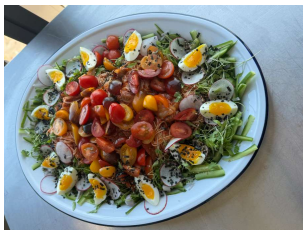
Ingredients
For the sauce
3 tablespoons tomato paste
2 tablespoons gochujang
1 teaspoon kosher salt
1 1/2 tablespoons sesame oil
3 tablespoons apple cider vinegar
3 tablespoons kimchi juice
1 tablespoon honey
1 cup chopped kimchi
For the noodles
150 grams somen noodles
For the toppings
2 Persian cucumbers, sliced into matchsticks
1 shallot, minced
2 cups cherry tomatoes, halved
2 soft-boiled eggs (7 minutes, jammy yolks)
4 radishes, thinly sliced
To finish
Extra sesame oil, for drizzling
2 tablespoons furikake
Handful of cilantro
Directions
•Step 1
An English semantics professor is teaching a graduate seminar on polysemy and context-dependent meaning using culinary vocabulary from the recipe. The professor highlights the word "tender" in the instruction "cook for 3 to 4 minutes, until just tender" and asks students to analyze its semantic range across different contexts: "tender meat," "a tender moment," "legal tender," "tender loving care," and "tender one's resignation." When discussing how context disambiguates polysemous meanings and how semantic features shift across different domains (physical texture, emotional quality, monetary function, affectionate care, formal offering), which linguistic analysis demonstrates the most sophisticated understanding of lexical semantics?
Cold Kimchi Tomato Bibim Noodles
Ingredients
For the sauce
3 tablespoons tomato paste
2 tablespoons gochujang
1 teaspoon kosher salt
1 1/2 tablespoons sesame oil
3 tablespoons apple cider vinegar
3 tablespoons kimchi juice
1 tablespoon honey
1 cup chopped kimchi
For the noodles
150 grams somen noodles
For the toppings
2 Persian cucumbers, sliced into matchsticks
1 shallot, minced
2 cups cherry tomatoes, halved
2 soft-boiled eggs (7 minutes, jammy yolks)
4 radishes, thinly sliced
To finish
Extra sesame oil, for drizzling
2 tablespoons furikake
Handful of cilantro
Directions
•Step 1
An English teacher is designing a lesson sequence based on the Cold Kimchi Tomato Bibim Noodles recipe, aiming to align with Brazil's Base Nacional Comum Curricular (BNCC) competencies for English language teaching. The BNCC emphasizes developing students' repertoires through contact with linguistic and cultural manifestations, critical language awareness, intercultural communication, and English as a lingua franca. The teacher plans activities exploring the recipe's fusion of Korean, Japanese, and Western ingredients as a metaphor for linguistic and cultural hybridity, discussing food globalization, analyzing how recipes constitute intercultural texts, and having students create their own fusion recipes using Brazilian ingredients. Regarding the BNCC's theoretical framework and contemporary approaches to English language teaching that reject native-speaker models and emphasize pluricentric, decolonial perspectives, which pedagogical approach best exemplifies BNCC-aligned practice?
Cold Kimchi Tomato Bibim Noodles
Ingredients
For the sauce
3 tablespoons tomato paste
2 tablespoons gochujang
1 teaspoon kosher salt
1 1/2 tablespoons sesame oil
3 tablespoons apple cider vinegar
3 tablespoons kimchi juice
1 tablespoon honey
1 cup chopped kimchi
For the noodles
150 grams somen noodles
For the toppings
2 Persian cucumbers, sliced into matchsticks
1 shallot, minced
2 cups cherry tomatoes, halved
2 soft-boiled eggs (7 minutes, jammy yolks)
4 radishes, thinly sliced
To finish
Extra sesame oil, for drizzling
2 tablespoons furikake
Handful of cilantro
Directions
•Step 1
I.The phrasal verb "shake off" in "shake off excess water" consists of a transitive separable phrasal verb where "shake" functions as the lexical verb and "off" as an adverbial particle modifying the verb's meaning to indicate removal or elimination, and this construction could be paraphrased as "remove by shaking" without significant semantic loss.
II.The passive voice construction "until each strand is coated" demonstrates a grammatical transformation from an active equivalent "until the sauce coats each strand," where the patient (each strand) becomes the syntactic subject while the agent (sauce) is demoted or omitted, and this passivization serves the rhetorical function of maintaining focus on the noodles rather than the sauce throughout the instructional sequence.
III.The temporal subordinate clause "until completely cooled" in "rinse under cold water until completely cooled" exhibits ellipsis of the subject and auxiliary verb, with the complete structure being "until [the noodles are] completely cooled," and this syntactic reduction represents a common feature of procedural discourse where redundant elements are omitted for brevity and efficiency.
The following statement(s) is/are CORRECT:
Cold Kimchi Tomato Bibim Noodles
Ingredients
For the sauce
3 tablespoons tomato paste
2 tablespoons gochujang
1 teaspoon kosher salt
1 1/2 tablespoons sesame oil
3 tablespoons apple cider vinegar
3 tablespoons kimchi juice
1 tablespoon honey
1 cup chopped kimchi
For the noodles
150 grams somen noodles
For the toppings
2 Persian cucumbers, sliced into matchsticks
1 shallot, minced
2 cups cherry tomatoes, halved
2 soft-boiled eggs (7 minutes, jammy yolks)
4 radishes, thinly sliced
To finish
Extra sesame oil, for drizzling
2 tablespoons furikake
Handful of cilantro
Directions
•Step 1
"Bring a pot of water to a rolling boil. Add the somen noodles and cook for 3 to 4 minutes, until just tender. Drain and rinse under cold water until completely cooled, then shake off excess water."An English teacher specializing in pragmatics and speech act theory is analyzing this instructional sequence with advanced students. When examining the illocutionary force of imperative constructions in procedural discourse and their pragmatic functions within the recipe genre, particularly how directives function to guide reader behavior while maintaining cooperative communication principles, the teacher should recognize that:
Cold Kimchi Tomato Bibim Noodles
Ingredients
For the sauce
3 tablespoons tomato paste
2 tablespoons gochujang
1 teaspoon kosher salt
1 1/2 tablespoons sesame oil
3 tablespoons apple cider vinegar
3 tablespoons kimchi juice
1 tablespoon honey
1 cup chopped kimchi
For the noodles
150 grams somen noodles
For the toppings
2 Persian cucumbers, sliced into matchsticks
1 shallot, minced
2 cups cherry tomatoes, halved
2 soft-boiled eggs (7 minutes, jammy yolks)
4 radishes, thinly sliced
To finish
Extra sesame oil, for drizzling
2 tablespoons furikake
Handful of cilantro
Directions
•Step 1
A professional translator working on a Brazilian Portuguese edition of an international cookbook encounters the recipe title "Cold Kimchi Tomato Bibim Noodles" and several culture-specific ingredients including "gochujang," "furikake," "Persian cucumbers," and "somen noodles." The translator must decide between foreignization (maintaining source-language terms to preserve cultural authenticity) and domestication (adapting to target-culture equivalents for familiarity). Regarding translation theory, particularly Lawrence Venuti's concepts of foreignization versus domestication and Eugene Nida's formal versus dynamic equivalence, which approach demonstrates the most theoretically informed and contextually appropriate translation strategy?

 Conheça nossos planos