Questões de Concurso Público UNICENTRO 2025 para Vestibular
Foram encontradas 14 questões


I. A Educação é um dos campos com maior rejeição ao uso de IA, tanto no ambiente escolar quanto na produção de materiais pedagógicos de ensino.
II. A IA desfavorece a interação humana, prejudica a relação de ensino-aprendizagem em sala de aula e substitui o professor tecnicamente.
III. O cenário internacional é protagonista em relação ao uso de IA, devido ao estímulo à inclusão digital oficializado nas políticas educacionais escolares.
IV. A garantia de uma educação tecnológica, com equidade e impacto social, é possível a partir de políticas públicas e de formação continuada de docentes.
Assinale a alternativa correta.
I. No primeiro parágrafo, o sujeito “inteligência artificial” é retomado três vezes por meio de diferentes pronomes: “ela”, “sua”, “-la”.
II. No segundo parágrafo, o termo “que” é pronome relativo nas duas ocorrências e introduz orações subordinadas adjetivas.
III. No terceiro parágrafo, o termo “que” funciona como conjunção e introduz uma oração que desempenha função de complemento do verbo “revelou”.
IV. No quarto parágrafo, o uso excessivo de verbos prejudica a composição dos períodos assim como a sintaxe do enunciado.
Assinale a alternativa correta.
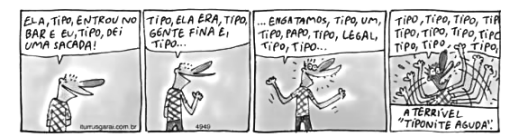
I. A constituição do gênero textual, além de apresentar linguagem verbal e não verbal, permite o uso de linguagem informal, enfatizando a linguagem cotidiana dos usuários da língua.
II. O título do texto apresenta um termo formado com sufixo do campo da saúde (tiponite), descaracterizando o tipo textual.
III. A linguagem empregada deve estar atenta ao uso adequado de gírias, jargões e coloquialismos, característica central desse gênero de texto.
IV. No último quadro, a soma de linguagens (verbal e não verbal) indica, implicitamente, uma crítica ao uso excessivo do coloquialismo na fala.
Assinale a alternativa correta.
Leia o poema a seguir.
Homero
Os gregos foram capazes de

milhares de troianos
porém
no último canto de ilíada
aquiles devolve a príamo
o corpo de seu filho heitor
hoje nesse momento aqui
no sul do sul do mundo
ainda não se tem notícia
dos mais de duzentos desaparecidos
na ditadura militar
um corpo é um atestado de barbárie
até os gregos tinham piedade
(ROMÃO, Luiza. Também Guardamos Pedras Aqui. São Paulo: Nós, 2021. Ed. Digital.)
A partir da leitura do poema e dos conhecimentos sobre a obra de Luiza Romão, considere as afirmativas a seguir.
I. A tarja preta, que toma dezenove linhas do poema, permite que o leitor complete o sentido, a partir de seus conhecimentos sobre a Guerra de Troia.
II. No que diz respeito à obra Também guardamos pedras aqui, pode-se afirmar que a tarja preta é um recurso estilístico que a autora utilizou apenas no poema em análise.
III. O verso “até os gregos tinham piedade” estabelece uma relação entre os gregos e os governos militares brasileiros, atribuindo a estes, qualidades que aqueles não tinham.
IV. O verso “porém” contribui para o estabelecimento de uma distinção entre os fatos do passado remoto, na Grécia, e os fatos do passado recente, no Brasil.
Assinale a alternativa correta.
Com um olhar incrédulo,
[o rapaz] sinalizou com o braço alguns metros à minha frente e disse:
– Moça, é aquela árvore ali, a única que tem na quadra.
Era uma árvore grande. Bem grande. Naquele momento eu
reconheci a castanheira.
Envergonhada, agradeci e fui em direção ao meu destino.
Por que não vejo mais árvores?
Quando foi que deixei de perceber gentes-floresta?
Quando?
E você?
(DORRICO, Julie. Eu sou Macuxi e outras histórias. Nova Lima: Caos e Letras, 2019. p. 83.)
A partir da leitura do excerto e dos conhecimentos sobre a obra Eu sou Macuxi e outras histórias, de Julie Derrico, considere as afirmativas a seguir.
I. A obra Eu sou Macuxi e outras histórias é construída a partir da técnica da prosa poética, em que poesia e prosa se misturam, criando uma obra de difícil classificação.
II. O trecho “Quando foi que deixei de perceber gentes-floresta? / Quando? / E você?” desafia o leitor a ver, na própria estrutura do poema, a árvore que a narradora não viu.
III. A história “Makunaima e os manos deuses” conta a história de como o “homem branco” decidiu se tornar um “Deus” mais importante do que os outros deuses, negando os seus irmãos indígenas.
IV. Em dado momento da obra, a narradora informa que sua mãe fala inglês: “[...] a língua de minha mãe seria o inglês, assim [...] sua vida seria mais fácil”. Isso ocorre porque a família migrou dos Estados Unidos da América.
Assinale a alternativa correta.
A hora era de muito sol — o povo caçava jeito de ficarem debaixo da sombra das árvores de cedro. O carro lembrava um canoão no seco, navio. A gente olhava: nas reluzências do ar, parecia que ele estava torto, que nas pontas se empinava. O borco bojudo do telhadilho dele alumiava em preto. Parecia coisa de invento de muita distância, sem piedade nenhuma, e que a gente não pudesse imaginar direito nem se acostumar de ver, e não sendo de ninguém. Para onde ia, no levar as mulheres, era para um lugar chamado Barbacena, longe. Para o pobre, os lugares são mais longe.
O Agente da estação apareceu, fardado de amarelo, com o livro de capa preta e as bandeirinhas verde e vermelha debaixo do braço. — "Vai ver se botaram água fresca no carro..." — ele mandou. Depois, o guarda-freios andou mexendo nas mangueiras de engate. Alguém deu aviso: — “Eles vêm!...” Apontavam, da Rua de Baixo, onde morava Sorôco. Ele era um homenzão, brutalhudo de corpo, com a cara grande, uma barba, fiosa, encardida em amarelo, e uns pés, com alpercatas: as crianças tomavam medo dele; mais, da voz, que era quase pouca, grossa, que em seguida se afinava. Vinham vindo, com o trazer de comitiva.
(ROSA, João Guimarães. Primeiras estórias. Rio de Janeiro: Editora Nova Fronteira, 2001. p. 63.)
Sobre o conto Soroco, sua mãe e sua filha, de Guimarães Rosa, é correto afirmar:
Leia o texto a seguir e responda à questão.
One of myfavorite scenes in writer/director James Gunn’s energetic but scattershot “Superman” is also one of the simplest. Rachel Brosnahan’s Lois Lane comes home to her apartment and finds David Corenswet’s Clark Kent cooking her “breakfast for dinner” as a surprise to celebrate their three-month anniversary.
Clark says that’s her favorite. your favorite. Lois says no—that’s They’re in that awkward and halting but sweet start-up period in a relationship, where one of them is ahead of the other in terms of making a commitment and they’re still getting to know each other. Oh, and then there’s the fact that Clark is Superman, and Clark Kent, the Daily Planet journalist, keeps getting exclusive, friendly interviews with Superman, but Clark agrees to give Lois an on-the-record interview with Superman. The result is a clearly written, well-performed conversation that feels like a funny romantic comedy with serious undertones, as Lois asks Superman fair but tough questions about the ethics of his decision to end a coming war in a foreign land without the approval of the United States government. Good stuff. There are a number of well-executed, dialogue-driven scenes mixed with the explosive CGI battles, the existential drama and the laugh-out-loud cameos, and writer/director Gunn admirably focuses on showing Superman as the embodiment of the classic American immigrant story—but this first entry in the new DC Universe left me with a cinematic fast-food vibe. You enjoy the flavors well enough, but you’re left feeling as if you’ve consumed a familiar, empty-calorie (relatively) Happy Meal. Despite the sincere and strong performances by Corenswet and Brosnahan, and plenty of colorful turns by the talented supporting cast, the fantastical elements of the Gods and Monsters universe come across as leftovers from Gunn’s “Guardians of the Galaxy” films and the battle sequences feel like fast-edited, unoriginal copies of fight scenes from dozens of other superhero movies. We’re left with a decent but not great take on “Superman” that, at times, will remind you of the 1978 version, but doesn’t quite match it for pure pop entertainment value. As for Corenswet, he makes for a charming Superman, but he can’t quite match the movie star power of Christopher Reeve, nor does he have the unsettling, laser-focused ferocity of Henry Cavill. We’ve had nearly a dozen versions of Superman on screens big and small through the decades—and for that matter, about the same number of Lex Luthors. This latest version makes for enjoyable-enough popcorn entertainment, but ultimately leaves us wondering: was it even necessary?

Superman
Action
130 minutes · PG-13 · 2025
Richard Roeper
July 8, 2025
5 min read
(Adaptado de ROEPER, Richard. Superman. In RogerEbert.com (ONLINE), 8 jul. 2025.)
(Disponível em:
Leia o texto a seguir e responda à questão.
One of myfavorite scenes in writer/director James Gunn’s energetic but scattershot “Superman” is also one of the simplest. Rachel Brosnahan’s Lois Lane comes home to her apartment and finds David Corenswet’s Clark Kent cooking her “breakfast for dinner” as a surprise to celebrate their three-month anniversary.
Clark says that’s her favorite. your favorite. Lois says no—that’s They’re in that awkward and halting but sweet start-up period in a relationship, where one of them is ahead of the other in terms of making a commitment and they’re still getting to know each other. Oh, and then there’s the fact that Clark is Superman, and Clark Kent, the Daily Planet journalist, keeps getting exclusive, friendly interviews with Superman, but Clark agrees to give Lois an on-the-record interview with Superman. The result is a clearly written, well-performed conversation that feels like a funny romantic comedy with serious undertones, as Lois asks Superman fair but tough questions about the ethics of his decision to end a coming war in a foreign land without the approval of the United States government. Good stuff. There are a number of well-executed, dialogue-driven scenes mixed with the explosive CGI battles, the existential drama and the laugh-out-loud cameos, and writer/director Gunn admirably focuses on showing Superman as the embodiment of the classic American immigrant story—but this first entry in the new DC Universe left me with a cinematic fast-food vibe. You enjoy the flavors well enough, but you’re left feeling as if you’ve consumed a familiar, empty-calorie (relatively) Happy Meal. Despite the sincere and strong performances by Corenswet and Brosnahan, and plenty of colorful turns by the talented supporting cast, the fantastical elements of the Gods and Monsters universe come across as leftovers from Gunn’s “Guardians of the Galaxy” films and the battle sequences feel like fast-edited, unoriginal copies of fight scenes from dozens of other superhero movies. We’re left with a decent but not great take on “Superman” that, at times, will remind you of the 1978 version, but doesn’t quite match it for pure pop entertainment value. As for Corenswet, he makes for a charming Superman, but he can’t quite match the movie star power of Christopher Reeve, nor does he have the unsettling, laser-focused ferocity of Henry Cavill. We’ve had nearly a dozen versions of Superman on screens big and small through the decades—and for that matter, about the same number of Lex Luthors. This latest version makes for enjoyable-enough popcorn entertainment, but ultimately leaves us wondering: was it even necessary?
Superman
Action
130 minutes · PG-13 · 2025
Richard Roeper
July 8, 2025
5 min read
(Adaptado de ROEPER, Richard. Superman. In RogerEbert.com (ONLINE), 8 jul. 2025.)
(Disponível em:
Leia o texto a seguir e responda à questão.
One of myfavorite scenes in writer/director James Gunn’s energetic but scattershot “Superman” is also one of the simplest. Rachel Brosnahan’s Lois Lane comes home to her apartment and finds David Corenswet’s Clark Kent cooking her “breakfast for dinner” as a surprise to celebrate their three-month anniversary.
Clark says that’s her favorite. your favorite. Lois says no—that’s They’re in that awkward and halting but sweet start-up period in a relationship, where one of them is ahead of the other in terms of making a commitment and they’re still getting to know each other. Oh, and then there’s the fact that Clark is Superman, and Clark Kent, the Daily Planet journalist, keeps getting exclusive, friendly interviews with Superman, but Clark agrees to give Lois an on-the-record interview with Superman. The result is a clearly written, well-performed conversation that feels like a funny romantic comedy with serious undertones, as Lois asks Superman fair but tough questions about the ethics of his decision to end a coming war in a foreign land without the approval of the United States government. Good stuff. There are a number of well-executed, dialogue-driven scenes mixed with the explosive CGI battles, the existential drama and the laugh-out-loud cameos, and writer/director Gunn admirably focuses on showing Superman as the embodiment of the classic American immigrant story—but this first entry in the new DC Universe left me with a cinematic fast-food vibe. You enjoy the flavors well enough, but you’re left feeling as if you’ve consumed a familiar, empty-calorie (relatively) Happy Meal. Despite the sincere and strong performances by Corenswet and Brosnahan, and plenty of colorful turns by the talented supporting cast, the fantastical elements of the Gods and Monsters universe come across as leftovers from Gunn’s “Guardians of the Galaxy” films and the battle sequences feel like fast-edited, unoriginal copies of fight scenes from dozens of other superhero movies. We’re left with a decent but not great take on “Superman” that, at times, will remind you of the 1978 version, but doesn’t quite match it for pure pop entertainment value. As for Corenswet, he makes for a charming Superman, but he can’t quite match the movie star power of Christopher Reeve, nor does he have the unsettling, laser-focused ferocity of Henry Cavill. We’ve had nearly a dozen versions of Superman on screens big and small through the decades—and for that matter, about the same number of Lex Luthors. This latest version makes for enjoyable-enough popcorn entertainment, but ultimately leaves us wondering: was it even necessary?
Superman
Action
130 minutes · PG-13 · 2025
Richard Roeper
July 8, 2025
5 min read
(Adaptado de ROEPER, Richard. Superman. In RogerEbert.com (ONLINE), 8 jul. 2025.)
(Disponível em:
I. A metáfora do “fast-food” serve para destacar a contradição entre qualidade técnica e profundidade narrativa.
II. A associação com o “Happy Meal” sugere que, embora o filme seja divertido, ele se caracteriza pela falta de originalidade.
III. A metáfora sugere que o filme é saboroso e memorável, deixando uma experiência única no espectador.
IV. A expressão “cinematic fast-food vibe” sugere que o filme usa ação e humor para criticar a sociedade norte-americana.
Assinale a alternativa correta.
O “ofício do historiador” é um ofício de homens que escrevem a história no masculino. Os campos que abordam são os da ação e do poder masculinos, mesmo quando anexam novos territórios. Econômica, a história ignora a mulher improdutiva. Social, ela privilegia as classes e negligencia os sexos. Cultural ou “mental”, ela fala do Homem em geral, tão assexuado quanto a Humanidade. Célebres– piedosas ou escandalosas–, as mulheres alimentam as crônicas da “pequena” história, meras coadjuvantes da História!
(PERROT, Michellle. Os Excluídos da História: Operários, Mulheres e Prisioneiros. Rio de Janeiro: Paz e Terra, 1988, p.185.)
Sobre essa passagem da historiadora Michelle Perrot, considere as afirmativas a seguir.
I. A historiadora afirma que a história tem sido escrita pelo olhar masculino, relegando à mulher um lugar de coadjuvante.
II. Segundo Perrot, a história deve ser escrita apenas por homens, pois este é um ofício masculino.
III. Para a autora, todas as histórias que são escritas sobre as mulheres são pequenas crônicas.
IV. O texto da autora faz uma crítica à forma como a História tem sido escrita, pois os campos de ação analisados são geralmente masculinos.
Assinale a alternativa correta.
Santaella (2003) diz que “para compreender essas passagens de uma cultura à outra” é preciso considerar seis tipos de eras culturais no processo de evolução da humanidade: a cultura oral, a cultura escrita, a cultura impressa, a cultura de massas, a cultura das mídias e a cultura digital. Segundo a autora, “essas divisões estão pautadas na convicção de que os meios de comunicação, desde o aparelho fonador até as redes digitais atuais, não passam de meros canais para a transmissão de informação”. [...] Como já afirmava Santaella, em 2003, as novas tecnologias digitais de informação e comunicação estão mudando não apenas as formas do entretenimento e do lazer, mas potencialmente todas as esferas da sociedade: o trabalho, o gerenciamento político, as atividades militares e policiais, o consumo, a comunicação e a educação, “enfim, estão mudando toda a cultura em geral”.
(KENSKI, Vani Moreira. “Cultura Digital”. In: MILL, Daniel. Dicionário Crítico de Educação e Tecnologias e de educação a distância. Campinas: Editora Papirus, 2018.)
Com base no texto e nos conhecimentos sobre Cultura e Tecnologias, assinale a alternativa correta.
(Disponível em:<https://jornal.usp.br/ciencias/residuos-farmacologicos-sao-encontrados-em-agua-destinada-ao-consumo-humano>. Acesso em: 9 jul .2025.)

 Conheça nossos planos