Questões de Concurso Público SEED-PR 2026 para Língua Inglesa / Informação e Comunicação
Foram encontradas 72 questões


O texto a seguir é referência para a questão.
Em 10 de dezembro de 1987, Londrina foi palco de um evento que entraria para a história policial brasileira: o assalto com o maior número de reféns já registrados no país. Sete homens armados invadiram a agência do Banestado, exigindo uma montanha de 30 milhões de cruzados e, no processo, mantiveram mais de 300 pessoas reféns.
Essa é a história que o diretor José Eduardo Belmonte decidiu contar em Assalto à Brasileira, filme que adapta um dos capítulos policiais mais bizarros do país. O longa não perde tempo com introduções prolixas; rapidamente somos jogados no olho do furacão, acompanhando Paulo (Murilo Benício), um jornalista recém-demitido que vai à agência buscar sua rescisão, e Moreno (Christian Malheiros), o líder do assalto. Os motivos dos criminosos são contextualizados pela crise econômica da época, mas o filme prefere a ação imediata a longas explicações.
Benício é o grande destaque do longa. Ele entrega uma atuação fantástica, um equilíbrio entre a tensão, a comédia e a malandragem do personagem em cada cena, seja no desespero inicial ou nas negociações com a polícia. Contudo, o foco não recai apenas sobre o ator. Quase todo o elenco entrega performances memoráveis. Muitos dos reféns roubam a cena com reações cômicas diante do absurdo, e a química entre os assaltantes é um acerto cirúrgico; suas interações fazem o público se divertir, como se tivessem reunido “Os Trapalhões” para executar um grande assalto. […]
Outro ponto técnico que merece destaque é a direção de arte e a fotografia. Trabalhando com um espaço limitado – o banco assaltado em questão –, a equipe constrói uma ambientação incrivelmente fiel à década de 80, desde a redação da Folha de Londrina até a multidão histérica do lado de fora. […]
Disponível em: https://www.omelete.com.br/.
A situação hipotética a seguir é referência para a questão.
Ao preparar seu plano de aula sobre um determinado tópico, uma professora selecionou materiais em diferentes suportes: vídeo, imagem, HQ e textos escritos (literário e não literário). Uma semana antes dessa aula, a professora disponibilizou todo o material aos alunos e às alunas, encaminhando-o pelos endereços de e-mail que cada estudante tem cadastrado na escola, bem como inserindo-o na plataforma digital de uso cotidiano na instituição. Também foram indicados para leitura materiais complementares, que alunos e alunas deveriam acessar em diferentes sites. A professora orientou que todos esses materiais deveriam ser lidos. Os materiais não indicavam explicitamente o tópico que seria objeto da aula, mas, de uma maneira ou outra, ele estava tematizado em todos. No dia previsto para a aula sobre o tópico, a professora dividiu a turma em grupos, solicitando que cada grupo sintetizasse o tema central de cada material. Em seguida, cada grupo expôs sua síntese aos demais. Após o compartilhamento das leituras dos grupos, a professora distribuiu a cada estudante um questionário com perguntas que iam gradativamente fechando o foco no tópico que ela havia previamente selecionado como tema daquela aula.
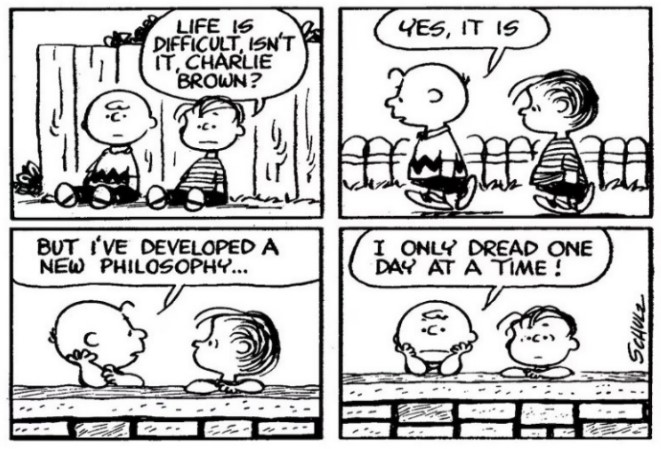
According to the comic strip, Charlie Brown:
“People who live in glass houses should not throw stones.”
What does this proverb mean?
Mark the correct verb tenses that fill in the gaps of the sentence below:
If Mark _______ a scholarship he _______ to England to improve his English.
Mark the prepositon that fills in the gap of the sentence below:
The football game had to be postponed _______ weather conditions.
Consider the following headline:
Harry and Meghan likely to meet King Charles on UK return in matter of weeks.
Available in: https://www.mirror.co.uk.
According to the headline, it is correct to say that:
The following text is reference to question.
Why strength training advice for women is mostly wrong
For years, women were told to train differently because of their hormones. New research suggests the fundamentals of building strength and muscle look remarkably similar across sexes.
For decades, women have been told they need special workout rules. Don’t lift too heavy. Train around your hormones. Change your workouts throughout the month.
The advice seemed logical. Men have substantially higher testosterone levels, a hormone that plays a major role in muscle growth. “Testosterone increases muscle mass in boys, and so you get an adult 20-year-old man and an adult 20-year-old woman, and there’s going to be differences in baseline muscle size and strength,” says Lauren Colenso-Semple, a researcher and science communicator specializing in female physiology and exercise.
___(1)___ a growing body of research suggests those differences may matter less than many people assume once training begins. A 2025 meta-analysis published in PeerJ found that women have a similar capacity for muscle growth, known as hypertrophy, as men. While men typically start with more muscle mass, women make comparable relative gains in muscle mass through resistance training.
Once people start exercising, the sex differences disappear quite quickly: “When you think about lifting weights and the magnitude of muscle size and strength that you can gain in response to training, the trajectory is very, very similar in men and women,” says Semple, a researcher and science specializing in female physiology and exercise.
___(2)___ hormones can influence how exercise feels from day to day, there is little evidence that most women need entirely different training programs to build muscle, strength, or fitness. That matters because resistance training remains one of the most powerful tools for improving cardiovascular health, preserving bone density, and supporting healthy aging.
Available in: https://www.nationalgeographic.com.
Consider the following sentences:
1. When a man begins training, he usually starts with more muscle mass.
2. When the process of working out begins, differences between men and women become insignificant.
3. Regular exercise maintains the body’s strength and it is the basis of aging well.
4. In the past, women were told to focus less on optimizing around their hormones and more on the fundamentals of getting stronger.
The text contains the idea(s) in the sentence(s):

 Conheça nossos planos