Questões de Concurso Público SEDUC-AL 2026 para Professor - Inglês
Foram encontradas 117 questões


Ano: 2026
Banca:
CESPE / CEBRASPE
Órgão:
SEDUC-AL
Prova:
CESPE / CEBRASPE - 2026 - SEDUC-AL - Professor - Inglês |
Q4443012
Inglês
Texto associado
Evaluate the following item, which relates to the provided text and to new trends in English language teaching.
Dante, the Italian author, was sort of a linguistic Darwin.
He held a heretical theory. Europe’s languages, he thought, had
not been made in a single moment, in a biblical Babel, but had
evolved. With the care of a Victorian naturalist, he thus split
Europe’s languages into families by their words for "yes": those
who lived in southern France and said "oc" spoke a "Langue
d’oc".
He was spot-on. Four centuries later, a British judge and
polyglot called Sir William Jones arrived in Calcutta and was
struck by the similarities between Latin and Sanskrit words for
terms such as house (domus, dam) and god (deus, deva). Clearly
they had "sprung from some common source, which, perhaps, no
longer exists". The world’s languages were not a Babel but a
brotherhood.
Proto, a new book by Laura Spinney, a journalist, offers a
biography of that brotherhood—or rather its parent. For Jones’s
"common source" now has a name: "Proto-Indo-European" (PIE).
It was first spoken by as little as a few dozen people around the
Black Sea then, roughly 5,000 years ago, spread with rapidity
"from Ireland to India". Today, its offshoots include Irish,
Hindi—and more or less everything in between. Almost half of
the world’s population speaks a descendant of it.
PIE is long dead, but traces of it remain caught, like
insects in amber, in modern languages, allowing academics to
bring it back to life. Scholars know, for example, its speakers
found visitors irritating: the PIE word "ghostis" gives English not
just "guest" but "ghost", and Latin its word for "host" but also
"enemy".
Internet: <https://www.economist.com>(Adapted)
Calling the world’s languages "a brotherhood" (second
paragraph) emphasizes the fact that they have similarities
and common traces, an idea that is reinforced by the use of
"its parent" in the third paragraph.
Ano: 2026
Banca:
CESPE / CEBRASPE
Órgão:
SEDUC-AL
Prova:
CESPE / CEBRASPE - 2026 - SEDUC-AL - Professor - Inglês |
Q4443013
Inglês
Texto associado
Evaluate the following item, which relates to the provided text and to new trends in English language teaching.
Dante, the Italian author, was sort of a linguistic Darwin.
He held a heretical theory. Europe’s languages, he thought, had
not been made in a single moment, in a biblical Babel, but had
evolved. With the care of a Victorian naturalist, he thus split
Europe’s languages into families by their words for "yes": those
who lived in southern France and said "oc" spoke a "Langue
d’oc".
He was spot-on. Four centuries later, a British judge and
polyglot called Sir William Jones arrived in Calcutta and was
struck by the similarities between Latin and Sanskrit words for
terms such as house (domus, dam) and god (deus, deva). Clearly
they had "sprung from some common source, which, perhaps, no
longer exists". The world’s languages were not a Babel but a
brotherhood.
Proto, a new book by Laura Spinney, a journalist, offers a
biography of that brotherhood—or rather its parent. For Jones’s
"common source" now has a name: "Proto-Indo-European" (PIE).
It was first spoken by as little as a few dozen people around the
Black Sea then, roughly 5,000 years ago, spread with rapidity
"from Ireland to India". Today, its offshoots include Irish,
Hindi—and more or less everything in between. Almost half of
the world’s population speaks a descendant of it.
PIE is long dead, but traces of it remain caught, like
insects in amber, in modern languages, allowing academics to
bring it back to life. Scholars know, for example, its speakers
found visitors irritating: the PIE word "ghostis" gives English not
just "guest" but "ghost", and Latin its word for "host" but also
"enemy".
Internet: <https://www.economist.com>(Adapted)
The mention of the word 'ghostis' and the words it originated
in English (fourth paragraph) demonstrates that Proto-Indo- European lives on in modern languages.
Ano: 2026
Banca:
CESPE / CEBRASPE
Órgão:
SEDUC-AL
Prova:
CESPE / CEBRASPE - 2026 - SEDUC-AL - Professor - Inglês |
Q4443014
Inglês
Texto associado
Evaluate the following item, which relates to the provided text and to new trends in English language teaching.
Dante, the Italian author, was sort of a linguistic Darwin.
He held a heretical theory. Europe’s languages, he thought, had
not been made in a single moment, in a biblical Babel, but had
evolved. With the care of a Victorian naturalist, he thus split
Europe’s languages into families by their words for "yes": those
who lived in southern France and said "oc" spoke a "Langue
d’oc".
He was spot-on. Four centuries later, a British judge and
polyglot called Sir William Jones arrived in Calcutta and was
struck by the similarities between Latin and Sanskrit words for
terms such as house (domus, dam) and god (deus, deva). Clearly
they had "sprung from some common source, which, perhaps, no
longer exists". The world’s languages were not a Babel but a
brotherhood.
Proto, a new book by Laura Spinney, a journalist, offers a
biography of that brotherhood—or rather its parent. For Jones’s
"common source" now has a name: "Proto-Indo-European" (PIE).
It was first spoken by as little as a few dozen people around the
Black Sea then, roughly 5,000 years ago, spread with rapidity
"from Ireland to India". Today, its offshoots include Irish,
Hindi—and more or less everything in between. Almost half of
the world’s population speaks a descendant of it.
PIE is long dead, but traces of it remain caught, like
insects in amber, in modern languages, allowing academics to
bring it back to life. Scholars know, for example, its speakers
found visitors irritating: the PIE word "ghostis" gives English not
just "guest" but "ghost", and Latin its word for "host" but also
"enemy".
Internet: <https://www.economist.com>(Adapted)
Proto is the name journalist Laura Spinney gave to the
language believed to be spoken roughly 5,000 years ago.
Ano: 2026
Banca:
CESPE / CEBRASPE
Órgão:
SEDUC-AL
Prova:
CESPE / CEBRASPE - 2026 - SEDUC-AL - Professor - Inglês |
Q4443015
Inglês
Texto associado
Evaluate the following item based on the preceding text.
It all started with some exasperated emails. Back in 2009,
a group of researchers began venting their frustration with the
programming languages designed to help scientists and other
researchers perform complex mathematical operations and
statistical simulations without learning how to code. These
programming languages were rigid and slow.
The emails turned into a research project at MIT
(Massachusetts Institute of Technology) with the mission of
building an easy-to-use, high-performance programming
language called Julia, which is designed for scientific research,
data analysis, and modeling complex systems such as jet engines,
drugs, financial markets, and robots, to name a few examples.
That research project turned into a lab at MIT, and the lab
turned into the company JuliaHub. Along the way, Julia gained a
loyal following among scientists, engineers, mathematicians, and
others. Today, the free and open-source language counts more
than 1 million users, including people working in thousands of
companies and universities around the world.
It is only a slight exaggeration to say Julia has been used
to model everything under the sun, from the behavior of tiny
atoms to semiconductors, neural networks, race cars, and
airplanes. It has also been used to study much beyond the sun,
with astronomers using Julia for imaging black holes.
Internet: <https://news.mit.edu> (Adapted).
The passage "It is only a slight exaggeration" (last
paragraph) is used to introduce an overstatement about the
programming language Julia, which is not actually capable
of modelling the behavior of tiny atoms.
Ano: 2026
Banca:
CESPE / CEBRASPE
Órgão:
SEDUC-AL
Prova:
CESPE / CEBRASPE - 2026 - SEDUC-AL - Professor - Inglês |
Q4443016
Inglês
Texto associado
Evaluate the following item based on the preceding text.
It all started with some exasperated emails. Back in 2009,
a group of researchers began venting their frustration with the
programming languages designed to help scientists and other
researchers perform complex mathematical operations and
statistical simulations without learning how to code. These
programming languages were rigid and slow.
The emails turned into a research project at MIT
(Massachusetts Institute of Technology) with the mission of
building an easy-to-use, high-performance programming
language called Julia, which is designed for scientific research,
data analysis, and modeling complex systems such as jet engines,
drugs, financial markets, and robots, to name a few examples.
That research project turned into a lab at MIT, and the lab
turned into the company JuliaHub. Along the way, Julia gained a
loyal following among scientists, engineers, mathematicians, and
others. Today, the free and open-source language counts more
than 1 million users, including people working in thousands of
companies and universities around the world.
It is only a slight exaggeration to say Julia has been used
to model everything under the sun, from the behavior of tiny
atoms to semiconductors, neural networks, race cars, and
airplanes. It has also been used to study much beyond the sun,
with astronomers using Julia for imaging black holes.
Internet: <https://news.mit.edu> (Adapted).
The expressions "everything under the sun" and "much
beyond the sun" (last paragraph) are used to emphasize the
all-encompassing nature of Julia’s uses.
Ano: 2026
Banca:
CESPE / CEBRASPE
Órgão:
SEDUC-AL
Prova:
CESPE / CEBRASPE - 2026 - SEDUC-AL - Professor - Inglês |
Q4443017
Inglês
Texto associado
Evaluate the following item based on the preceding text.
It all started with some exasperated emails. Back in 2009,
a group of researchers began venting their frustration with the
programming languages designed to help scientists and other
researchers perform complex mathematical operations and
statistical simulations without learning how to code. These
programming languages were rigid and slow.
The emails turned into a research project at MIT
(Massachusetts Institute of Technology) with the mission of
building an easy-to-use, high-performance programming
language called Julia, which is designed for scientific research,
data analysis, and modeling complex systems such as jet engines,
drugs, financial markets, and robots, to name a few examples.
That research project turned into a lab at MIT, and the lab
turned into the company JuliaHub. Along the way, Julia gained a
loyal following among scientists, engineers, mathematicians, and
others. Today, the free and open-source language counts more
than 1 million users, including people working in thousands of
companies and universities around the world.
It is only a slight exaggeration to say Julia has been used
to model everything under the sun, from the behavior of tiny
atoms to semiconductors, neural networks, race cars, and
airplanes. It has also been used to study much beyond the sun,
with astronomers using Julia for imaging black holes.
Internet: <https://news.mit.edu> (Adapted).
According to the text, the writers of the "exasperated emails"
(first paragraph) became the founders of the company
JuliaHub.
Ano: 2026
Banca:
CESPE / CEBRASPE
Órgão:
SEDUC-AL
Prova:
CESPE / CEBRASPE - 2026 - SEDUC-AL - Professor - Inglês |
Q4443018
Inglês
Texto associado
Evaluate the following item based on the preceding text.
It all started with some exasperated emails. Back in 2009,
a group of researchers began venting their frustration with the
programming languages designed to help scientists and other
researchers perform complex mathematical operations and
statistical simulations without learning how to code. These
programming languages were rigid and slow.
The emails turned into a research project at MIT
(Massachusetts Institute of Technology) with the mission of
building an easy-to-use, high-performance programming
language called Julia, which is designed for scientific research,
data analysis, and modeling complex systems such as jet engines,
drugs, financial markets, and robots, to name a few examples.
That research project turned into a lab at MIT, and the lab
turned into the company JuliaHub. Along the way, Julia gained a
loyal following among scientists, engineers, mathematicians, and
others. Today, the free and open-source language counts more
than 1 million users, including people working in thousands of
companies and universities around the world.
It is only a slight exaggeration to say Julia has been used
to model everything under the sun, from the behavior of tiny
atoms to semiconductors, neural networks, race cars, and
airplanes. It has also been used to study much beyond the sun,
with astronomers using Julia for imaging black holes.
Internet: <https://news.mit.edu> (Adapted).
The reason the researchers mentioned in the first paragraph
were irritated was that they wanted people to learn how to
code.
Ano: 2026
Banca:
CESPE / CEBRASPE
Órgão:
SEDUC-AL
Prova:
CESPE / CEBRASPE - 2026 - SEDUC-AL - Professor - Inglês |
Q4443019
Inglês
Texto associado
The item below presents a situation in which a teacher carried out a type of pedagogical activity. Evaluate the following item with regard to new trends in English Language Teaching (ELT).
Students are asked to memorize the sentences they heard in a
podcast, following transcripts and picking up the verb tenses
each speaker uses regularly, to learn to use the verb tenses
correctly. It is correct to state that this is a clear example of a
communicative approach activity.
Ano: 2026
Banca:
CESPE / CEBRASPE
Órgão:
SEDUC-AL
Prova:
CESPE / CEBRASPE - 2026 - SEDUC-AL - Professor - Inglês |
Q4443020
Inglês
Texto associado
The item below presents a situation in which a teacher carried out a type of pedagogical activity. Evaluate the following item with regard to new trends in English Language Teaching (ELT).
A teacher proposed an activity which consisted in organizing
the students in small groups so that they would prepare
questions in English in order to interview people in the
school and then report their findings to the whole class. It is
correct to state that the activity proposed by the teacher is an
example of a task-based language learning activity.
Ano: 2026
Banca:
CESPE / CEBRASPE
Órgão:
SEDUC-AL
Prova:
CESPE / CEBRASPE - 2026 - SEDUC-AL - Professor - Inglês |
Q4443021
Pedagogia
Texto associado
The item below presents a situation in which a teacher carried out a type of pedagogical activity. Evaluate the following item with regard to new trends in English Language Teaching (ELT).
Students are asked to work in pairs to prepare topics of their
choice about anything concerning language to present to
class in a way they are also relatively free to decide (music,
podcast, video etc.); they are also encouraged to use AI tools
for research purposes only. It is correct to state that the
activity proposed combines elements of the communicative
approach and the task-based language learning.
Ano: 2026
Banca:
CESPE / CEBRASPE
Órgão:
SEDUC-AL
Prova:
CESPE / CEBRASPE - 2026 - SEDUC-AL - Professor - Inglês |
Q4443022
Inglês
Texto associado
Considering the preceding text and reading strategies such as skimming, scanning, and prediction, evaluate the following item.
How can education stay ahead in a world being
transformed by climate change, AI, inequality, conflict and
shifting labor markets?
Societies are being reshaped by powerful forces, such as
demographic change, technological transformation, climate and
environmental pressures, threats to peace and democracy,
disinformation, rising inequalities and polarization, and major
labor market transformations. These forces are already changing
how people learn, work, live and participate in society.
As
the
world undergoes rapid and profound
transformation, education systems cannot afford to only respond
to crises after they happen. They need to look ahead, anticipate,
and strategize. Foresight helps us do exactly that: it brings
together evidence, diverse perspectives and structured reflection
to identify the trends, risks and opportunities that could define the
future of education.
It
will
strengthen international, inter-sectoral and
inter-generational dialogue, helping ensure that the emerging
post-2030 education agenda reflects both expert insights and the
diverse realities and aspirations of young people.
Internet: <https://www.unesco.org/sdg4education2030/en/articles/>(adapted).
It can be inferred from the ideas in the third paragraph of the
text that education systems should no longer respond to
crises once they have occurred.
Ano: 2026
Banca:
CESPE / CEBRASPE
Órgão:
SEDUC-AL
Prova:
CESPE / CEBRASPE - 2026 - SEDUC-AL - Professor - Inglês |
Q4443023
Inglês
Texto associado
Considering the preceding text and reading strategies such as skimming, scanning, and prediction, evaluate the following item.
How can education stay ahead in a world being
transformed by climate change, AI, inequality, conflict and
shifting labor markets?
Societies are being reshaped by powerful forces, such as
demographic change, technological transformation, climate and
environmental pressures, threats to peace and democracy,
disinformation, rising inequalities and polarization, and major
labor market transformations. These forces are already changing
how people learn, work, live and participate in society.
As
the
world undergoes rapid and profound
transformation, education systems cannot afford to only respond
to crises after they happen. They need to look ahead, anticipate,
and strategize. Foresight helps us do exactly that: it brings
together evidence, diverse perspectives and structured reflection
to identify the trends, risks and opportunities that could define the
future of education.
It
will
strengthen international, inter-sectoral and
inter-generational dialogue, helping ensure that the emerging
post-2030 education agenda reflects both expert insights and the
diverse realities and aspirations of young people.
Internet: <https://www.unesco.org/sdg4education2030/en/articles/>(adapted).
Skimming would be the appropriate strategy to identify the
main purpose of the text, which is to discuss the need for
education systems to anticipate major transformations that
may affect education and society.
Ano: 2026
Banca:
CESPE / CEBRASPE
Órgão:
SEDUC-AL
Prova:
CESPE / CEBRASPE - 2026 - SEDUC-AL - Professor - Inglês |
Q4443024
Inglês
Texto associado
Considering the preceding text and reading strategies such as skimming, scanning, and prediction, evaluate the following item.
How can education stay ahead in a world being
transformed by climate change, AI, inequality, conflict and
shifting labor markets?
Societies are being reshaped by powerful forces, such as
demographic change, technological transformation, climate and
environmental pressures, threats to peace and democracy,
disinformation, rising inequalities and polarization, and major
labor market transformations. These forces are already changing
how people learn, work, live and participate in society.
As
the
world undergoes rapid and profound
transformation, education systems cannot afford to only respond
to crises after they happen. They need to look ahead, anticipate,
and strategize. Foresight helps us do exactly that: it brings
together evidence, diverse perspectives and structured reflection
to identify the trends, risks and opportunities that could define the
future of education.
It
will
strengthen international, inter-sectoral and
inter-generational dialogue, helping ensure that the emerging
post-2030 education agenda reflects both expert insights and the
diverse realities and aspirations of young people.
Internet: <https://www.unesco.org/sdg4education2030/en/articles/>(adapted).
If a teacher asks his students to search for specific
information in the text about which forces are reshaping
societies, students should apply the scanning strategy to
identify them.
Ano: 2026
Banca:
CESPE / CEBRASPE
Órgão:
SEDUC-AL
Prova:
CESPE / CEBRASPE - 2026 - SEDUC-AL - Professor - Inglês |
Q4443025
Inglês
Texto associado
Considering the preceding text and reading strategies such as skimming, scanning, and prediction, evaluate the following item.
How can education stay ahead in a world being
transformed by climate change, AI, inequality, conflict and
shifting labor markets?
Societies are being reshaped by powerful forces, such as
demographic change, technological transformation, climate and
environmental pressures, threats to peace and democracy,
disinformation, rising inequalities and polarization, and major
labor market transformations. These forces are already changing
how people learn, work, live and participate in society.
As
the
world undergoes rapid and profound
transformation, education systems cannot afford to only respond
to crises after they happen. They need to look ahead, anticipate,
and strategize. Foresight helps us do exactly that: it brings
together evidence, diverse perspectives and structured reflection
to identify the trends, risks and opportunities that could define the
future of education.
It
will
strengthen international, inter-sectoral and
inter-generational dialogue, helping ensure that the emerging
post-2030 education agenda reflects both expert insights and the
diverse realities and aspirations of young people.
Internet: <https://www.unesco.org/sdg4education2030/en/articles/>(adapted).
In the expression "diverse perspectives" (third paragraph),
the word "perspectives" conveys the idea of predictions
about the future of education.
Ano: 2026
Banca:
CESPE / CEBRASPE
Órgão:
SEDUC-AL
Prova:
CESPE / CEBRASPE - 2026 - SEDUC-AL - Professor - Inglês |
Q4443026
Inglês
Texto associado
Considering the preceding text and reading strategies such as skimming, scanning, and prediction, evaluate the following item.
How can education stay ahead in a world being
transformed by climate change, AI, inequality, conflict and
shifting labor markets?
Societies are being reshaped by powerful forces, such as
demographic change, technological transformation, climate and
environmental pressures, threats to peace and democracy,
disinformation, rising inequalities and polarization, and major
labor market transformations. These forces are already changing
how people learn, work, live and participate in society.
As
the
world undergoes rapid and profound
transformation, education systems cannot afford to only respond
to crises after they happen. They need to look ahead, anticipate,
and strategize. Foresight helps us do exactly that: it brings
together evidence, diverse perspectives and structured reflection
to identify the trends, risks and opportunities that could define the
future of education.
It
will
strengthen international, inter-sectoral and
inter-generational dialogue, helping ensure that the emerging
post-2030 education agenda reflects both expert insights and the
diverse realities and aspirations of young people.
Internet: <https://www.unesco.org/sdg4education2030/en/articles/>(adapted).
According to the text, the emerging post-2030 education
agenda is expected to reflect not only expert insights but also
diverse realities and aspirations of young people.
Ano: 2026
Banca:
CESPE / CEBRASPE
Órgão:
SEDUC-AL
Prova:
CESPE / CEBRASPE - 2026 - SEDUC-AL - Professor - Inglês |
Q4443027
Inglês
Texto associado
Considering the preceding text and reading strategies such as skimming, scanning, and prediction, evaluate the following item.
How can education stay ahead in a world being
transformed by climate change, AI, inequality, conflict and
shifting labor markets?
Societies are being reshaped by powerful forces, such as
demographic change, technological transformation, climate and
environmental pressures, threats to peace and democracy,
disinformation, rising inequalities and polarization, and major
labor market transformations. These forces are already changing
how people learn, work, live and participate in society.
As
the
world undergoes rapid and profound
transformation, education systems cannot afford to only respond
to crises after they happen. They need to look ahead, anticipate,
and strategize. Foresight helps us do exactly that: it brings
together evidence, diverse perspectives and structured reflection
to identify the trends, risks and opportunities that could define the
future of education.
It
will
strengthen international, inter-sectoral and
inter-generational dialogue, helping ensure that the emerging
post-2030 education agenda reflects both expert insights and the
diverse realities and aspirations of young people.
Internet: <https://www.unesco.org/sdg4education2030/en/articles/>(adapted).
The question presented in the first paragraph can be used as a
prediction reading exercise in an ESL/EFL class, making
students anticipate the topic of the text and possible
vocabulary.
Ano: 2026
Banca:
CESPE / CEBRASPE
Órgão:
SEDUC-AL
Prova:
CESPE / CEBRASPE - 2026 - SEDUC-AL - Professor - Inglês |
Q4443029
Inglês
Texto associado
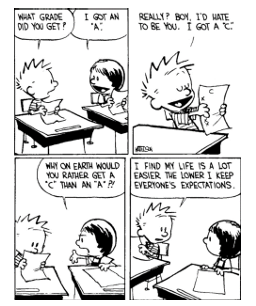
Internet: <https://larrycuban.wordpress>.
The comic strip above depicts a boy (on the left) and a girl (on the right) talking in a classroom. Considering the comic strip and the ideas it conveys, evaluate the following item.
The boy’s argument shows that he considers academic
achievement less important than keeping his expectations
about himself low.
Ano: 2026
Banca:
CESPE / CEBRASPE
Órgão:
SEDUC-AL
Prova:
CESPE / CEBRASPE - 2026 - SEDUC-AL - Professor - Inglês |
Q4443030
Inglês
Texto associado
Internet: <https://larrycuban.wordpress>.
The comic strip above depicts a boy (on the left) and a girl (on the right) talking in a classroom. Considering the comic strip and the ideas it conveys, evaluate the following item.
The boy thinks that he got a higher grade than the girl did.
Ano: 2026
Banca:
CESPE / CEBRASPE
Órgão:
SEDUC-AL
Prova:
CESPE / CEBRASPE - 2026 - SEDUC-AL - Professor - Inglês |
Q4443031
Inglês
Texto associado
Internet: <https://larrycuban.wordpress>.
The comic strip above depicts a boy (on the left) and a girl (on the right) talking in a classroom. Considering the comic strip and the ideas it conveys, evaluate the following item.
In the second box, the expression "I’d hate to be you"
indicates that the boy prefers his academic performance than
the girl’s.
Ano: 2026
Banca:
CESPE / CEBRASPE
Órgão:
SEDUC-AL
Prova:
CESPE / CEBRASPE - 2026 - SEDUC-AL - Professor - Inglês |
Q4443032
Inglês
Texto associado
Fluency in a foreign language is often thought to be about
speaking quickly and using advanced vocabulary. However,
researchers reveal that speakers who use common, everyday
expressions sound more fluent than those who rely on rare,
complex words. There is a study that highlights the importance of
mastering familiar phrases to improve fluency perception,
suggesting that learners should naturally incorporate common
formulaic expressions in spontaneous speech.
The findings revealed that utterance fluency (smoothness
of speech delivery) was the strongest predictor of fluency
perception, accounting for 61% of the variance in ratings.
However, high-frequency formulaic expressions added an extra
0.8% to fluency judgments, while rarer, more complex phrases
had little to no effect.
This research suggests that learners should shift their
focus from advanced vocabulary to mastering everyday phrases
that come naturally in conversation. For example, instead of
saying "I concur with the idea" — which sounds unnatural —
learners should use "I agree with the idea." These common
expressions are easy to find in textbooks and everyday
conversations, making them more accessible for learners of all
levels.
Internet: <https://sciencedaily.com>(adapted).
Based on the preceding text, evaluate the following item.
In the sentence "learners should use 'I agree with the idea. '"
(third paragraph), the preposition 'with' is grammatically
required by the verb 'agree' when introducing a prepositional
object representing an opinion, proposal, or idea.

 Conheça nossos planos