Questões de Concurso Público Prefeitura de Dormentes - PE 2023 para Professor de Inglês
Foram encontradas 30 questões


Text 6
“Riding a bicycle wil save you money, create less pollution, make you _______ and let you zip past heavy traffic. Will anything persuade auto owners to hop on a two-wheeler? Absolutely yes, says a new report from Washington’s Worldwatch Institute. In “Taking Bikes Seriously,” senior researcher Gary Gardner shows how cities around the world have increased bike ridership by offering a little encouragement. The city of Copenhagen, _________ , makes 2,300 bicycles available for public use; the $3 rental fee is refunded when the bike is returned. In Lima, Peru, lowincome residents ________ buy bicycles through a special small-loan program. During the 1980s Japan helped bikers by boosting the number of bicycle parking spaces at railway stations about fourfold, to 2.4 million. That strategy _________ both money and land; two bikes can fit into a square meter of parking space, while cars require about 30 sq m each. Bike-friendly policies ______ western Germany have lifted the amount of cycling by 50% since the early 1970s.”
(Source: “Back on the Bike, With a Little Help from the City”, PLANET WATCH, TIME, September 28, 1998, page 12.)
Algumas cidades ao redor do mundo ajudaram no crescimento do número de usuários de bicicletas das seguintes maneiras:
1) O Japão deu atenção considerável aos motociclistas, aumentando o número de estacionamentos para bicicletas.
2) A Alemanha Ocidental adotou regras menos restritivas para quem era favorável ao uso da bicicleta.
3) A cidade de Copenhague está determinada a bloquear o uso de cerca de 2.300 bicicletas pelo público.
4) Em Lima, Peru, as pessoas que têm uma família grande podem comprar bicicletas usando um programa especial de empréstimo.
5) A estratégia do Japão para motivar as pessoas a preferir usar bicicletas em vez de carros favoreceu a economia e o espaço livre.
As respostas adequadas são:
Text 7
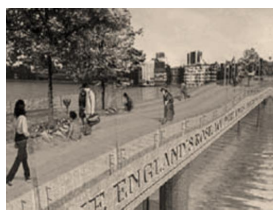
Imagine Joseph Paxton’s Great Victorian Way in Sydenham, a 10-mile stretch of glass and brightly painted iron arcades with its own snaking elevated railway. Or a National Cemetery on Primrose Hill, London’s answer to Paris’s Père Lachaise. Or Hyde Park Corner with a huge art deco music hall. Or White City with a vast expressionist towerscape designed by the German visionary Eric Mendelssohn. If architects’ imaginings had become reality, London could have been a completely different place.
The game of what-ifs in architecture is addictive. The organisers of a new Hayward Gallery touring exhibition had the brilliant idea of exploring the never-never land of building, drawing on the collections of the Royal Institute of British Architects and the Victoria and Albert museum. So many of these visions are a great deal more exciting than the buildings we actually got. In Liverpool, instead of Paddy’s wigwam and Gibberd’s gimcrack (and now sadly deteriorating) Roman Catholic cathedral, we might have had the grand and wonderful Metropolitan Cathedral of Christ the King by Lutyens. In the Strand, instead of George Edmund Street’s relatively makeshift Law Courts, we could have had Alfred Waterhouse’s much more ambitious and romantic urban concept: a magnificent assembly of pitched roofs, towers and walkways, Turneresque in its drama when viewed across the Thames. Waterhouse’s courts fell foul of the Victorian competition system. The designs remain to haunt us.
Source: The Guardian on the Web / April 15, 2004.
Text 7
Imagine Joseph Paxton’s Great Victorian Way in Sydenham, a 10-mile stretch of glass and brightly painted iron arcades with its own snaking elevated railway. Or a National Cemetery on Primrose Hill, London’s answer to Paris’s Père Lachaise. Or Hyde Park Corner with a huge art deco music hall. Or White City with a vast expressionist towerscape designed by the German visionary Eric Mendelssohn. If architects’ imaginings had become reality, London could have been a completely different place.
The game of what-ifs in architecture is addictive. The organisers of a new Hayward Gallery touring exhibition had the brilliant idea of exploring the never-never land of building, drawing on the collections of the Royal Institute of British Architects and the Victoria and Albert museum. So many of these visions are a great deal more exciting than the buildings we actually got. In Liverpool, instead of Paddy’s wigwam and Gibberd’s gimcrack (and now sadly deteriorating) Roman Catholic cathedral, we might have had the grand and wonderful Metropolitan Cathedral of Christ the King by Lutyens. In the Strand, instead of George Edmund Street’s relatively makeshift Law Courts, we could have had Alfred Waterhouse’s much more ambitious and romantic urban concept: a magnificent assembly of pitched roofs, towers and walkways, Turneresque in its drama when viewed across the Thames. Waterhouse’s courts fell foul of the Victorian competition system. The designs remain to haunt us.
Source: The Guardian on the Web / April 15, 2004.
Text 7
Imagine Joseph Paxton’s Great Victorian Way in Sydenham, a 10-mile stretch of glass and brightly painted iron arcades with its own snaking elevated railway. Or a National Cemetery on Primrose Hill, London’s answer to Paris’s Père Lachaise. Or Hyde Park Corner with a huge art deco music hall. Or White City with a vast expressionist towerscape designed by the German visionary Eric Mendelssohn. If architects’ imaginings had become reality, London could have been a completely different place.
The game of what-ifs in architecture is addictive. The organisers of a new Hayward Gallery touring exhibition had the brilliant idea of exploring the never-never land of building, drawing on the collections of the Royal Institute of British Architects and the Victoria and Albert museum. So many of these visions are a great deal more exciting than the buildings we actually got. In Liverpool, instead of Paddy’s wigwam and Gibberd’s gimcrack (and now sadly deteriorating) Roman Catholic cathedral, we might have had the grand and wonderful Metropolitan Cathedral of Christ the King by Lutyens. In the Strand, instead of George Edmund Street’s relatively makeshift Law Courts, we could have had Alfred Waterhouse’s much more ambitious and romantic urban concept: a magnificent assembly of pitched roofs, towers and walkways, Turneresque in its drama when viewed across the Thames. Waterhouse’s courts fell foul of the Victorian competition system. The designs remain to haunt us.
Source: The Guardian on the Web / April 15, 2004.
Text 8
THE ROLE OF TEXTBOOKS IN A LANGUAGE PROGRAM
Textbooks are a key component in most language programs. In some situations they serve as the basis for much of the language input learners receive and the language practice that occurs in the classroom. They may provide the basis for the content of the lessons, the balance of skills taught and the kinds of language practice the students take part in. in other situations, the textbook may serve primarily to supplement the teacher’s instruction. For learners, the textbook may provide the major source of contact they have with the language apart from input provided by the teacher. In the case of inexperienced teachers, textbooks may also serve as a form of teacher training. – they provide ideas on how to plan and teach lessons as well as formats that teachers can use. Much of the language teaching that occurs throughout the world today could not take place without the extensive use of commercial textbooks. Learning how to use and adapt textbooks is hence an important part of a teacher’s professional knowledge.
Text 8
THE ROLE OF TEXTBOOKS IN A LANGUAGE PROGRAM
Textbooks are a key component in most language programs. In some situations they serve as the basis for much of the language input learners receive and the language practice that occurs in the classroom. They may provide the basis for the content of the lessons, the balance of skills taught and the kinds of language practice the students take part in. in other situations, the textbook may serve primarily to supplement the teacher’s instruction. For learners, the textbook may provide the major source of contact they have with the language apart from input provided by the teacher. In the case of inexperienced teachers, textbooks may also serve as a form of teacher training. – they provide ideas on how to plan and teach lessons as well as formats that teachers can use. Much of the language teaching that occurs throughout the world today could not take place without the extensive use of commercial textbooks. Learning how to use and adapt textbooks is hence an important part of a teacher’s professional knowledge.
Text 8
THE ROLE OF TEXTBOOKS IN A LANGUAGE PROGRAM
Textbooks are a key component in most language programs. In some situations they serve as the basis for much of the language input learners receive and the language practice that occurs in the classroom. They may provide the basis for the content of the lessons, the balance of skills taught and the kinds of language practice the students take part in. in other situations, the textbook may serve primarily to supplement the teacher’s instruction. For learners, the textbook may provide the major source of contact they have with the language apart from input provided by the teacher. In the case of inexperienced teachers, textbooks may also serve as a form of teacher training. – they provide ideas on how to plan and teach lessons as well as formats that teachers can use. Much of the language teaching that occurs throughout the world today could not take place without the extensive use of commercial textbooks. Learning how to use and adapt textbooks is hence an important part of a teacher’s professional knowledge.
According to the cartoon below:

1. Dustine isn’t the man’s daughter.
2. The man is Dustine’s father.
3. Dustine’s very happy with her father.
4. Dustine is the guy’s girlfriend.
5. The guy’s name’s Smudge.
It is CORRECT only
Text 9
Becoming
Back in the ancestral homeland of Michelle Obama, black women were rarely granted the honorific Miss or Mrs., but were addressed by their first name, or simply as "gal" or "auntie" or worse. This so openly demeaned them that many black women, long after they had left the South, refused to answer if called by their first name. A mother and father in 1970s Texas named their newborn "Miss" so that white people would have no choice but to address their daughter by that title. Black women were meant for the field, or the kitchen, or for use as they saw fit. They were, by definition, not ladies. The very idea of a black woman as first lady of the land, well, that would have been unthinkable.
Disponível em: www.nytimes.com. Acesso em: 28 dez. 2019 (adaptado).

 Conheça nossos planos