Questões de Concurso Sobre linguística
Foram encontradas 1.440 questões


“A: video? some doc – documentary about Climate Change hm hm hm yeah and . . . it B: yes and . . . and you know if you have a Climate Change policy in the future you, you might not A: it’s an immoral yes immoral because er Climate Change means anyway they restrict economic rights B: no no no, I mean – er you mean that Climate Change is immoral and we shouldn’t restrict A: which one is first? . . . the Climate Change eh yes? . . . what do you think, B: the reason that I er I’m against the Climate Change policy . . . when I was at school mh I A: very hard for the government. If er the Climate Change policy is not permitted and they will B: Climate Change? eh yes? . . . what do you think, Climate Change is an immoral act or not? hmm,”
The provided text analyzes a conversation in which the controversial concept of “Climate Change” functions as a keyword and is notably often preceded by the definite article ('the Climate Change'). This signals that speakers are often referring to the concept in general terms, which can heighten its sensitive, abstract, and politicized nature.
In your role as a Technical Specialist in Educational Affairs, advising a research team preparing a publication on an equally controversial, general concept (e.g., 'sustainable development equity' or 'global carbon tax') for an international journal, which directive best integrates Communicative Competence in ELF with the principles of Interculturality when addressing such “keywords”? Adapted from: DEWEY, Martin. English as a lingua franca and globalization: an interconnected perspective. International Journal of Applied Linguistics, v. 17, n. 3, 2007, p. 340.
In this case, which strategic action best demonstrates the application of Communicative Competence in an English as a Lingua Franca (ELF) and Interculturality context to resolve the impasse and provide capacity building to the Brazilian team?
Based on the critical perspective that you must go beyond methodology to consider political issues, analyze the following proposed actions and choose the correct alternative.
I. Initiate a mandatory, analytical seminar where students collectively debate how English is used in their field’s research, emphasizing that active engagement is key to preventing selfexclusion from global knowledge. II. Remove the EAP module from the curriculum, respecting the students’ resistance as a political decision to reject linguistic imperialism. III. Focus on improving students' grammar and vocabulary to native standards, dismissing their political arguments as irrelevant to communicative skills. IV. Promote a discussion where the EAP course is reframed to focus on English as a Lingua Franca (ELF), highlighting its use by non-native speakers to publish and circulate Global South research. V. Transfer the course to the History department, arguing that the political issues related to English are not the responsibility of the Internationalization Office.
À luz dessas abordagens contemporâneas, assinale a alternativa que apresenta a compreensão coerente, em termos teóricos, sobre a natureza do ato de produzir textos:
Considerando os conhecimentos sobre essa área, julgue as afirmativas:
I.A psicolinguística é a ciência que estuda a forma como adquirimos, compreendemos, produzimos e elaboramos a linguagem.
II.A psicolinguística concentra-se na análise dos fatores psicológicos e neurológicos que influenciam a linguagem.
III.A psicolinguística, em relação ao uso da linguagem, procura as formas mais elegantes, formais e abstratas da linguagem.
IV. Na linguística, a unidade mínima de som distintivo é o fonema, enquanto a psicolinguística estuda a linguagem considerando múltiplas unidades de análise, como fonemas, sílabas, palavras e sentenças, dependendo do processo cognitivo envolvido.
É correto o que se afirma em:
No estudo da linguagem, a 'natureza do significado' diz respeito à investigação:
Com base nessas três camadas de análise linguística, relacione a Coluna A com cada característica apresentada na Coluna B.
Coluna A
1.Pragmática. 2.Estilística. 3.Etimologia.
Coluna B
(__)É a análise da trajetória histórica das palavras, investigando sua origem e o desenvolvimento que sofreram ao longo do tempo. Essa área da linguística se dedica a identificar os étimos, ou seja, os vocábulos que deram origem a outros termos.
(__)Trata-se de um dos ramos da linguística responsável pela análise dos discursos em distintas situações comunicativas, levando em consideração fatores contextuais e incorporando conceitos de outras áreas, como a sintaxe, que estuda a construção dos enunciados, e a semântica, que se ocupa dos significados.
(__)Analisa a linguagem e sua capacidade de conferir maior ou menor expressividade e beleza às mensagens, sendo, por isso, especialmente relevante nos contextos literários. Enquanto a Gramática se ocupa da norma culta, essa área complementa os estudos linguísticos ao enfatizar a função expressiva dos discursos.
A sequência numérica que completa os itens acima, de cima para baixo, é:
Consider the dialogue below:
A: "Can you pass the salt?"
B: "Sure." (passes it)
From a pragmatic perspective, the utterance "Can you pass the salt?" exemplifies:
Cold Kimchi Tomato Bibim Noodles
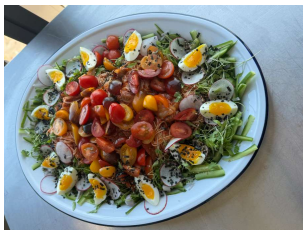
Ingredients
For the sauce
3 tablespoons tomato paste
2 tablespoons gochujang
1 teaspoon kosher salt
1 1/2 tablespoons sesame oil
3 tablespoons apple cider vinegar
3 tablespoons kimchi juice
1 tablespoon honey
1 cup chopped kimchi
For the noodles
150 grams somen noodles
For the toppings
2 Persian cucumbers, sliced into matchsticks
1 shallot, minced
2 cups cherry tomatoes, halved
2 soft-boiled eggs (7 minutes, jammy yolks)
4 radishes, thinly sliced
To finish
Extra sesame oil, for drizzling
2 tablespoons furikake
Handful of cilantro
Directions
•Step 1
"Bring a pot of water to a rolling boil. Add the somen noodles and cook for 3 to 4 minutes, until just tender. Drain and rinse under cold water until completely cooled, then shake off excess water."An English teacher specializing in pragmatics and speech act theory is analyzing this instructional sequence with advanced students. When examining the illocutionary force of imperative constructions in procedural discourse and their pragmatic functions within the recipe genre, particularly how directives function to guide reader behavior while maintaining cooperative communication principles, the teacher should recognize that:
Cold Kimchi Tomato Bibim Noodles
Ingredients
For the sauce
3 tablespoons tomato paste
2 tablespoons gochujang
1 teaspoon kosher salt
1 1/2 tablespoons sesame oil
3 tablespoons apple cider vinegar
3 tablespoons kimchi juice
1 tablespoon honey
1 cup chopped kimchi
For the noodles
150 grams somen noodles
For the toppings
2 Persian cucumbers, sliced into matchsticks
1 shallot, minced
2 cups cherry tomatoes, halved
2 soft-boiled eggs (7 minutes, jammy yolks)
4 radishes, thinly sliced
To finish
Extra sesame oil, for drizzling
2 tablespoons furikake
Handful of cilantro
Directions
•Step 1
An English semantics professor is teaching a graduate seminar on polysemy and context-dependent meaning using culinary vocabulary from the recipe. The professor highlights the word "tender" in the instruction "cook for 3 to 4 minutes, until just tender" and asks students to analyze its semantic range across different contexts: "tender meat," "a tender moment," "legal tender," "tender loving care," and "tender one's resignation." When discussing how context disambiguates polysemous meanings and how semantic features shift across different domains (physical texture, emotional quality, monetary function, affectionate care, formal offering), which linguistic analysis demonstrates the most sophisticated understanding of lexical semantics?
De acordo com a BNCC para o Ensino Fundamental, o estudo da estrutura linguística deve contribuir para que os alunos:
Acerca das relações semânticas, marque V, para as afirmativas verdadeiras, e F, para as falsas:
(__)A polissemia ocorre quando uma mesma palavra (um único verbete no dicionário) adquire múltiplos significados ao longo do tempo, como a palavra 'banco' (de sentar, instituição financeira).
(__)A homonímia homófona ocorre entre palavras com grafias iguais, mas sons diferentes, como 'colher' (verbo) e 'colher' (substantivo).
(__)A relação entre 'acender' (atear fogo) e 'ascender' (subir) é um exemplo de paronímia, pois são palavras com pronúncia e grafia semelhantes, mas significados distintos.
(__)Sinonímia perfeita, onde duas palavras são absolutamente intercambiáveis em todos os contextos sem qualquer alteração de sentido ou estilo, é um fenômeno comum na língua.
Após análise, assinale a alternativa que apresenta a sequência correta dos itens acima, de cima para baixo:

 Conheça nossos planos