Questões de Concurso Sobre linguística
Foram encontradas 1.354 questões


De acordo com esse enfoque, assinale a alternativa correta.
Leia o texto a seguir para responder à questão:
Indiscutivelmente, o mais significativo da obra reside no idílio entre a campônia e ingênua Joaninha e o inglesado e conflitivo Carlos. Nele, percebe-se a projeção confessional da própria vida interior de Garrett: Carlos é talvez o mais autêntico de seus alter egos. Em Joaninha e no cenário natural que serve de palco aos acontecimentos, circula o ar de melancólico saudosismo que já vimos na Menina e Moça, de Bernardim Ribeiro. Situa-se precisamente aqui – neste sopro de pureza e inocência, de alada fantasia a envolver a história duma jovem que perece de amor, pois ama um homem tolhido noutras malhas sentimentais –, o mais tocante desse episódio emocional.
(Massaud Moisés. A Literatura Portuguesa, 1997)
Leia o texto para responder à questão.
Communicative language competence can be considered as comprising several components: linguistic, sociolinguistic and pragmatic.
Linguistic competences include lexical, phonological, syntactical knowledge and skills and other dimensions of language as system, independently of the sociolinguistic value of its variations and the pragmatic functions of its realisations.
Sociolinguistic competences refer to the sociocultural conditions of language use. Through its sensitivity to social conventions (rules of politeness, norms governing relations between generations, sexes, classes and social groups, linguistic codification of certain fundamental rituals in the functioning of a community), the sociolinguistic component strictly affects all language communication between representatives of different cultures, even though participants may often be unaware of its influence.
Pragmatic competences are concerned with the functional use of linguistic resources (production of language functions, speech acts), drawing on scenarios or scripts of interactional exchanges. It also concerns the mastery of discourse, cohesion and coherence, the identification of text types and forms, irony, and parody. For this component even more than the linguistic component, it is hardly necessary to stress the major impact of interactions and cultural environments in which such abilities are constructed.
(https://www.coe.int/en/web/common-european-framework-
reference-languages. Acesso 17.08.2025. Adaptado)
Nesse contexto, o autor defende que
I – O silêncio coletivo constitui uma forma de linguagem não verbal, pois expressa respeito e solenidade por meio de comportamento simbólico.
II – O discurso do orador representa a linguagem verbal, por se realizar por meio da fala articulada.
III – A presença da bandeira e o ato de hasteá-la também se inserem na linguagem não verbal, pois transmitem valores e significados simbólicos.
Após análise das afirmações, é correto afirmar que:
Analise as afirmações sobre homonímia e polissemia e analise as frases a seguir:
I. O aluno fez um ponto na redação.
II. O motorista parou no ponto.
III. O médico observou um ponto estranho no exame.
IV. O alfaiate deu o último ponto na barra da calça.
De acordo com as definições apresentadas, especialmente o critério da manutenção da classe gramatical e da pertinência ao mesmo campo semântico, assinale a alternativa correta.
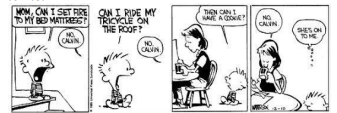
Based on a pragmatic and discourse-analysis perspective, which statement BEST explains the mother’s response pattern and Calvin’s final inference?
I.Catáfora: Ocorre na sentença 'Here is the news: the prime minister has resigned', onde 'the news' antecipa a informação que será dada posteriormente.
II.Substituição Nominal: Ocorre em 'I don't have a pen. Can you lend me one?', onde 'one' substitui o substantivo 'pen' para evitar repetição.
III.Elipse: É verificada em 'Have you been to Paris? Yes, I have.', onde há a omissão de todo o predicado restante (been to Paris) que é recuperável pelo contexto.
Assinale a alternativa que apresenta somente a(s) proposição(ões) CORRETA(S):
Kanhgág ga kãmĩ kar escola mĩ bilinguismo cenário tóg ‘e tĩ. Ũ tỹ vẽnhvĩ régre tó tĩ tag vỹ tỹ’ũ nĩ ke nĩ, mỹr ti prỹg tỹ ne ra kar contexto tỹ ne ki vẽnhvĩ régre tag kajrẽn ja tóg categoria ũ kãki tĩ nĩm ke mũ. Categoria tag hã vỹ tỹ: bilingue simultaneo, bilingue sequencial de primeira infancia, bilingue sequencial de segunda infancia, kar ver bilingue sequencial adulto tỹ nỹtĩ. Kỹ gen kỹ professor tóg to vẽnhkajrãn ke nĩ aquisição bilingue tag processo to, ti tỹ ti aluno tỹ vẽnhvĩ régre tó tag mré segunda lingua tỹ rãnhrãj há han jé. (cf. Amaral 2011).
Tag to jykrén kỹ alternativa tỹ ki hã ke nĩtón.
Kanhgág tỹ ser ti tỹ fóg vĩ kinhrãg kỹ ti vĩ pẽ kãjatun sór tĩ, ẽg vĩ hẽn ne ki há tũ nĩ ha ke kỹ. Linguistica kãki estudo tỹ hã ra ven hori, vẽnhvĩ régre tó tỹ nén kar ki há nỹ, mỹr bilingue ag, ũ tỹ kurẽ kar mĩ ti vĩ régre tó tĩ vỹ prỹg tỹ pẽnkar ki atrasa kej mũ ti krĩ ki vẽnhkaga desenvolve ken jé, vẽnhkaga tỹ Alzheimer rike ti.
Tag to jykrén kỹ alternativa tỹ ki hã ke nĩtón.
Vẽnhvĩ ‘e tó tag to Amaral (2011) tỹ estudo ũ ven mũ gé. Hã vỹ tỹ pluralismo linguistico tỹ vẽnhkar mỹ há nỹ, mỹr sociedade kãmĩ tỹ’ũ nĩ ke mũ tag to kry tóg sĩ kej mũ. Ũ tỹ vẽnhvĩ régre tó há tag saúde mental mỹ tóg há tỹvĩ nĩ, ti krĩ/jykre mỹ.
Tag to jykrén kỹ alternativa tỹ ki hã ke nĩtón.
Povo Indigena ag escola mĩ vẽnhvĩ tugtó contexto tỹ ‘e tỹvĩ tĩg nĩ. Bilinguismo ti, kanhgáh vĩ kar fóg vĩ ti, kar ver multilinguismo ti kegé, vẽnhvĩ régre tag kar venhvĩ ũ kegé. Amaral (2011) ki tóg tỹ vãmén mũ vẽnhvĩ régre kĩnhrẽg tỹ gĩr krĩ/jykre mỹ há ti. Gĩr tỹ vẽnhvĩ régre tó tĩ ki mog tỹ area tẽgtũ ki kajró mág nĩj mũ: ũ mré vãmén há, conceito linguistico elabora ke há, kar vẽnhvĩ ‘e kajrẽn há.
Tag to jykrén kỹ alternativa tỹ ki hã ke nĩtón.
Vẽnhkagta tỹ gĩr kype to jé
Isỹ inh vẽnhkagta tỹ ã kype jã ha
à tỹ tĩg há han jé, inh kósin
Ũri ã tỹ nãn kãmĩ vãnhkagta tỹ
vẽnhkype kỹ jãj mỹ
à tỹ tar há jãj mỹ inh kósin
Ũri ã tỹ nãn kãmĩ ã tỹ vẽnh jyjy tỹ
Vẽnhkri fi kỹ jãj mỹ inh kósin
Kósin ã tỹ tar há jã jé
Inh kósin ã pi vẽnhkaga kórég kãgmĩj mỹ
à tỹ tar há ja nĩ
Ne jé gĩr kype nẽ, vẽnhkagta tỹ? Alternativa tỹ ki hã ke nĩtón ra.
Mỹg pẽ
Prỹg tỹ 1840 tá krỹg tũ ki Brasil ki mỹg pẽ tỹ ‘e tỹvĩ ja tĩg nĩ vẽ. Mỹg pẽ tag pi préj nỹtĩ. To Novo Mundo ke mũ tag kar mĩ, kỹnỹ tỹ asukri han fã tỹ ki jun tũ ki kar Europa tá mỹg sy gékãmũ tũ ki, mỹg pẽ tóg tỹ nén ũ tỹ grãj gy kej fã pẽ nĩ ja vã. Mỹg pẽ tỹ ‘e tỹvĩ ja tĩ, Brasil kãki. Hãra ũri tóg pipir ke rã nĩ, mỹg pẽ ti, ga kar mĩ, ser humano tỹ nén han fã tugnĩn. Kỹ tag tóg jagy nỹ, mỹr mỹgsy tỹ tũ ke kỹ ka mré ãkré tỹ figfej kar hynhan mãn ke tũ nĩ, mỹr misu kãsir ũ mré ag hã vỹ polinização han tĩ ẽkré ki (adaptado de Mỹg pẽ, 2008).
Texto tỹ ne kãmén nẽ?

 Conheça nossos planos