Questões de Concurso
Sobre vocabulário | vocabulary em inglês
Foram encontradas 3.149 questões


As questão diz respeito ao texto. Leia-o atentamente antes de respondê-la.
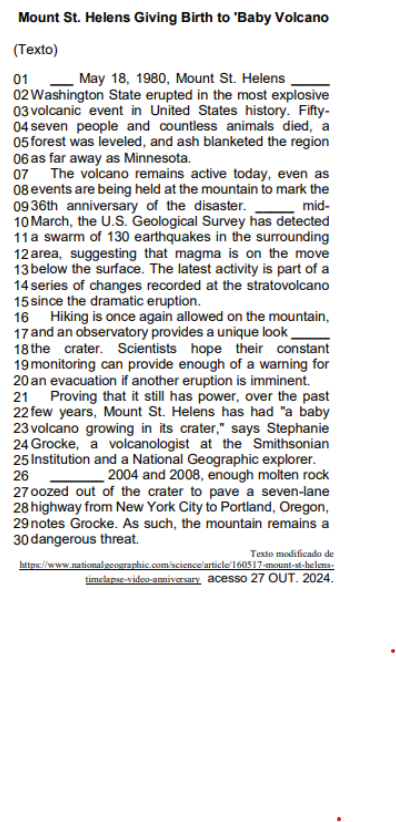
( ) The plan has been carefully looked at. (The sentence is in the Passive Voice)
( ) After the performance, the actor took a bow. (The underlined word means a fancy knot).
( ) I’m not liking her hairstyle.(The sentence is in the Present Progressive Tense)
( ) Staying at home in such bad weather was a sensible thing to do. (The underlined word is a false cognate that means easily affected by).
( ) She got ill because she hadn’t been sleeping enough. (The sentence is in the Past Perfect Tense)
Select the option that presents the correct sequence from top to bottom.
Choose the alternative that presents these kind of words.
Assinale a alternativa que apresenta exemplos de palavras do inglês que se tornaram comuns na língua portuguesa.
Reading skill will help you to improve your understanding of the language and build your vocabulary.
Social Media Across Generations
Today’s grandparents are joining their grandchildren on social media, but the different generations’ online habits couldn’t be more different. In the UK the over-55s are joining Facebook in increasing numbers, meaning that they will soon be the site’s second biggest user group, with 3.5 million users aged 55-64 and 2.9 million over-65s.
Sheila, aged 59, says, I joined to see what my grandchildren are doing, as my daughter posts videos and photos of them. It’s a much better way to see what they’re doing than waiting for letters and photos in the post. That’s how we did it when I was a child, but I think I’m lucky I get to see so much more of their lives than my grandparents did.
Ironically, Sheila’s grandchildren are less likely to use Facebook themselves. Children under 17 in the UK are leaving the site – only 2.2 million users are under 17 – but they’re not going far from their smartphones. Chloe, aged 15, even sleeps with her phone. It’s my alarm clock so I have to she says. I look at it before I go to sleep and as soon as I wake up.
Unlike her grandmother’s generation, Chloe’s age group is spending so much time.......... their phones.......... home that they are missing out on spending time with their friends in real life. Sheila, on the other hand, has made contact with old friends from school she hasn’t heard...................40 years. We use Facebook to arrange to meet all over the country, she says. It’s changed my social life completely.
Teenagers might have their parents to thank for their smartphone and social media addiction as their parents were the early adopters of the smartphone. Peter, 38 and father of two teenagers, reports that he used to be on his phone or laptop constantly. I was always connected and I felt like I was always working, he says. How could I tell my kids to get off their phones if I was always in front of a screen myself? So, in the evenings and at weekends, he takes his SIM card out of his smartphone and puts it into an old-style mobile phone that can only make calls and send text messages. I’m not completely cut off from the world in case of emergencies, but the important thing is I’m setting a better example to my kids and spending more quality time with them.
Column 1 Words
1. addiction
2. constantly
3. unlike
4. ironically
5. social media
Column 2 Definitions
( ) websites and apps like Facebook, Twitter.
( ) needing something too much or in an unhealthy way.
( ) in a funny or strange way because it’s unexpected.
( ) different form.
( ) time without a break.
Select the option that presents the correct sequence from top to bottom.
Magi Richani is the founder of San Francisco-based Nobell Foods, a startup company developing a new kind of cheese made from soybeans. She says plant-based cheese not only accommodates people who can’t consume dairy, but it also could be key to more sustainable food production worldwide. “The reality is that when you raise an animal for food, it’s not just the animals, you are actually growing crops, you are clearing land, and you’re raising the animal for years so it builds biomass,” Richani explained. “It’s an extremely inefficient supply chain.”
Nobell is particularly focused on creating plant-based casein, which is a protein produced when a cow gives birth and is present in the milk for its offspring. It is the ingredient that gives dairy cheese its unique stretchy texture. If Nobell is able to go to market and have the kind of impact it’s hoping to, then plant-based cheese could help us stretch toward a more sustainable future.
Internet: <newsweek.com> (adapted).
Based on the ideas presented in the previous text as well as its linguistic aspects, judge the following item.
The word “offspring”, in the first sentence of the last paragraph, can be replaced with calf without harming the coherence and the correctness of the text.
POLITICAL POLLS
Despite their popularity, political polls, often seen on TV during elections, sometimes give _______1 results, and some Americans question their _______ 2 .
_______ 3 both 2016 and 2020, most national polls overestimated support for Democrats. Polls aim to show what people think at a certain time but can be tricky to predict future outcomes accurately.
Mallory Newall explains that reliable polls focus on understanding public opinions rather than just predicting election winners. She warns _______4 reading too much into small differences in polls, especially far _______5 election day. Red flags for bad polls include _______6 the right people and not being clear about how the data was collected.
Polling methods _______ 7 since 2016, with more surveys done on line. Online surveys may influence results; however, concerns remain about reaching everyone, especially in rural areas without good internet. Although _______8 challenges, polls remain important _______9 public opinion.
Source:
https://www.newsinlevels.com/products/political-polls-level-3/
POLITICAL POLLS
Despite their popularity, political polls, often seen on TV during elections, sometimes give _______1 results, and some Americans question their _______ 2 .
_______ 3 both 2016 and 2020, most national polls overestimated support for Democrats. Polls aim to show what people think at a certain time but can be tricky to predict future outcomes accurately.
Mallory Newall explains that reliable polls focus on understanding public opinions rather than just predicting election winners. She warns _______4 reading too much into small differences in polls, especially far _______5 election day. Red flags for bad polls include _______6 the right people and not being clear about how the data was collected.
Polling methods _______ 7 since 2016, with more surveys done on line. Online surveys may influence results; however, concerns remain about reaching everyone, especially in rural areas without good internet. Although _______8 challenges, polls remain important _______9 public opinion.
Source:
https://www.newsinlevels.com/products/political-polls-level-3/
POLITICAL POLLS
Despite their popularity, political polls, often seen on TV during elections, sometimes give _______1 results, and some Americans question their _______ 2 .
_______ 3 both 2016 and 2020, most national polls overestimated support for Democrats. Polls aim to show what people think at a certain time but can be tricky to predict future outcomes accurately.
Mallory Newall explains that reliable polls focus on understanding public opinions rather than just predicting election winners. She warns _______4 reading too much into small differences in polls, especially far _______5 election day. Red flags for bad polls include _______6 the right people and not being clear about how the data was collected.
Polling methods _______ 7 since 2016, with more surveys done on line. Online surveys may influence results; however, concerns remain about reaching everyone, especially in rural areas without good internet. Although _______8 challenges, polls remain important _______9 public opinion.
Source:
https://www.newsinlevels.com/products/political-polls-level-3/
POLITICAL POLLS
Despite their popularity, political polls, often seen on TV during elections, sometimes give _______1 results, and some Americans question their _______ 2 .
_______ 3 both 2016 and 2020, most national polls overestimated support for Democrats. Polls aim to show what people think at a certain time but can be tricky to predict future outcomes accurately.
Mallory Newall explains that reliable polls focus on understanding public opinions rather than just predicting election winners. She warns _______4 reading too much into small differences in polls, especially far _______5 election day. Red flags for bad polls include _______6 the right people and not being clear about how the data was collected.
Polling methods _______ 7 since 2016, with more surveys done on line. Online surveys may influence results; however, concerns remain about reaching everyone, especially in rural areas without good internet. Although _______8 challenges, polls remain important _______9 public opinion.
Source:
https://www.newsinlevels.com/products/political-polls-level-3/
Text IV
Diversity and Inclusive Teaching
Teaching to engage diversity, to include all learners, and to seek equity is essential for preparing civically engaged adults and for creating a campus and society that recognizes the contributions of all people. Teaching for diversity refers to acknowledging a range of differences in the classroom. Teaching for inclusion signifies embracing difference. Teaching for equity allows the differences to transform the way we think, teach, learn and act such that all experiences and ways of being are handled with fairness and justice. These ideas complement each other and enhance educational opportunities for all students when simultaneously engaged. […]
Inclusive teaching strategies are intended to ensure that all students feel supported such that they freely learn and explore new ideas, feel safe to express their views in a civil manner, and are respected as individuals and members of groups. Intentionally incorporating inclusive teaching strategies helps students view themselves as people who belong to the community of learners in a classroom and university.
Adapted from https://ctal.udel.edu/resources-2/inclusive-teaching/
Text III
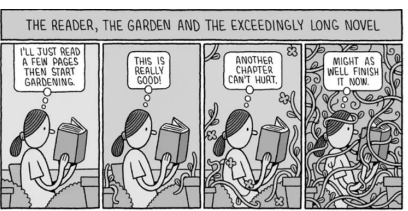
From: https://streetlibrary.org.au/reading-in-the-garden-tom-gauld-cartoon/
Text II
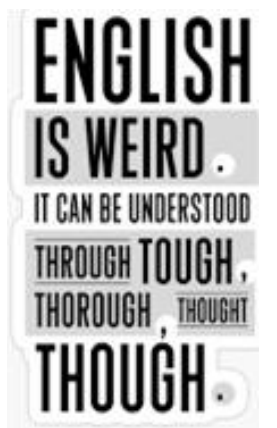
From: https://images.app.goo.gl/dCFurjmcnZzU7AHS6

 Conheça nossos planos