Questões de Concurso
Sobre vocabulário | vocabulary em inglês
Foram encontradas 3.148 questões


Leia o texto para responder à questão.
The Research Assignment
Students today have access to so much information that they need to weigh the reliability of sources. Any resource – print, human, or electronic – used to support your research inquiry has to be evaluated for its credibility and reliability. In other words, you have to exercise some quality control over what you use. When you use the print and multimedia materials found in your college library, your evaluation task is not so complicated because librarians have already established the credibility and appropriateness of those materials for academic research. The marketplace forces publishers to be discriminating as well.
Data collected in interviews of persons whose reliability is not always clearly established should be carefully screened, especially if you present this material as expert opinion or as based on knowledge of your topic. And you may have even more difficulty establishing trustworthiness for electronic sources, especially Web and Internet sources.
Because the Internet and World Wide Web are easy to use and accessible, Web material is volatile – it changes, becomes outdated, or is deleted. Its lack of consistency and sometimes crude form make Web information suspect for people who use it for research. Because there is frequently no quality control over Web information, you must critically evaluate all the material you find there, text and graphics alike.
(http://www.umuc.edu/writingcenter/onlineguide/
chapter4-07.cfm-27.10.2013. Adaptado)
Everyone keeps data. Big organizations spend millions to look after their payroll, customer and transaction data. The penalties for getting it wrong are severe: businesses may collapse, shareholders and customers lose money, and for many organizations (airlines, health boards, energy companies), it is not exaggerating to say that even personal safety may be put at risk. And then there are the lawsuits. The problems in successfully designing, installing, and maintaining such large databases are the subject of numerous books on data management and software engineering. However, many small databases are used within large organizations and also for small businesses, clubs, and private concerns. When these go wrong, it doesn't make the front page of the papers; but the costs, often hidden, can be just as serious.
Where do we find these smaller electronic databases? Sports clubs will have membership information and match results; small businesses might maintain their own customer data. Within large organizations, there will also be a number of small projects to maintain data information that isn't easily or conveniently managed by the large system-wide databases. Researchers may keep their own experiment and survey results; groups will want to manage their own rosters or keep track of equipment; departments may keep their own detailed accounts and submit just a summary to the organization's financial software.
Most of these small databases are set up by end users. These are people whose main job is something other than that of a Computer professional. They will typically be scientists, administrators, technicians, accountants, or teachers, and many will have only modest skills when it comes to spreadsheet or database software.
The resulting databases often do not live up to expectations. Time and energy is expended to set up a few tables in a database product such as Microsoft Access, or in setting up a spreadsheet in a product such as Excel. Even more time is spent collecting and keying in data. But invariably (often within a short time frame) there is a problem producing what seems to be a quite simple report or query. Often this is because the way the tables have been set up makes the required result very awkward, if not impossible, to achieve.
A database that does not fulfill expectations becomes a
costly exercise in more ways than one. We clearly have the
cost of the time and effort expended on setting up an
unsatisfactory application. However, a much more serious
problem is the unability to make the best use of valuable
data. This is especially so for research data. Scientific and
social researchers may spend considerable money and many
years designing experiments, hiring assistants and collecting
and analyzing data, but often very little thought goes into
storing it in an appropriately designed database.
Unfortunately, some quite simple mistakes in design can mean that much of the potential information is lost. The
immediate objective may be satisfied, but unforeseen uses
of the data may be seriously compromised. Next year's grant
opportunities are lost.
Read text II and answer the question:
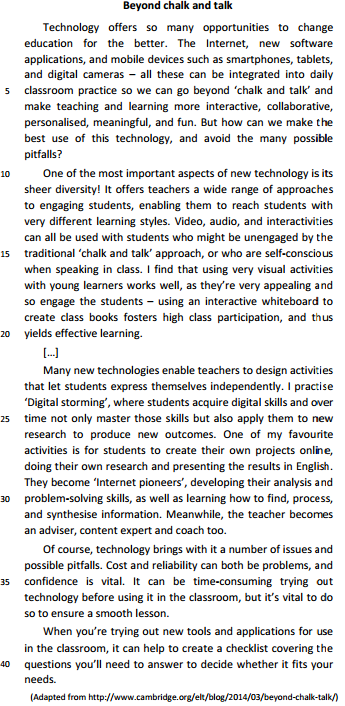
Read text II and answer the question:
Read text II and answer the question:
Read text II and answer the question:
Read text I and answer the question.
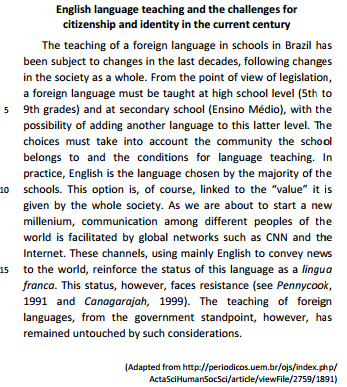
Read text I and answer the question.
Read text I and answer the question.


text VI
This is the first chapter of the mythic Star Wars saga.
Set thirty years before the original Star Wars film, Episode I introduces young Anakin Skywalker, a boy with special powers, unaware that the journey he is beginning will transform him into the evil Darth Vader.
Obi-Wan Kenobi, the wise old Jedi from the original series, is a determined young apprentice and Palpatine, well known as the evil Emperor, is an ambitious Senator in the Galactic Republic.
It is a time when the Jedi Knights are the guardians of peace in a turbulent galaxy and a young Queen fights to save her people. In the shadows an evil force is waiting for the right moment to strike.
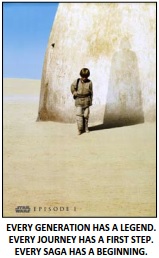
(Reinildes Dias. Reading Critically in English, 3rd ed. UFMG 2002.)
1.Saga.
2.Unaware.
3.Strike.
4.Evil.
5.Wise.
6.Journey.
( ) Bad.
( ) Trip.
( ) Attack.
( ) Tale.
( ) Oblivious
( ) Prudent.
The correct sequence is
Next time you’re swimming in the ocean, consider this: part of the water is older than the sun.
So concludes a team of scientists who ran computer models comparing the ratios of hydrogen isotopes over time. Taking into account new insights that the solar nebula had less ionizing radiation than previously thought, the models show that at least some of the water found in the ocean, as well as in comets, meteorites and on the moon, predate the sun’s birth.
The only other option, the scientists conclude, is that it formed in the cold, intersteller cloud from which the sun itself originated.
The discovery, reported in this week’s Science, stems from the insight of lead author Lauren Ilsedore Cleeves, a doctoral student at the University of Michigan, who realized that planet- forming disks around young stars should be shielded from galactic rays by the strong solar winds, dramatically altering the chemistry occurring inside the disks, said Conel Alexander, with the Carnegie Institution of Washington.
“The findingX makes it quite hard for these regions in the disk to synthesize any new molecules. This was an ‘aha’ moment for us - without any new water creation the only place these ices could have come from was the chemically rich interstellar gas out of which the solar system formed originally,” Cleeves wrote in an email to Discovery News.
“It’s remarkable that these ices survived the entire process of stellar birth,” she added.
The finding has implications for the search for life beyond Earth, as water is believed to be necessary for life.
“If the sun’s formation was typical, interstellar ices - including water - are likely common ingredients present during the formation of all planetary systems, which puts a wonderful outlook on the possibility of other life in the universe,” Cleeves said.
In addition, it’s not just water that likely survived the solar system’s birth.
“The same must be true for the organic matter that we know is present in molecular cloud ices. So I think this strengthens the case that we have interstellar organic matter in meteorites and comets too,” Alexander wrote in an email to Discovery News.
Available in: http://news.discovery.com
“It’s remarkable that these ices survived the entire process of stellar birth”.

Judge the following items according to the text above.

Based on the text above, judge the next items.

 Conheça nossos planos