Questões de Concurso Sobre vocabulário | vocabulary em inglês

Foram encontradas 3.148 questões

Q545661 Inglês

Based on the text, judge the following items.


The expressions “scrutinised” (l.7), “undertaking” (l.15) and “comply with” (l.21) can be respectively replaced by probed, setting about and conform to without this harming the text’s coherence and meaning.

Alternativas
Q542362 Inglês

In reference to the content of the text, its vocabulary and syntactic structure, decide whether the following statements are right (C) or wrong (E).

The use of the words “dome” (R.54) and “temples” (R.55) has the effect of creating a faint aura of saintliness and religiousness about Orlando.
Alternativas
Q542349 Inglês

About the vocabulary the author uses in his text, decide whether the statements below are right (C) or wrong (E).

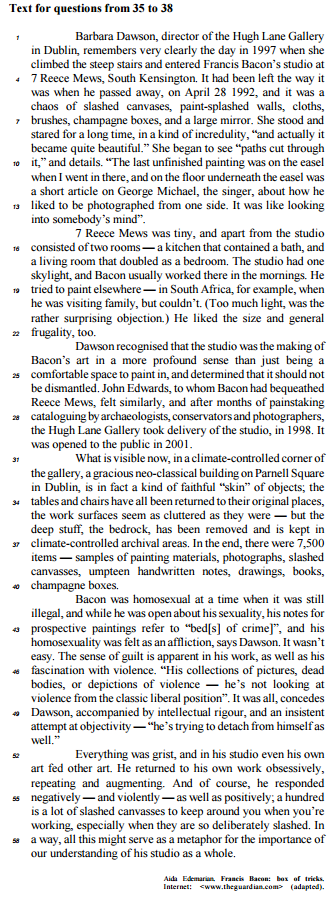
“took delivery” (l.29) means received something that has already been paid for.

Alternativas
Q542348 Inglês

About the vocabulary the author uses in his text, decide whether the statements below are right (C) or wrong (E).

“prospective paintings” (l.43) can be understood as paintings about which Bacon was still thinking or planning.

Alternativas
Q542347 Inglês

About the vocabulary the author uses in his text, decide whether the statements below are right (C) or wrong (E).

“cluttered” (j.35) is synonymous with scratched.

Alternativas
Q542346 Inglês

About the vocabulary the author uses in his text, decide whether the statements below are right (C) or wrong (E).

“umpteen” (l.39) could be correctly replaced by torn.

Alternativas
Q539464 Inglês

In the 8th paragraph of Text I (lines 81-94), the word vacancies is used three times.


To avoid one more repetition, the author chose as synonym for vacancies the word

Alternativas
Q539459 Inglês
In the fragment of Text I “CEB research shows that five-in-six hiring managers believe their new graduate hires present a lack of the skills and knowledge they consider necessary” (lines 9-12), the word lack can be replaced, without change in meaning, by
Alternativas
Q537970 Inglês

What if there were no bees? 

    It's a beautiful day for a picnic, but minutes after you spread a blanket on the grass and unpack an impressive selection of sandwiches, fruit salad and a show-stopping cherry pie, you discover an uninvited guest. A bee is making the rounds, buzzing around your head and scaring all your friends. You're about to swipe at the winged interloper with your shoe, but then think better of it. 
      It's a good thing, too, because bee populations are dwindling. Consider these United States Department of Agriculture (USDA) survey results, based on 21.7 percent of the 2.6 million bee colonies in the United States. During the 2013-2014 winter, more than 23 percent of honeybees in the managed colonies included in the survey had died. The winter before that was even worse, when more than 30 percent of the hives died [source: Jones].  
     And honeybees aren't the only bees at risk. There are more than 20,000 species of bees in the Hymenoptera order that are crucial to life as we know it [source: Encyclopedia Britannica]. So what would happen if there were no bees at all?
     Bees rely on pollen and nectar from plants for food. The nectar is later transformed into honey and the pollen is transferred from plant to plant as the bees travel, resulting in crosspollination. In fact, bees pollinate as much as 70 percent of the planet's top 100 food crops, including apples, avocadoes, cucumbers, nuts, squash and more [source: Greenpeace].
     Many of the diverse flavors and nutritional components in our food are the direct result of bees at work. And, without the crucial role bees play in agriculture, the world's food supplies would likely suffer. That's because an estimated one-third of all the food we eat relies on bees to flourish. Some of the foods we eat simply wouldn't exist without bees. Almonds, for instance, rely entirely on bees for pollination. In California alone, the almond crop needs 1.4 million bee colonies for successful pollination [source: USDA]. 
     If there were no bees, our food supply would be less varied and less available. While we might not go extinct, we would certainly need to find edible alternatives to many of the mainstay foods we currently enjoy -- particularly those crops dependent on bees for pollination -- and figure out ways to stave off economic hardship and famine until new cultivation methods could be developed.

Source: adapted from http://science.howstuffworks.com/science-vs-myth/what-if/what-if-no-bees in June, 2015 
Na frase “It's a good thing, too, because bee populations are dwindling", a palavra destacada pode ser melhor substituída por:
Alternativas
Q537968 Inglês

What if there were no bees? 

    It's a beautiful day for a picnic, but minutes after you spread a blanket on the grass and unpack an impressive selection of sandwiches, fruit salad and a show-stopping cherry pie, you discover an uninvited guest. A bee is making the rounds, buzzing around your head and scaring all your friends. You're about to swipe at the winged interloper with your shoe, but then think better of it. 
      It's a good thing, too, because bee populations are dwindling. Consider these United States Department of Agriculture (USDA) survey results, based on 21.7 percent of the 2.6 million bee colonies in the United States. During the 2013-2014 winter, more than 23 percent of honeybees in the managed colonies included in the survey had died. The winter before that was even worse, when more than 30 percent of the hives died [source: Jones].  
     And honeybees aren't the only bees at risk. There are more than 20,000 species of bees in the Hymenoptera order that are crucial to life as we know it [source: Encyclopedia Britannica]. So what would happen if there were no bees at all?
     Bees rely on pollen and nectar from plants for food. The nectar is later transformed into honey and the pollen is transferred from plant to plant as the bees travel, resulting in crosspollination. In fact, bees pollinate as much as 70 percent of the planet's top 100 food crops, including apples, avocadoes, cucumbers, nuts, squash and more [source: Greenpeace].
     Many of the diverse flavors and nutritional components in our food are the direct result of bees at work. And, without the crucial role bees play in agriculture, the world's food supplies would likely suffer. That's because an estimated one-third of all the food we eat relies on bees to flourish. Some of the foods we eat simply wouldn't exist without bees. Almonds, for instance, rely entirely on bees for pollination. In California alone, the almond crop needs 1.4 million bee colonies for successful pollination [source: USDA]. 
     If there were no bees, our food supply would be less varied and less available. While we might not go extinct, we would certainly need to find edible alternatives to many of the mainstay foods we currently enjoy -- particularly those crops dependent on bees for pollination -- and figure out ways to stave off economic hardship and famine until new cultivation methods could be developed.

Source: adapted from http://science.howstuffworks.com/science-vs-myth/what-if/what-if-no-bees in June, 2015 
Na frase “figure out ways to stave off economic hardship and famine until new cultivation methods could be developed", a palavra pode ser melhor substituída, considerando o contexto, por:
Alternativas
Q537966 Inglês

What if there were no bees? 

    It's a beautiful day for a picnic, but minutes after you spread a blanket on the grass and unpack an impressive selection of sandwiches, fruit salad and a show-stopping cherry pie, you discover an uninvited guest. A bee is making the rounds, buzzing around your head and scaring all your friends. You're about to swipe at the winged interloper with your shoe, but then think better of it. 
      It's a good thing, too, because bee populations are dwindling. Consider these United States Department of Agriculture (USDA) survey results, based on 21.7 percent of the 2.6 million bee colonies in the United States. During the 2013-2014 winter, more than 23 percent of honeybees in the managed colonies included in the survey had died. The winter before that was even worse, when more than 30 percent of the hives died [source: Jones].  
     And honeybees aren't the only bees at risk. There are more than 20,000 species of bees in the Hymenoptera order that are crucial to life as we know it [source: Encyclopedia Britannica]. So what would happen if there were no bees at all?
     Bees rely on pollen and nectar from plants for food. The nectar is later transformed into honey and the pollen is transferred from plant to plant as the bees travel, resulting in crosspollination. In fact, bees pollinate as much as 70 percent of the planet's top 100 food crops, including apples, avocadoes, cucumbers, nuts, squash and more [source: Greenpeace].
     Many of the diverse flavors and nutritional components in our food are the direct result of bees at work. And, without the crucial role bees play in agriculture, the world's food supplies would likely suffer. That's because an estimated one-third of all the food we eat relies on bees to flourish. Some of the foods we eat simply wouldn't exist without bees. Almonds, for instance, rely entirely on bees for pollination. In California alone, the almond crop needs 1.4 million bee colonies for successful pollination [source: USDA]. 
     If there were no bees, our food supply would be less varied and less available. While we might not go extinct, we would certainly need to find edible alternatives to many of the mainstay foods we currently enjoy -- particularly those crops dependent on bees for pollination -- and figure out ways to stave off economic hardship and famine until new cultivation methods could be developed.

Source: adapted from http://science.howstuffworks.com/science-vs-myth/what-if/what-if-no-bees in June, 2015 
De acordo com o texto, na frase “we would certainly need to find edible alternatives to many of the mainstay foods we currently enjoy", a melhor tradução para a palavra destacada, tendo em vista o contexto, é
Alternativas
Q525265 Inglês
Based on the previous text, judge the following items.

The word 'robust' (R.15) can be correctly replaced by effective without this bringing any change of meaning to the sentence.


Alternativas
Q525263 Inglês
According to the previous text, judge the following items.


The word 'changing' (R.13) conveys the idea that threats are constantly evolving.


Alternativas
Q519207 Inglês
Choose the alternative that presents the antonym of the word enough.
Alternativas
Q519202 Inglês
What is malnutrition?

    A malnourished person finds that their body has difficulty doing normal things such as growing and resisting disease. Physical work becomes problematic and even learning abilities can be diminished. For women, pregnancy becomes risky and they cannot be sure of producing nourishing breast milk.

   When a person is not getting enough food or not getting the right sort of food, malnutrition is just around the corner. Even if people get enough to eat, they will become malnourished if the food they eat does not provide the proper amounts of micronutrients – vitamins and minerals – to meet daily nutritional requirements.

   Disease and malnutrition are closely linked. Sometimes disease is the result of malnutrition, sometimes it is a contributing cause. In fact, malnutrition is the largest single contributor to disease in the world, according to the UN's Standing Committee on Nutrition (SCN).

Window of opportunity

The first two years of life are a critical “window of opportunity”. In this period it is possible to prevent the largely irreversible damage that follows early childhood undernutrition. WFP's operations routinely focus on the earliest phase of life, i.e. from conception (-9 months) to 24 months of age. We try to ensure under-twos receive the vitamins and minerals they need.

   There are two sides to eliminating malnutrition: sustaining the quality and quantity of food a person eats and ensuring adequate health care and a healthy environment.
Choose the alternative that presents the synonym of the noun “malnourishment".
Alternativas
Q519062 Inglês

                                      What causes hunger?

      The world produces enough to feed the entire global population of 7 billion people. And yet, one person in eight on the planet goes to bed hungry each night. In some countries, one child in three is underweight. Why does hunger exist? There are many reasons for the presence of hunger in the world and they are often interconnected. Here are six that we think are important.  


      Poverty trap

      People living in poverty cannot afford nutritious food for themselves and their families. This makes them weaker and less able to earn the money that would help them escape poverty and hunger. This is not just a day-to-day problem: when children are chronically malnourished, or ‘stunted’, it can affect their future income, condemning them to a life of poverty and hunger. In developing countries, farmers often cannot afford seeds, so they cannot plant the crops that would provide for their families. They may have to cultivate crops without the tools and fertilizers they need. Others have no land or water or education. In short, the poor are hungry and their hunger traps them in poverty. 


      Lack of investment in agriculture

      Too many developing countries lack key agricultural infrastructure, such as enough roads, warehouses and irrigation. The results are high transport costs, lack of storage facilities and unreliable water supplies. All conspire to limit agricultural yields and access to food. Investments in improving land management, using water more efficiently and making more resistant seed types available can bring big improvements. Research by the UN Food and Agriculture Organization shows that investment in agriculture is five times more effective in reducing poverty and hunger than investment in any other sector. 


      Climate and weather

      Natural disasters such as floods, tropical storms and long periods of drought are on the increase – with calamitous consequences for the hungry poor in developing countries. Drought is one of the most common causes of food shortages in the world. In 2011, recurrent drought caused crop failures and heavy livestock losses in parts of Ethiopia, Somalia and Kenya. In 2012 there was a similar situation in the Sahel region of West Africa. In many countries, climate change is exacerbating  already adverse natural conditions. Increasingly, the world’s fertile farmland is under threat from erosion, salination and desertification. Deforestation by human hands accelerates the erosion of land which could be used for growing food.


      War and displacement

      Across the globe, conflicts consistently disrupt farming and food production. Fighting also forces millions of people to flee their homes, leading to hunger emergencies as the displaced find themselves without the means to feed themselves. The conflict in Syria is a recent example. In war, food sometimes becomes a weapon. Soldiers will starve opponents into submission by seizing or destroying food and livestock and systematically wrecking local markets. Fields are often mined and water wells contaminated, forcing farmers to abandon their land. Ongoing conflict in Somalia and the has contributed significantly to the level of hunger in the two countries. By comparison, hunger is on the retreat in more peaceful parts of Africa such as Ghana and Rwanda.  


      Unstable markets

      In recent years, the price of food products has been very unstable. Roller-coaster food prices make it difficult for the poorest people to access nutritious food consistently. The poor need access to adequate food all year round. Price spikes may temporarily put food out of reach, which can have lasting consequences for small children. When prices rise, consumers often shift to cheaper, less-nutritious foods, heightening the risks of micronutrient deficiencies and other forms of malnutrition.  


      Food wastage

      One third of all food produced (1.3 billion tons) is never consumed. This food wastage represents a missed opportunity to improve global food security in a world where one in 8 is hungry. Producing this food also uses up precious natural resources that we need to feed the planet. Each year, food that is produced but not eaten guzzles up a volume of water equivalent to the annual flow of Russia’s Volga River. Producing this food also adds 3.3 billion tons of greenhouse gases to the atmosphere, with consequences for the climate and, ultimately, for food production. 


Choose the alternative that presents the phrasal verb that, once conjugated, can properly replace “on the retreat” in the sentence below.


“[ ] hunger is on the retreat in more peaceful parts of Africa such as Ghana and Rwanda.”

Alternativas
Q503706 Inglês
Questions 21 through 35 address existing theories of English teaching. Read them and mark the correct alternative.
The conceptual difference between “method” and “approach” is an interesting point to start discussing English language teaching. According to Richards and Rogers (2001), in “Approaches and Methods in Language Teaching”, “method” and “approach” can be translated into the two following phrases, respectively:
Alternativas
Ano: 2015 Banca: VUNESP Órgão: UNESP Prova: VUNESP - 2015 - UNESP - Bibliotecário |
Q499765 Inglês
Leia o texto a seguir para responder a  questão.
.
                                   Fundamental competencies for
                                 Special Collections Professionals

          Today's special collections environments are increasingly  diverse. They vary significantly with regard to institutional  setting, nature of collections, scope of functions and services,  and audience. A special collections professional may  experience much of this variety over the course of his/her  career, taking on different public and technical service duties, curatorial functions, and management responsibilities. Even those who remain focused on a single functional specialty  within one institution will best contribute to that institution's  vitality and success by developing broad awareness of the full
array of responsibilities that define the field as a whole. We  assume a professional who gradually achieves such general  proficiency over the course of his/her career; full mastery in all  areas, however, is by no means expected.

                                                              (http://www.ala.org/acrl/standards/comp4specollect. Adaptado)
No fragmento – ... developing broad awareness of the full array of responsibilities that define the field as a whole. – a expressão em destaque, no contexto em que aparece, associa-se, em português, à ideia de desenvolver
Alternativas
Q499575 Inglês
A man stepped onto the overnight train and told the conductor, “I need you to wake me up  in Philadelphia. I'm a  deep sleeper and can be angry when I get up, but no matter what, I want you to help me make that stop. Here's $100 to  make sure".

The conductor agreed. The man  fell asleep, and when he awoke he heard  the announcement  that  the  train was  approaching New York, which meant they had passed Philadelphia a long time ago.  Furious, he ran to the conductor. “I gave you $100 to make sure I got off in Philadelphia, you idiot!"  “Wow," another passenger said to his traveling companion. “Is that guy mad!"  “Yeah," his companion replied. “But not half as mad as that guy they forced off the train in Philadelphia." 

                                                            (English2Go, No 7,The Reader's Digest Association, 2005. P. 80.) 

In “Here's $100 to make sure" MAKE SURE is closest in meaning to:
Alternativas
Q499572 Inglês
                           The Office of Weights and Measures

The Office of Weights and Measures promotes uniformity in U.S. weights and measures laws, regulations, and standards to achieve equity between buyers and sellers in the marketplace. This enhances consumer confidence, enables U.S. businesses to compete fairly at home and abroad, and strengthens the U.S. economy.

OWM partners with the National Conference on Weights and Measures (NCWM), an organization of State and local weights and measures officials and representatives of business, industry, consumer groups, and Federal agencies, to develop U.S. standards in the form of uniform laws, regulations, and methods of practice. OWM serves as the U.S. representative to the International Organization of Legal Metrology (OIML) to bring efficiency and cost savings to U.S. manufacturers and other stakeholders doing business overseas, through the promotion of harmonized international standards and regulatory practices.

OWM ensures traceability of state weights and measures standards to the International System of Units (SI); develops procedures for legal metrology tests and inspections, and conducts training for laboratory metrologists and weights and measures officials. OWM provides guidance on the model weights and measures laws and regulations adopted by the NCWM and coordinates the development and publication of key NCWM publications.

It is estimated that sales of products or services impacted by weights and measures laws in the United States represent approximately 50 percent of the U.S. Gross Domestic Product. Industry sectors potentially affected by the decisions of the NCWM include retail food sales, other retail sales, petroleum products, transportation, and chemicals.

The NIST Office of Weights and Measures analyzes weights and measures training needs, obtains input from the weights and measures community, designs and delivers training for laboratory metrologists and weights and measures officials, measures the impact and effectiveness of training to ensure ongoing continual improvement, and consults with the weights and measures community to ensure ongoing professional development.

                                                                                (Available in: http://www.nist.gov/pml/wmd.)

Choose the item which is a measure:
Alternativas
Respostas
2461: C
2462: E
2463: C
2464: C
2465: E
2466: E
2467: D
2468: B
2469: A
2470: E
2471: C
2472: C
2473: C
2474: B
2475: E
2476: E
2477: D
2478: E
2479: D
2480: A