Questões de Concurso
Sobre vocabulário | vocabulary em inglês
Foram encontradas 3.148 questões


O texto a seguir apresenta lacunas numeradas de 41 a 51, das quais foi omitida uma ou mais palavras. Assinale a alternativa que apresenta a palavra ou expressão que completa corretamente cada uma das lacunas numeradas, tanto quanto à correção gramatical como quanto ao sentido e estruturação do texto.
Why talk about language teaching methods at all? In recent years, a number of writers have criticized the very concept of (41) in our field. “Let’s just focus on learners and teachers and everything else will fall into place,” they seem to suggest. Some say that teachers see methods as prescriptions for classroom behavior and follow them too (42) , too inflexibly. By contrast, others argue that in planning their lessons, (43) don’t really think about codified methods at all. In the one view, methods and the prefabricated materials that embody them (44) teachers to mere technicians; in the other, teachers are mere improvisers in the here-and-now, with no use for general statements about how (45) acts may fit together. Either view should make any writer about methods and materials stop and think.
Having stopped and (46) , I find myself giving a single reply to both of the above objections: Language teachers are simply not “mere.” They are neither mere technicians (47) mere improvisers. They are professionals who make their own decisions, informed by their own (48) but informed also by the findings of researchers and by the accumulated, distilled, crystallized experience of their peers.
Let me then suggest three questions that we might well ask about “method,” together with my proposed answers:
What is a “method”? A method is more concrete than (49) . An approach is a set of understandings about what is at stake in learning and also about the equipment, mechanical or neurological, that is at work in learning. At the same time, a method is more abstract than a teaching act, which is a one-time event that can be recorded on videotape and on the neurocortexes of learners.
Is it possible to evaluate or to profit from an approach without embodying it in some kind of (50) ? Possible, perhaps, to some limited degree, but not easy.
Is it possible to improvise teaching acts apart from some more or less conscious approach? Possible, perhaps, but rare.
“Method,” then, seems to occupy a strategic mid-position between approach and (51) . For this reason, whoever would either think usefully about teaching or would teach thoughtfully can profit from learning about methods.
(E. W. Stevick, Working with Teaching Methods)
41
Abaixo, encontra-se o fragmento de um Plano de Ensino que deverá ser vertido para o inglês e encaminhado para uma universidade americana nos Estados Unidos.
CURSO DE GRADUAÇÃO EM NUTRIÇÃO |
DISCIPLINA: Prática Orientada VI |
NATUREZA DA DISCIPLINA: Obrigatória |
|
OBJETIVO GERAL DA DISCIPLINA: Proporcionar ao aluno a compreensão básica da importância do trabalho de atenção à saúde (...). |
As versões apropriadas para “Curso de Graduação em Nutrição” e para “Prática Orientada VI” são, respectivamente:
Atenção: As questões de números 26 a 28 referem-se ao texto abaixo.
Judges Push Brevity in Briefs, and Get a Torrent of Arguments
By ELIZABETH OLSON
OCT. 3, 2016
The Constitution of the United States clocks in at 4,543 words. Yet a number of lawyers contend that 14,000 words are barely enough to lay out their legal arguments.
That’s the maximum word count for briefs filed in federal appellate courts. For years, judges have complained that too many briefs are repetitive and full of outmoded legal jargon, and that they take up too much of their time.
A recent proposal to bring the limit down by 1,500 words unleashed an outcry among lawyers.
Lawyers in criminal, environmental and securities law insisted that briefs’ lengths should not be shortened because legal issues and statutes are more complex than ever.
As a result, the new word limit − which takes effect on Dec. 1 − will be 13,500 words, a reduction of only 500 words. And appellate judges will have the freedom to opt out of the limits.
The new limit may not provide much relief for judges deluged with verbose briefs.
While workloads vary, according to federal court data, the average federal appeals court judge, for example, might need to read filings for around 1,200 cases annually.
That amount of reading − especially bad reading − can thin the patience of even the most diligent judge.
Briefs “are too long to be persuasive,” said Laurence H. Silberman, a judge on the United States Court of Appeals for the District of Columbia Circuit.
In arguing against a reduction of words, the American Academy of Appellate Lawyers urged singling out “bad briefs” rather than only lengthy ones. It advised courts to “post on their court websites short videos outlining how to write a decent brief.”
Robert N. Markle, a federal appellate lawyer, has argued − in his own personal view, not the government’s − that the limit should be reduced to 10,000 words. In a typical case, he said, “nothing justifies even approaching, much less reaching or exceeding 14,000 words.”
Still, he acknowledged that the cut of 500 words “was at least a start.”
(Adapted from http://www.nytimes.com/2016/10/04/business/dealbook/judges-push-brevity-in-briefs-and-get-a-torrent-of-arguments. html?_r=0)
A melhor tradução para are barely enough, no trecho Yet a number of lawyers contend that 14,000 words are barely enough to lay out their legal arguments, é
TEXT III
Important reasons for teaching kindness in schools
Most people have heard the phrase random acts of kindness, which refers to a selfless act of giving
resulting in the happiness of another person. Terms like this are increasing in popularity around the
world, as more people identify a deficiency in their lives that can only be fulfilled by altruism.
It seems we just can't get enough of those addictive feel good emotions and with good reason.
5 Scientific studies have shown that kindness has a great number of physical and emotional benefits,
and that children require a healthy dose of the warm and fuzzies in order to flourish as health, happy,
well-rounded individuals.
Patty O'Grady, PhD, is an expert in the area of neuroscience, emotional learning, and positive
psychology with special attention to the educational arena. She believes that kindness changes the brain
10 by the experience of kindness. Children and adolescents do not learn kindness by only thinking about it and
talking about it. Kindness is best learned by feeling it so that they can reproduce it. Kindness is an emotion that
students feel and empathy is a strength that they share.
A great number of benefits have been reported to support the theory of teaching kindness in schools:
1. Happy Children
15 Science explains that the good feelings we experience when being kind are produced by endorphins
that activate areas of the brain that are associated with pleasure, social connection and trust, and it's
proven that these feelings of joyfulness are contagious, encouraging more kind behaviour by the giver
and recipient.
2. Increased Peer Acceptance
20 Research on the subject has determined that kindness increases our ability to form meaningful
connections with others. Studies show that kind, happy children enjoy greater peer acceptance
because they are well-liked and that better than average mental health is reported in classrooms that
practice more inclusive behaviour due to an even distribution of popularity.
3. Improved Health and Less Stress
25 It's widely documented that being kind can trigger a release of the hormone oxytocin which has a
number of physical and mental health benefits as it can significantly increase a person's level of
happiness and reduce stress. More recently though, it's been found it plays a significant role in the
cardiovascular system, helping protect the heart by lowering blood pressure and reducing free
radicals and inflammation, which incidentally speed up the aging process.
30 4. Greater Sense of Belonging and Improved Self Esteem
Studies show that people experience a 'helpers high' when they do a good deed, a rush of endorphins
that creates a lasting sense of pride, wellbeing and an enriched sense of belonging. Even small acts of
kindness are reported to heighten our sense of wellbeing, increase energy and give a wonderful
feeling of optimism and self worth.
35 5. Increased Feelings of Gratitude
When children are part of projects that help others less fortunate than themselves, it provides them
with a real sense of perspective and helps them appreciate the good things in their own lives.
6. Better Concentration and Improved Results
As it increases serotonin, which plays an important part in learning, memory, mood, sleep, health and
40 digestion, kindness is a key ingredient that helps children feel good. Having a positive outlook allows
them greater attentions spans and enables more creative thinking to produce better results at school.
7. Less Bullying
Two Penn State Harrisburg faculty researchers, Shanetia Clark and Barbara Marinak say, unlike
previous generations, today's adolescents are victimizing each other at alarming rates. They argue adolescent
45 bullying and youth violence can be confronted through in-school programs that integrate kindness the
antithesis of victimization.
Many traditional anti-bullying programs focus on the negative actions that cause children anxiety and
often with little impact. Teaching kindness and compassion in schools, not only fosters the positive
behaviour that creates warm and inclusive school environments, but helps children feel that they
50 belong. It's documented that the effects of bullying can be significantly reduced by integrating
kindness based programs in schools.
8. Reduced Depression
Dr. Wayne Dyer, internationally renowned author and speaker, says research has discovered that an
act of kindness increases levels of serotonin (a natural chemical responsible for improving mood) in
55 the brain. It's also found that serotonin levels are increased in both the giver and receiver of an act of
kindness, as well as anyone who witnesses that kindness, making it a wonderful natural
antidepressant.
Maurice Elias, a professor at Rutgers University Psychology Department says that as a citizen,
grandparent, father, and professional, it is clear to me that the mission of schools must include teaching kindness.
60 Without it, communities, families, schools, and classrooms become places of incivility where lasting learning is
unlikely to take place.
We need to be prepared to teach kindness, because it can be delayed due to maltreatment early in life. It can be
smothered under the weight of poverty, and it can be derailed by victimization later in life. Yet despite these and
other travails, the receipt of kindness and the ability to show kindness through service are both growth enhancing
65 and soul cleansing.
Kindness can be taught, and it is a defining aspect of civilized human life. It belongs in every home, school,
neighborhood, and society.
It's become quite clear that modern education must encompass more than just academics, that in order
for children to develop into happy, confident, well-rounded individuals, matters of the heart must be
70 taken seriously and nurtured as a matter of priority.
Disponível em: <http://edarticle.com/8-important-reasons-for-teaching-kindness-in-schools/>. Acesso em: 15 set. 2016.
It's become quite clear that modern education must encompass more than just academics[…](l. 68).
The sentence which has the same meaning of the previous one is It's become quite clear that modern education
TEXT III
Important reasons for teaching kindness in schools
Most people have heard the phrase random acts of kindness, which refers to a selfless act of giving
resulting in the happiness of another person. Terms like this are increasing in popularity around the
world, as more people identify a deficiency in their lives that can only be fulfilled by altruism.
It seems we just can't get enough of those addictive feel good emotions and with good reason.
5 Scientific studies have shown that kindness has a great number of physical and emotional benefits,
and that children require a healthy dose of the warm and fuzzies in order to flourish as health, happy,
well-rounded individuals.
Patty O'Grady, PhD, is an expert in the area of neuroscience, emotional learning, and positive
psychology with special attention to the educational arena. She believes that kindness changes the brain
10 by the experience of kindness. Children and adolescents do not learn kindness by only thinking about it and
talking about it. Kindness is best learned by feeling it so that they can reproduce it. Kindness is an emotion that
students feel and empathy is a strength that they share.
A great number of benefits have been reported to support the theory of teaching kindness in schools:
1. Happy Children
15 Science explains that the good feelings we experience when being kind are produced by endorphins
that activate areas of the brain that are associated with pleasure, social connection and trust, and it's
proven that these feelings of joyfulness are contagious, encouraging more kind behaviour by the giver
and recipient.
2. Increased Peer Acceptance
20 Research on the subject has determined that kindness increases our ability to form meaningful
connections with others. Studies show that kind, happy children enjoy greater peer acceptance
because they are well-liked and that better than average mental health is reported in classrooms that
practice more inclusive behaviour due to an even distribution of popularity.
3. Improved Health and Less Stress
25 It's widely documented that being kind can trigger a release of the hormone oxytocin which has a
number of physical and mental health benefits as it can significantly increase a person's level of
happiness and reduce stress. More recently though, it's been found it plays a significant role in the
cardiovascular system, helping protect the heart by lowering blood pressure and reducing free
radicals and inflammation, which incidentally speed up the aging process.
30 4. Greater Sense of Belonging and Improved Self Esteem
Studies show that people experience a 'helpers high' when they do a good deed, a rush of endorphins
that creates a lasting sense of pride, wellbeing and an enriched sense of belonging. Even small acts of
kindness are reported to heighten our sense of wellbeing, increase energy and give a wonderful
feeling of optimism and self worth.
35 5. Increased Feelings of Gratitude
When children are part of projects that help others less fortunate than themselves, it provides them
with a real sense of perspective and helps them appreciate the good things in their own lives.
6. Better Concentration and Improved Results
As it increases serotonin, which plays an important part in learning, memory, mood, sleep, health and
40 digestion, kindness is a key ingredient that helps children feel good. Having a positive outlook allows
them greater attentions spans and enables more creative thinking to produce better results at school.
7. Less Bullying
Two Penn State Harrisburg faculty researchers, Shanetia Clark and Barbara Marinak say, unlike
previous generations, today's adolescents are victimizing each other at alarming rates. They argue adolescent
45 bullying and youth violence can be confronted through in-school programs that integrate kindness the
antithesis of victimization.
Many traditional anti-bullying programs focus on the negative actions that cause children anxiety and
often with little impact. Teaching kindness and compassion in schools, not only fosters the positive
behaviour that creates warm and inclusive school environments, but helps children feel that they
50 belong. It's documented that the effects of bullying can be significantly reduced by integrating
kindness based programs in schools.
8. Reduced Depression
Dr. Wayne Dyer, internationally renowned author and speaker, says research has discovered that an
act of kindness increases levels of serotonin (a natural chemical responsible for improving mood) in
55 the brain. It's also found that serotonin levels are increased in both the giver and receiver of an act of
kindness, as well as anyone who witnesses that kindness, making it a wonderful natural
antidepressant.
Maurice Elias, a professor at Rutgers University Psychology Department says that as a citizen,
grandparent, father, and professional, it is clear to me that the mission of schools must include teaching kindness.
60 Without it, communities, families, schools, and classrooms become places of incivility where lasting learning is
unlikely to take place.
We need to be prepared to teach kindness, because it can be delayed due to maltreatment early in life. It can be
smothered under the weight of poverty, and it can be derailed by victimization later in life. Yet despite these and
other travails, the receipt of kindness and the ability to show kindness through service are both growth enhancing
65 and soul cleansing.
Kindness can be taught, and it is a defining aspect of civilized human life. It belongs in every home, school,
neighborhood, and society.
It's become quite clear that modern education must encompass more than just academics, that in order
for children to develop into happy, confident, well-rounded individuals, matters of the heart must be
70 taken seriously and nurtured as a matter of priority.
Disponível em: <http://edarticle.com/8-important-reasons-for-teaching-kindness-in-schools/>. Acesso em: 15 set. 2016.
Science explains that the good feelings we experience when being kind are produced by endorphins that activate areas of the brain […] (l. 15-16)
In this sentence, that can be replaced by
TEXT III
Important reasons for teaching kindness in schools
Most people have heard the phrase random acts of kindness, which refers to a selfless act of giving
resulting in the happiness of another person. Terms like this are increasing in popularity around the
world, as more people identify a deficiency in their lives that can only be fulfilled by altruism.
It seems we just can't get enough of those addictive feel good emotions and with good reason.
5 Scientific studies have shown that kindness has a great number of physical and emotional benefits,
and that children require a healthy dose of the warm and fuzzies in order to flourish as health, happy,
well-rounded individuals.
Patty O'Grady, PhD, is an expert in the area of neuroscience, emotional learning, and positive
psychology with special attention to the educational arena. She believes that kindness changes the brain
10 by the experience of kindness. Children and adolescents do not learn kindness by only thinking about it and
talking about it. Kindness is best learned by feeling it so that they can reproduce it. Kindness is an emotion that
students feel and empathy is a strength that they share.
A great number of benefits have been reported to support the theory of teaching kindness in schools:
1. Happy Children
15 Science explains that the good feelings we experience when being kind are produced by endorphins
that activate areas of the brain that are associated with pleasure, social connection and trust, and it's
proven that these feelings of joyfulness are contagious, encouraging more kind behaviour by the giver
and recipient.
2. Increased Peer Acceptance
20 Research on the subject has determined that kindness increases our ability to form meaningful
connections with others. Studies show that kind, happy children enjoy greater peer acceptance
because they are well-liked and that better than average mental health is reported in classrooms that
practice more inclusive behaviour due to an even distribution of popularity.
3. Improved Health and Less Stress
25 It's widely documented that being kind can trigger a release of the hormone oxytocin which has a
number of physical and mental health benefits as it can significantly increase a person's level of
happiness and reduce stress. More recently though, it's been found it plays a significant role in the
cardiovascular system, helping protect the heart by lowering blood pressure and reducing free
radicals and inflammation, which incidentally speed up the aging process.
30 4. Greater Sense of Belonging and Improved Self Esteem
Studies show that people experience a 'helpers high' when they do a good deed, a rush of endorphins
that creates a lasting sense of pride, wellbeing and an enriched sense of belonging. Even small acts of
kindness are reported to heighten our sense of wellbeing, increase energy and give a wonderful
feeling of optimism and self worth.
35 5. Increased Feelings of Gratitude
When children are part of projects that help others less fortunate than themselves, it provides them
with a real sense of perspective and helps them appreciate the good things in their own lives.
6. Better Concentration and Improved Results
As it increases serotonin, which plays an important part in learning, memory, mood, sleep, health and
40 digestion, kindness is a key ingredient that helps children feel good. Having a positive outlook allows
them greater attentions spans and enables more creative thinking to produce better results at school.
7. Less Bullying
Two Penn State Harrisburg faculty researchers, Shanetia Clark and Barbara Marinak say, unlike
previous generations, today's adolescents are victimizing each other at alarming rates. They argue adolescent
45 bullying and youth violence can be confronted through in-school programs that integrate kindness the
antithesis of victimization.
Many traditional anti-bullying programs focus on the negative actions that cause children anxiety and
often with little impact. Teaching kindness and compassion in schools, not only fosters the positive
behaviour that creates warm and inclusive school environments, but helps children feel that they
50 belong. It's documented that the effects of bullying can be significantly reduced by integrating
kindness based programs in schools.
8. Reduced Depression
Dr. Wayne Dyer, internationally renowned author and speaker, says research has discovered that an
act of kindness increases levels of serotonin (a natural chemical responsible for improving mood) in
55 the brain. It's also found that serotonin levels are increased in both the giver and receiver of an act of
kindness, as well as anyone who witnesses that kindness, making it a wonderful natural
antidepressant.
Maurice Elias, a professor at Rutgers University Psychology Department says that as a citizen,
grandparent, father, and professional, it is clear to me that the mission of schools must include teaching kindness.
60 Without it, communities, families, schools, and classrooms become places of incivility where lasting learning is
unlikely to take place.
We need to be prepared to teach kindness, because it can be delayed due to maltreatment early in life. It can be
smothered under the weight of poverty, and it can be derailed by victimization later in life. Yet despite these and
other travails, the receipt of kindness and the ability to show kindness through service are both growth enhancing
65 and soul cleansing.
Kindness can be taught, and it is a defining aspect of civilized human life. It belongs in every home, school,
neighborhood, and society.
It's become quite clear that modern education must encompass more than just academics, that in order
for children to develop into happy, confident, well-rounded individuals, matters of the heart must be
70 taken seriously and nurtured as a matter of priority.
Disponível em: <http://edarticle.com/8-important-reasons-for-teaching-kindness-in-schools/>. Acesso em: 15 set. 2016.
In the sentence It seems we just can't get enough of those addictive feel good emotions and with good reason (l. 4), the expression can´t get enough of means
Read Text 4 and answer the question.
Text 4
Exploring Identity-based Challenges to English Teachers’ Professional Growth
Heather Camp
Minnesota State University-Mankato
Research on pre-service teacher education indicates that identity construction is an important facet of becoming a teacher. To establish oneself as a teaching professional, a person must craft a teacher identity out of the personal and professional discourses that surround him/her. This idea is consistent with contemporary theories of identity construction, which posit that the self is discursively constructed, made and remade by the various discourses that encompass the person. Such discourses -- “pattern[s] of thinking, speaking, behaving, and interacting that [are] socially, culturally, and historically constructed and sanctioned by a specific group or groups of people” (Miller Marsh 456) -- are constantly intermingling, wrangling for ideological power and dynamically shaping one another. To construct an identity, an individual must integrate these diverse discourses, weaving them together to form a dynamic but cohesive sense of self. On one hand, this twining process has the potential to promote psychological development, leading to the attainment of “an expanded, integrated self, more diverse and richer in the possibilities for action that these multiple identities afford” (Brown 676). Yet, it also may produce identity destabilization and fragmentation, leading to uncertainty, distress and stymied psychological growth.
New teachers are confronted with the task of adopting new discourses, and of forging relationships between old and new strands of their identities. Succeeding at this process facilitates the development of a secure and satisfying professional sense-ofself: research indicates that the attainment of an integrated identity helps teachers transition into and find satisfaction within the teaching profession, teach effectively, and nurture students’ self-development. Further, it suggests that attaining a cohesive identity better prepares teachers to champion educational reform.
Yet, research also suggests that accessing this array of rewards can be difficult. As teachers seek to integrate their teacherly roles with other discourses that contribute to their sense of self, they may encounter identity conflicts that work against a sense of identity cohesiveness. Encountering such conflicts can lead to emotional turmoil and stunted professional growth, even leading some student teachers (and practicing teachers) to leave the teaching profession altogether.
Growing awareness of the importance of professional identity construction and the psychological labor it demands has led to an upsurge in scholarship on pre-service teacher identity formation. […] This scholarship has drawn attention to the complexity of identity construction for pre-service teachers and offered educators insights into how they might support these students through this important work.
Adapted from http://scholarworks.wmich.edu/cgi/
viewcontent.cgi?article=1030&context=wte
Instructions: Question are based on the following text.
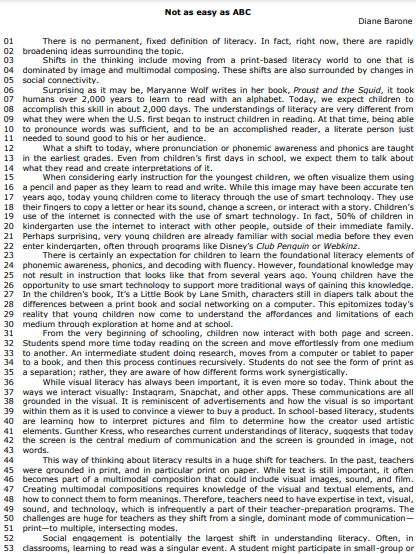
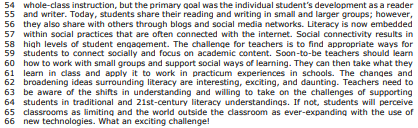
Source: http://languagemagazine.com/?page_id=124967
Instructions: Question are based on the following text.
Source: http://languagemagazine.com/?page_id=124967
TEXT
August 24, 2016 / By Digestive Health Team
Are You Pooping All Wrong?
5 tips to keep your bowels healthy
When it comes to our bowels — and their movements — we may not give them much thought. Of course, when things are not going well, we notice.
However, bowel movements don’t just tell us about the health of our digestive system. This may sound strange, but signs of everything from diseases to stress may show up in your bathroom habits. The key is knowing what to look for — and what the signs may mean.
Here are five tips to encourage healthy bowels:
1. Don’t ignore rectal bleeding
The first thing most people worry about when they have minor rectal bleeding is that they have a cancer. Of course, colon cancer is also a concern. But it’s the cause of rectal bleeding only 1 to 2 percent of the time.
Two problems are usually responsible for blood on the paper, on the stool or in the toilet: hemorrhoids and anal fissures. The good news is that both problems are usually easy to fix.
2. Be careful not to be overzealous when you wipe
A lot of people assume they have hemorrhoids. May their bottoms itch and they feel extra skin down there as they wipe. Must be hemorrhoids, right?
So they treat themselves with medicated wipes or cream. And yet the “hemorrhoids” don’t go away — they itch even more.
Often, the problem is, ironically, being too clean. What happens is a circular process. Filled with good intentions, you try to keep yourself scrupulously clean by using flushable wipes. But the unexpected result is that this leads to itching and the feeling that you have hemorrhoids.
3. Don’t treat the bathroom like a library
Think of your time in the bathroom as a necessity, not an extended escape. If your toilet has stacks of magazines or books on the water tank, consider moving them to another room.
Why? The more time you spend on the toilet, the more likely you will strain for bowel movements. Also, the seated position puts extra stress on your anal blood vessels. Both of these factors boost your risk of hemorrhoids.
4. Get enough fiber in your diet
The goal is to eat 25 to 35 grams of fiber each day. The lack of fiber in the American diet is perhaps the major problem that leads to issues with constipation.
One of the challenges is that not all natural sources are equal in the amounts of fiber they contain, so you don’t always get a consistent amount of fiber intake every day, depending on what you eat. One day a bowl of oatmeal may do it. Another day a serving of broccoli may not.
Of course, each person’s needs are different, too, so you have to find what works best for your body.
5. Avoid dehydration if you have diarrhea
The biggest danger with a short bout of diarrhea is dehydration, or the loss of water and nutrients from the body’s tissues. You could become dehydrated if you have diarrhea more than three times a day and are not drinking enough fluids. Dehydration can cause serious complications if it is not treated. The best way to guard against dehydration is to drink liquids that contain both salt and sugar.
(Source: https://health.clevelandclinic.org/2016/08/poop/)

http://www.theguardian.com/news/2016/feb/10/weatherwatch-ravilious-global-warming-limit-climate-change-uneven- arctic-europe-us
I. global warming (line 01). II. extra couple (line 03). III. Some countries (line 11).
Which ones are collocations?
http://www.theguardian.com/news/2016/feb/10/weatherwatch-ravilious-global-warming-limit-climate-change-uneven- arctic-europe-us
http://www.theguardian.com/news/2016/feb/10/weatherwatch-ravilious-global-warming-limit-climate-change-uneven- arctic-europe-us
The motion requests the prohibition of the hunting of captive-bred lions under any conditions and also states that breeding should only be allowed at “registered zoos or facilities that demonstrate a clear conservation benefit”.
The passing of this motion has come at a critical time as despite more than 20 years of campaigning by local and international activists and organizations to bring an end to these practices, the industry has shown steady growth over the last decade.
Currently there are more than 180 facilities holding approximately 7000 predators used for a variety of commercial purposes, including captive or ‘canned’ hunts.
Although basic legislation is in place to regulate the captive keeping and hunting of lions in South Africa, IUCN members have acknowledged that the SA government has had limited legal scope available to terminate “canned” hunting altogether and are hoping the guidelines set out in the motion will assist them to revise legislation.
“The Department (of Environmental Affairs) will consider the implications associated with the motion; engage the relevant IUCN members and then take appropriate actions, guided by its legal mandate,” says Albi Modise.
Adding to further implementation, amendments to TOPS (Threatened or Protected Species) Regulations will be published early next year which are expected to include prohibiting the introduction of wild lion to captive breeding facilities and the captive breeding of lion if no conservation benefit can be demonstrated.
While the passing of this motion is significant, it is only the first step of what could still be a tricky process.
With Brazil in Turmoil, Rio Counts Down to Olympics
By REBECCAR. RUIZAPRIL27, 2016
RIO DE JANEIRO- Brazil's president is facing impeachment. The country's economy is in sharp decline. Bodies of water that will be used for Olympic competitions are polluted, and global public health officials are trying to tamp down the Zika virus epidemic.
With less than 100 days before the Olympic Games come to South Amarica for the first time, Rio de Janeiro faces more than the usual challenges that bedevil host cities, like delayed stadium construction and transportation concerns. (Rio has those, too.) The mood here, however, is hardly one of panic. Officials in charge of executing the Summer Games say they feel insulated from Brazil's turmoil at this late stage. The Olympics, after all, tend to exist in their own bubble, elaborately coordinated to ensure that the multibillion-dollar operation goes off smoothly. "The machine is in place, and it's relatively stable," Ricardo Leyser, Brazil's sports minister, said in an interview this week. "My biggest concern isn't any individual issue. lt's the small demands that all come at once."
Local organizers are beginning to lay colorful comforters patterned with the silhouettes of cartoon cyclists, fencers and swimmers - on the twin beds in the athletes' village. They are monitoring the growth of 14-month-old grass that will be transplanted to Maracanã, the storied soccer stadium that will also be used for the opening and closing ceremonies. They are pulling trash from Guanabara Bay, where the Games' sailing events will be held; mopping up standing water to minimize mosquito breeding; and ramping up a round-the-clock security operation - all while publicly expressing little worry about the unrest encircling them.
On Wednesday, with the handoff of the Olympic flame in Greece and the start of a journey that in little more than a week will bring it to Brazil, the official countdown to the Aug. 5 opening ceremony began.
ln Rio, the race to be ready is intensifying, with construction workers here still laboring on mass transit projects that were key promises seven years ago in the city's bid to host the Games. Costing several billion dollars, those projects include a new subway line and express bus lanes that connect the Olympic Park in Barra da Tijuca to the rest of the city, which is expected to swell with more than half a million visitors.
As the value ofthe Brazilian real has drastically declined overthe last year, some have expressed doubt that the transit projects will materialize beyond the sleek, modernist weather shelters that have been built at various stations. At a news conference Wednesday, the city's secretary of transportation said the new routes would be ready i n ti me but did not specify when. To the vast majority of people watching the Games on television, however, such infrastructure may not matter.
The permanent venues for competitions here are mostly complete - all but those for tennis and track cycling - and athletes from around the world have competed in dozens of test events in Rio in recent months. "lt's about the filling of the cake," Mr. Leyser said. "lt's not about the stadiums; it's about the scoreboards."
As ofthe latest counts, 62 percent ofthe 5.7 million tickets on the market had been sold - roughly half of the total tickets for the Olympics - and 24 percent of tickets available for the Paralympics had been sold. But compareci with past Olympics, the buyers of those tickets may be disproportionately international, saidAndrew Parsons, the presidentofthe Brazilian Paralympic Committee.
For some Brazilians, the country's political and economic crises have cast a shadow on the celebration. President Dilma Rousseff's ouster looks increasingly likely amid a sweeping graft scandal, and those in line to succeed her have their own controversies hanging overthem.
Questions of corruption have extended to Olympics planning, particularly after a businessman who worked on many Olympic projects in Rio was convicted of corruption and money laundering related to separata contracts. Mr. Leyser said that the questions centered on irregularities at the Deodoro event site and that no publicofficial had been accused ofwrongdoing. "lt's more an administrativa issue than a corruption scheme," he said. "lt's basically a question ofthe numbers." Mr. Leyser called the devaluation of Brazil's currency an opportunity because it increases the buying power of foreign money coming into Brazil forthe Games.
But not everyone sees the event as a boon to the country. Shirlei Alves, who lives in the Santa Marta favela of Rio, criticized the government for spending on the Olympics in the face of Brazil's problems.
"The world is just getting worse here," Ms. Alves said, noting that she was without medication and electricity. "The government is making a mistake. l'd like if they'd take a better look at the poor people and not help people who are already rich." Eduardo Paes, the mayor of Rio, said Wednesday that the city had a "comfortable financial situation" and had spent on stadium construction 1 percent ofwhat it spent on health education. "I know people are skeptical," Mr. Paes said, citing the "huge deliverables" for the Olympics. "Of course the situation here has been difficult. But there is a commitment of the Brazilian state to deliverthe Olympics."
Perhaps the most vexing issue for local organizers-the one that may stir anxiety among athletes and spectators - is the mosquito-borne Zika virus, which has been linked to birth defects and temporary paralysis. Zika is of greater concern outside Rio, in the far north part of Brazil, but the World Health Organization has declared the virus a global public health emergency and has advised pregnant women notto travei anywhere in Brazil.
"The Olympics is a pretty effective way of taking whatever disease is local and making it global," said Ashish K. Jha, director ofthe Global Health lnstitute at Harvard.
Some scientists have suggested that by the time the Olympics start in August - wintertime in Brazil, when mosquitoes are less numerous - the virus might be more prevalent in the southern United States.
"Zika's been spreading effectively on its own, but there's very good reason to think the Olympics will accelerate the spread," Dr. Jhasaid.
But the virus poses a unique problem because it isso far beyond the contrai of local organizing officials, and so many questions about it remain unanswered. Few athletes have publicly expressed concern, but it is unclear how many might withdraw as the Games draw closer.
"At this point you just keep going," David Wallechinsky, an Olympics historian, said. "You have to continue as if everything's going to be fine. These are real concerns - Zika, the water quality. But even if Dilma is forced out of office, it's not going to stop the Olympics."
Com base na Leitura do texto "With Brazil in Turmoil, Rio Counts Down to Olympics", responda a questão:
“Neither Bob nor his sister Aileen borrows money to anyone, under any circumstances.”
A B C D
Choose the inconsistent item and its corresponding correction.

It’s been a long time since attending school consisted of hauling in a large pile of books and sitting still looking at the teacher all day. Students these days are online, connected and digitally savvy. But are we making the most of this? One Hertfordshire school certainly is.
Back in 2013, Hobletts Manor Junior School in Hemel Hempstead received its Oftsed report. Though it was very good, the report suggested the school could be outstanding if its pupils were able to use their ICT skills in more subjects. At the time, the school had a similar IT setup to most other UK primary schools: one ICT suite with limited pupil access. This, says head teacher Sally Short, made it difficult to embed technology across the curriculum in the ways they would like. But with the help of the school’s ICT coordinator and year 4 teacher Alice Baker, the local authority and PC World Business, Mrs Short came up with a shortlist of requirements to bring the school and its teaching style properly into the digital age.
From ordering to installation, the process took just four weeks and at the end of it the school had a whole host of innovative tech, including an interactive 70inch Smart table, which works like a giant iPad. Miss Baker devised an interactive activity about the Egyptians and, she says, things like this have made a huge difference to learning. Because more than one person can interact with the Smart table, Mrs Short says her own teaching style has changed: “Before, lessons were purely teacher-led. It’s opening doors we didn’t even know existed and having an amazing impact.” The students were also each given their own Windows 8-enabled tablet; one child was so excited about this that he even burst into tears. The digital natives needed just one session to experiment and they were off. Miss Baker laughs: “They even teach me how to use the kit sometimes.” It might seem as though increased technology decreases concentration but, says Miss Baker, “Pupils are so much more engaged when they’re using the tablets, even if they’re just checking their answers on them.”
The tech has also allowed the children to be more independent in their learning, but there are security measures in place to ensure Miss Baker has control over content and activity. Miss Baker has Acer Class Management software installed on her tablet. This allows her to see what all the students are doing on their tablets, and also enables her to share slideshows and websites. Handily, she can even lock their screens. At the same time, the entire school network has been upgraded. Pupils and teachers can now access a Wi-Fi connection in the outdoor learning area and there are plans afoot to allow them to use their tech in the nearby woodland and garden. The school is carefully monitoring the impact of the new technology, and has been making careful comparisons on the students’ progress. The teachers hope, too, that the tech will have a positive impact on attendance as students become increasingly engaged in lessons. “Following the installation, we surveyed pupils to gauge their perceptions on technology,” says Miss Baker, “Pupils who have been able to take advantage of the tools provided by PC World Business said that they felt technology was really important and that they will use it when they grow up. Perhaps most importantly, all the students in the class agreed that the technology has helped them learn.”
(Available in: www.telegraph.co.uk. Adapted.)
“… didn’t even know existed and having an amazing impact. The students were also each given their own Windows 8-enabled tablet;…” (L 15-16)
In the active voice “The students were also given their own Windows 8-enabled tablet” becomes:
Refugee judokas searching for peace while fighting for their Olympic dream in Rio

More than two and a half years after they came to Rio de Janeiro to compete in the World Judo Championships, two refugees from the Democratic Republic of the Congo are still here, in pursuit of an extraordinary Olympic dream. When teams from more than 200 countries march into the Maracanã Stadium for the opening ceremony of the Rio 2016 Games on 5 August, Popole Misenga and Yolanda Mabika intend to be among them, walking behind the Olympic flag. The International Olympic Committee (IOC) will mount a unique team of refugee athletes which will compete in Rio. It has been a long journey from central Africa and from a war that has claimed an estimated 5.4 million lives. Mabika, now 28, cannot hold back the tears when she remembers the brothers and sisters she has not seen since 1998, when she was evacuated from her home town to the country’s capital, Kinshasa. It was there, as a child, that she first took up judo. Misenga’s mother was murdered when he was just six years old. The young child wandered for days in the Congolese rainforest before he too was rescued and taken to Kinshasa. Like his compatriot, he soon took to judo, a sport which the Congolese government saw as an ideal way of giving some structure to the lives of the country’s countless orphans. In 2010, Misenga won a bronze medal at the under-20 African Judo Championship. But Misenga and Mabika said training conditions were excessively rigorous, with losing judokas beaten and locked in cells. At the 2013 World Judo Championship, Misenga took the opportunity to begin a better life. After escaping from the team hotel, a couple of days later Misenga found himself in the favela community of Cinco Bocas in northern Rio, home to most of the city’s Congolese community of some 900 people. He sent Mabika a message and she also decided to stay. Life in northern Rio has not always been easy for the judokas. It has been a story of odd jobs and informal employment.The two athletes are now training three times a week at the Instituto Reação. The learning curve has been steep. Geraldo Bernardes, the veteran coach of the Brazilian team in four Olympic Games, says that Misenga and Mabika were initially far too aggressive in training. “They were used to being punished and mistreated when they lost,” Geraldo explains. “I had to tell them that training and fighting are different things.”
Misenga told rio2016.com that he had adjusted to his new surrounds: “I have learnt a lot on the technical side. I can feel in my body that I have learnt what was missing before in my judo.” Their coach says the two judokas are rough diamonds and are still making up for the lost time in their training. Brazil has a strong tradition in the sport and both athletes are hoping that by refining their skills in the country they will make the cut when the IOC decides which athletes (from a shortlist of 43) will form part of Team Refugee in June. In the meantime, both Misenga and Mabika are enjoying their new lives in Rio. The Instituto Reação and the local Estácio de Sá university have given them the opportunity to learn Portuguese, maths and other subjects. Neither of the two judokas has any plan to leave the new home town that has given them so much.
(Available in: http://www.rio2016.com. Adapted.)
Refugee judokas searching for peace while fighting for their Olympic dream in Rio
More than two and a half years after they came to Rio de Janeiro to compete in the World Judo Championships, two refugees from the Democratic Republic of the Congo are still here, in pursuit of an extraordinary Olympic dream. When teams from more than 200 countries march into the Maracanã Stadium for the opening ceremony of the Rio 2016 Games on 5 August, Popole Misenga and Yolanda Mabika intend to be among them, walking behind the Olympic flag. The International Olympic Committee (IOC) will mount a unique team of refugee athletes which will compete in Rio. It has been a long journey from central Africa and from a war that has claimed an estimated 5.4 million lives. Mabika, now 28, cannot hold back the tears when she remembers the brothers and sisters she has not seen since 1998, when she was evacuated from her home town to the country’s capital, Kinshasa. It was there, as a child, that she first took up judo. Misenga’s mother was murdered when he was just six years old. The young child wandered for days in the Congolese rainforest before he too was rescued and taken to Kinshasa. Like his compatriot, he soon took to judo, a sport which the Congolese government saw as an ideal way of giving some structure to the lives of the country’s countless orphans. In 2010, Misenga won a bronze medal at the under-20 African Judo Championship. But Misenga and Mabika said training conditions were excessively rigorous, with losing judokas beaten and locked in cells. At the 2013 World Judo Championship, Misenga took the opportunity to begin a better life. After escaping from the team hotel, a couple of days later Misenga found himself in the favela community of Cinco Bocas in northern Rio, home to most of the city’s Congolese community of some 900 people. He sent Mabika a message and she also decided to stay. Life in northern Rio has not always been easy for the judokas. It has been a story of odd jobs and informal employment.The two athletes are now training three times a week at the Instituto Reação. The learning curve has been steep. Geraldo Bernardes, the veteran coach of the Brazilian team in four Olympic Games, says that Misenga and Mabika were initially far too aggressive in training. “They were used to being punished and mistreated when they lost,” Geraldo explains. “I had to tell them that training and fighting are different things.”
Misenga told rio2016.com that he had adjusted to his new surrounds: “I have learnt a lot on the technical side. I can feel in my body that I have learnt what was missing before in my judo.” Their coach says the two judokas are rough diamonds and are still making up for the lost time in their training. Brazil has a strong tradition in the sport and both athletes are hoping that by refining their skills in the country they will make the cut when the IOC decides which athletes (from a shortlist of 43) will form part of Team Refugee in June. In the meantime, both Misenga and Mabika are enjoying their new lives in Rio. The Instituto Reação and the local Estácio de Sá university have given them the opportunity to learn Portuguese, maths and other subjects. Neither of the two judokas has any plan to leave the new home town that has given them so much.
(Available in: http://www.rio2016.com. Adapted.)

 Conheça nossos planos