Questões de Concurso
Sobre verbos | verbs em inglês
Foram encontradas 3.093 questões


In a dystopian future, where time travel is a reality, individuals are given a unique opportunity. They can alter the course of history by making a single decision that will have far-reaching consequences. However, there's a catch - the decision must be made under a specific condition.
If the protagonist (1) ____________ to save a loved one, the entire timeline would shift, creating a ripple effect that might lead to a different dystopian reality. However, the condition is that the decision must be made within a limited time frame.
Now, choose the option that correctly completes the sentence.
"Each morning, she kick-starts her day with a hearty breakfast, a routine she cherishes as a moment of quiet reflection before plunging into the demanding world of work."
Concerning the Future Perfect Continuous, analyze the following items.
I. We use will/shall + have + been + the -ing form of the verb.
II. We use shall only for future time reference with I and we.
III. Shall is more informal and less common than will.
IV. We use the future perfect continuous form when we are looking back to the past from a point in the future and we want to emphasise the length or duration of na activity or event.
Choose the correct answer:
Analyze the underlined sentences:
I. “Scientists have delivered a final warning on the climate crisis, as rising greenhouse gas emissions push the world to the brink of irrevocable damage that only swift and drastic action can avert.”
II. “The comprehensive review of human knowledge of the climate crisis took hundreds of scientists eight years to compile and runs to thousands of pages, but boiled down to one message: act now, or it will be too late.”
Text 1
Romanticism
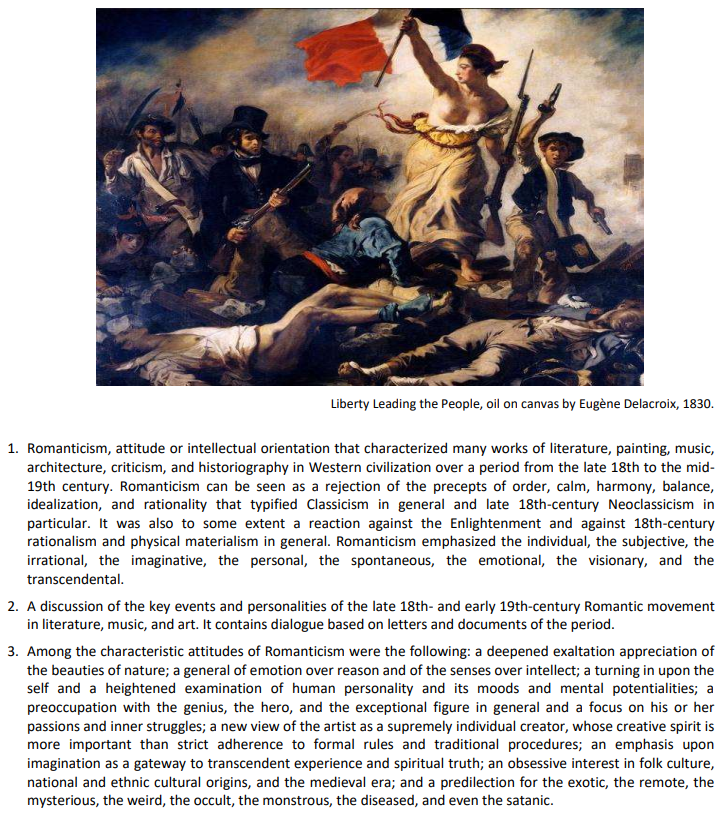
BRITANNICA, The Editors of Encyclopaedia. “Romanticism”. Encyclopedia Britannica, 26 Dec. 2023,
https://www.britannica.com/art/Romanticism. Accessed 1 February 2024
Analyze the sentences of text 1:
I. “Romanticism emphasized the individual, the subjective, the irrational, the imaginative, the personal, the spontaneous, the emotional, the visionary, and the transcendental”.
II. “A discussion of the key events and personalities of the late 18th- and early 19th-century Romantic movement in literature, music, and art. It contains dialogue based on letters and documents of the period”.
III.”Among the characteristic attitudes of Romanticism were the following: a deepened appreciation of the beauties of nature; a general exaltation of emotion over reason and of the senses over intellect”.
“Wonderful experience”: Researcher’s close encounter with Svalbard polar bears
By Miranda Bryant

(Available at: www.theguardian.com/environment/2024/apr/02/wonderful-experience-svalbardresearchers-close-encounter-with-svalbard-polar-bears – text especially adapted for this test).
I. This verb tense is used because the sentence states when the action started, but not when it finishes, once it is still ongoing. II. The verb “have” is used in the third person singular form to agree with the subject of the sentence. III. If the present perfect structure were substituted by a simple past structure, there would be no changes in meaning.
Which ones are correct?
Analyze the assertions below.
I - "In" correctly fills the gap in the text. II - There is a phrasal verb in the sentence “(…) which included laying off more than (…)”. III - The words in italics are respectively: an uncountable noun; a personal pronoun; the comparative form of the adjective “quart”.
It is correct to affirm that:
Read Text I and answer question.
Text I
How to have a healthier relationship with your phone
A few years ago, a Google employee sent an email to thousands of her co-workers: What if for six weeks straight, you spent one night per week without technology? The email was from Laura Mae Martin, Google’s executive productivity adviser, a role that, among other things, was created to help staff members foster healthier relationships with their gadgets and apps. After she sent the note, Ms. Martin was flooded with responses from coworkers eager for a respite from some of the very products they helped build. Thousands of employees have since participated in the annual “No-Tech Tuesday Night Challenge,” said Ms. Martin.
The problem she was trying to solve isn’t unique to Google workers. One survey found that Americans say they spend too much time on their phones. But dramatic solutions – a digital detox, a phone downgrade or a complete exit from social media – may feel impractical.
Is it possible to have a healthy relationship with technology while still using it daily? Fortunately, according to experts, the answer is a resounding ‘yes’ and here are a few things you can try:
First, start with one simple question.
You know that urge you get to reach for your phone without realizing it? And then, before you know it, you’re an hour into a social media binge? If you want to peacefully coexist with technology, you need to get a handle on those impulses, said Richard J. Davidson, the founder and director of the Center for Healthy Minds at the University of Wisconsin-Madison. According to him, people should start by noticing when they have an urge to lift their phone or open social media on their browser window. By becoming conscious of what you’re about to do, you’re interrupting an automatic behavior and awakening the part of your brain that governs self-control, he added. As one research article suggests, awareness of your actions can help you rein in bad habits.
Secondly, take the “mobile” out of your mobile devices.
Dr. Anna Lembke, a professor of psychiatry and addiction medicine at Stanford University School of Medicine, said one of the biggest problems with smartphones is what she calls “texting while running to catch a bus.” Using our devices while we’re on the move – walking from meeting to meeting, taking a child to school or catching a bus – prevents us from being more engaged in our lives, Dr. Lembke said.
One way to create harmony with technology is to limit your phone use when you’re on the move. Headed out for a walk? Turn off your notifications. Going to grab a coffee? Leave your phone on your desk. If you’re feeling brave, try powering down your phone while in transit. It won’t buzz with notifications, text messages or phone calls, which Dr. Lembke said could help you focus on the world around you.
Last of all, make technology work for you.
One thing experts agree on: To forge a healthy relationship with technology, you need to be in control of it and not the other way around. Think about your gadgets as tools that you decide how to use.
“Make it work for you, not against you; whether it’s an email program or your dishwasher, it’s the intention behind how you’re using it that really makes the big difference”, said Ms. Martin, the productivity expert at Google.
(Adapted from:
https://www.nytimes.com/2024/03/21/well/social-media-phone-addiction.html)
I - “(…) here are a few things you can try”. II - “Turn off your notifications”. III - “(…) of your actions can help you rein in bad habits.” IV - “(…) the part of your brain that governs self-control, he added.”
The sentence(s) in which there is a phrasal verb is/are:
Read Text I and answer question.
Text I
How to have a healthier relationship with your phone
A few years ago, a Google employee sent an email to thousands of her co-workers: What if for six weeks straight, you spent one night per week without technology? The email was from Laura Mae Martin, Google’s executive productivity adviser, a role that, among other things, was created to help staff members foster healthier relationships with their gadgets and apps. After she sent the note, Ms. Martin was flooded with responses from coworkers eager for a respite from some of the very products they helped build. Thousands of employees have since participated in the annual “No-Tech Tuesday Night Challenge,” said Ms. Martin.
The problem she was trying to solve isn’t unique to Google workers. One survey found that Americans say they spend too much time on their phones. But dramatic solutions – a digital detox, a phone downgrade or a complete exit from social media – may feel impractical.
Is it possible to have a healthy relationship with technology while still using it daily? Fortunately, according to experts, the answer is a resounding ‘yes’ and here are a few things you can try:
First, start with one simple question.
You know that urge you get to reach for your phone without realizing it? And then, before you know it, you’re an hour into a social media binge? If you want to peacefully coexist with technology, you need to get a handle on those impulses, said Richard J. Davidson, the founder and director of the Center for Healthy Minds at the University of Wisconsin-Madison. According to him, people should start by noticing when they have an urge to lift their phone or open social media on their browser window. By becoming conscious of what you’re about to do, you’re interrupting an automatic behavior and awakening the part of your brain that governs self-control, he added. As one research article suggests, awareness of your actions can help you rein in bad habits.
Secondly, take the “mobile” out of your mobile devices.
Dr. Anna Lembke, a professor of psychiatry and addiction medicine at Stanford University School of Medicine, said one of the biggest problems with smartphones is what she calls “texting while running to catch a bus.” Using our devices while we’re on the move – walking from meeting to meeting, taking a child to school or catching a bus – prevents us from being more engaged in our lives, Dr. Lembke said.
One way to create harmony with technology is to limit your phone use when you’re on the move. Headed out for a walk? Turn off your notifications. Going to grab a coffee? Leave your phone on your desk. If you’re feeling brave, try powering down your phone while in transit. It won’t buzz with notifications, text messages or phone calls, which Dr. Lembke said could help you focus on the world around you.
Last of all, make technology work for you.
One thing experts agree on: To forge a healthy relationship with technology, you need to be in control of it and not the other way around. Think about your gadgets as tools that you decide how to use.
“Make it work for you, not against you; whether it’s an email program or your dishwasher, it’s the intention behind how you’re using it that really makes the big difference”, said Ms. Martin, the productivity expert at Google.
(Adapted from:
https://www.nytimes.com/2024/03/21/well/social-media-phone-addiction.html)
Poor Things – Emma Stone transfixes in Lanthimos’s thrilling carnival of oddness
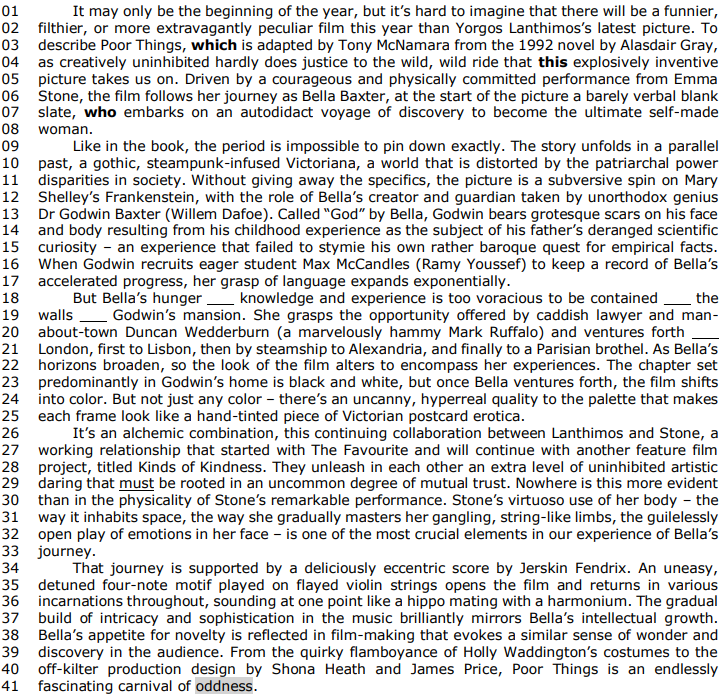
(Available at: www.theguardian.com/film/2024/jan/14/poor-things-review-yorgos-lanthimos-emma-stonefrankenstein – text specially adapted for this test).
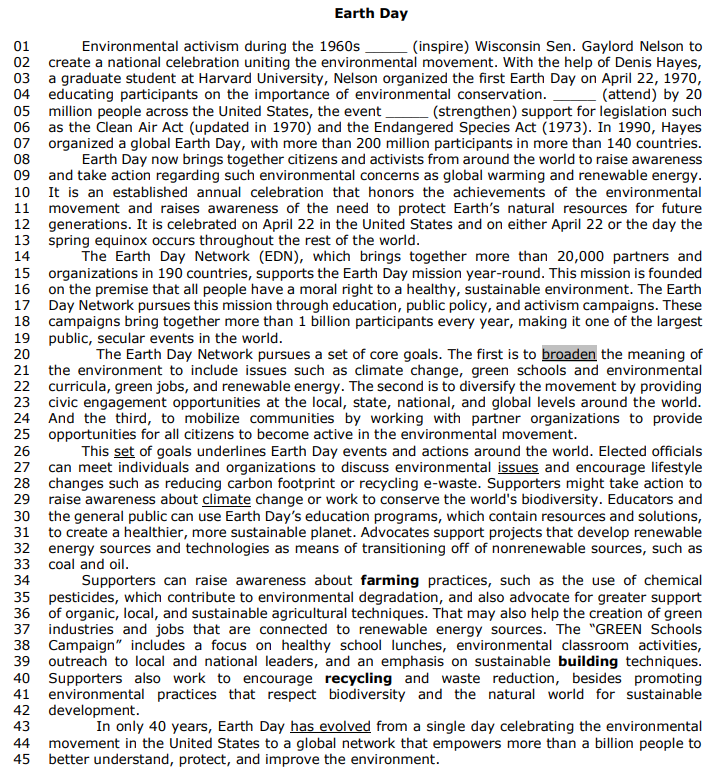
(Available at: education.nationalgeographic.org/resource/earth-day/– text specially adapted for this test).
(Available at: education.nationalgeographic.org/resource/earth-day/– text specially adapted for this test).
(Available at: education.nationalgeographic.org/resource/earth-day/– text specially adapted for this test).
I. The verb “farm” is in its gerund form in line 34 because it follows the preposition “about”.
II. The verb “build” is in its gerund form in line 39 because it serves as an adjective for “techniques”.
III. The verb “recycle” is in its gerund form in line 40 because it follows the verb “encourage”.
Which ones are correct?
"Maybe next year, I ___ (participate in) an international education conference, and I ___ (develop) new curriculum materials."
"I ___ (implement) a new teaching strategy, and I ___ (notice) significant improvements in student engagement."

 Conheça nossos planos