Questões de Concurso
Sobre verbos | verbs em inglês
Foram encontradas 3.093 questões


Julgue o item subsequente.
The sentence "My mother said that she loved the gift you
gave her", the phrasing is the reported speech in the
simple past, in this case if the sentence was made on
direct speech it should be always in the simple present.
Julgue o item subsequente.
The sentence "The students are studying diligently for
their upcoming exams." is grammatically correct.
Julgue o item subsequente.
The sentence "The students must pass the exam to
ingress the college", the modal verb "must" is used to
express a necessity.
Teaching Teens How to Understand Their Feelings is Key to Helping Them Grow and Mature
By Good News Network

What is Validity?
by Evelina Galaczi
July 17th, 2020
The fundamental concept to keep in mind when creating any assessment is validity. Validity refers to whether a test measures what it aims to measure. For example, a valid driving test should include a practical driving component and not just a theoretical test of the rules of driving. A valid language test for university entry, for example, should include tasks that are representative of at least some aspects of what actually happens in university settings, such as listening to lectures, giving presentations, engaging in tutorials, writing essays, and reading texts.
Validity has different elements, which we are now going to look at
in turn.
Test Purpose – Why am I testing?
We can never really say that a test is valid or not valid. Instead, we can say that a test is valid for a particular purpose. There are several reasons why you might want to test your students. You could be trying to check their learning at the end of a unit, or trying to understand what they know and don't know. Or, you might want to use a test to place learners into groups based on their ability, or to provide test takers with a certificate of language proficiency. Each of these different reasons for testing represents a different test purpose.
The purpose of the test determines the type of test you're going
to produce, which in turn affects the kinds of tasks you're going
to choose, the number of test items, the length of the test, and so
on. For example, a test certifying that doctors can practise in an
English-speaking country would be different from a placement test
which aims to place those doctors into language courses.
Test Takers – Who am I testing?
It’s also vital to keep in mind who is taking your test. Is it primary
school children or teenagers or adults? Or is it airline pilots or
doctors or engineers? This is an important question because the
test has to be appropriate for the test takers it is aimed for. If your
test takers are primary school children, for instance, you might
want to give them more interactive tasks or games to test their
language ability. If you are testing listening skills, for example,
you might want to use role plays for doctors, but lectures or
monologues with university students.
Test Construct – What am I testing?
Another key point is to consider what you want to test. Before
designing a test, you need to identify the ability or skill that the test
is designed to measure – in technical terms, the ‘test construct’.
Some examples of constructs are: intelligence, personality,
anxiety, English language ability, pronunciation. To take
language assessment as an example, the test construct could be
communicative language ability, or speaking ability, or perhaps
even a construct as specific as pronunciation. The challenge is
to define the construct and find ways to elicit it and measure it;
for example, if we are testing the construct of fluency, we might
consider features such as rate of speech, number of pauses/
hesitations and the extent to which any pauses/hesitations cause
strain for a listener.
Test Tasks – How am I testing?
Once you’ve defined what you want to test, you need to decide how
you’re going to test it. The focus here is on selecting the right test
tasks for the ability (i.e. construct) you're interested in testing. All
task types have advantages and limitations and so it’s important to
use a range of tasks in order to minimize their individual limitations
and optimize the measurement of the ability you’re interested in.
The tasks in a test are like a menu of options that are available to
choose from, and you must be sure to choose the right task or the
right range of tasks for the ability you're trying to measure.
Test Reliability - How am I scoring?
Next it’s important to consider how to score your test. A test needs
to be reliable and to produce accurate scores. So, you’ll need to
make sure that the scores from a test reflect a learner's actual
ability. In deciding how to score a test, you’ll need to consider
whether the answers are going to be scored as correct or incorrect
(this might be the case for multiple–choice tasks, for example) or
whether you might use a range of marks and give partial credit,
as for example, in reading or listening comprehension questions.
In speaking and writing, you’ll also have to decide what criteria
to use (for example, grammar, vocabulary, pronunciation, essay, organisation in writing, and so on). You’ll also need to make sure
that the teachers involved in speaking or writing assessment have
received some training, so that they are marking to (more or less)
the same standard.
Test Impact - How will my test help learners?
The final – and in many ways most important – question to ask yourself is how the test is benefitting learners. Good tests engage learners in situations similar to ones that they might face outside the classroom (i.e. authentic tasks), or which provide useful feedback or help their language development by focusing on all four skills (reading, listening, writing, speaking). For example, if a test has a speaking component, this will encourage speaking practice in the classroom. And if that speaking test includes both language production (e.g. describe a picture) and interaction (e.g. discuss a topic with another student), then preparing for the test encourages the use of a wide range of speaking activities in the classroom and enhances learning.
Adapted from: https://www.cambridgeenglish.org/blog/what-is-validity. Acesso em:
15 dez. 2023.
What is Validity?
by Evelina Galaczi
July 17th, 2020
The fundamental concept to keep in mind when creating any assessment is validity. Validity refers to whether a test measures what it aims to measure. For example, a valid driving test should include a practical driving component and not just a theoretical test of the rules of driving. A valid language test for university entry, for example, should include tasks that are representative of at least some aspects of what actually happens in university settings, such as listening to lectures, giving presentations, engaging in tutorials, writing essays, and reading texts.
Validity has different elements, which we are now going to look at
in turn.
Test Purpose – Why am I testing?
We can never really say that a test is valid or not valid. Instead, we can say that a test is valid for a particular purpose. There are several reasons why you might want to test your students. You could be trying to check their learning at the end of a unit, or trying to understand what they know and don't know. Or, you might want to use a test to place learners into groups based on their ability, or to provide test takers with a certificate of language proficiency. Each of these different reasons for testing represents a different test purpose.
The purpose of the test determines the type of test you're going
to produce, which in turn affects the kinds of tasks you're going
to choose, the number of test items, the length of the test, and so
on. For example, a test certifying that doctors can practise in an
English-speaking country would be different from a placement test
which aims to place those doctors into language courses.
Test Takers – Who am I testing?
It’s also vital to keep in mind who is taking your test. Is it primary
school children or teenagers or adults? Or is it airline pilots or
doctors or engineers? This is an important question because the
test has to be appropriate for the test takers it is aimed for. If your
test takers are primary school children, for instance, you might
want to give them more interactive tasks or games to test their
language ability. If you are testing listening skills, for example,
you might want to use role plays for doctors, but lectures or
monologues with university students.
Test Construct – What am I testing?
Another key point is to consider what you want to test. Before
designing a test, you need to identify the ability or skill that the test
is designed to measure – in technical terms, the ‘test construct’.
Some examples of constructs are: intelligence, personality,
anxiety, English language ability, pronunciation. To take
language assessment as an example, the test construct could be
communicative language ability, or speaking ability, or perhaps
even a construct as specific as pronunciation. The challenge is
to define the construct and find ways to elicit it and measure it;
for example, if we are testing the construct of fluency, we might
consider features such as rate of speech, number of pauses/
hesitations and the extent to which any pauses/hesitations cause
strain for a listener.
Test Tasks – How am I testing?
Once you’ve defined what you want to test, you need to decide how
you’re going to test it. The focus here is on selecting the right test
tasks for the ability (i.e. construct) you're interested in testing. All
task types have advantages and limitations and so it’s important to
use a range of tasks in order to minimize their individual limitations
and optimize the measurement of the ability you’re interested in.
The tasks in a test are like a menu of options that are available to
choose from, and you must be sure to choose the right task or the
right range of tasks for the ability you're trying to measure.
Test Reliability - How am I scoring?
Next it’s important to consider how to score your test. A test needs
to be reliable and to produce accurate scores. So, you’ll need to
make sure that the scores from a test reflect a learner's actual
ability. In deciding how to score a test, you’ll need to consider
whether the answers are going to be scored as correct or incorrect
(this might be the case for multiple–choice tasks, for example) or
whether you might use a range of marks and give partial credit,
as for example, in reading or listening comprehension questions.
In speaking and writing, you’ll also have to decide what criteria
to use (for example, grammar, vocabulary, pronunciation, essay, organisation in writing, and so on). You’ll also need to make sure
that the teachers involved in speaking or writing assessment have
received some training, so that they are marking to (more or less)
the same standard.
Test Impact - How will my test help learners?
The final – and in many ways most important – question to ask yourself is how the test is benefitting learners. Good tests engage learners in situations similar to ones that they might face outside the classroom (i.e. authentic tasks), or which provide useful feedback or help their language development by focusing on all four skills (reading, listening, writing, speaking). For example, if a test has a speaking component, this will encourage speaking practice in the classroom. And if that speaking test includes both language production (e.g. describe a picture) and interaction (e.g. discuss a topic with another student), then preparing for the test encourages the use of a wide range of speaking activities in the classroom and enhances learning.
Adapted from: https://www.cambridgeenglish.org/blog/what-is-validity. Acesso em:
15 dez. 2023.
Internet:<www.learnenglishteens.britishcouncil.org>
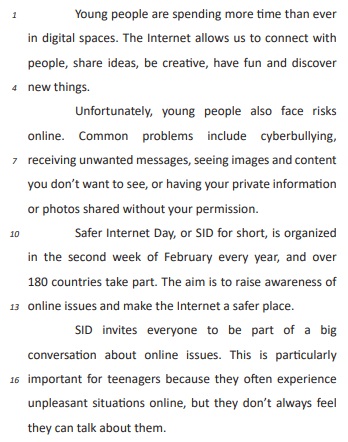
According to the text and general English knowledge answer the item.
The words “receiving” (line 7), “seeing” (line 7)
and “having” (line 8) are examples of the present
continuous or present progressive tense.

(Available in: https://www.france24.com/en/europe/20240114-denmark-s-frederik-x-to-become-king-afterqueen-margrethe-s-abdication – text especially adapted for this test).
(Available in: https://www.france24.com/en/europe/20240114-denmark-s-frederik-x-to-become-king-afterqueen-margrethe-s-abdication – text especially adapted for this test).
(Available in: https://www.france24.com/en/europe/20240114-denmark-s-frederik-x-to-become-king-afterqueen-margrethe-s-abdication – text especially adapted for this test).
I. The word “may” suggests a possibility.
II. In a negative structure, “may not represent” and “cannot represent” have the same meaning.
III. “Will retain” is an example of the Simple Future Verb Tense.
Which statements are correct?
Read Text IV and answer the three questions that follow it:
Text IV

Adapted from: https://www.facebook.com/photo/?fbid=1294646317355834&set
=a.915379355282534
The simple past and the past participle of the verb “split” in “split
bills” are formed in the same way as in
Read Text I and answer the fourteen questions that follow it
Text I The “literacy turn” in education: reexamining
what it means to be literate
In response to the phenomena of mass migration and the emergence of digital communications media that defined the last decade of the 20th century, the New London Group (NLG) called for a broader view of literacy and literacy teaching in its 1996 manifesto, A Pedagogy of Multiliteracies: Designing Social Futures. The group argued that literacy pedagogy in education must (1) reflect the increasing cultural and linguistic diversity of the contemporary globalized world, and (2) account for the new kinds of texts and textual engagement that have emerged in the wake of new information and multimedia technologies. In order to better capture the plurality of discourses, languages, and media, they proposed the term ‘multiliteracies’.
Within the NLG’s pedagogy of multiliteracies, language and
other modes of communication are viewed as dynamic resources
for meaning making that undergo constant changes in the
dynamics of language use as learners attempt to achieve their
own purposes. Within this broader view of literacy and literacy
teaching, learners are no longer “users as decoders of language”
but rather “designers of meaning.” Meaning is not viewed as
something that resides in texts; rather, deriving meaning is
considered an active and dynamic process in which learners
combine and creatively apply both linguistic and other semiotic
resources (e.g., visual, gesture, sound, etc.) with an awareness of
“the sets of conventions connected with semiotic activity [...] in a
given social space” (NLG, 1996, p. 74).
Grounded within the view that learning develops in social,
cultural, and material contexts as a result of collaborative
interactions, NLG argued that instantiating literacy-based
teaching in classrooms calls on the complex integration and
interaction of four pedagogical components that are neither
hierarchical nor linear and can at times overlap: situated practice,
overt instruction, critical framing, and transformed practice. […]
Although the NLG’s pedagogy of multiliteracies was
conceived as a “statement of general principle” (1996, p. 89) for
schools, the group’s call for educators to recognize the diversity
and social situatedness of literacy has had a lasting impact on
foreign language (FL) teaching and learning. The reception of the
group’s work along with that of other scholars from critical
pedagogy appeared at a time when the field was becoming less
solidly anchored in theories of L2 acquisition and more interested
in the social practice of FL education itself. In the section that
follows, we describe the current state of FL literacy studies as it
has developed in recent years, before finally turning to some very
recent emerging trends that we are likely to see develop going
forward.
(Adapted from: https://www.colorado.edu/center/altec/sites/default/files/ attachedfiles/moving_toward_multiliteracies_in_foreign_language_teaching.pdf)
Planes top 800 mph as near-record winds sweep high over Mid-Atlantic

(Available at: www.washingtonpost.com/weather/2024/02/18/record-jet-stream-winds-dc-flights/ – text
specially adapted for this test)
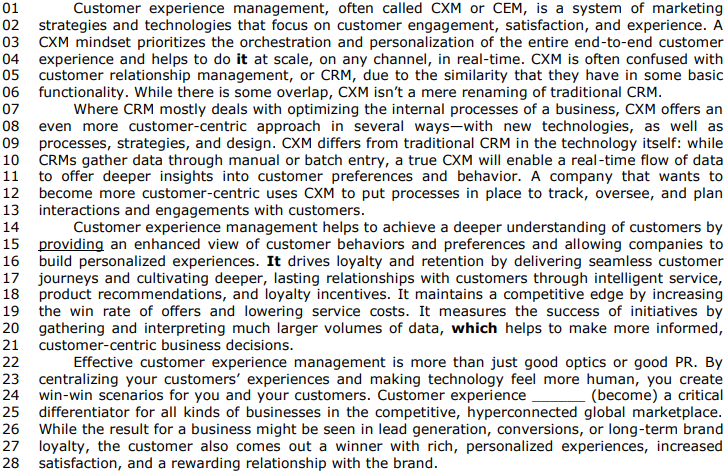
What is customer experience management?
(Available at: www.dynamics.microsoft.com/en-us/marketing/what-is-customer-experience-management-cxm/
– text specially adapted for this test).
What is customer experience management?
(Available at: www.dynamics.microsoft.com/en-us/marketing/what-is-customer-experience-management-cxm/
– text specially adapted for this test).
Keeping in mind the ideas expressed above and the linguistic aspects of the text, judge the following item.
The verb “prompted” (in the second sentence of the third
paragraph) conveys the same idea as restrained.

 Conheça nossos planos