Questões de Concurso
Sobre verbos | verbs em inglês
Foram encontradas 3.093 questões


Ano: 2026
Banca:
FUNDATEC
Órgão:
Prefeitura de Pinheiro Preto - SC
Prova:
FUNDATEC - 2026 - Prefeitura de Pinheiro Preto - SC - Professor de Inglês - Edital nº 1 |
Q4252672
Inglês
Texto associado
The Evolution of Digital Design
By Coursera Staff
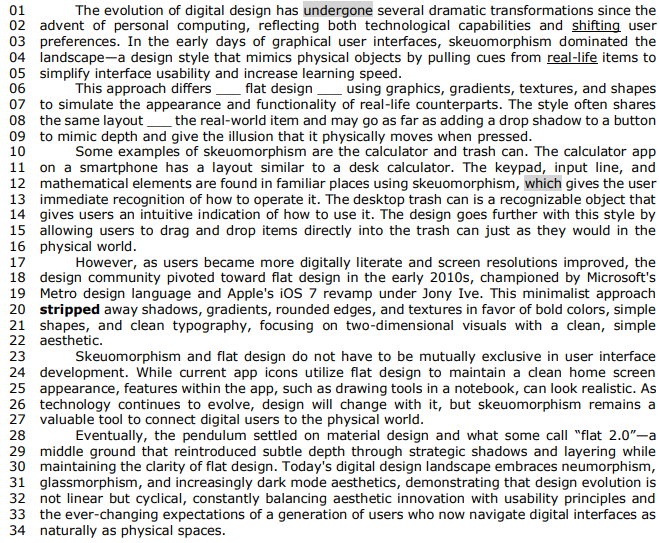
(Available at: https://www.coursera.org/articles/skeuomorphism – text specially adapted for this test).
In which of the following sentences does the word “shifting” function in the same way
as the underlined word (l. 02)?
Ano: 2026
Banca:
SELECON
Órgão:
Prefeitura de Conquista D'Oeste - MT
Prova:
SELECON - 2026 - Prefeitura de Conquista D'Oeste - MT - Professor de Inglês |
Q4250989
Inglês
Texto associado
Leia o texto a seguir.
In Brazil, four in ten teenagers face school bullying
In Brazil, four out of ten students aged 13 to 17 say they have already been
victims of bullying, and 27.2 percent in this age group have suffered some
form of humiliation two or more times.
The data, released this week, are based on testimonies collected in 2024
in schools across Brazil by the Brazilian government’s statistics agency
IBGE as part of the National School Health Survey (PeNSE).
Compared to the previous survey, conducted in 2019, there was a 0.7
percentage point increase in the total number of students who reported
having suffered bullying. The proportion of students who experienced it at
least twice rose by more than 4 percentage points, Marco Andreazzi, the
research manager, emphasized.
“Bullying is already characterized as something persistent, intermittent…
And here we observe an upward trend, indicating that more students have
begun to experience repeated situations of violence,” Andreazzi said.
The researcher stressed that “the number of those who suffer bullying
remains practically the same; however, the persistence and intensity of the
episodes have increased.”
Appearance, race, gender
Bullied students told researchers that their facial features or hair were the
main targets of bullying, accounting for 30.2 percent of cases.
Next is body appearance, accounting for 24.7 percent, followed by bullying
related to color or race, reported by 10.6 percent.
“There is also a high percentage - 26.3 percent - of students who say the
bullying had no reason. That is, many of those who suffer do not know
why, and this is natural, since bullying occurs collectively and the victim
does not necessarily perceive a reason for it. On the contrary, they feel
completely wronged,” the research manager noted.
The research found that girls are the most affected - 43.3 percent have
experienced bullying, compared to 37.3 percent of boys.
Furthermore, 30.1 percent of female adolescent students reported feeling
humiliated by teasing from classmates two or more times. This proportion
is nearly 6 percentage points higher than among male students.
Profile of the aggressors
Data on those who commit bullying show an inverse pattern: 13.7 percent
of students reported having engaged in some form of violence - 16.5
percent of boys and 10.9 percent of girls.
IBGE also asked about the reasons for the aggression, and once again,
facial features, hair, body type, and skin color or race were the most
frequently cited.
However, some significant differences emerged in relation to victims’
reports. For example, 12.1 percent of perpetrators said they engaged in
bullying because of their classmates’ gender or sexual orientation, while
only 6.4 percent of victims identified this as a motive for the violence.
A similar pattern emerged regarding disability: while 7.6 percent of
perpetrators acknowledged engaging in bullying for this reason, only 2.6
percent of victims associated the attacks with this characteristic.
For researchers, this may indicate that many victims prefer to remain silent
about the circumstances for fear of being stigmatized.
TÂMARA FREIRE
Fonte: https://agenciabrasil.ebc.com.br/en/educacao/noticia/2026-03/brazil-four-tenteenagers-face-school-bullying-27/5/2026/. Excerto. Acesso em: 10/06/2026.
No trecho “In Brazil, four out of ten students aged 13 to 17
say they have already been victims of bullying...” (1º parágrafo),
a locução verbal destacada está flexionada no:
Ano: 2026
Banca:
AMEOSC
Órgão:
Prefeitura de Bandeirante - SC
Prova:
AMEOSC - 2026 - Prefeitura de Bandeirante - SC - Professor de Inglês - Edital nº 8 |
Q4248840
Inglês
Texto associado
'It's Happening': Daniel Johns Drops More Teases
After Making Shock Appearance at Silverchair
Tribute Show
Daniel Johns has been sharing cryptic messages in
recent months, and fans are only asking more questions
The iconic Australian musician has been sharing cryptic
messages in recent months, and fans are only asking
more questions on the back of his latest social media
post.
In clips shared to the Silverchair frontman's Instagram,
captioned "It's happening", it was revealed that Johns
made a surprise appearance at the soundcheck of local
band The Lizards' show earlier this year at Little Bosa in
Port Elliot, South Adelaide. The band were playing
Silverchair's debut album Frogstomp in full to celebrate
the record's 30th anniversary.
Per the video, Johns "just rocks up at soundcheck,
played with The Lizards for a bit, did a jam, and it was
just really odd", before returning later in the night for the
gig. He is believed to have shown up quietly as the show
started as "Dan didn't want to freak anyone out" and
watched from the kitchen: "Then Dan just disappeared.
Just vanished. It was so trippy, but it happened. I filmed a
bit on my phone because I knew no one would believe
me. It was crazy."
It comes after Johns posted a black-and-white Polaroid
on his Instagram in June, paired with short clips of
himself tearing through a frantic guitar piece. The
captions read: "5 Minute Warning," "Stand 'em up against
the wall," and "This concludes the intermission — see
you in 1995. #FutureNever."
The posts continue a run of unusual updates in recent
weeks, with Johns dropping hints about "time travelling"
and slipping in references to 1994.
For Johns, 1994 is more than just a throwback. It was the
year Silverchair broke through with their debut EP
Tomorrow, whose title track topped the ARIA Charts.
Back in April, on his 46th birthday, Johns reemerged on
Instagram for the first time since October 2023, writing: "I
have to go back in time to finalise something."
Silverchair celebrated the Frogstomp anniversary with a
special event in Sydney in March, though Johns was not
in attendance.
In 2023, his Silverchair bandmates Ben Gillies and Chris
Joannou teamed up to release the memoir Love & Pain,
which covered the rise of Silverchair as a burgeoning trio
from Newcastle to one of the world's biggest acts.
At the time, Johns pushed for the removal of a two-part
Australian Story documentary from ABC iView ahead of
the book's release, claiming he had not cleared the rights
to Silverchair songs being used in the programme.
"I was and remain incredibly supportive of them telling
their story," Johns wrote on Instagram.
"I was asked at the end of filming to be interviewed about
their contribution to the band and although I wished them
all the best, I respectfully declined for one reason.
"I haven't been involved in the book nor am I aware of the
contents. I've asked on many occasions to read the book
but haven't been sent a copy, consequently I was
uncomfortable being interviewed to help promote it."
Johns' last offering of new music came in 2022 with his
second studio album, FutureNever, which also hit #1 in
Australia and picked up ARIA, APRA and AIR Award
nominations.
https://au.rollingstone.com/music/music-news/daniel-johns-silverchair-fr
ogstomp-lizards-81005/
Consider the sentences below.
I."Johns made a surprise appearance at the soundcheck."
II."The posts continue a run of unusual updates."
III."The band will release more information."
Regarding verb tense and meaning, mark the correct alternative.
I."Johns made a surprise appearance at the soundcheck."
II."The posts continue a run of unusual updates."
III."The band will release more information."
Regarding verb tense and meaning, mark the correct alternative.
Ano: 2026
Banca:
Avança SP
Órgão:
Prefeitura de Ubatuba - SP
Prova:
Avança SP - 2026 - Prefeitura de Ubatuba - SP - Professor da Educação Básica II - Inglês |
Q4247264
Inglês
The sentence must report a completed action that occurred at a definite time in the past. Choose the
correct alternative.
Ano: 2026
Banca:
Avança SP
Órgão:
Prefeitura de Ubatuba - SP
Prova:
Avança SP - 2026 - Prefeitura de Ubatuba - SP - Professor da Educação Básica II - Inglês |
Q4247262
Inglês
Mark the alternative in which the "-ed" ending of the highlighted word is pronounced as /1d/.
Ano: 2026
Banca:
Avança SP
Órgão:
Prefeitura de Ubatuba - SP
Prova:
Avança SP - 2026 - Prefeitura de Ubatuba - SP - Professor da Educação Básica II - Inglês |
Q4247258
Inglês
In the passive voice, the focus shifts from who
performs the action to what receives it. To
transform an active sentence into a passive one,
the object of the active sentence becomes the
subject; the verb is formed with the appropriate
tense of the verb "to be" + the past participle of
the main verb; and the original subject (the
agent) may be introduced by "by," when
relevant. The verb tense of the active sentence
must be preserved in the passive construction.
Consider the following sentence in the active voice:
"The manager approved the new project last week."
Mark the alternative that correctly transforms the sentence above into the passive voice.
Consider the following sentence in the active voice:
"The manager approved the new project last week."
Mark the alternative that correctly transforms the sentence above into the passive voice.
Ano: 2026
Banca:
Avança SP
Órgão:
Prefeitura de Ubatuba - SP
Prova:
Avança SP - 2026 - Prefeitura de Ubatuba - SP - Professor da Educação Básica II - Inglês |
Q4247249
Inglês
Choose the option that completes the sentence
with the correct particle to form the appropriate
phrasal verb.
"Despite the initial tension between the two departments, the new employees managed to get ______ well with everyone during their first week."
"Despite the initial tension between the two departments, the new employees managed to get ______ well with everyone during their first week."
Ano: 2026
Banca:
Avança SP
Órgão:
Prefeitura de Ubatuba - SP
Prova:
Avança SP - 2026 - Prefeitura de Ubatuba - SP - Professor da Educação Básica II - Inglês |
Q4247247
Inglês
Texto associado
Read the text to answer question.
Using Machine Learning to Develop
Personalized Vaccines for Cancer
Yale researchers have developed a machine
learning model, called Immunostruct, that can
help scientists create more personalized
vaccines, including vaccines for cancer. They
described the tool in Nature Machine
Intelligence along with findings from applying
it to cancer and immunology data.
When a potential threat, such as a virus
or tumor, arises in our body, our immune cells
recognize peptides---essentially short
proteins---on the surface of the invader and
mount a defensive response. This small region
that the immune system interacts with is known
as an epitope.
Epitope-based vaccines are an emerging
technology that contain specific peptides in
order to trigger immune responses that
precisely target particular diseases. Ongoing
studies show that these vaccines are a
promising potential immunotherapy for a range
of cancers including melanomas, breast
cancers, and glioblastomas. Researchers are
also investigating whether these vaccines could
more effectively combat new variants of
infectious diseases.
To develop these vaccines, scientists
can use models that help them predict which
peptides are most likely to trigger a strong immune response to a particular antigen. A
limitation of many of these models, the
researchers say, is that they treat peptides as a
one-dimensional sequence of amino acids, not
the three-dimensional, active structures that
they are.
Now, Yale researchers have created a
model that also incorporates structural and
biochemical properties of peptides. In the new
study, they show that the multimodal model is
more effective at identifying peptide candidates
than its predecessors.
"Cancer is extremely heterogeneous---which often makes it very hard to treat
effectively," says Kevin B. Givechian, PhD, an
MD-PhD student at Yale and co-first author on
the study. “We have built a deep-learning model
that integrates more information than had
previously been combined to help us improve
the identification of vaccine targets that
stimulate people's immune system against their
own tumor. Doing so would enable a more
effective and less toxic method of treatment."
ВАCKMAN, Isabella. Using Machine Learning to
Develop Personalized Vaccines for Cancer. Yale School
of Medicine, 24 fev. 2026. Acesso em: 28 june. 2026.
Read the excerpt: "these vaccines could more
effectively combat new variants of infectious
diseases."
The modal verb "could" in this context primarily expresses:
The modal verb "could" in this context primarily expresses:
Ano: 2026
Banca:
Avança SP
Órgão:
Prefeitura de Ubatuba - SP
Prova:
Avança SP - 2026 - Prefeitura de Ubatuba - SP - Professor da Educação Básica II - Inglês |
Q4247246
Inglês
Texto associado
Read the text to answer question.
Using Machine Learning to Develop
Personalized Vaccines for Cancer
Yale researchers have developed a machine
learning model, called Immunostruct, that can
help scientists create more personalized
vaccines, including vaccines for cancer. They
described the tool in Nature Machine
Intelligence along with findings from applying
it to cancer and immunology data.
When a potential threat, such as a virus
or tumor, arises in our body, our immune cells
recognize peptides---essentially short
proteins---on the surface of the invader and
mount a defensive response. This small region
that the immune system interacts with is known
as an epitope.
Epitope-based vaccines are an emerging
technology that contain specific peptides in
order to trigger immune responses that
precisely target particular diseases. Ongoing
studies show that these vaccines are a
promising potential immunotherapy for a range
of cancers including melanomas, breast
cancers, and glioblastomas. Researchers are
also investigating whether these vaccines could
more effectively combat new variants of
infectious diseases.
To develop these vaccines, scientists
can use models that help them predict which
peptides are most likely to trigger a strong immune response to a particular antigen. A
limitation of many of these models, the
researchers say, is that they treat peptides as a
one-dimensional sequence of amino acids, not
the three-dimensional, active structures that
they are.
Now, Yale researchers have created a
model that also incorporates structural and
biochemical properties of peptides. In the new
study, they show that the multimodal model is
more effective at identifying peptide candidates
than its predecessors.
"Cancer is extremely heterogeneous---which often makes it very hard to treat
effectively," says Kevin B. Givechian, PhD, an
MD-PhD student at Yale and co-first author on
the study. “We have built a deep-learning model
that integrates more information than had
previously been combined to help us improve
the identification of vaccine targets that
stimulate people's immune system against their
own tumor. Doing so would enable a more
effective and less toxic method of treatment."
ВАCKMAN, Isabella. Using Machine Learning to
Develop Personalized Vaccines for Cancer. Yale School
of Medicine, 24 fev. 2026. Acesso em: 28 june. 2026.
The verb tense in "Yale researchers have
developed a machine learning model" is used
to indicate that:
Ano: 2026
Banca:
FGV
Órgão:
SEDUC-SP
Prova:
FGV - 2026 - SEDUC-SP - Professor de Ensino Fundamental e Ensino Médio – Inglês |
Q4246823
Inglês
Texto associado
READ TEXT IV AND ANSWER THE QUESTION THAT FOLLOW.
TEXT IV

From: https://as2.ftcdn.net
The past tense and past participle of the verb “rise” in this context
are, respectively
Ano: 2026
Banca:
FGV
Órgão:
SEDUC-SP
Prova:
FGV - 2026 - SEDUC-SP - Professor de Ensino Fundamental e Ensino Médio – Inglês |
Q4246815
Inglês
Texto associado

READ TEXT II AND ANSWER THE QUESTION THAT FOLLOW.
TEXT II
Taken from: https://ecdn.teacherspayteachers.com
The poster presents a sentence in the interrogative form and in the
simple past tense.
According to the rules of standard grammar, to rephrase this question in the simple present, the teacher should choose
According to the rules of standard grammar, to rephrase this question in the simple present, the teacher should choose
Ano: 2026
Banca:
FGV
Órgão:
SEDUC-SP
Prova:
FGV - 2026 - SEDUC-SP - Professor de Ensino Fundamental e Ensino Médio – Inglês |
Q4246813
Inglês
Texto associado
READ TEXT II AND ANSWER THE QUESTION THAT FOLLOW.
TEXT II
Taken from: https://ecdn.teacherspayteachers.com
A typical situation during a class is when a student asks to leave
the room.
In this case, when granting permission, the teacher’s reply should be
In this case, when granting permission, the teacher’s reply should be
Ano: 2026
Banca:
MSConcursos
Órgão:
Prefeitura de Santana de Parnaíba - SP
Prova:
MSConcursos - 2026 - Prefeitura de Santana de Parnaíba - SP - Professor PEB II - Inglês |
Q4242177
Inglês
Leia o trecho, extraído do romance Mrs Dalloway, de Virginia Woolf. "Look," she repeated.
Look the unseen bade him, the voice which now communicated with him who was the greatest of mankind, Septimus, lately taken from life to death, the Lord who had come to renew society, who lay like a coverlet, a snow blanket smitten only by the sun, for ever unwashed, suffering for ever, the scape-goat, the eternal sufferer, but he did not want it, he moaned, putting from him with a wave of his hand that eternal suffering, that eternal loneliness. "Look," she repeated, for he must not talk aloud to himself out of doors. "Oh look," she implored him. But what was there to look at? A few sheep. That was all. WOOLF, Virginia. Mrs Dalloway. San Diego: Harcourt Brace Jovanovich, 1981. P.44
Com base no trecho e no uso dos phrasal verbs em Língua Inglesa, marque a alternativa correta.
Look the unseen bade him, the voice which now communicated with him who was the greatest of mankind, Septimus, lately taken from life to death, the Lord who had come to renew society, who lay like a coverlet, a snow blanket smitten only by the sun, for ever unwashed, suffering for ever, the scape-goat, the eternal sufferer, but he did not want it, he moaned, putting from him with a wave of his hand that eternal suffering, that eternal loneliness. "Look," she repeated, for he must not talk aloud to himself out of doors. "Oh look," she implored him. But what was there to look at? A few sheep. That was all. WOOLF, Virginia. Mrs Dalloway. San Diego: Harcourt Brace Jovanovich, 1981. P.44
Com base no trecho e no uso dos phrasal verbs em Língua Inglesa, marque a alternativa correta.
Ano: 2026
Banca:
MSConcursos
Órgão:
Prefeitura de Santana de Parnaíba - SP
Prova:
MSConcursos - 2026 - Prefeitura de Santana de Parnaíba - SP - Professor PEB II - Inglês |
Q4242176
Inglês
As conditional clauses, (orações condicionais), são empregadas para expressar diferentes
relações entre condição e consequência. A Second Conditional é utilizada para indicar
situações hipotéticas ou improváveis no presente ou no futuro.
Considerando-se as regras de uso da Second Conditional, assinale a alternativa que apresente a construção gramaticalmente correta.
Considerando-se as regras de uso da Second Conditional, assinale a alternativa que apresente a construção gramaticalmente correta.
Ano: 2026
Banca:
MSConcursos
Órgão:
Prefeitura de Santana de Parnaíba - SP
Prova:
MSConcursos - 2026 - Prefeitura de Santana de Parnaíba - SP - Professor PEB II - Inglês |
Q4242175
Inglês
Leia o trecho do poema Tulips, de Sylvia Plath.
The tulips are too excitable, it is winter here. Look how white everything is, how quiet, how snowed-in. I am learning peacefulness, lying by myself quietly As the light lies on these white walls, this bed, these hands. I am nobody; I have nothing to do with explosions. I have given my name and my day-clothes up to the nurses And my history to the anaesthetist and my body to surgeons. PLATH, Sylvia. Tulips. In: PLATH, Sylvia. Collected Poems. Edited by Ted Hughes. New York: Harper & Row, 1981. p. 160–162.
Assinale a alternativa que apresenta a transposição correta para o reported speech da afirmação "I have given my name and my day-clothes up to the nurses."
The tulips are too excitable, it is winter here. Look how white everything is, how quiet, how snowed-in. I am learning peacefulness, lying by myself quietly As the light lies on these white walls, this bed, these hands. I am nobody; I have nothing to do with explosions. I have given my name and my day-clothes up to the nurses And my history to the anaesthetist and my body to surgeons. PLATH, Sylvia. Tulips. In: PLATH, Sylvia. Collected Poems. Edited by Ted Hughes. New York: Harper & Row, 1981. p. 160–162.
Assinale a alternativa que apresenta a transposição correta para o reported speech da afirmação "I have given my name and my day-clothes up to the nurses."
Ano: 2026
Banca:
Instituto Legalle
Órgão:
Prefeitura de Fagundes Varela - RS
Prova:
Instituto Legalle - 2026 - Prefeitura de Fagundes Varela - RS - Professor de Língua Estrangeira |
Q4241028
Inglês
Texto associado
Sex Pollution
Sex pollution is a concept found in cultural
anthropology
-
specifically in the work of lrzlary Douglas.
In her book Purity and Danger, she examined
some of the different ways modern and more primitive
peoples determine what is clean and unclean.
Douglas explain ed that "dirt is essentially
disorder." When we clean something, we are "positively reordering our environment, making it conform to an idea."
When something or someone is determined to be
dirty, it has been contaminated by a thing from a different
category. Until it is cleaned or purified, it is partially out of
order.
In Douglas's words, "rituals of purity and impurity
create unity in experience." What is out of order becomes alien, dissonant, and suspect, making everyone else
uncomfortable.
Sexual pollution occurs when the sexes interact in
a way that blurs or ofÍends boundaries between males and
females, arrd disorder is created between the sexes.
In the case of men, it is usually believed that sexual
pollution weakens virility and diminishes their masculine
power.
Some readers may be familiar with the primitive
practice of constructing "menstrual huts" that separate
menstruating women from men. Tribes that engaged in
this practice viewed menstruating women as impure or
tainted in some way, and believed that their feminine
impurity could infect or pollute the masculine energy of
the tribe's men
-
ultimately weakening them and making
the tribe as a whole more vulnerable.
Menstrual huts are a simple example of a practice
dealing with the concept of sex pollution. There are a wide
variety of other ways that cultures have sought to contain
female energy to maintain an ordered separation of male
and female sexual identity.
Symbolically speaking, masculine identity always
represents the creation of distance and separation from
the feminine, the safety oÍ the nurturing mother, and a
protected womb-like existence. Virility is established and
maintained by venturing away from the world of women
and out into the wild, dangerous world of the men who
contend with danger and uncertainty at the edge of the
cultural perimeter and beyond. Establishing a masculine
identity always means establishing that men are not
women through the creation or revelation of contrast
between the sexes.
Fonte: https://www jack-donovan.com/sowilo /2024 /07 /06/beyond -theman-cave-sex-pollution and-the-retreat of-men-from-the-arts/
Read the following sentence: Tribes that
engaged in this practice viewed menstruating women
as impure. If we rewrite this sentence to focus on the
duration of the practice in the past beÍore another event
occurred, the MOST appropriate structure would be:
Ano: 2026
Banca:
AMEOSC
Órgão:
Prefeitura de São Miguel do Oeste - SC
Prova:
AMEOSC - 2026 - Prefeitura de São Miguel do Oeste - SC - Professor (Língua Inglesa) |
Q4229157
Inglês
Texto associado
O texto seguinte servirá de base para responder à questão.
Peru's Nazca lines were paths for prehistoric culture:
Japanese researchers
Tokyo, 16 Jan (EFE).- The mysteries shrouding Peru's
Nazca Lines have intrigued scientists for decades. Now,
a group of Japanese researchers has developed a new
theory that the geoglyphs etched into the ground served
as paths and routes. The lines forged into myriad figures
of animals and plants straddle an area of 1,000 square
kilometers of the immense Ica desert in southern Peru.
They were created during the Nazca culture, a
pre-Columbian archaeological culture that flourished
between the 1st and 7th centuries BC. A research team
led by Masato Sakai, of the University of Yamagata in
western Japan, has discovered, with the help of local
archaeologists, aerial images and drones, over 350 new
etchings since 2004. Sakai says there are two types of
geoglyphs, linear motifs that were created by removing
the upper black stones to reveal the white earth
underneath and raised lines that give the pictorial
representations depth and that archeologists call relief
lines. «The linear ones exist at the beginning and end of
straight paths and can be used to travel from one valley
to another (...) while the relief ones are on the sides of
paths that are not straight and are usually etched on a
slope,» the expert says. The meaning of the lines has
long been up for debate. Some say they represented an
astronomical calendar, others considered they were
religious figures and some have even suggested that
they serve as landing pads for UFOs. «I'm interested in
letters,» Sakai says. «Everyone uses alphabets, but in
Andean civilization, they didn't have that way of
communicating, so I wanted to discover how they did
(communicate).»
The researcher is convinced that the Nazca lines were
used as a means of prehistoric communication
Despite their antiquity, the geoglyphs were not
discovered until 1930 because these could only be
appreciated with an aerial view or from some of the site's
surrounding hills. The team of Japanese researchers
started the project using satellite and aerial photos, and
more recently using drones, and have now identified
hundreds of figures, including a spider, a monkey, a
hummingbird, a condor, a pelican, a gull, a snail, a whale,
a snake and a llama. The team struck a deal with tech
giant IBM in 2019 and have tapped into state-of-the-art
artificial intelligence (AI) that could help reveal the
location of more figures and help with deciphering their
meaning. «It is always a hypothesis, but we hope that
with AI we can check whether theories are correct or
suggest better ones that coincide with the new data,» the
expert adds. Finding all the figures, which according to
the expert could be in the thousands, is key to their
conservation from both the weather and mining and
agriculture which is prevalent in the region. «For the
people of Nazca, the geoglyphs are a source of pride because the city is not very big, but many people come to
see the figures. When we find new ones, we share the
information with the local people because we know that
they will respect and defend them, because it is the work
of their ancestors» Sakai says. EFE
https://efe.com/other-news/2023-01-16/nazca-lines/
Consider the sentences from the text:
"The mysteries shrouding Peru's Nazca Lines have intrigued scientists for decades."
"They were created during the Nazca culture."
"A research team led by Masato Sakai [...] has discovered [...] over 350 new etchings since 2004."
The verb forms used in the sentences are correctly explained in:
"The mysteries shrouding Peru's Nazca Lines have intrigued scientists for decades."
"They were created during the Nazca culture."
"A research team led by Masato Sakai [...] has discovered [...] over 350 new etchings since 2004."
The verb forms used in the sentences are correctly explained in:
Ano: 2026
Banca:
AMEOSC
Órgão:
Prefeitura de São Miguel do Oeste - SC
Prova:
AMEOSC - 2026 - Prefeitura de São Miguel do Oeste - SC - Professor (Língua Inglesa) |
Q4229156
Inglês
Texto associado
O texto seguinte servirá de base para responder à questão.
Peru's Nazca lines were paths for prehistoric culture:
Japanese researchers
Tokyo, 16 Jan (EFE).- The mysteries shrouding Peru's
Nazca Lines have intrigued scientists for decades. Now,
a group of Japanese researchers has developed a new
theory that the geoglyphs etched into the ground served
as paths and routes. The lines forged into myriad figures
of animals and plants straddle an area of 1,000 square
kilometers of the immense Ica desert in southern Peru.
They were created during the Nazca culture, a
pre-Columbian archaeological culture that flourished
between the 1st and 7th centuries BC. A research team
led by Masato Sakai, of the University of Yamagata in
western Japan, has discovered, with the help of local
archaeologists, aerial images and drones, over 350 new
etchings since 2004. Sakai says there are two types of
geoglyphs, linear motifs that were created by removing
the upper black stones to reveal the white earth
underneath and raised lines that give the pictorial
representations depth and that archeologists call relief
lines. «The linear ones exist at the beginning and end of
straight paths and can be used to travel from one valley
to another (...) while the relief ones are on the sides of
paths that are not straight and are usually etched on a
slope,» the expert says. The meaning of the lines has
long been up for debate. Some say they represented an
astronomical calendar, others considered they were
religious figures and some have even suggested that
they serve as landing pads for UFOs. «I'm interested in
letters,» Sakai says. «Everyone uses alphabets, but in
Andean civilization, they didn't have that way of
communicating, so I wanted to discover how they did
(communicate).»
The researcher is convinced that the Nazca lines were
used as a means of prehistoric communication
Despite their antiquity, the geoglyphs were not
discovered until 1930 because these could only be
appreciated with an aerial view or from some of the site's
surrounding hills. The team of Japanese researchers
started the project using satellite and aerial photos, and
more recently using drones, and have now identified
hundreds of figures, including a spider, a monkey, a
hummingbird, a condor, a pelican, a gull, a snail, a whale,
a snake and a llama. The team struck a deal with tech
giant IBM in 2019 and have tapped into state-of-the-art
artificial intelligence (AI) that could help reveal the
location of more figures and help with deciphering their
meaning. «It is always a hypothesis, but we hope that
with AI we can check whether theories are correct or
suggest better ones that coincide with the new data,» the
expert adds. Finding all the figures, which according to
the expert could be in the thousands, is key to their
conservation from both the weather and mining and
agriculture which is prevalent in the region. «For the
people of Nazca, the geoglyphs are a source of pride because the city is not very big, but many people come to
see the figures. When we find new ones, we share the
information with the local people because we know that
they will respect and defend them, because it is the work
of their ancestors» Sakai says. EFE
https://efe.com/other-news/2023-01-16/nazca-lines/
Read the sentence below:
"It is always a hypothesis, but we hope that with AI we can check whether theories are correct or suggest better ones that coincide with the new data," the expert adds.
The modal verb "can" is used in the sentence to express:
"It is always a hypothesis, but we hope that with AI we can check whether theories are correct or suggest better ones that coincide with the new data," the expert adds.
The modal verb "can" is used in the sentence to express:
Ano: 2026
Banca:
INSTITUTO AOCP
Órgão:
Prefeitura de Vitória da Conquista - BA
Prova:
INSTITUTO AOCP - 2026 - Prefeitura de Vitória da Conquista - BA - Professor Fundamental II - Nível II - Inglês |
Q4219695
Inglês
Texto associado
Underground library in Warsaw metro invites
commuters to trade scrolling for stories
In Warsaw’s Targówek district, a metro ride has
become more than a daily routine. Now it offers a
chance to escape into a story. Thanks to Metroteka, a
newly opened subterranean library inside the
Kondratowicza M2 metro station, commuters can now
trade mindless scrolling for meaningful reading.
The 150-square-meter space is stocked with more than
16,000 books, all available through a fast self-checkout
system. Visitors can also borrow laptops, sip
complimentary coffee, and unwind in a cozy communal
area, all while waiting for their train.
“Our dream is for Metroteka to become an educational
and cultural center, and not just a place where you can
borrow your books from,” says Grażyna StrzelczakBatkowska, deputy director of the Targówek library.
A modern space that breathes life into books
Metroteka’s design is as inviting as its mission. A lush
hydroponic garden wall filled with herbs and flowers
gives the underground space a breath of fresh air,
literally. Basil, oregano, and other plants grow without
soil or sunlight, infusing the library with an unexpected
sense of vitality. The bookshelves, shaped like soft,
undulating waves, add to the organic feel.
“I always joke that books are not made of glass,”
Strzelczak-Batkowska says. “You can just pop in, grab
a few, throw them on a self-checkout machine, and
that’s it—you’re out on a new adventure.”
Aiming to reverse a national trend
Poland’s reading habits have been in steady decline for
years. A 2024 survey by the National Library of Poland
found that only 41 percent of respondents had read at
least one book in the past year. According to Tomasz
Makowski, director of the National Library, the legacy
of war has shaped these numbers. During World War
II, Poland lost 70 percent of its libraries.
“We had several generations that did not see their
parents or grandparents in front of a wall of books,”
Makowski says. “Reading is [also] not something
associated with adulthood, but with schools, teachers,
librarians, and usually mothers reading to children.”
By placing literature in the path of everyday
commuters, Metroteka hopes to shift that cultural
perception.
An open invitation to all
For Makowski, the location is just as important as the
books. “Opening a library in a metro station is like a
dream for us,” he says. “Libraries should be beautiful
and open; inviting, not intimidating. It’s not a shrine, but
a place where you can spend time freely, take part in
discussions, public consultations, or meet people.”
In the coming months, Metroteka plans to host author
readings, workshops, and classes to further engage the
community. Books can be returned either directly to the
library or via parcel lockers outside the station,
available around the clock.
As commuters pass through Kondratowicza station
with coffee in hand and a novel tucked under one arm,
Metroteka quietly transforms daily routines into cultural
moments. By meeting people where they are, literally
underground, the library isn’t just promoting reading.
It’s redefining what public space can offer.
Source: https://www.optimistdaily.com/2025/09/underground-libraryin-warsaw-metro-invites-commuters-to-trade-scrolling-for-stories/.
Access on May 4th 2026.
Analyze the last sentence of the excerpt:
By placing literature in the path of everyday commuters, Metroteka hopes to shift that cultural perception.
About the underlined part, it is correct to say that
By placing literature in the path of everyday commuters, Metroteka hopes to shift that cultural perception.
About the underlined part, it is correct to say that
Ano: 2026
Banca:
INSTITUTO AOCP
Órgão:
Prefeitura de Vitória da Conquista - BA
Prova:
INSTITUTO AOCP - 2026 - Prefeitura de Vitória da Conquista - BA - Professor Fundamental II - Nível II - Inglês |
Q4219694
Inglês
Texto associado
Underground library in Warsaw metro invites
commuters to trade scrolling for stories
In Warsaw’s Targówek district, a metro ride has
become more than a daily routine. Now it offers a
chance to escape into a story. Thanks to Metroteka, a
newly opened subterranean library inside the
Kondratowicza M2 metro station, commuters can now
trade mindless scrolling for meaningful reading.
The 150-square-meter space is stocked with more than
16,000 books, all available through a fast self-checkout
system. Visitors can also borrow laptops, sip
complimentary coffee, and unwind in a cozy communal
area, all while waiting for their train.
“Our dream is for Metroteka to become an educational
and cultural center, and not just a place where you can
borrow your books from,” says Grażyna StrzelczakBatkowska, deputy director of the Targówek library.
A modern space that breathes life into books
Metroteka’s design is as inviting as its mission. A lush
hydroponic garden wall filled with herbs and flowers
gives the underground space a breath of fresh air,
literally. Basil, oregano, and other plants grow without
soil or sunlight, infusing the library with an unexpected
sense of vitality. The bookshelves, shaped like soft,
undulating waves, add to the organic feel.
“I always joke that books are not made of glass,”
Strzelczak-Batkowska says. “You can just pop in, grab
a few, throw them on a self-checkout machine, and
that’s it—you’re out on a new adventure.”
Aiming to reverse a national trend
Poland’s reading habits have been in steady decline for
years. A 2024 survey by the National Library of Poland
found that only 41 percent of respondents had read at
least one book in the past year. According to Tomasz
Makowski, director of the National Library, the legacy
of war has shaped these numbers. During World War
II, Poland lost 70 percent of its libraries.
“We had several generations that did not see their
parents or grandparents in front of a wall of books,”
Makowski says. “Reading is [also] not something
associated with adulthood, but with schools, teachers,
librarians, and usually mothers reading to children.”
By placing literature in the path of everyday
commuters, Metroteka hopes to shift that cultural
perception.
An open invitation to all
For Makowski, the location is just as important as the
books. “Opening a library in a metro station is like a
dream for us,” he says. “Libraries should be beautiful
and open; inviting, not intimidating. It’s not a shrine, but
a place where you can spend time freely, take part in
discussions, public consultations, or meet people.”
In the coming months, Metroteka plans to host author
readings, workshops, and classes to further engage the
community. Books can be returned either directly to the
library or via parcel lockers outside the station,
available around the clock.
As commuters pass through Kondratowicza station
with coffee in hand and a novel tucked under one arm,
Metroteka quietly transforms daily routines into cultural
moments. By meeting people where they are, literally
underground, the library isn’t just promoting reading.
It’s redefining what public space can offer.
Source: https://www.optimistdaily.com/2025/09/underground-libraryin-warsaw-metro-invites-commuters-to-trade-scrolling-for-stories/.
Access on May 4th 2026.
Consider paragraphs 06 and 07 of the text:
Poland’s reading habits have been in steady decline for years. A 2024 survey by the National Library of Poland found that only 41 percent of respondents had read at least one book in the past year. According to Tomasz Makowski, director of the National Library, the legacy of war has shaped these numbers. During World War II, Poland lost 70 percent of its libraries.
“We had several generations that did not see their parents or grandparents in front of a wall of books,” Makowski says. “Reading is [also] not something associated with adulthood, but with schools, teachers, librarians, and usually mothers reading to children.”
About the underlined conjugations, it is correct to say that they are examples of
Poland’s reading habits have been in steady decline for years. A 2024 survey by the National Library of Poland found that only 41 percent of respondents had read at least one book in the past year. According to Tomasz Makowski, director of the National Library, the legacy of war has shaped these numbers. During World War II, Poland lost 70 percent of its libraries.
“We had several generations that did not see their parents or grandparents in front of a wall of books,” Makowski says. “Reading is [also] not something associated with adulthood, but with schools, teachers, librarians, and usually mothers reading to children.”
About the underlined conjugations, it is correct to say that they are examples of

 Conheça nossos planos