Questões de Concurso
Sobre verbos | verbs em inglês
Foram encontradas 3.093 questões


TEXT IV
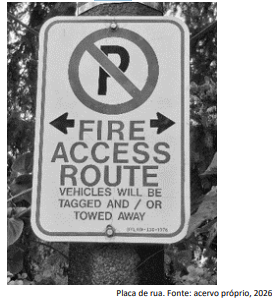
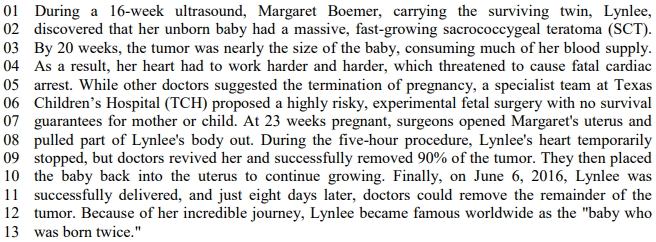
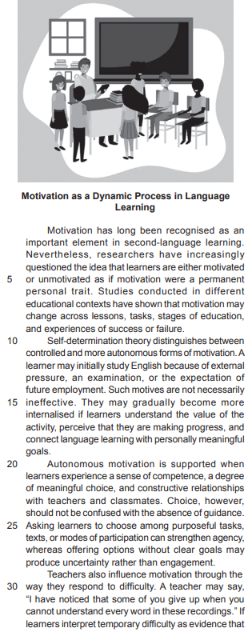
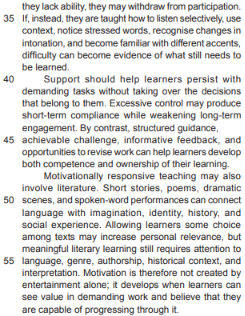
Ao relatar posteriormente esse episódio em uma narrativa situada integralmente no passado, empregando a sequência convencional de tempos do discurso indireto e realizando as alterações referenciais necessárias, a professora deveria registrar:

O texto seguinte servirá de base para responder à questão.
World's largest intelligent container ship sets sail
The delivery of the nation's first and the world's largest intelligent container ship powered entirely by electricity marks the transition toward a greener and more intelligent future by China's shipping industry, experts said.
Following the successful completion of various tests, the vessel, named Ning Yuan Dian Kun, was delivered in Ningbo, Zhejiang province, on Wednesday.
"From the initial project approval to the final delivery, the vessel showcased the full life-cycle development of zero carbon ships, characterized by pure electric propulsion, autonomous navigation and high operational efficiency, achieved by China's shipping industry," said Ma Hongmeng, a senior engineer at Shanghai Merchant Ship Design and Research Institute and the person in charge of the intelligent container ship.
According to Ma, the ship is proof that China's coastal container transportation segment is entering a new era marked by zero-emissions, intelligent operations and high efficiency, a prerequisite for achieving carbon neutrality and shipping energy transformation.
With a capacity of over 740 twenty-foot equivalent units, the vessel was independently developed and designed by SDARI. Its electric propulsion system was provided by Shanghai Marine Equipment Research Institute. Both companies are subsidiaries of China State Shipbuilding Corp.
"Independently developed by SMERI, the innovative electric propulsion system has undergone maritime navigation tests, which fully proved its reliability, superiority and adaptability," said Wu Guodong, a senior engineer at the institute.
He added that with all performance indicators meeting expectations, the technological breakthrough from design to application highlighted China's leading position in pure electric ship power system integration worldwide, and laid a solid foundation for the transformation of China's shipping industry to a greener and carbon neutral one.
With a length of 127.8 meters and a width of 21.6 meters, the ship has been tailor-made for Ningbo Ocean Shipping Co and will run on the coastal shipping route between Ningbo and Jiaxing in Zhejiang province.
A senior official from the Ningbo Maritime Safety Administration said that due to the distinctive features of new-generation intelligent vessels, a dedicated service team has been established to provide comprehensive support. The team will conduct continuous tracking and precise assessments throughout the entire process — from design and construction to navigation — ensuring a thorough grasp of the vessels' technical characteristics and effective control of operational risks.
The vessel is equipped with 10 container-shaped power units with a total power supply capacity of about 19,600 kilowatt-hours.
"This allows the ship to achieve zero-emission and zero-noise green operation throughout the entire voyage, while perfectly adapting to the practical operational needs of coastal container transportation," Ma said.
Wang Ting, captain of Ning Yuan Dian Kun, also confirmed this view. "Compared with traditional fuel-powered vessels, the most noticeable change in a fully electric seagoing ship is the lack of noise. In the past, the engine room would be filled by the roar of the main engine, whereas voyages nowadays are almost silent. This creates a more relaxed working environment and allows crew members to concentrate better on operations — a significant improvement brought about by green energy," he said.
He added that in terms of power response, the torque output of electric propulsion motors is linear and instantaneous. Acceleration and deceleration are smooth and highly responsive, with virtually no delay, making operations more straightforward. However, this also places new demands on operators — they must learn to manage energy efficiently, closely monitor power consumption, and plan vessel speed in a more rational manner.
The ship has also adopted two permanent magnet synchronous propulsion motors, capable of cutting carbon emissions by 1,462 tons per year, and completely eliminating emissions of sulfur oxides, nitrogen oxides and fine particles.
"In this way, we manage to achieve zero pollution throughout the entire process of transportation, ranging from navigation and berthing to loading and unloading," Ma from SDARI said.
Currently, Ningbo Ocean Shipping Co operates 32 green and energy-efficient vessels, accounting for 57 percent of its self-owned fleet, marking the initial formation of a sizable green fleet.
Chen Xiaofeng, chairman of the company, said: "We hope to achieve breakthroughs in key areas through Ning Yuan Dian Kun. We aim to build the country's first demonstration model of a fully electric seagoing vessel, promoting the expansion of pure electric technology from inland waterways to maritime transport. We seek to establish a complete, replicable technical and operational system for 'zero-carbon transportation'."
https://global.chinadaily.com.cn/a/202604/16/WS69e0ee90a310d6866e b43dd4.html
Read the excerpt below.
"However, this also places new demands on operators — they must learn to manage energy efficiently, closely monitor power consumption, and plan vessel speed in a more rational manner."
In the excerpt, the modal verb "must" expresses:
O texto seguinte servirá de base para responder à questão.
World's largest intelligent container ship sets sail
The delivery of the nation's first and the world's largest intelligent container ship powered entirely by electricity marks the transition toward a greener and more intelligent future by China's shipping industry, experts said.
Following the successful completion of various tests, the vessel, named Ning Yuan Dian Kun, was delivered in Ningbo, Zhejiang province, on Wednesday.
"From the initial project approval to the final delivery, the vessel showcased the full life-cycle development of zero carbon ships, characterized by pure electric propulsion, autonomous navigation and high operational efficiency, achieved by China's shipping industry," said Ma Hongmeng, a senior engineer at Shanghai Merchant Ship Design and Research Institute and the person in charge of the intelligent container ship.
According to Ma, the ship is proof that China's coastal container transportation segment is entering a new era marked by zero-emissions, intelligent operations and high efficiency, a prerequisite for achieving carbon neutrality and shipping energy transformation.
With a capacity of over 740 twenty-foot equivalent units, the vessel was independently developed and designed by SDARI. Its electric propulsion system was provided by Shanghai Marine Equipment Research Institute. Both companies are subsidiaries of China State Shipbuilding Corp.
"Independently developed by SMERI, the innovative electric propulsion system has undergone maritime navigation tests, which fully proved its reliability, superiority and adaptability," said Wu Guodong, a senior engineer at the institute.
He added that with all performance indicators meeting expectations, the technological breakthrough from design to application highlighted China's leading position in pure electric ship power system integration worldwide, and laid a solid foundation for the transformation of China's shipping industry to a greener and carbon neutral one.
With a length of 127.8 meters and a width of 21.6 meters, the ship has been tailor-made for Ningbo Ocean Shipping Co and will run on the coastal shipping route between Ningbo and Jiaxing in Zhejiang province.
A senior official from the Ningbo Maritime Safety Administration said that due to the distinctive features of new-generation intelligent vessels, a dedicated service team has been established to provide comprehensive support. The team will conduct continuous tracking and precise assessments throughout the entire process — from design and construction to navigation — ensuring a thorough grasp of the vessels' technical characteristics and effective control of operational risks.
The vessel is equipped with 10 container-shaped power units with a total power supply capacity of about 19,600 kilowatt-hours.
"This allows the ship to achieve zero-emission and zero-noise green operation throughout the entire voyage, while perfectly adapting to the practical operational needs of coastal container transportation," Ma said.
Wang Ting, captain of Ning Yuan Dian Kun, also confirmed this view. "Compared with traditional fuel-powered vessels, the most noticeable change in a fully electric seagoing ship is the lack of noise. In the past, the engine room would be filled by the roar of the main engine, whereas voyages nowadays are almost silent. This creates a more relaxed working environment and allows crew members to concentrate better on operations — a significant improvement brought about by green energy," he said.
He added that in terms of power response, the torque output of electric propulsion motors is linear and instantaneous. Acceleration and deceleration are smooth and highly responsive, with virtually no delay, making operations more straightforward. However, this also places new demands on operators — they must learn to manage energy efficiently, closely monitor power consumption, and plan vessel speed in a more rational manner.
The ship has also adopted two permanent magnet synchronous propulsion motors, capable of cutting carbon emissions by 1,462 tons per year, and completely eliminating emissions of sulfur oxides, nitrogen oxides and fine particles.
"In this way, we manage to achieve zero pollution throughout the entire process of transportation, ranging from navigation and berthing to loading and unloading," Ma from SDARI said.
Currently, Ningbo Ocean Shipping Co operates 32 green and energy-efficient vessels, accounting for 57 percent of its self-owned fleet, marking the initial formation of a sizable green fleet.
Chen Xiaofeng, chairman of the company, said: "We hope to achieve breakthroughs in key areas through Ning Yuan Dian Kun. We aim to build the country's first demonstration model of a fully electric seagoing vessel, promoting the expansion of pure electric technology from inland waterways to maritime transport. We seek to establish a complete, replicable technical and operational system for 'zero-carbon transportation'."
https://global.chinadaily.com.cn/a/202604/16/WS69e0ee90a310d6866e b43dd4.html
Read the sentence below.
"Following the successful completion of various tests, the vessel, named Ning Yuan Dian Kun, was delivered in Ningbo, Zhejiang province, on Wednesday."
In the sentence, the structure "was delivered" is in the:
• They turned down the proposal. • They turned the proposal down. • They turned it down. • *They turned down it. • They looked after the student. • *They looked the student after.
Which analysis accounts for the contrast?
(1) Continuous verbs
(2) Gerunds acting as nouns
(3) Adjectives
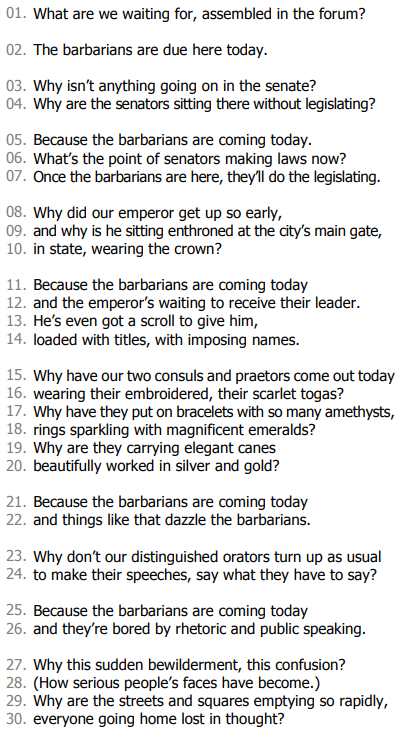
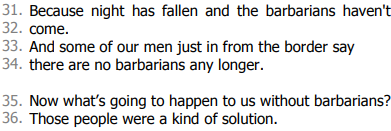
( ) “Why are the senators sitting there without legislating?” (l. 4)
( ) “Once the barbarians are here, they’ll do the legislating” (l. 7)
( ) “Why have they put on bracelets with so many amethysts, rings sparkling with magnificent emeralds?” (l. 17-18)
( ) “Now what’s going to happen to us without barbarians?” (l. 35)
( ) “loaded with titles, with imposing names.” (l. 14)
( ) “and they’re bored by rhetoric and public speaking” (l. 26)
Select the alternative with the correct sequence from top to bottom.
"The researchers made attention to several inconsistencies and later looked into their possible causes.
The teacher wants to correct the lexical problem without changing the intended meaning.
Which revision is appropriate?
Which sentence correctly expresses a past unreal condition with a present result?
"I may send the revised material tomorrow, but I haven't finished checking it yet."
On Wednesday, another teacher reports what was said.
Which sentence accurately reports the original statement from the later temporal perspective?
Column A
( 1 ) This fact relates to a gap in foreign language teaching policy documents.
( 2 ) […] and it is treating it as a tool for citizenship.
( 3 ) A recent reform in 2017 has added that English […]
( 4 ) Previous versions of LDB, however, did not mandate the teaching of English […]
Column B
( ) Present Perfect
( ) Present Continuous
( ) Present Simple
( ) Past Simple
Which question is CORRECT for this practical situation?

 Conheça nossos planos