Questões de Concurso
Sobre verbos | verbs em inglês
Foram encontradas 3.093 questões


"By the time the meeting started, the committee had already reviewed the revised proposal."
Which interpretation accurately explains the relationship between the verb forms?
(__) In "The research team carried out several interviews," carried out means conducted.
(__) In "The school turned down the proposal," the object pronoun may be correctly placed as in "The school turned it down."
(__) In "The volunteer looked after the children," the phrasal verb is separable and may be rewritten as "The volunteer looked the children after."
(__) In "She eventually got over the disappointment," got over means examined the disappointment carefully.
Mark T for true statements and F for false statements. Then select the alternative that presents the CORRECT sequence
"Jefferies' Andrew Tsai estimates BPL-003 could generate sales of more than $1 billion to $2 billion if it succeeds in late-stage trials."
Consider the statements:
I. The modal verb could expresses a projected commercial possibility rather than a guaranteed result.
II. The clause introduced by if establishes a condition for the estimated sales performance.
III. The simple present form succeeds refers to a habitual event repeatedly observed in previous trials.
Mark the alternative that presents only the CORRECT statements.
Read the lyrics’ song Dai Dai, by Shakira (Feat. Burna Boy), to answer question
[…]
You knew from the day
you were born
That here in this place you belong
You've been this brave all along
What broke you once made you strong (strong)
Dai, dai, ikou, dale, allez, let's go
Dai, dai, ikou, dale, allez, let's go (ow)
Come follow your desire
Where there's a will, there's a way
You are the owner of that fire
No one can take it away
Sweat and blood to write your story
That is how you paved the way
You're about to reach the glory
Only one step away
All the highs and lows
All the tears and the pain
You been there through it all,
been through it all
Just do it again
Now you got to believe (I believe)
[…]
(Available at: https://www.letras.mus.br/shakira/dai-dai-feat-burna-boy/)
"Had the school received the funds earlier, it would have completed the accessibility project before the beginning of the term."
Which analysis is CORRECT?
If the local community continues to show such high levels of engagement, the library ______ one of the most important culturalcenters in the region.
Which option BEST completes the sentence to express a likely outcome based on that condition?
I. The description of the community having been without a library service for two decades indicates a state that concluded when the facility opened in early 2025.
II. When the librarian says, We have been very lucky, she is referencing a period of ongoing community support that started in the past and continues to the present day.
III.lf the community were to stop visiting the library tomorrow, the institution will lose its shortlisting status for the Library of the Year 2026 award.
Which of the following statements islare CORRECT?
Leia o texto a seguir para responder à questão:
In the Star Trek universe, the audience occasionally gets a glimpse inside schools on the planet Vulcan. Young children stand alone in “capsules” surrounded by 360-degree digital screens. Adults walk around but do not talk to the students. Instead, each child interacts only with a sophisticated artificial intelligence (AI). Although this is not the reality in today’s classrooms on Earth, there are people for whom a vision of personalized learning conducted by artificial intelligence has considerable appeal.
Individualized learning has its place. But decades of educational research also demonstrate that learning is essentially a social endeavor. Classrooms that privilege personalized AI chatbots overlook that fact.
Generative AI is quickly coming to classrooms. If decades ago educators worldwide promoted the benefits of “One Laptop per Child”, today we may be approaching the model “one chatbot per child.” What does educational research tell us about what this model could mean for children’s learning and well-being?
During much of the 20th century, learning was understood as mainly as a matter of individual cognition. A misconception, if compared to today’s comprehension of what learning involves. Scientists now understand that apparently individual processes – such as building new knowledge – are actually social interactions with the world around us. In classrooms, this suggests that opportunities for daily personal interaction can strongly support brain health and academic learning.
Therefore, it is important to understand generative AI’s real-life impact on students.
For example: How does it feel to learn from a chatbot, day after day? How will long-term use of AI affect children’s mental health? How does AI use affect children’s relationships with each other and with their teachers? What kinds of relationships might children form with the chatbots themselves? More broadly, we could also ask: What do we, as a society, actually want children to learn?
Good teaching and learning blends social and individual processes. I see the beneficial application of any new technology in the classroom – AI or otherwise – as a way to build upon the social fabric of human learning. My concern about personalized AI tutors is how they might displace already infrequent opportunities for social interaction, further isolating children in classrooms.
(Niral Shah. www.converstion.com, 15.12.2025. Adaptado)
( ) In "Educational games were all the rage," the simple past situates a completed historical condition in the early nineteenth century.
( ) In "A handful of Young's Musical Games can be found," the simple present indicates a situation that remains valid at the time of writing.
( ) In "Her Fletcher Music Method would later be endorsed," the construction "would + verb" expresses a future event viewed from a past reference point.
( ) In "Many music videogames have become wildly popular," the present perfect presents a past development connected with the present.
Mark the alternative that presents the CORRECT sequence.
The Evolution of Digital Design
By Coursera Staff
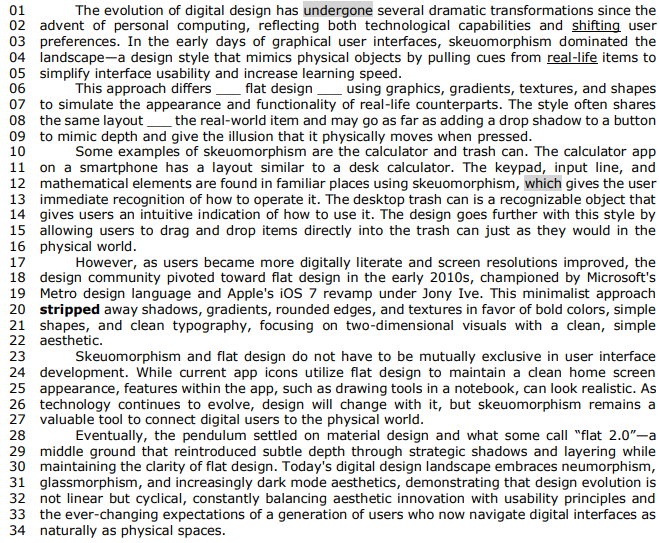
(Available at: https://www.coursera.org/articles/skeuomorphism – text specially adapted for this test).
The Evolution of Digital Design
By Coursera Staff
(Available at: https://www.coursera.org/articles/skeuomorphism – text specially adapted for this test).
The Evolution of Digital Design
By Coursera Staff
(Available at: https://www.coursera.org/articles/skeuomorphism – text specially adapted for this test).

 Conheça nossos planos