Questões de Concurso
Sobre verbos | verbs em inglês
Foram encontradas 3.093 questões


(__)Modal verbs are always followed by the base form of the main verb (without "to"), and they do not change their form according to the subject.
(__)The modal verb "must" can be used to express a strong obligation or a logical deduction based on certain evidence in the present.
(__)"Should" is the most appropriate modal verb to ask for a formal permission in a professional environment, replacing the use of "can" or "may."
(__)The negative form of "can" in the past tense is "could not" or "couldn't," which can indicate both a lack of ability or a lack of permission in the past.
After analyzing the statements, choose the alternative that presents the CORRECT sequence, from top to bottom:
I.The Present Perfect is used to describe actions that happened at an unspecified time in the past or that have a connection with the present moment.
II.The Future with "going to" is typically used for spontaneous decisions made at the exact moment of speaking, without any prior plan or evidence.
III.The Past Continuous is used to describe an action that was in progress at a specific time in the past, often interrupted by another event.
Choose the alternative that presents the CORRECT statement(s):
(__)Regular verbs form their past tense by adding the suffix "-ed" to the base form, following specific spelling rules for verbs ending in "-y" or consonant-vowel-consonant.
(__)Irregular verbs follow a predictable pattern of vowel mutation, allowing the speaker to determine the past form of any unknown verb by analogy with the verb "to go."
(__)Some irregular verbs have the same form for the infinitive, the simple past, and the past participle, such as the verbs "put," "cut," and "set."
(__)The past tense of the verb "to read" is spelled differently from the present tense to indicate the change in pronunciation from /ri:d/ to /red/ in formal registers.
After analyzing the statements, choose the alternative that presents the CORRECT sequence of the items above, from top to bottom:
(__) Em 'Phrasal Verbs' separáveis, se o objeto for um pronome pessoal, ele deve vir obrigatoriamente entre o verbo e a partícula.
(__) 'Prepositional Verbs' são inseparáveis, ou seja, a preposição deve seguir imediatamente o verbo.
(__) O significado de um 'Phrasal Verb' é frequentemente idiomático e não dedutível pelas partes individuais.
(__) Verbos frasais intransitivos, como 'wake up', exigem obrigatoriamente um objeto direto para terem sentido.
Após análise, assinale a alternativa que apresenta a sequência CORRETA dos itens acima, de cima para baixo:
I. O modal 'should' é primariamente utilizado para expressar conselhos ou recomendações (advice).
II. A estrutura 'used to' refere-se a hábitos do passado que não mais ocorrem no presente.
III. O verbo modal 'must' na negativa (mustn't) expressa uma ausência de obrigação ou necessidade.
IV. 'Can' e 'May' podem ambos ser utilizados para pedir permissão, sendo 'May' mais formal.
Assinale a alternativa que apresenta somente a(s) proposição(ões) CORRETA(S):
“Had I known you were coming,” she exclaimed, “I could have arranged something far more suitable!”
TEXT 1
The Decolonial Option in English Teaching: Can the Subaltern Act?
In this reflective article that straddles the personal and the professional, the author shares his critical thoughts on the impact of the steady stream of discourse on the native speaker/nonnative speaker (NS/NNS) inequity in the field of TESOL. His contention is that more than a quarter century of the discoursal output has not in any significant way altered the ground reality of NNS subordination. Therefore, he further contends, it is legitimate to ask what the discourse has achieved, where it has fallen short, why it has fallen short, and what needs to be done. Drawing insights from the works of Gramsci (1971) on hegemony and subalternity, and Mignolo (2010) on decoloniality, the author characterizes the NNS community as a subaltern community and argues that, if it wishes to effectively disrupt the hegemonic power structure, the only option open to it is a decolonial option which demands resultoriented action, not just “intellectual elaboration.” Accordingly, he presents the contours of a five-point plan of action for the consideration of the subaltern community. He claims that only a collective, concerted, and coordinated set of actions carries the potential to shake the foundation of the hegemonic power structure and move the subaltern community forward.
Excerpt extracted and adapted from: KUMARAVADIVELU, Bala. The decolonial option in English teaching: Can the subaltern act? TESOL Quarterly, [S.l.], v. 50, n. 1, p. 66–85, 2016. DOI: 10.1002/tesq.202. Available in: https://doi.org/10.1002/tesq.202.
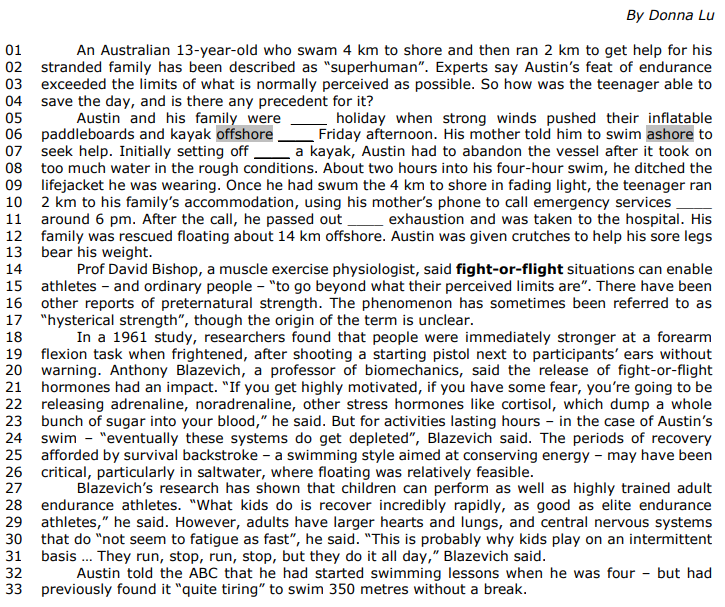
( ) In the sentence “An Australian 13-year-old who swam 4 km to shore” (l. 01), the relative pronoun “who” could be replaced by “that” without changing the meaning.
( ) The sentence “In a 1961 study, researchers found that people were immediately stronger” (l. 18) could be rewritten using the present perfect tense without any change in meaning.
( ) In the sentence “Once he had swum the 4 km to shore in fading light” (l. 09), the verb tense used expresses an action completed before another action in the past.
( ) In the sentence “His family was rescued floating about 14 km offshore” (l. 11-12), the verb form indicates an action performed by the subject “his family”.
The correct order of filling in the parentheses, from top to bottom, is:
Read the text below and answer the questions:
New beginnings in Wrocław: The refugee students building brighter futures
Eighteen-year-old Daria hopes to begin studying psychology at the university in Wroclaw, Poland in the autumn. She already knows what career she wants to pursue: working with formerly incarcerated individuals to support their reintegration into society.
“I want to help people start a new life after having made mistakes,” Daria says. “I believe everyone deserves a chance to change, and I want to support them.” Three years ago, it wasn’t clear that Daria would be able to study psychology at all – or even graduate from secondary school. In early 2022, with the escalation of the war in Ukraine, she was forced to leave her home of Kryvyi Rih in central Ukraine for Wroclaw, together with her mother and younger brother.
Daria was one of hundreds of Ukrainians who ended up at the same high school in Wroclaw. Wrocław’s multicultural identity has long been a source of pride, and the school is no different: out of its 1,500 students, 500 are from Ukraine. There are also students from Belarus, Kyrgyzstan and Kenya, among other countries.
Still, the transition to life in a different country, while being separated from loved ones who remained in Ukraine, was not easy. In the first few months, Daria herself needed psychological support.
Eighteen-year-old Daria hopes to study psychology at university. If that doesn’t work out, she is also considering game design as a backup plan, inspired by her strong interest in video games.
Eighteen-year-old Daria hopes to study psychology at university. If that doesn’t work out, she is also considering game design as a backup plan, inspired by her strong interest in video games.
Fortunately, she found support from the educators and staff at her school. This included the school psychologist, who is Polish but speaks Ukrainian. Her teachers also helped. “They genuinely do everything they can to help us adapt,” Daria says.
“They show us that they are learning together with us – they’re not pretending to know everything. They make mistakes too, they apologize, and everything feels very natural and supportive.”
For 18-year-old Kamila, who graduated from the same high school this year, the language barrier was the greatest challenge. “You don’t immediately understand what the teachers are saying, and you have to ask several times,” she says. “They couldn’t really explain either, because they didn’t speak Ukrainian. That was very hard for me.”
Kamila recalls that during her first months at the new secondary school, she had little time for her hobbies – she spent nearly all her free time learning Polish and keeping up with school assignments. Kamila recalls that during her first months at the new secondary school, she had little time for her hobbies – she spent nearly all her free time learning Polish and keeping up with school assignments.
Subjects like physics and biology were especially difficult because of the complex technical vocabulary. “I had to learn every term from scratch,” says Kamila, who came from IvanoFrankivsk, western Ukraine, with her family in 2022.
Learning Polish wasn’t only key to succeeding in school, but to feeling connected. “Only after I overcame the language barrier I did start participating in extracurricular activities at school,” Kamila explains. “It was important for me to build friendships with Polish students too.”
Despite these difficulties, Kamila now dreams of becoming a translator and is currently learning English and German in addition to Polish.
Seventeen-year-old Sofia, another graduate of the high school, shares this love of language. She studies English, Polish and German. “Aside from languages, I also love history,” she says.
Seventeen-year-old Sofia, who graduated this year from a secondary school in Wrocław, dreams of a career as a translator. She has applied to several universities in Wrocław to pursue her studies.
Seventeen-year-old Sofia, who graduated this year from a secondary school in Wrocław, dreams of a career as a translator. She has applied to several universities in Wrocław to pursue her studies.
Sofia’s passion for history deepened her connection to Wrocław, one of Poland’s oldest and most culturally rich cities. “I really like Wrocław, and right now I think that if my future is in Poland, it will be in this city,” she says.
Like many of her peers, Sofia’s first steps in a new country were filled with fear and uncertainty.
“At the beginning, it was a bit scary – a different country, a different culture, a different language,” she recalls. “But there were actually many kind people who were ready to help. Thanks to them, I managed to adapt, and now I feel quite good living here.”
As well as graduating with honors from her school in Ukraine, in Wroclaw, Sofia received the red stripe distinction, a special recognition for outstanding academic results in Polish schools. She also earned a scholarship for being the top-performing student in the school last year.
Seventeen-year-old Sofia and her mother, Tetiana. The family plans to stay in Poland, as Sofia sees her future in this country.
Sofia and her mother, Tetiana. The family plans to stay in Poland, as Sofia sees her future in this country.
Her family has recently decided to stay in Poland.
“Our daughter sees her future here, and we are ready to support her decision,” her mother Tetiana says.
These stories are a powerful reminder of the resilience and potential of young people when they are given the right opportunities and support.
As we mark International Youth Day, UNICEF celebrates youth like Daria, Kamila and Sofia – who, despite the trauma of war and displacement, are building their futures through education, courage, and determination.
UNICEF, in partnership with local governments and civil society, remains committed to ensuring that every young person has access to quality education and support, no matter their background or circumstances.
This work for refugee children and caregivers from Ukraine in Poland is made possible thanks to the generous support of the Bureau of Population, Refugees, and Migration of the US Department of State (PRM) and the Government of the Republic of Korea and the Government of Japan.
Source: https://www.unicef.org/eca/stories/new-beginnings-in-Wroclaw
Analyze the modal verb in: "You don't immediately understand what the teachers are saying, and you have to ask several times." The modal construction expresses a specific type of modality.
Which alternative correctly identifies the modal meaning conveyed in this context?
Read the text below and answer the questions:
New beginnings in Wrocław: The refugee students building brighter futures
Eighteen-year-old Daria hopes to begin studying psychology at the university in Wroclaw, Poland in the autumn. She already knows what career she wants to pursue: working with formerly incarcerated individuals to support their reintegration into society.
“I want to help people start a new life after having made mistakes,” Daria says. “I believe everyone deserves a chance to change, and I want to support them.” Three years ago, it wasn’t clear that Daria would be able to study psychology at all – or even graduate from secondary school. In early 2022, with the escalation of the war in Ukraine, she was forced to leave her home of Kryvyi Rih in central Ukraine for Wroclaw, together with her mother and younger brother.
Daria was one of hundreds of Ukrainians who ended up at the same high school in Wroclaw. Wrocław’s multicultural identity has long been a source of pride, and the school is no different: out of its 1,500 students, 500 are from Ukraine. There are also students from Belarus, Kyrgyzstan and Kenya, among other countries.
Still, the transition to life in a different country, while being separated from loved ones who remained in Ukraine, was not easy. In the first few months, Daria herself needed psychological support.
Eighteen-year-old Daria hopes to study psychology at university. If that doesn’t work out, she is also considering game design as a backup plan, inspired by her strong interest in video games.
Eighteen-year-old Daria hopes to study psychology at university. If that doesn’t work out, she is also considering game design as a backup plan, inspired by her strong interest in video games.
Fortunately, she found support from the educators and staff at her school. This included the school psychologist, who is Polish but speaks Ukrainian. Her teachers also helped. “They genuinely do everything they can to help us adapt,” Daria says.
“They show us that they are learning together with us – they’re not pretending to know everything. They make mistakes too, they apologize, and everything feels very natural and supportive.”
For 18-year-old Kamila, who graduated from the same high school this year, the language barrier was the greatest challenge. “You don’t immediately understand what the teachers are saying, and you have to ask several times,” she says. “They couldn’t really explain either, because they didn’t speak Ukrainian. That was very hard for me.”
Kamila recalls that during her first months at the new secondary school, she had little time for her hobbies – she spent nearly all her free time learning Polish and keeping up with school assignments. Kamila recalls that during her first months at the new secondary school, she had little time for her hobbies – she spent nearly all her free time learning Polish and keeping up with school assignments.
Subjects like physics and biology were especially difficult because of the complex technical vocabulary. “I had to learn every term from scratch,” says Kamila, who came from IvanoFrankivsk, western Ukraine, with her family in 2022.
Learning Polish wasn’t only key to succeeding in school, but to feeling connected. “Only after I overcame the language barrier I did start participating in extracurricular activities at school,” Kamila explains. “It was important for me to build friendships with Polish students too.”
Despite these difficulties, Kamila now dreams of becoming a translator and is currently learning English and German in addition to Polish.
Seventeen-year-old Sofia, another graduate of the high school, shares this love of language. She studies English, Polish and German. “Aside from languages, I also love history,” she says.
Seventeen-year-old Sofia, who graduated this year from a secondary school in Wrocław, dreams of a career as a translator. She has applied to several universities in Wrocław to pursue her studies.
Seventeen-year-old Sofia, who graduated this year from a secondary school in Wrocław, dreams of a career as a translator. She has applied to several universities in Wrocław to pursue her studies.
Sofia’s passion for history deepened her connection to Wrocław, one of Poland’s oldest and most culturally rich cities. “I really like Wrocław, and right now I think that if my future is in Poland, it will be in this city,” she says.
Like many of her peers, Sofia’s first steps in a new country were filled with fear and uncertainty.
“At the beginning, it was a bit scary – a different country, a different culture, a different language,” she recalls. “But there were actually many kind people who were ready to help. Thanks to them, I managed to adapt, and now I feel quite good living here.”
As well as graduating with honors from her school in Ukraine, in Wroclaw, Sofia received the red stripe distinction, a special recognition for outstanding academic results in Polish schools. She also earned a scholarship for being the top-performing student in the school last year.
Seventeen-year-old Sofia and her mother, Tetiana. The family plans to stay in Poland, as Sofia sees her future in this country.
Sofia and her mother, Tetiana. The family plans to stay in Poland, as Sofia sees her future in this country.
Her family has recently decided to stay in Poland.
“Our daughter sees her future here, and we are ready to support her decision,” her mother Tetiana says.
These stories are a powerful reminder of the resilience and potential of young people when they are given the right opportunities and support.
As we mark International Youth Day, UNICEF celebrates youth like Daria, Kamila and Sofia – who, despite the trauma of war and displacement, are building their futures through education, courage, and determination.
UNICEF, in partnership with local governments and civil society, remains committed to ensuring that every young person has access to quality education and support, no matter their background or circumstances.
This work for refugee children and caregivers from Ukraine in Poland is made possible thanks to the generous support of the Bureau of Population, Refugees, and Migration of the US Department of State (PRM) and the Government of the Republic of Korea and the Government of Japan.
Source: https://www.unicef.org/eca/stories/new-beginnings-in-Wroclaw
Consider the sentence below:
"Wrocław's multicultural identity has long been a source of pride."
The tense selection conveys temporal and aspectual information about the city's characteristic. Which analysis correctly interprets the temporal-aspectual function of this verb construction?
Read the text below and answer the questions:
New beginnings in Wrocław: The refugee students building brighter futures
Eighteen-year-old Daria hopes to begin studying psychology at the university in Wroclaw, Poland in the autumn. She already knows what career she wants to pursue: working with formerly incarcerated individuals to support their reintegration into society.
“I want to help people start a new life after having made mistakes,” Daria says. “I believe everyone deserves a chance to change, and I want to support them.” Three years ago, it wasn’t clear that Daria would be able to study psychology at all – or even graduate from secondary school. In early 2022, with the escalation of the war in Ukraine, she was forced to leave her home of Kryvyi Rih in central Ukraine for Wroclaw, together with her mother and younger brother.
Daria was one of hundreds of Ukrainians who ended up at the same high school in Wroclaw. Wrocław’s multicultural identity has long been a source of pride, and the school is no different: out of its 1,500 students, 500 are from Ukraine. There are also students from Belarus, Kyrgyzstan and Kenya, among other countries.
Still, the transition to life in a different country, while being separated from loved ones who remained in Ukraine, was not easy. In the first few months, Daria herself needed psychological support.
Eighteen-year-old Daria hopes to study psychology at university. If that doesn’t work out, she is also considering game design as a backup plan, inspired by her strong interest in video games.
Eighteen-year-old Daria hopes to study psychology at university. If that doesn’t work out, she is also considering game design as a backup plan, inspired by her strong interest in video games.
Fortunately, she found support from the educators and staff at her school. This included the school psychologist, who is Polish but speaks Ukrainian. Her teachers also helped. “They genuinely do everything they can to help us adapt,” Daria says.
“They show us that they are learning together with us – they’re not pretending to know everything. They make mistakes too, they apologize, and everything feels very natural and supportive.”
For 18-year-old Kamila, who graduated from the same high school this year, the language barrier was the greatest challenge. “You don’t immediately understand what the teachers are saying, and you have to ask several times,” she says. “They couldn’t really explain either, because they didn’t speak Ukrainian. That was very hard for me.”
Kamila recalls that during her first months at the new secondary school, she had little time for her hobbies – she spent nearly all her free time learning Polish and keeping up with school assignments. Kamila recalls that during her first months at the new secondary school, she had little time for her hobbies – she spent nearly all her free time learning Polish and keeping up with school assignments.
Subjects like physics and biology were especially difficult because of the complex technical vocabulary. “I had to learn every term from scratch,” says Kamila, who came from IvanoFrankivsk, western Ukraine, with her family in 2022.
Learning Polish wasn’t only key to succeeding in school, but to feeling connected. “Only after I overcame the language barrier I did start participating in extracurricular activities at school,” Kamila explains. “It was important for me to build friendships with Polish students too.”
Despite these difficulties, Kamila now dreams of becoming a translator and is currently learning English and German in addition to Polish.
Seventeen-year-old Sofia, another graduate of the high school, shares this love of language. She studies English, Polish and German. “Aside from languages, I also love history,” she says.
Seventeen-year-old Sofia, who graduated this year from a secondary school in Wrocław, dreams of a career as a translator. She has applied to several universities in Wrocław to pursue her studies.
Seventeen-year-old Sofia, who graduated this year from a secondary school in Wrocław, dreams of a career as a translator. She has applied to several universities in Wrocław to pursue her studies.
Sofia’s passion for history deepened her connection to Wrocław, one of Poland’s oldest and most culturally rich cities. “I really like Wrocław, and right now I think that if my future is in Poland, it will be in this city,” she says.
Like many of her peers, Sofia’s first steps in a new country were filled with fear and uncertainty.
“At the beginning, it was a bit scary – a different country, a different culture, a different language,” she recalls. “But there were actually many kind people who were ready to help. Thanks to them, I managed to adapt, and now I feel quite good living here.”
As well as graduating with honors from her school in Ukraine, in Wroclaw, Sofia received the red stripe distinction, a special recognition for outstanding academic results in Polish schools. She also earned a scholarship for being the top-performing student in the school last year.
Seventeen-year-old Sofia and her mother, Tetiana. The family plans to stay in Poland, as Sofia sees her future in this country.
Sofia and her mother, Tetiana. The family plans to stay in Poland, as Sofia sees her future in this country.
Her family has recently decided to stay in Poland.
“Our daughter sees her future here, and we are ready to support her decision,” her mother Tetiana says.
These stories are a powerful reminder of the resilience and potential of young people when they are given the right opportunities and support.
As we mark International Youth Day, UNICEF celebrates youth like Daria, Kamila and Sofia – who, despite the trauma of war and displacement, are building their futures through education, courage, and determination.
UNICEF, in partnership with local governments and civil society, remains committed to ensuring that every young person has access to quality education and support, no matter their background or circumstances.
This work for refugee children and caregivers from Ukraine in Poland is made possible thanks to the generous support of the Bureau of Population, Refugees, and Migration of the US Department of State (PRM) and the Government of the Republic of Korea and the Government of Japan.
Source: https://www.unicef.org/eca/stories/new-beginnings-in-Wroclaw
Examine the verb tenses in: "In early 2022, with the escalation of the war in Ukraine, she was forced to leave her home of Kryvyi Rih in central Ukraine for Wroclaw." The temporal structure and verb choice carry specific aspectual meanings.
Which alternative correctly analyzes the aspectual function of the verb tense employed?
Transform the following direct speech into INDIRECT DISCOURSE:
"I am working on a new project for my students today," the teacher said.
In the context of professional feedback:
"The candidate SHOULD HAVE PREPARED a more detailed lesson plan for the demonstration class." The highlighted modal structure expresses:
Identify the correct passive voice transformation for the following sentence:
"The pedagogical coordinator will have finalized the new curriculum by next Monday."

 Conheça nossos planos