Questões de Concurso
Sobre verbos | verbs em inglês
Foram encontradas 3.093 questões


Text 3
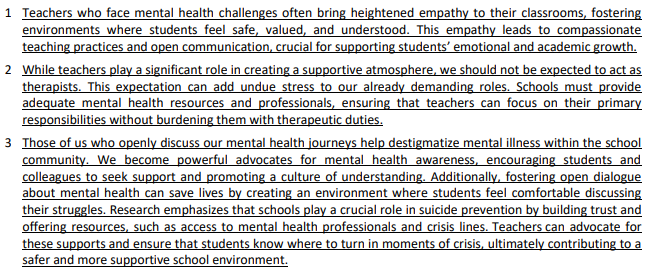
Teaching with mental health challenges
Sewell, A. (2024, December 9). Supporting teachers with anxiety and depression. Edutopia. https://www.edutopia.org/article/teachermental-health-challenges/
To answer question, read the text below.
The Language of Performance
Well, the word “performative” is generally meant as an insult. It’s meant to trivialize and indicate that someone is play-acting or “faking it.” It suggests that someone is only doing something to be seen doing it, and not because it represents a sincere interest or enjoyment.
This is one of those situations in which metaphors are overextended, and language distorts rather than describes natural human behavior. It is normal for our species for men and women to “perform” acts to impress both our own sex and the opposite sex. Males and females have different sex “roles,” and we “perform” acts to satisfy those roles.
The language seems to “portray” us as “actors performing roles” and implies that we are all essentially “lying” or “faking.” This is the kind of wordcel wordtrap that lends itself to Marxist gender theory ideology and postmodernist thinking.
“Nothing is real, everything is fake. Everything is a performance.”
That’s a frame, but it isn’t the whole picture.
Men are primates. We imitate each other. Monkey see, monkey do. And yes, we do things to try to impress each other. You can frame that in a way that seems trivial or superficial, but it is also foundational to human nature and social hierarchy.
Fonte: https//mrjackdonovan.substack.com/p/on-performative-males
Read the following statements about the phrase faking it (first paragraph) and mark True (T) or False (F):
( ) It is a phrasal verb (intransitive, with "it" as a pronoun object).
( ) It appears in the context of the word performative.
( ) It is implying sincerity, synonymous with pretending or acting truly.
( ) It is a compound noun.
Which option CORRECTLY fills in the parenthesis above, from top to bottom?
Publisher cancels horror novel's release over AI claims
¹Buzzy (adj.): Something that is buzzy is getting a lot of attention and excitement, especially online. People are talking about it a lot, and it is popular right now.
(Available at: https://www.bbc.com/news/articles/c5y9d44jj24o – text specially adapted for this test).
Analyse the following sentence based on the text's ideas:
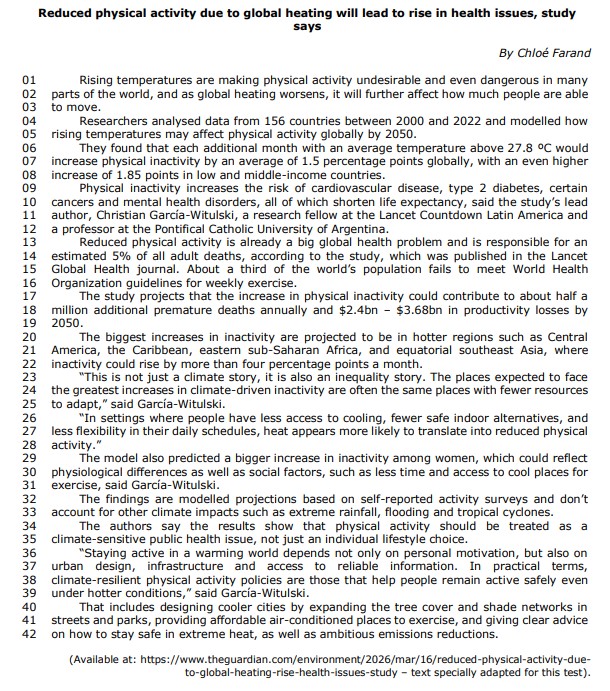
“If global heating continues to worsen, physical inactivity __________ even more common”.
Mark the alternative that correctly fills in the blank in the sentence above.
Identify the group of verbs whose past forms follow the same pronunciation pattern as the example above.
The phrasal verb “turn down” may carry this meaning depending on the context. Which sentence correctly uses “turn down” with the meaning of refuse?
Look at the sky. Those dark clouds are gathering quickly. It ______ heavily in a few minutes.
Brazil floods: 'I saw people trapped in their
The plural of “that wise Englishman keeps his gold watch in a safe” is:
Considering the preceding text, judge the following item.
In the fragment "The temperature rise associated with the growing volume of heat-trapping gas has kicked in" (second paragraph), "has kicked in" is used to indicate that the temperature rise has started to take effect.
Read the text and the quote below to answer question
Obama’s Speech- 2008
For when we have faced down impossible odds, when we've been told we're not ready or that we shouldn't try or that we can't, generations of Americans have responded with a simple creed that sums up the spirit of a people: Yes, we can. Yes, we can. Yes, we can.
It was a creed written into the founding documents that declared the destiny of a nation: Yes, we can.
It was whispered by slaves and abolitionists as they blazed a trail towards freedom through the darkest of nights: Yes, we can.
It was sung by immigrants as they struck out from distant shores and pioneers who pushed westward against an unforgiving wilderness: Yes, we can.
It was the call of workers who organized, women who reached for the ballot, a president who chose the moon as our new frontier, and a king who took us to the mountaintop and pointed the way to the promised land: Yes, we can, to justice and equality.
Yes, we can, to opportunity and prosperity. Yes, we can heal this nation. Yes, we can repair this world. Yes, we can.
https://www.vpro.nl/zomergasten/artikelen/new-hampshire-primary-2008. Acesso em 04 fev.2026.
“Meanings are not in words; they are in people, situated in social contexts.”
KRAMSCH, Claire. Language and Culture. Oxford: Oxford University Press, 1998
Text for question
At around 6:30 p.m., I decide I’m not going to sleep at the hospital tonight. I need to shower and eat real food. I call my best friend, Yara, and tell her I’m on my way to her house. Everything in Gaza is within walking distance, but I’m absolutely exhausted. I realize with dread that, if I’m not mistaken, I’ve left my wallet in mama’s bag, and I don’t have any money at all. So I do something embarrassing, and ask a taxi driver if he can drive me to Yara’s for free. He agrees on one condition: ‘When I get killed’, he says, ‘post a nice picture of me online, and ask people to pray for me.’
Everyone in Gaza knows that they’ll eventually die, and that it’s only a matter of time. I smile at the taxi driver and assent.
ALAQAD, Plestia. The Eyes of Gaza: A Diary of Resilience. New York: Little, Brown and Company, 2025.

 Conheça nossos planos