Questões de Concurso
Sobre tradução | translation em inglês
Foram encontradas 656 questões


I. O aprendizado de língua inglesa impede o aluno de ter acesso a bens culturais da humanidade construídos em outras partes do mundo. II. No contexto escolar, o ensino de língua inglesa deve limitar-se às explicações das formas gramaticais. III. À luz da Lei 9.394/96, a jornada escolar diária do aluno no Ensino Fundamental deve ser superior a doze horas.
Marque a alternativa CORRETA:
I. A vinculação entre a educação escolar, o trabalho e as práticas sociais é indispensável no contexto da atuação do professor de língua inglesa na instituição de ensino. II. O trecho em inglês “to chowse bitween” pode ser melhor traduzido como “lutar por um sonho”. III. É dever fundamental do servidor público municipal deixar de utilizar os avanços técnicos e científicos ao seu alcance ou do seu conhecimento para o cumprimento das suas atribuições.
Marque a alternativa CORRETA:
I. Ao ensinar a língua inglesa, é essencial ao educador uma compreensão teórica do que é a linguagem do ponto de vista dos conhecimentos necessários para usá-la, mas não em relação ao uso que se faz desses conhecimentos para construir significados no mundo social. II. Está correta a grafia do trecho a seguir em inglês: i an oversias caul (uma ligação telefônica intencional). III. O aprendizado de língua inglesa não permite ao educando construir uma consciência crítica dos usos que se fazem da língua que está aprendendo.
Marque a alternativa CORRETA:
I. O trecho “there are no flies on him”, em inglês, está corretamente grafado e seu significado equivale a “ele não é bobo e não se deixa enganar”. II. Para Vygotsky, a educação de crianças deve contemplar exclusivamente a formação para o trabalho. III. O trecho “to read out”, em inglês, está corretamente grafado e seu significado equivale a “ler em voz alta”.
Marque a alternativa CORRETA:
I. A gestão escolar está desassociada da distribuição de funções e atribuições, na relação interpessoal de trabalho, e veda a partilha do poder. II. A aprendizagem de língua inglesa não deve ocorrer de forma relacionada com o uso que se faz dessa língua. III. O trecho “to register oneself”, em inglês, está corretamente grafado e seu significado equivale a “alistar-se” ou “dar entrada em seu nome”.
Marque a alternativa CORRETA:
I. No trecho “to eat one’s head off”, o vocábulo “eat” pode ser literalmente traduzido como “viver” ou “vivenciar”. II. O ensino de língua inglesa na escola tem um papel importante à medida que permite aos educandos entrar em contato com outras culturas (inglesa, norte americana etc.) e com modos diferentes de ver e interpretar a realidade. III. No trecho em inglês “to be crauling with” ocorre um verbo cujo significado literal é “caminhar”.
Marque a alternativa CORRETA:
I. De acordo com a Lei 9.394/96, o ensino religioso, de matrícula obrigatória, é parte integrante da formação básica do cidadão da região Norte do Brasil, apenas. II. Na frase em inglês “he eats hin aut of house and home”, o verbo “eats” pode ser melhor traduzido como “discutir / debater”. III. No trecho “to be eaten up with”, o vocábulo “eaten” pode ser literalmente traduzido como “vencer”.
Marque a alternativa CORRETA:
I. No trecho em inglês “in full suing” ocorre um verbo cujo significado literal é “calcular”. II. O trecho “to read for”, em inglês, está corretamente grafado e seu significado equivale a “estudar para”. III. Na frase em inglês “i took a suim” ocorre um verbo que pode ser melhor traduzido como “recordar”.
Marque a alternativa CORRETA:
I. Na perspectiva de Vygotsky, a aquisição de conhecimentos não passa pela interação do sujeito com o meio. Assim, o professor de língua inglesa deve evitar utilizar atividades lúdicas em sala de aula. II. A avaliação da aprendizagem impede o professor de desenvolver uma reflexão sobre a sua prática e de retomar aspectos que devem ser revistos em sala de aula. III. O trecho em inglês “I bought hin of” apresenta uma grafia correta e pode ser melhor traduzido como “provocar uma comoção entusiástica”.
Marque a alternativa CORRETA:
I. No trecho "at a run" ocorre um verbo cujo significado é "estudar". II. Está correta a grafia do trecho seguinte: roasted coffee (café torrado).
Marque a alternativa CORRETA:
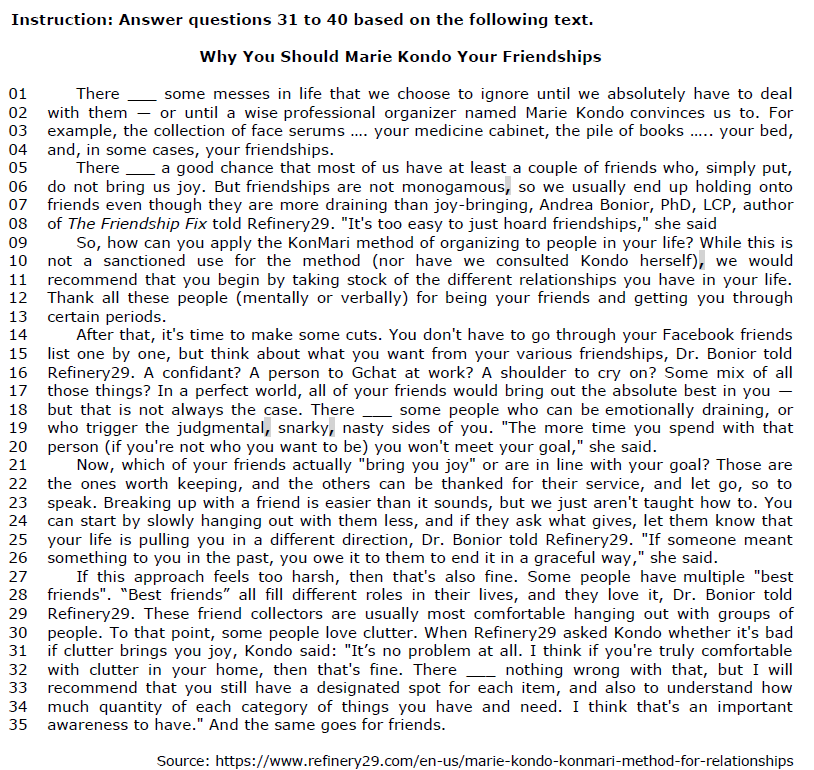
I. is an adverb. II. may be translated as ‘bagunça’. III. could be replaced by ‘hush’.
Which ones are correct?
I. ‘Marie Kondo’ is used as a noun. II. To understand the sentence you have to know who is Marie Kondo. III. The best translation would be “Por que você deveria se tornar a Marie Kondo das amizades?”.
Which ones are correct?
Leia o texto e responda à questão.
For years attention has been paid to so-called communicative tests – usually implying tests dealing with speaking. More recently, efforts have been made to design truly communicative tests of other language skills as well, such as reading comprehension.
Canale (1984) points out that a good test is not just one which is valid, reliable, and practical in terms of test administration and scoring, but rather one that is accepted as fair, important and interesting by test takers (the teachers) and test users (the students). Also, a good test has feedback potential, rewarding both teachers and students with clear, rich, relevant, and generalizable information. Canale suggests that acceptability and feedback potential have often been accorded low priority, thus explaining the curious phenomenon of multiple-choice tests claiming to assess oral interaction skills.
One example of a communicative test has been referred to as a “storyline” test. In such a test, a common theme runs throughout in order to assess the effects of context. The basis for such an approach is that the respondents learn as they read on, that they check previous content, and that the ability to use language in conversation or writing depends in large measure on the skill of picking up information from past discussion and using it in formulating new strategies.
Swain (1984), for example, developed a storyline test of French as a foreign language for high school French immersion students. The test consisted of six tasks around a common theme, “finding summer employment”. There were four writing tasks (a letter, a note, a composition, a technical exercise) and two speaking tasks (a group discussion and a job interview). The test was designed so that the topic would be motivating to the students and so that there would be enough information provided in order to give the tasks credibility. There was access to dictionaries and reference material, and opportunity for students to review and revise their work. Swain’s main concern was to “bias for best” in the construction of the test – to make every effort to support the respondent in doing their best on the test.
(Andrew D.Cohen. Second Language Assessment.
IN: Marianne Celce-Murcia(ed). Teaching English as a second or foreign
language. Boston, Massachusstes: Heinle&Heinle. 2nd edition. 2001. Adaptado)
Leia o texto e responda à questão.
Culture is really an integral part of the interaction between language and thought. Cultural patterns, customs, and ways of life are expressed in language; culture-specific world views are reflected in language. Each culture has at its disposal a particular range of colours, illustrating its particular world view on what color is and how to identify color. The African Shona and Bassa peoples, for example, have fewer color categories than speakers of European languages and they break up the spectrum at different points, as shown below:

Of course, the Shona or Bassa are able to perceive and describe other colors, in the same way that an English speaker might describe a “dark bluish green”, but the labels which the language provides tend to shape the person’s overall cognitive organization of color and to cause varying degrees of color discrimination. Eskimo tribes commonly have as many as seven different words for snow to distinguish among different types of snow (falling snow, snow on the ground, fluffy snow, wet snow, etc.), whereas certain African cultures in the equatorial forests of Zaire have no word at all for snow.
(Douglas Brown. Principles of language learning and teaching.
5th ed. Longman, 2000. Adaptado)
Leia o texto e responda à questão.
Culture is really an integral part of the interaction between language and thought. Cultural patterns, customs, and ways of life are expressed in language; culture-specific world views are reflected in language. Each culture has at its disposal a particular range of colours, illustrating its particular world view on what color is and how to identify color. The African Shona and Bassa peoples, for example, have fewer color categories than speakers of European languages and they break up the spectrum at different points, as shown below:
Of course, the Shona or Bassa are able to perceive and describe other colors, in the same way that an English speaker might describe a “dark bluish green”, but the labels which the language provides tend to shape the person’s overall cognitive organization of color and to cause varying degrees of color discrimination. Eskimo tribes commonly have as many as seven different words for snow to distinguish among different types of snow (falling snow, snow on the ground, fluffy snow, wet snow, etc.), whereas certain African cultures in the equatorial forests of Zaire have no word at all for snow.
(Douglas Brown. Principles of language learning and teaching.
5th ed. Longman, 2000. Adaptado)

If we met our forebears, even from not too long ago, we'd likely find they held views that we find abhorrent today.
I. ‘forebears’ refers to a specie of bears. II. ‘held the view’ is a collocation that means ‘to believe something’. III. ‘abhorrent’ could be translated as ‘abominável’.
Which ones are correct?
I. Só porque você chama isso de disruptivo, não significa que é. II. Só porque você não liga para ser disruptivo, não significa que seja. III. Só por que você chama de inesperado, não significa que não é.
Which ones are correct?
Instruction: Answer question based on the following text.

Source: https://www.newyorker.com/humor/daily-shouts/the-eurohug-is-it-a-thing-a-global-guide-toembrace
I. ‘hug, arm-wrestle, back-slap, whatever’ are adverbs. II. ‘These’ is incorrect, as it should have been ‘This’. III. The correct translation is ‘Tais pessoas são capazes de distribuir abraços, brigar com os braços, dar golpes nas costas, todas essas coisas’.
Which ones are INCORRECT?
Instruction: answer the question based one the following text.

Consider the following statements about the expression ‘bald-faced lies’ (l.15):
I. It is an idiomatic expression.
II. It means “showing no shame or embarassment about doing something bad”.
III. It could be translated as ‘mentira descarada’.
Which ones are correct?

 Conheça nossos planos