Questões de Concurso
Sobre sinônimos | synonyms em inglês
Foram encontradas 1.586 questões


Text for question
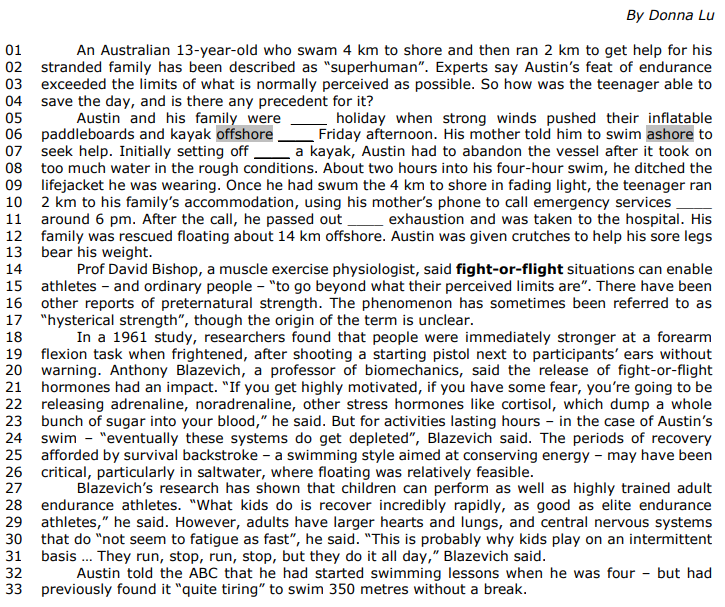
Hero boy swims for four hours to save his family (9th February 2026)
A 13-year-old Australian boy has been hailed a hero after an epic swim that saved his family. The boy, Austin Appelbee, and his family were on a beach holiday in Western Australia. They were kayaking and paddleboarding in shallow water when strong winds pushed them farther offshore. They ended up over four kilometres away from land, and the daylight was fading. Austin decided to kayak to shore to get help. However, the waves had damaged his kayak, which had taken in water and flipped over. He said he then lost an oar and knew he was in trouble. He decided he had no alternative but to swim back to land. He swam through shark-frequented waters to raise the alarm.
Austin made it to the beach and phoned for help. This sparked a huge rescue operation, which resulted in coastguards finding the teenager's mother and two younger sisters. The boy said: "I hit the bottom of the beach and I just collapsed, and then, after that, I had to “ sprint two kilometres to get to the phone." Rescuers called his efforts "superhuman". One rescuer said Austin's actions could not "be praised highly enough." He added that the teenager's "determination and courage ultimately saved the lives of his mother and siblings." Austin's mother Joanne, 47, told reporters: "The wind picked up. We lost oars, and we drifted out further. It was an absolute nightmare."

Culture is ordinary. Every human society has its own shape, its own purposes, its own meanings. Every human society expresses these, in institutions, and in arts and learning. The making of a society is the finding of common meanings and directions, and its growth is an active debate and amendment under the pressures of experience, contact, and discovery, writing themselves into the land. The growing society is there, yet it is also made and remade in every individual mind.
The making of a mind is, first, the slow learning of shapes, purposes, and meanings, so that work, observation and communication are possible. Then, second, but equal in importance, is the testing of these in experience, the making of new observations, comparisons, and meanings.
A culture has two aspects: the known meanings and directions, which its members are trained to; the new observations and meanings, which are offered and tested. These are the ordinary processes of human societies and human minds, and we see through them the nature of a culture: that it is always both traditional and creative; that it is both the most ordinary common meanings and the finest individual meanings.
We use the word culture in these two senses: to mean a whole way of life ⸺ the common meanings; to mean the arts and learning ⸺ the special processes of discovery and creative effort. Some writers reserve the word for one or other of these senses; I insist on both, and on the significance of their conjunction. The questions I ask about our culture are questions about our general and common purposes, yet also questions about deep personal meanings.
Culture is ordinary, in every society and in every mind.
Raymond Williams. Culture is Ordinary. In: R. Williams.
Resources of Hope: Culture, Democracy, Socialism.
London: Verso, 1989. p. 3-14 (adapted).
Based on the grammatical and semantic aspects of the preceding text, judge the item that follow.
In the last sentence of the text ⸺ "Culture is ordinary, in every society and in every mind" ⸺, "every" can be replaced with either each or all without compromising grammatical correctness or altering the overall meaning, but the change nonetheless alters the emphasis of the original wording.
Culture is ordinary. Every human society has its own shape, its own purposes, its own meanings. Every human society expresses these, in institutions, and in arts and learning. The making of a society is the finding of common meanings and directions, and its growth is an active debate and amendment under the pressures of experience, contact, and discovery, writing themselves into the land. The growing society is there, yet it is also made and remade in every individual mind.
The making of a mind is, first, the slow learning of shapes, purposes, and meanings, so that work, observation and communication are possible. Then, second, but equal in importance, is the testing of these in experience, the making of new observations, comparisons, and meanings.
A culture has two aspects: the known meanings and directions, which its members are trained to; the new observations and meanings, which are offered and tested. These are the ordinary processes of human societies and human minds, and we see through them the nature of a culture: that it is always both traditional and creative; that it is both the most ordinary common meanings and the finest individual meanings.
We use the word culture in these two senses: to mean a whole way of life ⸺ the common meanings; to mean the arts and learning ⸺ the special processes of discovery and creative effort. Some writers reserve the word for one or other of these senses; I insist on both, and on the significance of their conjunction. The questions I ask about our culture are questions about our general and common purposes, yet also questions about deep personal meanings.
Culture is ordinary, in every society and in every mind.
Raymond Williams. Culture is Ordinary. In: R. Williams.
Resources of Hope: Culture, Democracy, Socialism.
London: Verso, 1989. p. 3-14 (adapted).
Based on the grammatical and semantic aspects of the preceding text, judge the item that follow.
In the passage "The growing society is there, yet it is also made and remade in every individual mind" (last sentence of the first paragraph), "yet" could be replaced with and yet without altering the overall meaning of the fragment.
Read the text to answer question.
The Tipping Point.
Last week at my neighborhood coffee shop, the barista flipped that dreaded tablet toward me. Three tip options glared back: 18%. 22%. 25%. For a $3.50 latte I was picking up. That took thirty seconds to make. I’ve hit my breaking point with tipping culture.
Growing up, tipping was simple: 15–20% for sitdown restaurants, maybe your hairdresser. Now it’s an expected tax on every transaction. The frozen yogurt shop where I serve myself wants 20%. Self-checkout kiosks are asking for tips. This is insane.
When I traveled Europe last summer, I paid exactly what was on the menu. No guilt, no calculations, no awkward pressure. Servers were paid living wages and the service was excellent.
Meanwhile, I’m expected to subsidize corporate America’s refusal to pay fair wages while their CEOs pocket millions in bonuses.
It’s 2025, and American tipping culture has spiraled out of control. It’s hurting workers, stressing customers, and letting profitable businesses guilt-trip their own customers into covering payroll. When I worked retail years ago, my employer paid my full wage. I didn’t expect customers to subsidize my paycheck because my boss decided to pocket the difference. Yet somehow in 2025, we’ve normalized corporations outsourcing their payroll responsibility to guilt-ridden customers. 72% of U.S. adults say tipping is expected in more places today than it was five years ago. But even as Americans say they’re being asked to tip more often, only about a third say it’s extremely or very easy to know whether (34%) or how much (33%) to tip for various services.
[...] The confusion is real and it’s intentional. Companies benefit from our uncertainty because confused customers tend to over-tip rather than risk social judgment.
Murdock, Jeff. Why Is Tipping Culture Out of Control in 2025? Medium. 16 Jun. 2025. Disponível em:<https://medium.com/@frat1309/why-is-tipping-cultureout-of-control-in-2025-im-done-subsidizing-corporategreed-76ba74887b82>
Text 10A2-I
Everyone ages, but, sometimes, people outlive all predictions. Previous research has uncovered an unlikely factor related to longevity: intelligence. However, intelligence isn‟t a simple characteristic. There are many traits that contribute to it that can be tested — from memory to mathematical logic. In a 2024 clinical psychological science study, Paolo Ghisletta, of the University of Geneva, linked longevity specifically to one of those traits: verbal fluency, the measure of one‟s vocabulary and their ability to use it. Ghisletta‟s research used samples from the Berlin Aging Study, which started collecting data shortly before the Berlin Wall came down in 1989. It tracked 516 people aged 70 to 105 from enrollment to their death, over as long as 18 years in some cases. The study measured factors like dental health, stress levels, and economic well-being, as well as cognition. This makes it a “rich and rare data set,” said Ghisletta in an interview.
Internet: http://www.sciencedaily.com/
TEXT 1
The Decolonial Option in English Teaching: Can the Subaltern Act?
In this reflective article that straddles the personal and the professional, the author shares his critical thoughts on the impact of the steady stream of discourse on the native speaker/nonnative speaker (NS/NNS) inequity in the field of TESOL. His contention is that more than a quarter century of the discoursal output has not in any significant way altered the ground reality of NNS subordination. Therefore, he further contends, it is legitimate to ask what the discourse has achieved, where it has fallen short, why it has fallen short, and what needs to be done. Drawing insights from the works of Gramsci (1971) on hegemony and subalternity, and Mignolo (2010) on decoloniality, the author characterizes the NNS community as a subaltern community and argues that, if it wishes to effectively disrupt the hegemonic power structure, the only option open to it is a decolonial option which demands resultoriented action, not just “intellectual elaboration.” Accordingly, he presents the contours of a five-point plan of action for the consideration of the subaltern community. He claims that only a collective, concerted, and coordinated set of actions carries the potential to shake the foundation of the hegemonic power structure and move the subaltern community forward.
Excerpt extracted and adapted from: KUMARAVADIVELU, Bala. The decolonial option in English teaching: Can the subaltern act? TESOL Quarterly, [S.l.], v. 50, n. 1, p. 66–85, 2016. DOI: 10.1002/tesq.202. Available in: https://doi.org/10.1002/tesq.202.
Text CB2A6
ARPA is considered the biggest conservation program of its kind, successfully leveraging cross-sector support through a financing model that has inspired similar projects around the world, and delivered tangible outcomes on the Amazon forest conservation. The fund guarantees donations over the long term with a clearly defined scope, offering more stability to the implementation of the program.
“Investments indeed translated into a reduction of deforestation and reduction in CO2 emissions resulting from deforestation,” said Britaldo Soares, an associate researcher at the Center for Technology and Innovation at the Federal University of Minas Gerais, and lead author of a paper that analyzes ARPA‘s impact on forest conservation.
Soares and researchers from WWF and FUNBIO found that deforestation between 2008 and 2020 was between 9% and 39% lower in Amazonian protected areas benefiting from ARPA support, and that this helped avoid 104 million metric tons of CO2 emissions.
For Júlio Barbosa, a resident of the Chico Mendes Extractive Reserve, ARPA has been important not just for creating conservation areas and infrastructure to support them, but also for strengthening local organizations, like cooperatives and deliberative councils.
ARPA focuses on traditional communities living within sustainable-use reserves, rather than Indigenous populations on Indigenous land, which are protected under different legislation. But the program also supports Indigenous populations who may live within the protected areas it targets and could even bring indirect benefits to other conservation areas, including Indigenous territories, as it helps maintain forest cover across the Amazon.

 Conheça nossos planos