Questões de Concurso Sobre sinônimos | synonyms em inglês

Foram encontradas 1.604 questões

Q2184949 Inglês
In the text “Mark Moffet and his strange love”, it can be read: “An entomologist is a person who studies insects. By the way, do you like ants? Tick the alternative that is not a synonymous of the highlighted expression.
Alternativas
Q2184934 Inglês
Text: The importance of the PowerPoint as a classroom resource
(Text adapted from Teachers: 5 Tips for Creating Great PowerPoint Presentations, retrieved

   PowerPoint is a resource developed by Microsoft and released initially in 1990. It is mainly used in professional meeting presentations all over the world.
    One of these professions is in educational area: teacher.
    PowerPoint presentation is spread among teachers because it is different from lecturing or teaching with a textbook; it is also a way of sharing content with students.
    To produce a PowerPoint correctly, teachers need to know how to put the slides together, it can be an effective way of reinforcing content to students so that they are better able to retain it. Otherwise, teachers can print and distribute the PowerPoint presentation or post it online, so students can go back and access it as reference material. However, if it is not put together correctly, a PowerPoint presentation can disengage and make students bored.
   To develop PowerPoint presentation is simple and it can also provide a fun time noticed by its characteristics: basic, simple, and not distracting, it can be focused on keywords; for instance, always be sure to include a summary slide of what the presentation is intending to accomplish as well as a table of contents on the different topics that will be covered in the program. The summary slide serves as the main topic and what students should learn after viewing the presentation. Then, at the end of the PowerPoint presentation, teachers should include another summary slide, going over everything that was just covered and, again, highlighting the main point.

Bottom line
    PowerPoint presentations need to have a purpose and the teacher must make sure that the purpose is understood.

Add pictures
    Teachers can reinforce the content with pictures, charts, symbols, and other images. In fact, sometimes it’s better to have more pictures than text in a PowerPoint presentation, because images work to reinforce a content main point.
     Teachers typically will just share it with their classes, so they can pull images straight from the Internet. However, for teachers who are making more public and widespread presentations, copyright law needs to be considered (Brazil Information Access Law nº 12.527; Art. 31; paragraph 3; item II). 

Add video
      Pictures can help to reinforce a main point or support content, as well as videos. Some research affirm that students enjoy watching videos and retain information from them well, especially if the video is engaging, interesting and informative. Teachers can embed videos right from YouTube or from their desktops to complement a PowerPoint presentation.

Practice
      Nothing turns off a class like a poorly put together PowerPoint presentation, so teachers should always be sure to do a quick rehearsal before they present it to the class. While testing it, make sure all the images load up on the slides, videos load up properly and audio works, too. Also, it’s important for teachers to make sure that there’s a way to connect their computer, or upload anything that’s storing the PowerPoint presentation, to a larger TV monitor or projector screen so the whole class does not have to huddle around a computer screen to view it. Teachers should also make sure that any text can be read and understood. Be sure that the color scheme is good.

Make it fun
    A PowerPoint presentation can be an innovative way of teaching. It’s a more interesting and engaging way for students to learn than the typical lecture. Teachers should embrace this teaching resource and have fun with it. Throw in some jokes, possibly some funny pictures and be sure to get creative with presentations.

      As we previously noted, the more students enjoy a lecture, presentation, or activity, the more likely they are to retain information. 
Read the following fragment and choose the alternative that best replaces the highlighted words, respectively:
“However, if it is not put together correctly, a PowerPoint presentation can disengage and make students bored.” 
Alternativas
Q2184929 Inglês
Text: The importance of the PowerPoint as a classroom resource
(Text adapted from Teachers: 5 Tips for Creating Great PowerPoint Presentations, retrieved

   PowerPoint is a resource developed by Microsoft and released initially in 1990. It is mainly used in professional meeting presentations all over the world.
    One of these professions is in educational area: teacher.
    PowerPoint presentation is spread among teachers because it is different from lecturing or teaching with a textbook; it is also a way of sharing content with students.
    To produce a PowerPoint correctly, teachers need to know how to put the slides together, it can be an effective way of reinforcing content to students so that they are better able to retain it. Otherwise, teachers can print and distribute the PowerPoint presentation or post it online, so students can go back and access it as reference material. However, if it is not put together correctly, a PowerPoint presentation can disengage and make students bored.
   To develop PowerPoint presentation is simple and it can also provide a fun time noticed by its characteristics: basic, simple, and not distracting, it can be focused on keywords; for instance, always be sure to include a summary slide of what the presentation is intending to accomplish as well as a table of contents on the different topics that will be covered in the program. The summary slide serves as the main topic and what students should learn after viewing the presentation. Then, at the end of the PowerPoint presentation, teachers should include another summary slide, going over everything that was just covered and, again, highlighting the main point.

Bottom line
    PowerPoint presentations need to have a purpose and the teacher must make sure that the purpose is understood.

Add pictures
    Teachers can reinforce the content with pictures, charts, symbols, and other images. In fact, sometimes it’s better to have more pictures than text in a PowerPoint presentation, because images work to reinforce a content main point.
     Teachers typically will just share it with their classes, so they can pull images straight from the Internet. However, for teachers who are making more public and widespread presentations, copyright law needs to be considered (Brazil Information Access Law nº 12.527; Art. 31; paragraph 3; item II). 

Add video
      Pictures can help to reinforce a main point or support content, as well as videos. Some research affirm that students enjoy watching videos and retain information from them well, especially if the video is engaging, interesting and informative. Teachers can embed videos right from YouTube or from their desktops to complement a PowerPoint presentation.

Practice
      Nothing turns off a class like a poorly put together PowerPoint presentation, so teachers should always be sure to do a quick rehearsal before they present it to the class. While testing it, make sure all the images load up on the slides, videos load up properly and audio works, too. Also, it’s important for teachers to make sure that there’s a way to connect their computer, or upload anything that’s storing the PowerPoint presentation, to a larger TV monitor or projector screen so the whole class does not have to huddle around a computer screen to view it. Teachers should also make sure that any text can be read and understood. Be sure that the color scheme is good.

Make it fun
    A PowerPoint presentation can be an innovative way of teaching. It’s a more interesting and engaging way for students to learn than the typical lecture. Teachers should embrace this teaching resource and have fun with it. Throw in some jokes, possibly some funny pictures and be sure to get creative with presentations.

      As we previously noted, the more students enjoy a lecture, presentation, or activity, the more likely they are to retain information. 
Read this fragment: “Nothing turns off a class like a poorly put together PowerPoint presentation”, about the vocabulary, tick the alternative with the synonym of the highlighted expression.
Alternativas
Ano: 2023 Banca: UFPR Órgão: IF-PR Prova: UFPR - 2023 - IF-PR - Letras Português/Inglês |
Q2183142 Inglês

The following text refers to question


Disponível em: https://www.inglesnasescolas.org/en/headline/english-language-in-bncc/. Adaptado. 

Consider the following words, in bold type and retrieved from the text:
rooted – however – intelligibility – fostering
These words can be respectively substituted without losing their meaning by:
Alternativas
Q2178060 Inglês
Artificial General Intelligence Is Not as Imminent as You
Might Think

     To the average person, it must seem as if the field of artificial intelligence is making immense progress. According to the press releases, and some of the more ________ media accounts, OpenAI’s DALL-E 2 can seemingly create spectacular images from any text; another OpenAI system called GPT-3 can talk about just about anything; and a system called Gato that was released in May by DeepMind, a division of Alphabet, seemingly worked well on every task the company could throw at it. One of DeepMind’s highlevel executives even went so far as to brag that in the quest for artificial general intelligence (AGI), AI that has the flexibility and resourcefulness of human intelligence, “The Game is Over!” And Elon Musk said recently that he would be surprised if we didn’t have artificial general intelligence by 2029.
     Don’t be fooled. Machines may someday be as smart as people, and perhaps even smarter, but the game is far from over. There is still an immense amount of work to be done in making machines that truly can comprehend and reason about the world around them. What we really need right now is less posturing and more basic research.
     To be sure, there are indeed some ways in which AI truly is making progress—synthetic images look more and more realistic, and speech recognition can often work in noisy environments—but we are still light-years away from general purpose, human-level AI that can understand the true meanings of articles and videos, or deal with unexpected obstacles and interruptions. We are still stuck on precisely the same challenges that academic scientists having been pointing out for years: getting AI to be reliable and getting it to cope with unusual circumstances.

(Fonte: Scientific American - adaptado.)

In “One of DeepMind’s high-level executives even went so far as to brag that in the quest for artificial general intelligence (AGI), AI that has the flexibility and resourcefulness of human intelligence, ‘The Game is Over!’”, the underlined word can be substituted without loss of meaning by: 
Alternativas
Q2176573 Inglês

Text CB1A2-II 

    There’s one fact that seems to stand out for anyone who has read Rama Gheerawo’s 2022 book, Creative leadership: born from design. It likely sticks with people because it seems so absurd as to border on very bleak comedy, but also because it reveals a fundamental truth about how unnervingly simple us humans can be. 

    In the very first chapter of the book, we learn that a study of Fortune 500 companies showed that (in America), something as arbitrary as height can be the key to the C-suite: 4% of adult men in the general US population are 6’2” or taller, but 30% in the CEO sample reached those heights. It feels pathetically caveman-like that even now, in the 21st century, we implicitly place power in the hands of those who are taller than us — or that those taller than us have a natural propensity to get that power for themselves. 

    For Gheerawo, issues around leadership really came to a head around 15 years ago, he says, when he found himself “really disillusioned” with the constant and innumerable ways the world excluded certain groups of people, and how much of that could be solved if there was far more willingness from decision-makers to involve design early on as a key tool for problem-solving.

<R>Emily Gosling. Why the world needs a new type of leader. Internet: (adapted).  

In the first paragraph of text CB1A2-II, the adjective “bleak” is synonymous with  
Alternativas
Q2176571 Inglês
Text CB1A2-I 

    The quest for universal administrative standards to promote the effective application of public laws and policies gave birth to the field of public administration. Woodrow Wilson argued for a distinction between politics and administration, arguing that the former was more concerned with democracy, justice, and equality, while the latter was more concerned with efficiency, as he postulated that “administration lies beyond the proper domain of politics; administrative questions are not political questions” (Wilson, 1887). 
    According to Waldo (1948), the means and measurements of efficiency were the same for all administrations: democracy, if it were to survive, could not afford to ignore the lessons of centralization, hierarchy and discipline. Bureaucracy as an organisational type has seen its heyday in the field of public administration, owing to Woodrow Wilson’s Transfer of Administrative Principles.
    That notwithstanding, the field has gone through paradigmatic evolution over time by a quest for management paradigm derived from the discipline of business administration. The management approach is said to hold the promise of future public sector reform, replacing the administrative approach traditionally provided by public administration. A new concept arises when the management perspective is combined with an emphasis on the public sector: public management. 
    Courses and programmes, as well as whole academic institutions and colleges, are adapting by switching from the term “public administration” to “public management”. Considering the growing demands for efficiency in the public sector, the transition from a public administration to a public management framework seems to be the right step.

M.O. Obimpeh and J.A. Dankwa. Public administration – public management interface: how different is the “management” from the “administration”? Internet: (adapted)

In text CB1A2-I the word “promote”, in the first paragraph, means the same as
Alternativas
Q2176569 Inglês
Text CB1A2-I 

    The quest for universal administrative standards to promote the effective application of public laws and policies gave birth to the field of public administration. Woodrow Wilson argued for a distinction between politics and administration, arguing that the former was more concerned with democracy, justice, and equality, while the latter was more concerned with efficiency, as he postulated that “administration lies beyond the proper domain of politics; administrative questions are not political questions” (Wilson, 1887). 
    According to Waldo (1948), the means and measurements of efficiency were the same for all administrations: democracy, if it were to survive, could not afford to ignore the lessons of centralization, hierarchy and discipline. Bureaucracy as an organisational type has seen its heyday in the field of public administration, owing to Woodrow Wilson’s Transfer of Administrative Principles.
    That notwithstanding, the field has gone through paradigmatic evolution over time by a quest for management paradigm derived from the discipline of business administration. The management approach is said to hold the promise of future public sector reform, replacing the administrative approach traditionally provided by public administration. A new concept arises when the management perspective is combined with an emphasis on the public sector: public management. 
    Courses and programmes, as well as whole academic institutions and colleges, are adapting by switching from the term “public administration” to “public management”. Considering the growing demands for efficiency in the public sector, the transition from a public administration to a public management framework seems to be the right step.

M.O. Obimpeh and J.A. Dankwa. Public administration – public management interface: how different is the “management” from the “administration”? Internet: (adapted)

In text CB1A2-I, the word “quest”, which appears in the first and in the third paragraphs, is synonymous with  
Alternativas
Q2170175 Inglês
I have always quite irrationally prided myself on my good health, for I have only occasionally had to take a day off work when I have had a cold.
     So I was quite offended by my doctor who, when we ran into each other in the street one day, took one look at me and told me that I was definitely overweight and that if I did not make an effort to lose some weight, I could expect to have a heart attack before very long. He added that, like many middle-aged men, I led a completely sedentary life: I sat behind my office desk during the day and relaxed in my armchair in the evening with my eyes firmly fixed on the television set.
      It was true that I had been getting fatter, but this had not worried me much, for I simply attributed it to the fact that I was getting older.
     My doctor advised me to go on a diet immediately, so I tried cutting down on fattening foods, such  as potatoes and butter, but without any visible signs of success, for my trouble is that I am very fond of my food and besides, my wife is an excellent cook. I then decided that it was all a question of exercise, and for this year’s holiday, I was determined to go somewhere which was conducive to taking exercise and not to our usual seaside resort, where one is tempted to simply go down to the beach and lie in the sun. (In other words – L.G. Alexander and Catherine Wilson).
Observe o trecho abaixo retirado do texto e assinale a alternativa incorreta:
“So I was quite offended by my doctor who, when we ran into each other in the street one day, took one look at me and told me that I was definitely overweight”.
Alternativas
Q2169587 Inglês

Text CB1A2-II  


18.png (381×155)


Jorge Cham. Piled higher and deeper. Internet: <www.phdcomics.com>.

Choose the option that presents an appropriate synonym for “raised” in text CB1A2-II. 
Alternativas
Q2169586 Inglês

Text CB1A2-II  


18.png (381×155)


Jorge Cham. Piled higher and deeper. Internet: <www.phdcomics.com>.

Choose the option that presents an appropriate synonym for “current” in text CB1A2-II. 
Alternativas
Q2166438 Inglês
Instruction: answer question based on the following text. The highlights throughout the text are cited in the questions.


(Available at: https://www.internations.org/expat-insider/2022/best-and-worst-places-for-expats-40242 – text 
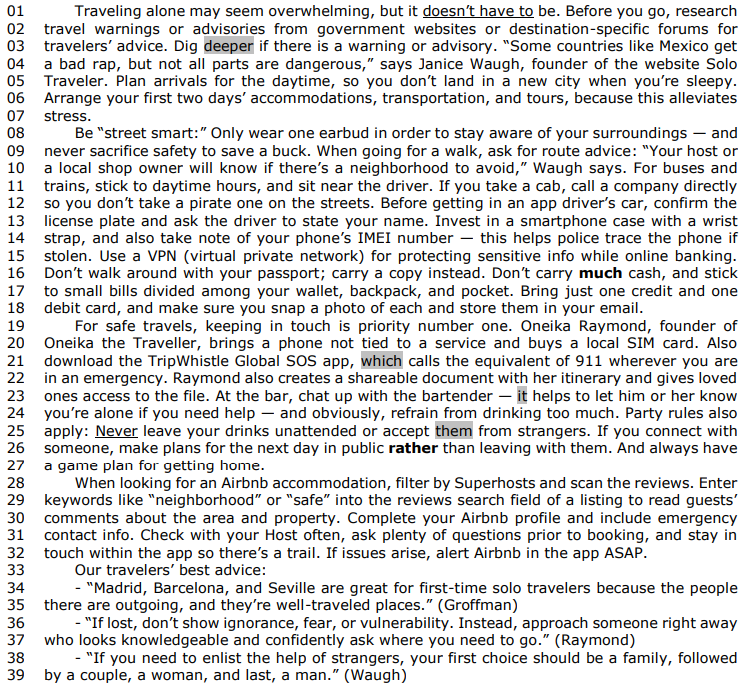
In which of the sentences below the word “rather” has the same meaning as the highlighted one in line 08?
Alternativas
Q2143857 Inglês
INSTRUCTION: Read the article to answer question.

Making Sure Students’ Struggles Are Productive
By Peg Grafwallner

While we know every learning challenge is an empowering opportunity to grow, we also know that message might sometimes be lost on our students. Those learning challenges can cause some students to become frustrated and shut down from the learning.

We need to empower our students to celebrate those learning challenges and help them realize that obstacles and setbacks are a valued part of the classroom culture. We need to create a not-yet classroom where productive struggle is encouraged and students see themselves as capable learners and fearless risk-takers. The not-yet approach is all about designing and creating an authentic classroom culture that encourages the process of learning while accepting that setbacks and obstacles are part of that process.

EMBRACING THE STRUGGLE

Let’s start with productive struggle. According to Jo Boaler, professor at Stanford Graduate School of Education, “If you aren’t struggling, you aren’t really learning. When we’re struggling and making mistakes, those are the very best times for our brains.”

As educators we understand and appreciate the importance of that struggle. We have often struggled ourselves to learn something new. But because that new learning was important to us and because we had support in case we weren’t successful, we continued until we achieved our goal.

So how do we create a classroom community where students value the importance of that struggle and where they see themselves as not-yet learners?

Here are four suggestions to help you create a not-yet classroom.

1. Create a vigorous learning intention: Scaffold success criteria that give students the opportunity to make sense of what they’re supposed to know and be able to do. Give students a chance to ask questions about the learning intention and time to paraphrase it so that it makes sense to them.

In my book Ready to Learn: The FRAME Model for Optimizing Student Success, I explain, “When students paraphrase the learning intention and success criteria, it gives teachers a chance to discover what their students know or understand about the learning intention.”

This discovery is critical because if students find paraphrasing the learning intention a challenge, this could indicate a gap in the students’ learning. Teachers, then, can address this gap and, if necessary, rewrite the success criteria so that the students have the opportunity to overcome the deficit.

 Scaffolding the success criteria provides a means to motivate students and gives students an opportunity to self-assess their understanding and determine whether they’ve achieved that particular criterion. As students move through the success criteria, there’s a sense of empowerment – they know they’re heading successfully toward the fulfillment of the learning intention. If they haven’t met a specific criterion, however, the teacher can dedicate time so that students are able to work in small groups with their peers or one-on-one with their teacher for more support in meeting that criterion.

2. Eliminate the word failure from your vocabulary: As an example, if your essay directions asked students to write a thesis paragraph and a student turned in a body paragraph, did the student fail the assignment?

The student fell short of the goal of writing a thesis paragraph, but there certainly was some degree of understanding, since the student was able to write an analytical body paragraph. Make allowances for that and offer positive guidance.

3. Be transparent in your introduction of the work: Don’t sugarcoat the assignment or project by telling your students it’s “so easy” or that everyone will “get it.” On the contrary, tell your students the task will be difficult, but the work they’re about to do is worthy of their time and their talent.

Let students know they’ll encounter setbacks and obstacles as a part of learning that task, but with support from you, their classmates, and various teacher-chosen resources, students will be able to meet that challenge and work toward mastery of the goal.

4. Give students the time and space they need to be successful: Create learning opportunities to normalize development and empower students to realize that learning takes time and that mastery isn’t the end of growth. We’re all working within parameters of schedules, and those schedules dictate the time spent on learning. Often those schedules are determined by mandates beyond our control, but there are ways we can offer time and space within our own classrooms.

To add in extra time, maybe the lesson covers two class periods instead of one; or maybe the teacher is able to co-teach with another educator to assist students who might need extra help, therefore moving the learning at a more structured pace.

To offer extra space, perhaps the teacher and students could utilize the library or auditorium to give students more room to create groups or pods of learning; or maybe the teacher is able to create learning situations that move beyond the classroom walls through the use of virtual field trips. We’ve seen the curiosity and wonder in our students as they devour something that piques their interest because they have the time and the space to dig deep into something of relevance to them.

Where each student is on their learning journey at any given time is a result of situations and experiences that might often be beyond our control. We know that high expectations don’t mean anything if the learning process doesn’t support achieving them.

Designing classrooms and routines that normalize productive struggle as part of the learning process gives students the opportunity to meet those high expectations within a supportive yet challenging classroom community.
The conjunction therefore in “or maybe the teacher is able to co-teach with another educator to assist students who might need extra help, therefore moving the learning at a more structured pace” can be replaced by
Alternativas
Q2143855 Inglês
INSTRUCTION: Read the article to answer question.

Making Sure Students’ Struggles Are Productive
By Peg Grafwallner

While we know every learning challenge is an empowering opportunity to grow, we also know that message might sometimes be lost on our students. Those learning challenges can cause some students to become frustrated and shut down from the learning.

We need to empower our students to celebrate those learning challenges and help them realize that obstacles and setbacks are a valued part of the classroom culture. We need to create a not-yet classroom where productive struggle is encouraged and students see themselves as capable learners and fearless risk-takers. The not-yet approach is all about designing and creating an authentic classroom culture that encourages the process of learning while accepting that setbacks and obstacles are part of that process.

EMBRACING THE STRUGGLE

Let’s start with productive struggle. According to Jo Boaler, professor at Stanford Graduate School of Education, “If you aren’t struggling, you aren’t really learning. When we’re struggling and making mistakes, those are the very best times for our brains.”

As educators we understand and appreciate the importance of that struggle. We have often struggled ourselves to learn something new. But because that new learning was important to us and because we had support in case we weren’t successful, we continued until we achieved our goal.

So how do we create a classroom community where students value the importance of that struggle and where they see themselves as not-yet learners?

Here are four suggestions to help you create a not-yet classroom.

1. Create a vigorous learning intention: Scaffold success criteria that give students the opportunity to make sense of what they’re supposed to know and be able to do. Give students a chance to ask questions about the learning intention and time to paraphrase it so that it makes sense to them.

In my book Ready to Learn: The FRAME Model for Optimizing Student Success, I explain, “When students paraphrase the learning intention and success criteria, it gives teachers a chance to discover what their students know or understand about the learning intention.”

This discovery is critical because if students find paraphrasing the learning intention a challenge, this could indicate a gap in the students’ learning. Teachers, then, can address this gap and, if necessary, rewrite the success criteria so that the students have the opportunity to overcome the deficit.

 Scaffolding the success criteria provides a means to motivate students and gives students an opportunity to self-assess their understanding and determine whether they’ve achieved that particular criterion. As students move through the success criteria, there’s a sense of empowerment – they know they’re heading successfully toward the fulfillment of the learning intention. If they haven’t met a specific criterion, however, the teacher can dedicate time so that students are able to work in small groups with their peers or one-on-one with their teacher for more support in meeting that criterion.

2. Eliminate the word failure from your vocabulary: As an example, if your essay directions asked students to write a thesis paragraph and a student turned in a body paragraph, did the student fail the assignment?

The student fell short of the goal of writing a thesis paragraph, but there certainly was some degree of understanding, since the student was able to write an analytical body paragraph. Make allowances for that and offer positive guidance.

3. Be transparent in your introduction of the work: Don’t sugarcoat the assignment or project by telling your students it’s “so easy” or that everyone will “get it.” On the contrary, tell your students the task will be difficult, but the work they’re about to do is worthy of their time and their talent.

Let students know they’ll encounter setbacks and obstacles as a part of learning that task, but with support from you, their classmates, and various teacher-chosen resources, students will be able to meet that challenge and work toward mastery of the goal.

4. Give students the time and space they need to be successful: Create learning opportunities to normalize development and empower students to realize that learning takes time and that mastery isn’t the end of growth. We’re all working within parameters of schedules, and those schedules dictate the time spent on learning. Often those schedules are determined by mandates beyond our control, but there are ways we can offer time and space within our own classrooms.

To add in extra time, maybe the lesson covers two class periods instead of one; or maybe the teacher is able to co-teach with another educator to assist students who might need extra help, therefore moving the learning at a more structured pace.

To offer extra space, perhaps the teacher and students could utilize the library or auditorium to give students more room to create groups or pods of learning; or maybe the teacher is able to create learning situations that move beyond the classroom walls through the use of virtual field trips. We’ve seen the curiosity and wonder in our students as they devour something that piques their interest because they have the time and the space to dig deep into something of relevance to them.

Where each student is on their learning journey at any given time is a result of situations and experiences that might often be beyond our control. We know that high expectations don’t mean anything if the learning process doesn’t support achieving them.

Designing classrooms and routines that normalize productive struggle as part of the learning process gives students the opportunity to meet those high expectations within a supportive yet challenging classroom community.
The author states that “… learning challenges can cause some students to become frustrated and shut down from the learning.” A synonym for the verb to shut down is
Alternativas
Q2133209 Inglês

Text CB2A2 


   Anyone who has interacted with superbot ChatGPT or image generator DALL-E might be wondering what the future of artificial intelligence (AI) holds for humanity.

    ChatGPT is an AI program that generates text in a very human-like manner when asked questions. Just ask DALL-E or similar programs to create a picture of a French bulldog driving a pink convertible and voila: you’ll see several versions in seconds.

    Science fiction in the mid-20th century created good-natured AI such as the computer on Star Trek helping the Enterprise crew, as well as its evil twin set on destroying its creators like HAL in Arthur C. Clarke’s famous book (or Stanley Kubrick’s 1968 film adaptation) 2001: A Space Odyssey. In 2023, however, we’re surrounded by AI that’s far more mundane than those examples. The virtual assistant in your smartphone, the airline chatbot and the robot vacuum cleaning your floors don’t seem to have any aspirations to rise above humanity and have been designed to help us.

    We should be prepared for bigger things to come than games, better chatbots or photo generators. Connectivity is key: think of AI as a general-purpose innovation like electricity that powers and connects other technologies, including sensors, robots, genomic devices and 3D printers. AI’s use will only intensify and accelerate as faster computing technology is developed, along with greater sensors capturing data, often called the Internet of Things (IoT). In the future, AI will be interwoven in virtually every aspect of commercial and personal activities.

Peter Marber. Artificial Intelligence: Why Should We Care?. Internet: (adapted). 

Considering the linguistic and semantic aspects of text CB2A2, judge the following item. 


The word “wonder”, in the first paragraph, is used here in the sense of “decide”.

Alternativas
Q2128683 Inglês
Fed’s Jefferson says inflation is U.S. central bank’s most worrisome problem


Available at: https://www.reuters.com/markets/us/feds-jefferson-first-remarks-calls-inflation-most-concerning-problem-2022-10-04/. Retrieved on: Oct 4, 2022. Adapted.
In the section of last paragraph “it remains uncertain how that will work, and in the meantime inflation remains elevated”, the expression in the meantime is synonymous with
Alternativas
Q2128682 Inglês
Fed’s Jefferson says inflation is U.S. central bank’s most worrisome problem


Available at: https://www.reuters.com/markets/us/feds-jefferson-first-remarks-calls-inflation-most-concerning-problem-2022-10-04/. Retrieved on: Oct 4, 2022. Adapted.
In the fragment of 5th paragraph “the worst outcome would be to let inflation take root”, the expression take root could be replaced, with no change in meaning, by
Alternativas
Q2110021 Inglês
Instruction: Answer question based on the following text. The highlights throughout the text are cited in the question.

Watch your back! Idioms with the word ‘back’ 


(Available at: https://dictionaryblog.cambridge.org/2023/03/01/watch-your-back-idioms-with-the-word-back/ – text especially adapted for this test).
The highlighted word “Several” (l. 02) could be replaced with no significative chances in meaning by: 
Alternativas
Q2106873 Inglês
Creating Knowledge Base Videos

texto_13 - 19 .png (767×487)

(Available at: https://www.helpscout.com/blog/video-knowledge-base/ – text especially adapted for this test). 
The options below could replace the bold word “however” (l. 10) with no significative changes in meaning, EXCEPT for: 
Alternativas
Q2106871 Inglês
Creating Knowledge Base Videos

texto_13 - 19 .png (767×487)

(Available at: https://www.helpscout.com/blog/video-knowledge-base/ – text especially adapted for this test). 
Consider the following statements about the word “can” in the sentence “Video can explain steps more naturally” (l. 13) in the context presented in the article: 
I. Its past form is “could”. II. It could be replaced by “must” with no significative changes in meaning. III. It expresses permission.
Which statements are correct?
Alternativas
Respostas
461: B
462: A
463: C
464: E
465: E
466: A
467: C
468: D
469: B
470: D
471: B
472: C
473: C
474: A
475: E
476: E
477: E
478: D
479: E
480: A