Questões de Concurso Sobre inglês
Foram encontradas 26.019 questões


“So I was quite offended by my doctor who, when we ran into each other in the street one day, took one look at me and told me that I was definitely overweight”.
I – The doctor said the narrator might have a heart attack. II – The narrator became worried because he was getting older. III – Following doctor’s orders, he started a diet, but it didn’t work out. IV – He decided to go to the seaside on his next holiday in order to walk on the beach.
Text CB1A2-II
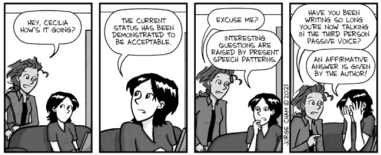
Jorge Cham. Piled higher and deeper. Internet: <www.phdcomics.com>.
Text CB1A2-II
Jorge Cham. Piled higher and deeper. Internet: <www.phdcomics.com>.
Text CB1A2-II
Jorge Cham. Piled higher and deeper. Internet: <www.phdcomics.com>.
Text CB1A2-I
Although an oft-cited poll showed that 85% of Americans approve of organ donation, less than half had made a decision about donating, and fewer still (28%) had granted permission by signing a donor card, a pattern also observed in Germany, Spain, and Sweden. Given the shortage of donors, the gap between approval and action is a matter of life and death.
What drives the decision to become a potential donor? Within the European Union, donation rates vary by nearly an order of magnitude across countries and these differences are stable from year to year. Even when controlling for variables such as transplant infrastructure, economic and educational status, and religion, large differences in donation rates persist. Why?
Most public policy choices have a no-action default, that is, a condition is imposed when an individual fails to make a decision. In the case of organ donation, European countries have one of two default policies. In presumed-consent states, people are organ donors unless they register not to be, and in explicitconsent countries, nobody is an organ donor without registering to be one.
We examined the rate of agreement to become a donor across European countries with explicit and presumed consent laws. If preferences concerning organ donation are strong, we would expect defaults to have little or no effect. However, defaults appear to make a large difference: the four opt-in countries (Denmark, Netherlands, United Kingdom, Germany) had lower rates than the six opt-out countries (Austria, Belgium, France, Hungary, Poland, Portugal, Sweden). The two distributions have no overlap, and nearly 60 percentage points separate the two groups
Our data suggest changes in defaults could increase donations in the United States of additional thousands of donors a year. Because each donor can donate for about three transplants, the consequences are substantial in lives saved. Our results stand in contrast with the suggestion that defaults do not matter. Policy-makers performing analysis in this and other domains should consider that defaults make a difference.
Eric J. Johnson; Daniel Goldstein. Do Defaults Save Lives?
Internet: <www.dangoldstein.com> (adapted).
Text CB1A2-I
Although an oft-cited poll showed that 85% of Americans approve of organ donation, less than half had made a decision about donating, and fewer still (28%) had granted permission by signing a donor card, a pattern also observed in Germany, Spain, and Sweden. Given the shortage of donors, the gap between approval and action is a matter of life and death.
What drives the decision to become a potential donor? Within the European Union, donation rates vary by nearly an order of magnitude across countries and these differences are stable from year to year. Even when controlling for variables such as transplant infrastructure, economic and educational status, and religion, large differences in donation rates persist. Why?
Most public policy choices have a no-action default, that is, a condition is imposed when an individual fails to make a decision. In the case of organ donation, European countries have one of two default policies. In presumed-consent states, people are organ donors unless they register not to be, and in explicitconsent countries, nobody is an organ donor without registering to be one.
We examined the rate of agreement to become a donor across European countries with explicit and presumed consent laws. If preferences concerning organ donation are strong, we would expect defaults to have little or no effect. However, defaults appear to make a large difference: the four opt-in countries (Denmark, Netherlands, United Kingdom, Germany) had lower rates than the six opt-out countries (Austria, Belgium, France, Hungary, Poland, Portugal, Sweden). The two distributions have no overlap, and nearly 60 percentage points separate the two groups
Our data suggest changes in defaults could increase donations in the United States of additional thousands of donors a year. Because each donor can donate for about three transplants, the consequences are substantial in lives saved. Our results stand in contrast with the suggestion that defaults do not matter. Policy-makers performing analysis in this and other domains should consider that defaults make a difference.
Eric J. Johnson; Daniel Goldstein. Do Defaults Save Lives?
Internet: <www.dangoldstein.com> (adapted).
Text CB1A2-I
Although an oft-cited poll showed that 85% of Americans approve of organ donation, less than half had made a decision about donating, and fewer still (28%) had granted permission by signing a donor card, a pattern also observed in Germany, Spain, and Sweden. Given the shortage of donors, the gap between approval and action is a matter of life and death.
What drives the decision to become a potential donor? Within the European Union, donation rates vary by nearly an order of magnitude across countries and these differences are stable from year to year. Even when controlling for variables such as transplant infrastructure, economic and educational status, and religion, large differences in donation rates persist. Why?
Most public policy choices have a no-action default, that is, a condition is imposed when an individual fails to make a decision. In the case of organ donation, European countries have one of two default policies. In presumed-consent states, people are organ donors unless they register not to be, and in explicitconsent countries, nobody is an organ donor without registering to be one.
We examined the rate of agreement to become a donor across European countries with explicit and presumed consent laws. If preferences concerning organ donation are strong, we would expect defaults to have little or no effect. However, defaults appear to make a large difference: the four opt-in countries (Denmark, Netherlands, United Kingdom, Germany) had lower rates than the six opt-out countries (Austria, Belgium, France, Hungary, Poland, Portugal, Sweden). The two distributions have no overlap, and nearly 60 percentage points separate the two groups
Our data suggest changes in defaults could increase donations in the United States of additional thousands of donors a year. Because each donor can donate for about three transplants, the consequences are substantial in lives saved. Our results stand in contrast with the suggestion that defaults do not matter. Policy-makers performing analysis in this and other domains should consider that defaults make a difference.
Eric J. Johnson; Daniel Goldstein. Do Defaults Save Lives?
Internet: <www.dangoldstein.com> (adapted).
Text CB1A2-I
Although an oft-cited poll showed that 85% of Americans approve of organ donation, less than half had made a decision about donating, and fewer still (28%) had granted permission by signing a donor card, a pattern also observed in Germany, Spain, and Sweden. Given the shortage of donors, the gap between approval and action is a matter of life and death.
What drives the decision to become a potential donor? Within the European Union, donation rates vary by nearly an order of magnitude across countries and these differences are stable from year to year. Even when controlling for variables such as transplant infrastructure, economic and educational status, and religion, large differences in donation rates persist. Why?
Most public policy choices have a no-action default, that is, a condition is imposed when an individual fails to make a decision. In the case of organ donation, European countries have one of two default policies. In presumed-consent states, people are organ donors unless they register not to be, and in explicitconsent countries, nobody is an organ donor without registering to be one.
We examined the rate of agreement to become a donor across European countries with explicit and presumed consent laws. If preferences concerning organ donation are strong, we would expect defaults to have little or no effect. However, defaults appear to make a large difference: the four opt-in countries (Denmark, Netherlands, United Kingdom, Germany) had lower rates than the six opt-out countries (Austria, Belgium, France, Hungary, Poland, Portugal, Sweden). The two distributions have no overlap, and nearly 60 percentage points separate the two groups
Our data suggest changes in defaults could increase donations in the United States of additional thousands of donors a year. Because each donor can donate for about three transplants, the consequences are substantial in lives saved. Our results stand in contrast with the suggestion that defaults do not matter. Policy-makers performing analysis in this and other domains should consider that defaults make a difference.
Eric J. Johnson; Daniel Goldstein. Do Defaults Save Lives?
Internet: <www.dangoldstein.com> (adapted).
Text CB1A2-I
Although an oft-cited poll showed that 85% of Americans approve of organ donation, less than half had made a decision about donating, and fewer still (28%) had granted permission by signing a donor card, a pattern also observed in Germany, Spain, and Sweden. Given the shortage of donors, the gap between approval and action is a matter of life and death.
What drives the decision to become a potential donor? Within the European Union, donation rates vary by nearly an order of magnitude across countries and these differences are stable from year to year. Even when controlling for variables such as transplant infrastructure, economic and educational status, and religion, large differences in donation rates persist. Why?
Most public policy choices have a no-action default, that is, a condition is imposed when an individual fails to make a decision. In the case of organ donation, European countries have one of two default policies. In presumed-consent states, people are organ donors unless they register not to be, and in explicitconsent countries, nobody is an organ donor without registering to be one.
We examined the rate of agreement to become a donor across European countries with explicit and presumed consent laws. If preferences concerning organ donation are strong, we would expect defaults to have little or no effect. However, defaults appear to make a large difference: the four opt-in countries (Denmark, Netherlands, United Kingdom, Germany) had lower rates than the six opt-out countries (Austria, Belgium, France, Hungary, Poland, Portugal, Sweden). The two distributions have no overlap, and nearly 60 percentage points separate the two groups
Our data suggest changes in defaults could increase donations in the United States of additional thousands of donors a year. Because each donor can donate for about three transplants, the consequences are substantial in lives saved. Our results stand in contrast with the suggestion that defaults do not matter. Policy-makers performing analysis in this and other domains should consider that defaults make a difference.
Eric J. Johnson; Daniel Goldstein. Do Defaults Save Lives?
Internet: <www.dangoldstein.com> (adapted).
“Lost-and-founds citywide are practically overflowing with discarded umbrellas - once the rain stops, many Vancouverites ______ leave them behind than lug them home.”
Choose the best option that fills in the blank:
“If global conditions _____ fraught, they ____ Goldilocks was a fairy tale after all.”
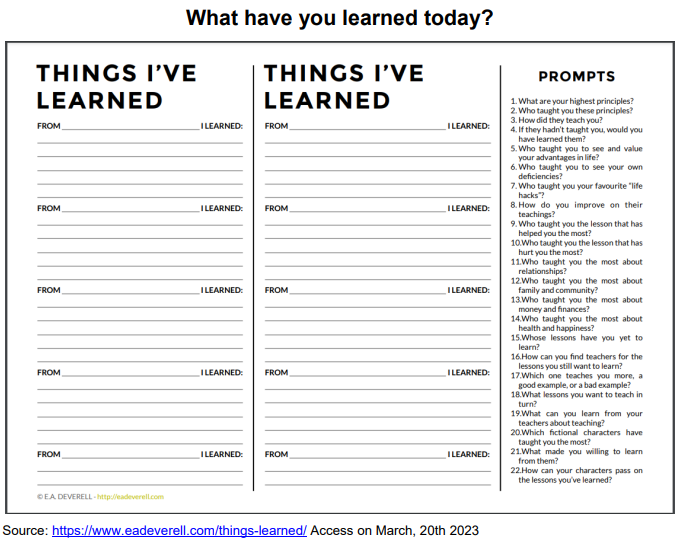
B. The verb tense in the question “What have you learned today?” was used to talk about:
I. Students generally don’t recognize vowel sounds, diphthongs or minimal pairs, for instance: live – leave
II. They face problems in listening to connected speech, for example: /How’zit going?/
III. They don’t understand weak forms such as in /ai k n s ki/
IV. Students generally don’t understand phonetic links such as in /He works saz an engineer/
“Communicative activities are the ones designed to motivate students to interact speaking and listening to each other. During these activities students generally communicate when one of the speakers have some information (facts, opinions, ideas, etc) and the others don’t. They aim at making students use the language they are learning to interact in a real and meaningful way, generally involving exchange of information” (SCRIVENER, 1994, p. 62)
B. Considering the definition above which item on the following list is a communicative activity?
I – Beowulf is a narrative poem and an example from the Old English Literature Period. ( )
II – The Canterbury Tales was written by Geoffrey Chaucer in The Middle Ages. ( )
III – William Shakespeare wrote tragedies, comedies and histories during The Renaissance. ( )
IV – Pride and Prejudice is a set of short stories and was written by Jane Austen. ( )
B. Considering Rainsford’s studies (2014), choose the correct alternative.
“By seven o’clock the orchestra _______________, no thin five-piece affair, but a whole pitful of oboes and trombones and saxophones and viols and cornets and piccolos, and low and high drums. The last swimmers ______________ in from the beach now and _______________ up-stairs; the cars from New York _______________ five deep in the drive […]” (FITZGERALD, 2011, p. 32-33).
Source: https://www.wsfcs.k12.nc.us/cms/lib/NC01001395/Centricity/Domain/7935/Gatsby_PDF_FullText.pdf Access on March, 20th 2023

 Conheça nossos planos