Questões de Concurso Sobre inglês
Foram encontradas 26.001 questões


Read the text below and answer the question
Paris 2024 Gymnastics: Rebeca Andrade captures
floor exercise gold ahead of Simone Biles and Jordan Chiles
By Scott Bregman / 05 August 2024

If this was a finale, Rebeca Andrade went out in style.
The most decorated Brazilian athlete at the Olympic Games added a gold medal Monday afternoon (5 August), claiming the women's floor title at the Olympic Games Paris 2024.
It's a second Olympic gold for Andrade, the Tokyo 2020 vaulting champion. She has six total medals in her three Olympic appearances. Andrade told media earlier this week that Paris could be her career floor finale.
"I am very happy and proud about what I did," she said. "We came here every day to compete and perform (well). Gymnastics is not an easy sport, it requires a lot from our body and mind.
"I was confident I was able to manage all of the pressure and I worked with my coach in order to achieve what we've done." Andrade's 14.166 was just ahead of Simone Biles (14.133).
Biles' American teammate Jordan Chiles was third, scoring a 13.766 after a scoring inquiry lifted her from fifth to the podium.
It's the 11th Olympic medal for Biles, extending her record as the most decorated U.S. Olympic gymnast. The Brazilian star tumbled a front layout full to full-in and a full-twisting double layout to open. She closed with a controlled double pike.
Andrade took her time coming off the podium, savouring the appreciation from the crowd. When the final scores flashed inside Bercy Arena, the 25-year-old artistic gymnastics star seemed stunned during an embrace with coach.
In the warm-up, Biles looked cautious.
She has been dealing with a strained calf injury throughout the Games and struggled through her signature triple-double (Biles II) in the moments before she competed.
But in competition, that tumbling pass gave her no trouble. Instead, Biles flew out of bounds with both feet on her second and fourth tumbling passes, incurring a .600 total neutral deduction.
"Obviously wasn't my best performances, but at the end of the day, whoever medaled, medaled and that's what's so exciting because you just never know with gymnastics," said Biles afterward. "So I'm not very upset or anything about my performance at the Olympics. I'm actually very happy, proud and even more excited about it."
Chiles' score was originally 13.666 but coaches Laurent and Cecile Landi filed an inquiry. It was accepting, raising her difficulty score by .1 and giving her the bronze medal.
"I didn't even realize my coaches put in an inquiry, and I was like, 'Okay, yeah. Like, let's see... it can vary,'" explained Chiles. "So when it came through, I was very proud of myself. It was my first event final and my first event medal. This is crazy."
https://olympics.com/en/news/paris-2024-gymnastics-rebeca-andrade-captures-floor-exercise-gold
Read the text below and answer the question
Paris 2024 Gymnastics: Rebeca Andrade captures
floor exercise gold ahead of Simone Biles and Jordan Chiles
By Scott Bregman / 05 August 2024
If this was a finale, Rebeca Andrade went out in style.
The most decorated Brazilian athlete at the Olympic Games added a gold medal Monday afternoon (5 August), claiming the women's floor title at the Olympic Games Paris 2024.
It's a second Olympic gold for Andrade, the Tokyo 2020 vaulting champion. She has six total medals in her three Olympic appearances. Andrade told media earlier this week that Paris could be her career floor finale.
"I am very happy and proud about what I did," she said. "We came here every day to compete and perform (well). Gymnastics is not an easy sport, it requires a lot from our body and mind.
"I was confident I was able to manage all of the pressure and I worked with my coach in order to achieve what we've done." Andrade's 14.166 was just ahead of Simone Biles (14.133).
Biles' American teammate Jordan Chiles was third, scoring a 13.766 after a scoring inquiry lifted her from fifth to the podium.
It's the 11th Olympic medal for Biles, extending her record as the most decorated U.S. Olympic gymnast. The Brazilian star tumbled a front layout full to full-in and a full-twisting double layout to open. She closed with a controlled double pike.
Andrade took her time coming off the podium, savouring the appreciation from the crowd. When the final scores flashed inside Bercy Arena, the 25-year-old artistic gymnastics star seemed stunned during an embrace with coach.
In the warm-up, Biles looked cautious.
She has been dealing with a strained calf injury throughout the Games and struggled through her signature triple-double (Biles II) in the moments before she competed.
But in competition, that tumbling pass gave her no trouble. Instead, Biles flew out of bounds with both feet on her second and fourth tumbling passes, incurring a .600 total neutral deduction.
"Obviously wasn't my best performances, but at the end of the day, whoever medaled, medaled and that's what's so exciting because you just never know with gymnastics," said Biles afterward. "So I'm not very upset or anything about my performance at the Olympics. I'm actually very happy, proud and even more excited about it."
Chiles' score was originally 13.666 but coaches Laurent and Cecile Landi filed an inquiry. It was accepting, raising her difficulty score by .1 and giving her the bronze medal.
"I didn't even realize my coaches put in an inquiry, and I was like, 'Okay, yeah. Like, let's see... it can vary,'" explained Chiles. "So when it came through, I was very proud of myself. It was my first event final and my first event medal. This is crazy."
https://olympics.com/en/news/paris-2024-gymnastics-rebeca-andrade-captures-floor-exercise-gold
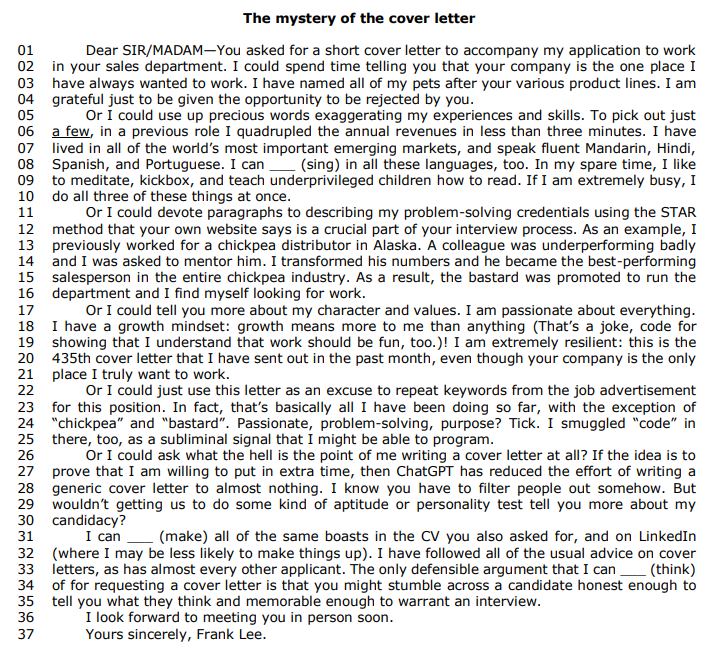
(Available at: https://www.economist.com/business/2024/09/05/the-mystery-of-the-cover-letter – text specially adapted for this test).
(Available at: https://www.economist.com/business/2024/09/05/the-mystery-of-the-cover-letter – text specially adapted for this test).
(Available at: https://www.economist.com/business/2024/09/05/the-mystery-of-the-cover-letter – text specially adapted for this test).
(Available at: https://www.economist.com/business/2024/09/05/the-mystery-of-the-cover-letter – text specially adapted for this test).
(Available at: https://www.economist.com/business/2024/09/05/the-mystery-of-the-cover-letter – text specially adapted for this test).
TEXT 1
Why is music good for the brain?
October 7, 2020
By Andrew E. Budson, MD, Editorial Advisory Board Member, Harvard Health Publishing

1. Can music really affect your well-being, learning, cognitive function, quality of life, and even happiness? Hand in a recent survey on music and brain health conducted by AARP revealed some interesting findings about the impact of music on cognitive and emotional well-being: music listeners had higher scores for mental well-being and slightly reduced levels of anxiety and depression compared to people overall.
2. Of survey respondents who currently go to musical performances, 69% rated their brain health as “excellent” or “very good,” compared to 58% for those who went in the past and 52% for those who never attended. Of those who reported often being exposed to music as a child, 68% rated their ability to learn new things as “excellent” or “very good,” compared to 50% of those who were not exposed to music.
3. Active musical engagement, including those over age 50, was associated with higher rates of happiness and good cognitive function. Adults with no early music exposure but who currently engage in some music appreciation show above average mental well-being scores. Those are pretty impressive results, to be sure. However, this 20-minute online survey has some limitations. For one, it included 3,185 US adults ages 18 and older; that is a small number if you are extrapolating to 328 million people across the country. For another, it is really a survey of people’s opinions. For example, although people might report their brain health as “excellent,” there was no objective measure of brain health such as an MRI scan, or even a test to measure their cognition.
4. Lastly, even if the ratings were true, the findings are only correlations. They do not prove that, for example, it was the exposure to music as a child that led to one’s improved ability to learn new things. It may be equally likely that those children brought up in more affluent households were both more likely to be exposed to music and to be given a good education that led to their being able to easily learn new things later in life.
5. Music has been shown to activate some of the broadest and most diverse networks of the brain. Of course, music activates the auditory cortex in the temporal lobes close to your ears, but that’s just the beginning. The parts of the brain involved in emotion are not only activated during emotional music, they are also synchronized. Music also activates a variety of memory regions. And, interestingly, music activates the motor system. In fact, it has been theorized that it is the activation of the brain’s motor system that allows us to pick out the beat of the music even before we start tapping our foot to it!
6. Okay, get along! so music activates just about all of the brain. Why is that so important? Well, have you ever heard the expression, “If you don’t use it, you’ll lose it”? It turns out this is actually true in the brain. Brain pathways — and even whole networks — are strengthened when they are used and are weakened when they are not used. The reason is that the brain is efficient; it isn’t going to bother keeping a brain pathway strong when it hasn’t been used in many years. The brain will use the neurons in that pathway for something else. These types of changes should be intuitively obvious to you — that’s why it is harder to speak that foreign language if you haven’t used it in 20 years; many of the old pathways have degraded and the neurons are being used for other purposes.
BUDSON, Andrew E. Why is music good for the brain? Harvard Health Publishing, 7 out. 2020. Disponível em:
Acoording the Communicative Language Teaching (CLT):
I. The communicative approach is based on the idea that learning language successfully comes through having to communicate real meaning.
II. The movement and approach known as Communicative Language Teaching (CLT) is a good example of how a paradigm shift in language teaching reflects these two sources of change.
III. Practising question forms by asking learners to find out personal information about their colleagues is an example of the communicative approach, as it involves meaningful communication.
The correct staments are:
TEXT 1
Why is music good for the brain?
October 7, 2020
By Andrew E. Budson, MD, Editorial Advisory Board Member, Harvard Health Publishing
1. Can music really affect your well-being, learning, cognitive function, quality of life, and even happiness? Hand in a recent survey on music and brain health conducted by AARP revealed some interesting findings about the impact of music on cognitive and emotional well-being: music listeners had higher scores for mental well-being and slightly reduced levels of anxiety and depression compared to people overall.
2. Of survey respondents who currently go to musical performances, 69% rated their brain health as “excellent” or “very good,” compared to 58% for those who went in the past and 52% for those who never attended. Of those who reported often being exposed to music as a child, 68% rated their ability to learn new things as “excellent” or “very good,” compared to 50% of those who were not exposed to music.
3. Active musical engagement, including those over age 50, was associated with higher rates of happiness and good cognitive function. Adults with no early music exposure but who currently engage in some music appreciation show above average mental well-being scores. Those are pretty impressive results, to be sure. However, this 20-minute online survey has some limitations. For one, it included 3,185 US adults ages 18 and older; that is a small number if you are extrapolating to 328 million people across the country. For another, it is really a survey of people’s opinions. For example, although people might report their brain health as “excellent,” there was no objective measure of brain health such as an MRI scan, or even a test to measure their cognition.
4. Lastly, even if the ratings were true, the findings are only correlations. They do not prove that, for example, it was the exposure to music as a child that led to one’s improved ability to learn new things. It may be equally likely that those children brought up in more affluent households were both more likely to be exposed to music and to be given a good education that led to their being able to easily learn new things later in life.
5. Music has been shown to activate some of the broadest and most diverse networks of the brain. Of course, music activates the auditory cortex in the temporal lobes close to your ears, but that’s just the beginning. The parts of the brain involved in emotion are not only activated during emotional music, they are also synchronized. Music also activates a variety of memory regions. And, interestingly, music activates the motor system. In fact, it has been theorized that it is the activation of the brain’s motor system that allows us to pick out the beat of the music even before we start tapping our foot to it!
6. Okay, get along! so music activates just about all of the brain. Why is that so important? Well, have you ever heard the expression, “If you don’t use it, you’ll lose it”? It turns out this is actually true in the brain. Brain pathways — and even whole networks — are strengthened when they are used and are weakened when they are not used. The reason is that the brain is efficient; it isn’t going to bother keeping a brain pathway strong when it hasn’t been used in many years. The brain will use the neurons in that pathway for something else. These types of changes should be intuitively obvious to you — that’s why it is harder to speak that foreign language if you haven’t used it in 20 years; many of the old pathways have degraded and the neurons are being used for other purposes.
BUDSON, Andrew E. Why is music good for the brain? Harvard Health Publishing, 7 out. 2020. Disponível em:
TEXT 1
Why is music good for the brain?
October 7, 2020
By Andrew E. Budson, MD, Editorial Advisory Board Member, Harvard Health Publishing
1. Can music really affect your well-being, learning, cognitive function, quality of life, and even happiness? Hand in a recent survey on music and brain health conducted by AARP revealed some interesting findings about the impact of music on cognitive and emotional well-being: music listeners had higher scores for mental well-being and slightly reduced levels of anxiety and depression compared to people overall.
2. Of survey respondents who currently go to musical performances, 69% rated their brain health as “excellent” or “very good,” compared to 58% for those who went in the past and 52% for those who never attended. Of those who reported often being exposed to music as a child, 68% rated their ability to learn new things as “excellent” or “very good,” compared to 50% of those who were not exposed to music.
3. Active musical engagement, including those over age 50, was associated with higher rates of happiness and good cognitive function. Adults with no early music exposure but who currently engage in some music appreciation show above average mental well-being scores. Those are pretty impressive results, to be sure. However, this 20-minute online survey has some limitations. For one, it included 3,185 US adults ages 18 and older; that is a small number if you are extrapolating to 328 million people across the country. For another, it is really a survey of people’s opinions. For example, although people might report their brain health as “excellent,” there was no objective measure of brain health such as an MRI scan, or even a test to measure their cognition.
4. Lastly, even if the ratings were true, the findings are only correlations. They do not prove that, for example, it was the exposure to music as a child that led to one’s improved ability to learn new things. It may be equally likely that those children brought up in more affluent households were both more likely to be exposed to music and to be given a good education that led to their being able to easily learn new things later in life.
5. Music has been shown to activate some of the broadest and most diverse networks of the brain. Of course, music activates the auditory cortex in the temporal lobes close to your ears, but that’s just the beginning. The parts of the brain involved in emotion are not only activated during emotional music, they are also synchronized. Music also activates a variety of memory regions. And, interestingly, music activates the motor system. In fact, it has been theorized that it is the activation of the brain’s motor system that allows us to pick out the beat of the music even before we start tapping our foot to it!
6. Okay, get along! so music activates just about all of the brain. Why is that so important? Well, have you ever heard the expression, “If you don’t use it, you’ll lose it”? It turns out this is actually true in the brain. Brain pathways — and even whole networks — are strengthened when they are used and are weakened when they are not used. The reason is that the brain is efficient; it isn’t going to bother keeping a brain pathway strong when it hasn’t been used in many years. The brain will use the neurons in that pathway for something else. These types of changes should be intuitively obvious to you — that’s why it is harder to speak that foreign language if you haven’t used it in 20 years; many of the old pathways have degraded and the neurons are being used for other purposes.
BUDSON, Andrew E. Why is music good for the brain? Harvard Health Publishing, 7 out. 2020. Disponível em:
TEXT 1
Why is music good for the brain?
October 7, 2020
By Andrew E. Budson, MD, Editorial Advisory Board Member, Harvard Health Publishing
1. Can music really affect your well-being, learning, cognitive function, quality of life, and even happiness? Hand in a recent survey on music and brain health conducted by AARP revealed some interesting findings about the impact of music on cognitive and emotional well-being: music listeners had higher scores for mental well-being and slightly reduced levels of anxiety and depression compared to people overall.
2. Of survey respondents who currently go to musical performances, 69% rated their brain health as “excellent” or “very good,” compared to 58% for those who went in the past and 52% for those who never attended. Of those who reported often being exposed to music as a child, 68% rated their ability to learn new things as “excellent” or “very good,” compared to 50% of those who were not exposed to music.
3. Active musical engagement, including those over age 50, was associated with higher rates of happiness and good cognitive function. Adults with no early music exposure but who currently engage in some music appreciation show above average mental well-being scores. Those are pretty impressive results, to be sure. However, this 20-minute online survey has some limitations. For one, it included 3,185 US adults ages 18 and older; that is a small number if you are extrapolating to 328 million people across the country. For another, it is really a survey of people’s opinions. For example, although people might report their brain health as “excellent,” there was no objective measure of brain health such as an MRI scan, or even a test to measure their cognition.
4. Lastly, even if the ratings were true, the findings are only correlations. They do not prove that, for example, it was the exposure to music as a child that led to one’s improved ability to learn new things. It may be equally likely that those children brought up in more affluent households were both more likely to be exposed to music and to be given a good education that led to their being able to easily learn new things later in life.
5. Music has been shown to activate some of the broadest and most diverse networks of the brain. Of course, music activates the auditory cortex in the temporal lobes close to your ears, but that’s just the beginning. The parts of the brain involved in emotion are not only activated during emotional music, they are also synchronized. Music also activates a variety of memory regions. And, interestingly, music activates the motor system. In fact, it has been theorized that it is the activation of the brain’s motor system that allows us to pick out the beat of the music even before we start tapping our foot to it!
6. Okay, get along! so music activates just about all of the brain. Why is that so important? Well, have you ever heard the expression, “If you don’t use it, you’ll lose it”? It turns out this is actually true in the brain. Brain pathways — and even whole networks — are strengthened when they are used and are weakened when they are not used. The reason is that the brain is efficient; it isn’t going to bother keeping a brain pathway strong when it hasn’t been used in many years. The brain will use the neurons in that pathway for something else. These types of changes should be intuitively obvious to you — that’s why it is harder to speak that foreign language if you haven’t used it in 20 years; many of the old pathways have degraded and the neurons are being used for other purposes.
BUDSON, Andrew E. Why is music good for the brain? Harvard Health Publishing, 7 out. 2020. Disponível em:
TEXT 1
Why is music good for the brain?
October 7, 2020
By Andrew E. Budson, MD, Editorial Advisory Board Member, Harvard Health Publishing
1. Can music really affect your well-being, learning, cognitive function, quality of life, and even happiness? Hand in a recent survey on music and brain health conducted by AARP revealed some interesting findings about the impact of music on cognitive and emotional well-being: music listeners had higher scores for mental well-being and slightly reduced levels of anxiety and depression compared to people overall.
2. Of survey respondents who currently go to musical performances, 69% rated their brain health as “excellent” or “very good,” compared to 58% for those who went in the past and 52% for those who never attended. Of those who reported often being exposed to music as a child, 68% rated their ability to learn new things as “excellent” or “very good,” compared to 50% of those who were not exposed to music.
3. Active musical engagement, including those over age 50, was associated with higher rates of happiness and good cognitive function. Adults with no early music exposure but who currently engage in some music appreciation show above average mental well-being scores. Those are pretty impressive results, to be sure. However, this 20-minute online survey has some limitations. For one, it included 3,185 US adults ages 18 and older; that is a small number if you are extrapolating to 328 million people across the country. For another, it is really a survey of people’s opinions. For example, although people might report their brain health as “excellent,” there was no objective measure of brain health such as an MRI scan, or even a test to measure their cognition.
4. Lastly, even if the ratings were true, the findings are only correlations. They do not prove that, for example, it was the exposure to music as a child that led to one’s improved ability to learn new things. It may be equally likely that those children brought up in more affluent households were both more likely to be exposed to music and to be given a good education that led to their being able to easily learn new things later in life.
5. Music has been shown to activate some of the broadest and most diverse networks of the brain. Of course, music activates the auditory cortex in the temporal lobes close to your ears, but that’s just the beginning. The parts of the brain involved in emotion are not only activated during emotional music, they are also synchronized. Music also activates a variety of memory regions. And, interestingly, music activates the motor system. In fact, it has been theorized that it is the activation of the brain’s motor system that allows us to pick out the beat of the music even before we start tapping our foot to it!
6. Okay, get along! so music activates just about all of the brain. Why is that so important? Well, have you ever heard the expression, “If you don’t use it, you’ll lose it”? It turns out this is actually true in the brain. Brain pathways — and even whole networks — are strengthened when they are used and are weakened when they are not used. The reason is that the brain is efficient; it isn’t going to bother keeping a brain pathway strong when it hasn’t been used in many years. The brain will use the neurons in that pathway for something else. These types of changes should be intuitively obvious to you — that’s why it is harder to speak that foreign language if you haven’t used it in 20 years; many of the old pathways have degraded and the neurons are being used for other purposes.
BUDSON, Andrew E. Why is music good for the brain? Harvard Health Publishing, 7 out. 2020. Disponível em:
TEXT 1
Why is music good for the brain?
October 7, 2020
By Andrew E. Budson, MD, Editorial Advisory Board Member, Harvard Health Publishing
1. Can music really affect your well-being, learning, cognitive function, quality of life, and even happiness? Hand in a recent survey on music and brain health conducted by AARP revealed some interesting findings about the impact of music on cognitive and emotional well-being: music listeners had higher scores for mental well-being and slightly reduced levels of anxiety and depression compared to people overall.
2. Of survey respondents who currently go to musical performances, 69% rated their brain health as “excellent” or “very good,” compared to 58% for those who went in the past and 52% for those who never attended. Of those who reported often being exposed to music as a child, 68% rated their ability to learn new things as “excellent” or “very good,” compared to 50% of those who were not exposed to music.
3. Active musical engagement, including those over age 50, was associated with higher rates of happiness and good cognitive function. Adults with no early music exposure but who currently engage in some music appreciation show above average mental well-being scores. Those are pretty impressive results, to be sure. However, this 20-minute online survey has some limitations. For one, it included 3,185 US adults ages 18 and older; that is a small number if you are extrapolating to 328 million people across the country. For another, it is really a survey of people’s opinions. For example, although people might report their brain health as “excellent,” there was no objective measure of brain health such as an MRI scan, or even a test to measure their cognition.
4. Lastly, even if the ratings were true, the findings are only correlations. They do not prove that, for example, it was the exposure to music as a child that led to one’s improved ability to learn new things. It may be equally likely that those children brought up in more affluent households were both more likely to be exposed to music and to be given a good education that led to their being able to easily learn new things later in life.
5. Music has been shown to activate some of the broadest and most diverse networks of the brain. Of course, music activates the auditory cortex in the temporal lobes close to your ears, but that’s just the beginning. The parts of the brain involved in emotion are not only activated during emotional music, they are also synchronized. Music also activates a variety of memory regions. And, interestingly, music activates the motor system. In fact, it has been theorized that it is the activation of the brain’s motor system that allows us to pick out the beat of the music even before we start tapping our foot to it!
6. Okay, get along! so music activates just about all of the brain. Why is that so important? Well, have you ever heard the expression, “If you don’t use it, you’ll lose it”? It turns out this is actually true in the brain. Brain pathways — and even whole networks — are strengthened when they are used and are weakened when they are not used. The reason is that the brain is efficient; it isn’t going to bother keeping a brain pathway strong when it hasn’t been used in many years. The brain will use the neurons in that pathway for something else. These types of changes should be intuitively obvious to you — that’s why it is harder to speak that foreign language if you haven’t used it in 20 years; many of the old pathways have degraded and the neurons are being used for other purposes.
BUDSON, Andrew E. Why is music good for the brain? Harvard Health Publishing, 7 out. 2020. Disponível em:

 Conheça nossos planos