Questões de Concurso Sobre inglês
Foram encontradas 25.994 questões


Ano: 2026
Banca:
AMEOSC
Órgão:
Prefeitura de São Miguel do Oeste - SC
Prova:
AMEOSC - 2026 - Prefeitura de São Miguel do Oeste - SC - Professor (Língua Inglesa) |
Q4229162
Inglês
Texto associado
O texto seguinte servirá de base para responder à questão.
Peru's Nazca lines were paths for prehistoric culture:
Japanese researchers
Tokyo, 16 Jan (EFE).- The mysteries shrouding Peru's
Nazca Lines have intrigued scientists for decades. Now,
a group of Japanese researchers has developed a new
theory that the geoglyphs etched into the ground served
as paths and routes. The lines forged into myriad figures
of animals and plants straddle an area of 1,000 square
kilometers of the immense Ica desert in southern Peru.
They were created during the Nazca culture, a
pre-Columbian archaeological culture that flourished
between the 1st and 7th centuries BC. A research team
led by Masato Sakai, of the University of Yamagata in
western Japan, has discovered, with the help of local
archaeologists, aerial images and drones, over 350 new
etchings since 2004. Sakai says there are two types of
geoglyphs, linear motifs that were created by removing
the upper black stones to reveal the white earth
underneath and raised lines that give the pictorial
representations depth and that archeologists call relief
lines. «The linear ones exist at the beginning and end of
straight paths and can be used to travel from one valley
to another (...) while the relief ones are on the sides of
paths that are not straight and are usually etched on a
slope,» the expert says. The meaning of the lines has
long been up for debate. Some say they represented an
astronomical calendar, others considered they were
religious figures and some have even suggested that
they serve as landing pads for UFOs. «I'm interested in
letters,» Sakai says. «Everyone uses alphabets, but in
Andean civilization, they didn't have that way of
communicating, so I wanted to discover how they did
(communicate).»
The researcher is convinced that the Nazca lines were
used as a means of prehistoric communication
Despite their antiquity, the geoglyphs were not
discovered until 1930 because these could only be
appreciated with an aerial view or from some of the site's
surrounding hills. The team of Japanese researchers
started the project using satellite and aerial photos, and
more recently using drones, and have now identified
hundreds of figures, including a spider, a monkey, a
hummingbird, a condor, a pelican, a gull, a snail, a whale,
a snake and a llama. The team struck a deal with tech
giant IBM in 2019 and have tapped into state-of-the-art
artificial intelligence (AI) that could help reveal the
location of more figures and help with deciphering their
meaning. «It is always a hypothesis, but we hope that
with AI we can check whether theories are correct or
suggest better ones that coincide with the new data,» the
expert adds. Finding all the figures, which according to
the expert could be in the thousands, is key to their
conservation from both the weather and mining and
agriculture which is prevalent in the region. «For the
people of Nazca, the geoglyphs are a source of pride because the city is not very big, but many people come to
see the figures. When we find new ones, we share the
information with the local people because we know that
they will respect and defend them, because it is the work
of their ancestors» Sakai says. EFE
https://efe.com/other-news/2023-01-16/nazca-lines/
Read the excerpt below:
"Everyone uses alphabets, but in Andean civilization, they didn't have that way of communicating, so I wanted to discover how they did (communicate)."
In the context of the text, Sakai's statement indicates that his research is concerned with:
"Everyone uses alphabets, but in Andean civilization, they didn't have that way of communicating, so I wanted to discover how they did (communicate)."
In the context of the text, Sakai's statement indicates that his research is concerned with:
Ano: 2026
Banca:
AMEOSC
Órgão:
Prefeitura de São Miguel do Oeste - SC
Prova:
AMEOSC - 2026 - Prefeitura de São Miguel do Oeste - SC - Professor (Língua Inglesa) |
Q4229161
Inglês
Texto associado
O texto seguinte servirá de base para responder à questão.
Peru's Nazca lines were paths for prehistoric culture:
Japanese researchers
Tokyo, 16 Jan (EFE).- The mysteries shrouding Peru's
Nazca Lines have intrigued scientists for decades. Now,
a group of Japanese researchers has developed a new
theory that the geoglyphs etched into the ground served
as paths and routes. The lines forged into myriad figures
of animals and plants straddle an area of 1,000 square
kilometers of the immense Ica desert in southern Peru.
They were created during the Nazca culture, a
pre-Columbian archaeological culture that flourished
between the 1st and 7th centuries BC. A research team
led by Masato Sakai, of the University of Yamagata in
western Japan, has discovered, with the help of local
archaeologists, aerial images and drones, over 350 new
etchings since 2004. Sakai says there are two types of
geoglyphs, linear motifs that were created by removing
the upper black stones to reveal the white earth
underneath and raised lines that give the pictorial
representations depth and that archeologists call relief
lines. «The linear ones exist at the beginning and end of
straight paths and can be used to travel from one valley
to another (...) while the relief ones are on the sides of
paths that are not straight and are usually etched on a
slope,» the expert says. The meaning of the lines has
long been up for debate. Some say they represented an
astronomical calendar, others considered they were
religious figures and some have even suggested that
they serve as landing pads for UFOs. «I'm interested in
letters,» Sakai says. «Everyone uses alphabets, but in
Andean civilization, they didn't have that way of
communicating, so I wanted to discover how they did
(communicate).»
The researcher is convinced that the Nazca lines were
used as a means of prehistoric communication
Despite their antiquity, the geoglyphs were not
discovered until 1930 because these could only be
appreciated with an aerial view or from some of the site's
surrounding hills. The team of Japanese researchers
started the project using satellite and aerial photos, and
more recently using drones, and have now identified
hundreds of figures, including a spider, a monkey, a
hummingbird, a condor, a pelican, a gull, a snail, a whale,
a snake and a llama. The team struck a deal with tech
giant IBM in 2019 and have tapped into state-of-the-art
artificial intelligence (AI) that could help reveal the
location of more figures and help with deciphering their
meaning. «It is always a hypothesis, but we hope that
with AI we can check whether theories are correct or
suggest better ones that coincide with the new data,» the
expert adds. Finding all the figures, which according to
the expert could be in the thousands, is key to their
conservation from both the weather and mining and
agriculture which is prevalent in the region. «For the
people of Nazca, the geoglyphs are a source of pride because the city is not very big, but many people come to
see the figures. When we find new ones, we share the
information with the local people because we know that
they will respect and defend them, because it is the work
of their ancestors» Sakai says. EFE
https://efe.com/other-news/2023-01-16/nazca-lines/
The words "hypothesis," "archaeological," "created,"
"lines," "culture" and "Japanese" appear in the text.
Considering pronunciation, stress and spelling-sound
relations in English, the correct statement is:
Ano: 2026
Banca:
AMEOSC
Órgão:
Prefeitura de São Miguel do Oeste - SC
Prova:
AMEOSC - 2026 - Prefeitura de São Miguel do Oeste - SC - Professor (Língua Inglesa) |
Q4229160
Inglês
Texto associado
O texto seguinte servirá de base para responder à questão.
Peru's Nazca lines were paths for prehistoric culture:
Japanese researchers
Tokyo, 16 Jan (EFE).- The mysteries shrouding Peru's
Nazca Lines have intrigued scientists for decades. Now,
a group of Japanese researchers has developed a new
theory that the geoglyphs etched into the ground served
as paths and routes. The lines forged into myriad figures
of animals and plants straddle an area of 1,000 square
kilometers of the immense Ica desert in southern Peru.
They were created during the Nazca culture, a
pre-Columbian archaeological culture that flourished
between the 1st and 7th centuries BC. A research team
led by Masato Sakai, of the University of Yamagata in
western Japan, has discovered, with the help of local
archaeologists, aerial images and drones, over 350 new
etchings since 2004. Sakai says there are two types of
geoglyphs, linear motifs that were created by removing
the upper black stones to reveal the white earth
underneath and raised lines that give the pictorial
representations depth and that archeologists call relief
lines. «The linear ones exist at the beginning and end of
straight paths and can be used to travel from one valley
to another (...) while the relief ones are on the sides of
paths that are not straight and are usually etched on a
slope,» the expert says. The meaning of the lines has
long been up for debate. Some say they represented an
astronomical calendar, others considered they were
religious figures and some have even suggested that
they serve as landing pads for UFOs. «I'm interested in
letters,» Sakai says. «Everyone uses alphabets, but in
Andean civilization, they didn't have that way of
communicating, so I wanted to discover how they did
(communicate).»
The researcher is convinced that the Nazca lines were
used as a means of prehistoric communication
Despite their antiquity, the geoglyphs were not
discovered until 1930 because these could only be
appreciated with an aerial view or from some of the site's
surrounding hills. The team of Japanese researchers
started the project using satellite and aerial photos, and
more recently using drones, and have now identified
hundreds of figures, including a spider, a monkey, a
hummingbird, a condor, a pelican, a gull, a snail, a whale,
a snake and a llama. The team struck a deal with tech
giant IBM in 2019 and have tapped into state-of-the-art
artificial intelligence (AI) that could help reveal the
location of more figures and help with deciphering their
meaning. «It is always a hypothesis, but we hope that
with AI we can check whether theories are correct or
suggest better ones that coincide with the new data,» the
expert adds. Finding all the figures, which according to
the expert could be in the thousands, is key to their
conservation from both the weather and mining and
agriculture which is prevalent in the region. «For the
people of Nazca, the geoglyphs are a source of pride because the city is not very big, but many people come to
see the figures. When we find new ones, we share the
information with the local people because we know that
they will respect and defend them, because it is the work
of their ancestors» Sakai says. EFE
https://efe.com/other-news/2023-01-16/nazca-lines/
Considering its structure, language and communicative
purpose, the text is classified as:
Ano: 2026
Banca:
AMEOSC
Órgão:
Prefeitura de São Miguel do Oeste - SC
Prova:
AMEOSC - 2026 - Prefeitura de São Miguel do Oeste - SC - Professor (Língua Inglesa) |
Q4229159
Inglês
Texto associado
O texto seguinte servirá de base para responder à questão.
Peru's Nazca lines were paths for prehistoric culture:
Japanese researchers
Tokyo, 16 Jan (EFE).- The mysteries shrouding Peru's
Nazca Lines have intrigued scientists for decades. Now,
a group of Japanese researchers has developed a new
theory that the geoglyphs etched into the ground served
as paths and routes. The lines forged into myriad figures
of animals and plants straddle an area of 1,000 square
kilometers of the immense Ica desert in southern Peru.
They were created during the Nazca culture, a
pre-Columbian archaeological culture that flourished
between the 1st and 7th centuries BC. A research team
led by Masato Sakai, of the University of Yamagata in
western Japan, has discovered, with the help of local
archaeologists, aerial images and drones, over 350 new
etchings since 2004. Sakai says there are two types of
geoglyphs, linear motifs that were created by removing
the upper black stones to reveal the white earth
underneath and raised lines that give the pictorial
representations depth and that archeologists call relief
lines. «The linear ones exist at the beginning and end of
straight paths and can be used to travel from one valley
to another (...) while the relief ones are on the sides of
paths that are not straight and are usually etched on a
slope,» the expert says. The meaning of the lines has
long been up for debate. Some say they represented an
astronomical calendar, others considered they were
religious figures and some have even suggested that
they serve as landing pads for UFOs. «I'm interested in
letters,» Sakai says. «Everyone uses alphabets, but in
Andean civilization, they didn't have that way of
communicating, so I wanted to discover how they did
(communicate).»
The researcher is convinced that the Nazca lines were
used as a means of prehistoric communication
Despite their antiquity, the geoglyphs were not
discovered until 1930 because these could only be
appreciated with an aerial view or from some of the site's
surrounding hills. The team of Japanese researchers
started the project using satellite and aerial photos, and
more recently using drones, and have now identified
hundreds of figures, including a spider, a monkey, a
hummingbird, a condor, a pelican, a gull, a snail, a whale,
a snake and a llama. The team struck a deal with tech
giant IBM in 2019 and have tapped into state-of-the-art
artificial intelligence (AI) that could help reveal the
location of more figures and help with deciphering their
meaning. «It is always a hypothesis, but we hope that
with AI we can check whether theories are correct or
suggest better ones that coincide with the new data,» the
expert adds. Finding all the figures, which according to
the expert could be in the thousands, is key to their
conservation from both the weather and mining and
agriculture which is prevalent in the region. «For the
people of Nazca, the geoglyphs are a source of pride because the city is not very big, but many people come to
see the figures. When we find new ones, we share the
information with the local people because we know that
they will respect and defend them, because it is the work
of their ancestors» Sakai says. EFE
https://efe.com/other-news/2023-01-16/nazca-lines/
Read the excerpt below:
"The lines forged into myriad figures of animals and plants straddle an area of 1,000 square kilometers of the immense Ica desert in southern Peru."
In this context, the verb "straddle" indicates that the figures:
"The lines forged into myriad figures of animals and plants straddle an area of 1,000 square kilometers of the immense Ica desert in southern Peru."
In this context, the verb "straddle" indicates that the figures:
Ano: 2026
Banca:
AMEOSC
Órgão:
Prefeitura de São Miguel do Oeste - SC
Prova:
AMEOSC - 2026 - Prefeitura de São Miguel do Oeste - SC - Professor (Língua Inglesa) |
Q4229158
Inglês
Texto associado
O texto seguinte servirá de base para responder à questão.
Peru's Nazca lines were paths for prehistoric culture:
Japanese researchers
Tokyo, 16 Jan (EFE).- The mysteries shrouding Peru's
Nazca Lines have intrigued scientists for decades. Now,
a group of Japanese researchers has developed a new
theory that the geoglyphs etched into the ground served
as paths and routes. The lines forged into myriad figures
of animals and plants straddle an area of 1,000 square
kilometers of the immense Ica desert in southern Peru.
They were created during the Nazca culture, a
pre-Columbian archaeological culture that flourished
between the 1st and 7th centuries BC. A research team
led by Masato Sakai, of the University of Yamagata in
western Japan, has discovered, with the help of local
archaeologists, aerial images and drones, over 350 new
etchings since 2004. Sakai says there are two types of
geoglyphs, linear motifs that were created by removing
the upper black stones to reveal the white earth
underneath and raised lines that give the pictorial
representations depth and that archeologists call relief
lines. «The linear ones exist at the beginning and end of
straight paths and can be used to travel from one valley
to another (...) while the relief ones are on the sides of
paths that are not straight and are usually etched on a
slope,» the expert says. The meaning of the lines has
long been up for debate. Some say they represented an
astronomical calendar, others considered they were
religious figures and some have even suggested that
they serve as landing pads for UFOs. «I'm interested in
letters,» Sakai says. «Everyone uses alphabets, but in
Andean civilization, they didn't have that way of
communicating, so I wanted to discover how they did
(communicate).»
The researcher is convinced that the Nazca lines were
used as a means of prehistoric communication
Despite their antiquity, the geoglyphs were not
discovered until 1930 because these could only be
appreciated with an aerial view or from some of the site's
surrounding hills. The team of Japanese researchers
started the project using satellite and aerial photos, and
more recently using drones, and have now identified
hundreds of figures, including a spider, a monkey, a
hummingbird, a condor, a pelican, a gull, a snail, a whale,
a snake and a llama. The team struck a deal with tech
giant IBM in 2019 and have tapped into state-of-the-art
artificial intelligence (AI) that could help reveal the
location of more figures and help with deciphering their
meaning. «It is always a hypothesis, but we hope that
with AI we can check whether theories are correct or
suggest better ones that coincide with the new data,» the
expert adds. Finding all the figures, which according to
the expert could be in the thousands, is key to their
conservation from both the weather and mining and
agriculture which is prevalent in the region. «For the
people of Nazca, the geoglyphs are a source of pride because the city is not very big, but many people come to
see the figures. When we find new ones, we share the
information with the local people because we know that
they will respect and defend them, because it is the work
of their ancestors» Sakai says. EFE
https://efe.com/other-news/2023-01-16/nazca-lines/
Based on the way the information is organized in the text, it can be inferred that:
Ano: 2026
Banca:
AMEOSC
Órgão:
Prefeitura de São Miguel do Oeste - SC
Prova:
AMEOSC - 2026 - Prefeitura de São Miguel do Oeste - SC - Professor (Língua Inglesa) |
Q4229157
Inglês
Texto associado
O texto seguinte servirá de base para responder à questão.
Peru's Nazca lines were paths for prehistoric culture:
Japanese researchers
Tokyo, 16 Jan (EFE).- The mysteries shrouding Peru's
Nazca Lines have intrigued scientists for decades. Now,
a group of Japanese researchers has developed a new
theory that the geoglyphs etched into the ground served
as paths and routes. The lines forged into myriad figures
of animals and plants straddle an area of 1,000 square
kilometers of the immense Ica desert in southern Peru.
They were created during the Nazca culture, a
pre-Columbian archaeological culture that flourished
between the 1st and 7th centuries BC. A research team
led by Masato Sakai, of the University of Yamagata in
western Japan, has discovered, with the help of local
archaeologists, aerial images and drones, over 350 new
etchings since 2004. Sakai says there are two types of
geoglyphs, linear motifs that were created by removing
the upper black stones to reveal the white earth
underneath and raised lines that give the pictorial
representations depth and that archeologists call relief
lines. «The linear ones exist at the beginning and end of
straight paths and can be used to travel from one valley
to another (...) while the relief ones are on the sides of
paths that are not straight and are usually etched on a
slope,» the expert says. The meaning of the lines has
long been up for debate. Some say they represented an
astronomical calendar, others considered they were
religious figures and some have even suggested that
they serve as landing pads for UFOs. «I'm interested in
letters,» Sakai says. «Everyone uses alphabets, but in
Andean civilization, they didn't have that way of
communicating, so I wanted to discover how they did
(communicate).»
The researcher is convinced that the Nazca lines were
used as a means of prehistoric communication
Despite their antiquity, the geoglyphs were not
discovered until 1930 because these could only be
appreciated with an aerial view or from some of the site's
surrounding hills. The team of Japanese researchers
started the project using satellite and aerial photos, and
more recently using drones, and have now identified
hundreds of figures, including a spider, a monkey, a
hummingbird, a condor, a pelican, a gull, a snail, a whale,
a snake and a llama. The team struck a deal with tech
giant IBM in 2019 and have tapped into state-of-the-art
artificial intelligence (AI) that could help reveal the
location of more figures and help with deciphering their
meaning. «It is always a hypothesis, but we hope that
with AI we can check whether theories are correct or
suggest better ones that coincide with the new data,» the
expert adds. Finding all the figures, which according to
the expert could be in the thousands, is key to their
conservation from both the weather and mining and
agriculture which is prevalent in the region. «For the
people of Nazca, the geoglyphs are a source of pride because the city is not very big, but many people come to
see the figures. When we find new ones, we share the
information with the local people because we know that
they will respect and defend them, because it is the work
of their ancestors» Sakai says. EFE
https://efe.com/other-news/2023-01-16/nazca-lines/
Consider the sentences from the text:
"The mysteries shrouding Peru's Nazca Lines have intrigued scientists for decades."
"They were created during the Nazca culture."
"A research team led by Masato Sakai [...] has discovered [...] over 350 new etchings since 2004."
The verb forms used in the sentences are correctly explained in:
"The mysteries shrouding Peru's Nazca Lines have intrigued scientists for decades."
"They were created during the Nazca culture."
"A research team led by Masato Sakai [...] has discovered [...] over 350 new etchings since 2004."
The verb forms used in the sentences are correctly explained in:
Ano: 2026
Banca:
AMEOSC
Órgão:
Prefeitura de São Miguel do Oeste - SC
Prova:
AMEOSC - 2026 - Prefeitura de São Miguel do Oeste - SC - Professor (Língua Inglesa) |
Q4229156
Inglês
Texto associado
O texto seguinte servirá de base para responder à questão.
Peru's Nazca lines were paths for prehistoric culture:
Japanese researchers
Tokyo, 16 Jan (EFE).- The mysteries shrouding Peru's
Nazca Lines have intrigued scientists for decades. Now,
a group of Japanese researchers has developed a new
theory that the geoglyphs etched into the ground served
as paths and routes. The lines forged into myriad figures
of animals and plants straddle an area of 1,000 square
kilometers of the immense Ica desert in southern Peru.
They were created during the Nazca culture, a
pre-Columbian archaeological culture that flourished
between the 1st and 7th centuries BC. A research team
led by Masato Sakai, of the University of Yamagata in
western Japan, has discovered, with the help of local
archaeologists, aerial images and drones, over 350 new
etchings since 2004. Sakai says there are two types of
geoglyphs, linear motifs that were created by removing
the upper black stones to reveal the white earth
underneath and raised lines that give the pictorial
representations depth and that archeologists call relief
lines. «The linear ones exist at the beginning and end of
straight paths and can be used to travel from one valley
to another (...) while the relief ones are on the sides of
paths that are not straight and are usually etched on a
slope,» the expert says. The meaning of the lines has
long been up for debate. Some say they represented an
astronomical calendar, others considered they were
religious figures and some have even suggested that
they serve as landing pads for UFOs. «I'm interested in
letters,» Sakai says. «Everyone uses alphabets, but in
Andean civilization, they didn't have that way of
communicating, so I wanted to discover how they did
(communicate).»
The researcher is convinced that the Nazca lines were
used as a means of prehistoric communication
Despite their antiquity, the geoglyphs were not
discovered until 1930 because these could only be
appreciated with an aerial view or from some of the site's
surrounding hills. The team of Japanese researchers
started the project using satellite and aerial photos, and
more recently using drones, and have now identified
hundreds of figures, including a spider, a monkey, a
hummingbird, a condor, a pelican, a gull, a snail, a whale,
a snake and a llama. The team struck a deal with tech
giant IBM in 2019 and have tapped into state-of-the-art
artificial intelligence (AI) that could help reveal the
location of more figures and help with deciphering their
meaning. «It is always a hypothesis, but we hope that
with AI we can check whether theories are correct or
suggest better ones that coincide with the new data,» the
expert adds. Finding all the figures, which according to
the expert could be in the thousands, is key to their
conservation from both the weather and mining and
agriculture which is prevalent in the region. «For the
people of Nazca, the geoglyphs are a source of pride because the city is not very big, but many people come to
see the figures. When we find new ones, we share the
information with the local people because we know that
they will respect and defend them, because it is the work
of their ancestors» Sakai says. EFE
https://efe.com/other-news/2023-01-16/nazca-lines/
Read the sentence below:
"It is always a hypothesis, but we hope that with AI we can check whether theories are correct or suggest better ones that coincide with the new data," the expert adds.
The modal verb "can" is used in the sentence to express:
"It is always a hypothesis, but we hope that with AI we can check whether theories are correct or suggest better ones that coincide with the new data," the expert adds.
The modal verb "can" is used in the sentence to express:
Ano: 2026
Banca:
AMEOSC
Órgão:
Prefeitura de São Miguel do Oeste - SC
Prova:
AMEOSC - 2026 - Prefeitura de São Miguel do Oeste - SC - Professor (Língua Inglesa) |
Q4229155
Inglês
Texto associado
O texto seguinte servirá de base para responder à questão.
Peru's Nazca lines were paths for prehistoric culture:
Japanese researchers
Tokyo, 16 Jan (EFE).- The mysteries shrouding Peru's
Nazca Lines have intrigued scientists for decades. Now,
a group of Japanese researchers has developed a new
theory that the geoglyphs etched into the ground served
as paths and routes. The lines forged into myriad figures
of animals and plants straddle an area of 1,000 square
kilometers of the immense Ica desert in southern Peru.
They were created during the Nazca culture, a
pre-Columbian archaeological culture that flourished
between the 1st and 7th centuries BC. A research team
led by Masato Sakai, of the University of Yamagata in
western Japan, has discovered, with the help of local
archaeologists, aerial images and drones, over 350 new
etchings since 2004. Sakai says there are two types of
geoglyphs, linear motifs that were created by removing
the upper black stones to reveal the white earth
underneath and raised lines that give the pictorial
representations depth and that archeologists call relief
lines. «The linear ones exist at the beginning and end of
straight paths and can be used to travel from one valley
to another (...) while the relief ones are on the sides of
paths that are not straight and are usually etched on a
slope,» the expert says. The meaning of the lines has
long been up for debate. Some say they represented an
astronomical calendar, others considered they were
religious figures and some have even suggested that
they serve as landing pads for UFOs. «I'm interested in
letters,» Sakai says. «Everyone uses alphabets, but in
Andean civilization, they didn't have that way of
communicating, so I wanted to discover how they did
(communicate).»
The researcher is convinced that the Nazca lines were
used as a means of prehistoric communication
Despite their antiquity, the geoglyphs were not
discovered until 1930 because these could only be
appreciated with an aerial view or from some of the site's
surrounding hills. The team of Japanese researchers
started the project using satellite and aerial photos, and
more recently using drones, and have now identified
hundreds of figures, including a spider, a monkey, a
hummingbird, a condor, a pelican, a gull, a snail, a whale,
a snake and a llama. The team struck a deal with tech
giant IBM in 2019 and have tapped into state-of-the-art
artificial intelligence (AI) that could help reveal the
location of more figures and help with deciphering their
meaning. «It is always a hypothesis, but we hope that
with AI we can check whether theories are correct or
suggest better ones that coincide with the new data,» the
expert adds. Finding all the figures, which according to
the expert could be in the thousands, is key to their
conservation from both the weather and mining and
agriculture which is prevalent in the region. «For the
people of Nazca, the geoglyphs are a source of pride because the city is not very big, but many people come to
see the figures. When we find new ones, we share the
information with the local people because we know that
they will respect and defend them, because it is the work
of their ancestors» Sakai says. EFE
https://efe.com/other-news/2023-01-16/nazca-lines/
Read the excerpt below:
"Finding all the figures, which according to the expert could be in the thousands, is key to their conservation from both the weather and mining and agriculture which is prevalent in the region."
According to the excerpt, the identification of new geoglyphs is relevant because it:
"Finding all the figures, which according to the expert could be in the thousands, is key to their conservation from both the weather and mining and agriculture which is prevalent in the region."
According to the excerpt, the identification of new geoglyphs is relevant because it:
Ano: 2026
Banca:
AMEOSC
Órgão:
Prefeitura de São Miguel do Oeste - SC
Prova:
AMEOSC - 2026 - Prefeitura de São Miguel do Oeste - SC - Professor (Língua Inglesa) |
Q4229154
Inglês
Texto associado
O texto seguinte servirá de base para responder à questão.
Peru's Nazca lines were paths for prehistoric culture:
Japanese researchers
Tokyo, 16 Jan (EFE).- The mysteries shrouding Peru's
Nazca Lines have intrigued scientists for decades. Now,
a group of Japanese researchers has developed a new
theory that the geoglyphs etched into the ground served
as paths and routes. The lines forged into myriad figures
of animals and plants straddle an area of 1,000 square
kilometers of the immense Ica desert in southern Peru.
They were created during the Nazca culture, a
pre-Columbian archaeological culture that flourished
between the 1st and 7th centuries BC. A research team
led by Masato Sakai, of the University of Yamagata in
western Japan, has discovered, with the help of local
archaeologists, aerial images and drones, over 350 new
etchings since 2004. Sakai says there are two types of
geoglyphs, linear motifs that were created by removing
the upper black stones to reveal the white earth
underneath and raised lines that give the pictorial
representations depth and that archeologists call relief
lines. «The linear ones exist at the beginning and end of
straight paths and can be used to travel from one valley
to another (...) while the relief ones are on the sides of
paths that are not straight and are usually etched on a
slope,» the expert says. The meaning of the lines has
long been up for debate. Some say they represented an
astronomical calendar, others considered they were
religious figures and some have even suggested that
they serve as landing pads for UFOs. «I'm interested in
letters,» Sakai says. «Everyone uses alphabets, but in
Andean civilization, they didn't have that way of
communicating, so I wanted to discover how they did
(communicate).»
The researcher is convinced that the Nazca lines were
used as a means of prehistoric communication
Despite their antiquity, the geoglyphs were not
discovered until 1930 because these could only be
appreciated with an aerial view or from some of the site's
surrounding hills. The team of Japanese researchers
started the project using satellite and aerial photos, and
more recently using drones, and have now identified
hundreds of figures, including a spider, a monkey, a
hummingbird, a condor, a pelican, a gull, a snail, a whale,
a snake and a llama. The team struck a deal with tech
giant IBM in 2019 and have tapped into state-of-the-art
artificial intelligence (AI) that could help reveal the
location of more figures and help with deciphering their
meaning. «It is always a hypothesis, but we hope that
with AI we can check whether theories are correct or
suggest better ones that coincide with the new data,» the
expert adds. Finding all the figures, which according to
the expert could be in the thousands, is key to their
conservation from both the weather and mining and
agriculture which is prevalent in the region. «For the
people of Nazca, the geoglyphs are a source of pride because the city is not very big, but many people come to
see the figures. When we find new ones, we share the
information with the local people because we know that
they will respect and defend them, because it is the work
of their ancestors» Sakai says. EFE
https://efe.com/other-news/2023-01-16/nazca-lines/
A teacher uses the text about the Nazca Lines in an
English class. Students read the article, examine images
of the geoglyphs, compare different hypotheses, discuss
the use of drones and artificial intelligence, and produce
a short multimodal news report in English. The procedure
that corresponds to multiliteracies and digital literacy is:
Ano: 2026
Banca:
AMEOSC
Órgão:
Prefeitura de São Miguel do Oeste - SC
Prova:
AMEOSC - 2026 - Prefeitura de São Miguel do Oeste - SC - Professor (Língua Inglesa) |
Q4229153
Inglês
Texto associado
O texto seguinte servirá de base para responder à questão.
Peru's Nazca lines were paths for prehistoric culture:
Japanese researchers
Tokyo, 16 Jan (EFE).- The mysteries shrouding Peru's
Nazca Lines have intrigued scientists for decades. Now,
a group of Japanese researchers has developed a new
theory that the geoglyphs etched into the ground served
as paths and routes. The lines forged into myriad figures
of animals and plants straddle an area of 1,000 square
kilometers of the immense Ica desert in southern Peru.
They were created during the Nazca culture, a
pre-Columbian archaeological culture that flourished
between the 1st and 7th centuries BC. A research team
led by Masato Sakai, of the University of Yamagata in
western Japan, has discovered, with the help of local
archaeologists, aerial images and drones, over 350 new
etchings since 2004. Sakai says there are two types of
geoglyphs, linear motifs that were created by removing
the upper black stones to reveal the white earth
underneath and raised lines that give the pictorial
representations depth and that archeologists call relief
lines. «The linear ones exist at the beginning and end of
straight paths and can be used to travel from one valley
to another (...) while the relief ones are on the sides of
paths that are not straight and are usually etched on a
slope,» the expert says. The meaning of the lines has
long been up for debate. Some say they represented an
astronomical calendar, others considered they were
religious figures and some have even suggested that
they serve as landing pads for UFOs. «I'm interested in
letters,» Sakai says. «Everyone uses alphabets, but in
Andean civilization, they didn't have that way of
communicating, so I wanted to discover how they did
(communicate).»
The researcher is convinced that the Nazca lines were
used as a means of prehistoric communication
Despite their antiquity, the geoglyphs were not
discovered until 1930 because these could only be
appreciated with an aerial view or from some of the site's
surrounding hills. The team of Japanese researchers
started the project using satellite and aerial photos, and
more recently using drones, and have now identified
hundreds of figures, including a spider, a monkey, a
hummingbird, a condor, a pelican, a gull, a snail, a whale,
a snake and a llama. The team struck a deal with tech
giant IBM in 2019 and have tapped into state-of-the-art
artificial intelligence (AI) that could help reveal the
location of more figures and help with deciphering their
meaning. «It is always a hypothesis, but we hope that
with AI we can check whether theories are correct or
suggest better ones that coincide with the new data,» the
expert adds. Finding all the figures, which according to
the expert could be in the thousands, is key to their
conservation from both the weather and mining and
agriculture which is prevalent in the region. «For the
people of Nazca, the geoglyphs are a source of pride because the city is not very big, but many people come to
see the figures. When we find new ones, we share the
information with the local people because we know that
they will respect and defend them, because it is the work
of their ancestors» Sakai says. EFE
https://efe.com/other-news/2023-01-16/nazca-lines/
Based on the text about the Nazca Lines, choose the
option that synthesizes the central claim presented by the
Japanese research team.
Ano: 2026
Banca:
AMEOSC
Órgão:
Prefeitura de São Miguel do Oeste - SC
Prova:
AMEOSC - 2026 - Prefeitura de São Miguel do Oeste - SC - Professor (Língua Inglesa) |
Q4229152
Inglês
Texto associado
O texto seguinte servirá de base para responder à questão.
Peru's Nazca lines were paths for prehistoric culture:
Japanese researchers
Tokyo, 16 Jan (EFE).- The mysteries shrouding Peru's
Nazca Lines have intrigued scientists for decades. Now,
a group of Japanese researchers has developed a new
theory that the geoglyphs etched into the ground served
as paths and routes. The lines forged into myriad figures
of animals and plants straddle an area of 1,000 square
kilometers of the immense Ica desert in southern Peru.
They were created during the Nazca culture, a
pre-Columbian archaeological culture that flourished
between the 1st and 7th centuries BC. A research team
led by Masato Sakai, of the University of Yamagata in
western Japan, has discovered, with the help of local
archaeologists, aerial images and drones, over 350 new
etchings since 2004. Sakai says there are two types of
geoglyphs, linear motifs that were created by removing
the upper black stones to reveal the white earth
underneath and raised lines that give the pictorial
representations depth and that archeologists call relief
lines. «The linear ones exist at the beginning and end of
straight paths and can be used to travel from one valley
to another (...) while the relief ones are on the sides of
paths that are not straight and are usually etched on a
slope,» the expert says. The meaning of the lines has
long been up for debate. Some say they represented an
astronomical calendar, others considered they were
religious figures and some have even suggested that
they serve as landing pads for UFOs. «I'm interested in
letters,» Sakai says. «Everyone uses alphabets, but in
Andean civilization, they didn't have that way of
communicating, so I wanted to discover how they did
(communicate).»
The researcher is convinced that the Nazca lines were
used as a means of prehistoric communication
Despite their antiquity, the geoglyphs were not
discovered until 1930 because these could only be
appreciated with an aerial view or from some of the site's
surrounding hills. The team of Japanese researchers
started the project using satellite and aerial photos, and
more recently using drones, and have now identified
hundreds of figures, including a spider, a monkey, a
hummingbird, a condor, a pelican, a gull, a snail, a whale,
a snake and a llama. The team struck a deal with tech
giant IBM in 2019 and have tapped into state-of-the-art
artificial intelligence (AI) that could help reveal the
location of more figures and help with deciphering their
meaning. «It is always a hypothesis, but we hope that
with AI we can check whether theories are correct or
suggest better ones that coincide with the new data,» the
expert adds. Finding all the figures, which according to
the expert could be in the thousands, is key to their
conservation from both the weather and mining and
agriculture which is prevalent in the region. «For the
people of Nazca, the geoglyphs are a source of pride because the city is not very big, but many people come to
see the figures. When we find new ones, we share the
information with the local people because we know that
they will respect and defend them, because it is the work
of their ancestors» Sakai says. EFE
https://efe.com/other-news/2023-01-16/nazca-lines/
Read the sentence below:
"The team struck a deal with tech giant IBM in 2019 and have tapped into state-of-the-art artificial intelligence that could help reveal the location of more figures."
In the sentence, the expressions "struck a deal" and "tapped into" indicate, respectively:
"The team struck a deal with tech giant IBM in 2019 and have tapped into state-of-the-art artificial intelligence that could help reveal the location of more figures."
In the sentence, the expressions "struck a deal" and "tapped into" indicate, respectively:
Ano: 2026
Banca:
AMEOSC
Órgão:
Prefeitura de São Miguel do Oeste - SC
Prova:
AMEOSC - 2026 - Prefeitura de São Miguel do Oeste - SC - Professor (Língua Inglesa) |
Q4229151
Inglês
Texto associado
O texto seguinte servirá de base para responder à questão.
Peru's Nazca lines were paths for prehistoric culture:
Japanese researchers
Tokyo, 16 Jan (EFE).- The mysteries shrouding Peru's
Nazca Lines have intrigued scientists for decades. Now,
a group of Japanese researchers has developed a new
theory that the geoglyphs etched into the ground served
as paths and routes. The lines forged into myriad figures
of animals and plants straddle an area of 1,000 square
kilometers of the immense Ica desert in southern Peru.
They were created during the Nazca culture, a
pre-Columbian archaeological culture that flourished
between the 1st and 7th centuries BC. A research team
led by Masato Sakai, of the University of Yamagata in
western Japan, has discovered, with the help of local
archaeologists, aerial images and drones, over 350 new
etchings since 2004. Sakai says there are two types of
geoglyphs, linear motifs that were created by removing
the upper black stones to reveal the white earth
underneath and raised lines that give the pictorial
representations depth and that archeologists call relief
lines. «The linear ones exist at the beginning and end of
straight paths and can be used to travel from one valley
to another (...) while the relief ones are on the sides of
paths that are not straight and are usually etched on a
slope,» the expert says. The meaning of the lines has
long been up for debate. Some say they represented an
astronomical calendar, others considered they were
religious figures and some have even suggested that
they serve as landing pads for UFOs. «I'm interested in
letters,» Sakai says. «Everyone uses alphabets, but in
Andean civilization, they didn't have that way of
communicating, so I wanted to discover how they did
(communicate).»
The researcher is convinced that the Nazca lines were
used as a means of prehistoric communication
Despite their antiquity, the geoglyphs were not
discovered until 1930 because these could only be
appreciated with an aerial view or from some of the site's
surrounding hills. The team of Japanese researchers
started the project using satellite and aerial photos, and
more recently using drones, and have now identified
hundreds of figures, including a spider, a monkey, a
hummingbird, a condor, a pelican, a gull, a snail, a whale,
a snake and a llama. The team struck a deal with tech
giant IBM in 2019 and have tapped into state-of-the-art
artificial intelligence (AI) that could help reveal the
location of more figures and help with deciphering their
meaning. «It is always a hypothesis, but we hope that
with AI we can check whether theories are correct or
suggest better ones that coincide with the new data,» the
expert adds. Finding all the figures, which according to
the expert could be in the thousands, is key to their
conservation from both the weather and mining and
agriculture which is prevalent in the region. «For the
people of Nazca, the geoglyphs are a source of pride because the city is not very big, but many people come to
see the figures. When we find new ones, we share the
information with the local people because we know that
they will respect and defend them, because it is the work
of their ancestors» Sakai says. EFE
https://efe.com/other-news/2023-01-16/nazca-lines/
Read the sentence below:
"Despite their antiquity, the geoglyphs were not discovered until 1930 because they could only be appreciated with an aerial view or from some of the site's surrounding hills."
The word "Despite" establishes a relation of:
"Despite their antiquity, the geoglyphs were not discovered until 1930 because they could only be appreciated with an aerial view or from some of the site's surrounding hills."
The word "Despite" establishes a relation of:
Ano: 2026
Banca:
AMEOSC
Órgão:
Prefeitura de São Miguel do Oeste - SC
Prova:
AMEOSC - 2026 - Prefeitura de São Miguel do Oeste - SC - Professor (Língua Inglesa) |
Q4229150
Inglês
Texto associado
O texto seguinte servirá de base para responder à questão.
Peru's Nazca lines were paths for prehistoric culture:
Japanese researchers
Tokyo, 16 Jan (EFE).- The mysteries shrouding Peru's
Nazca Lines have intrigued scientists for decades. Now,
a group of Japanese researchers has developed a new
theory that the geoglyphs etched into the ground served
as paths and routes. The lines forged into myriad figures
of animals and plants straddle an area of 1,000 square
kilometers of the immense Ica desert in southern Peru.
They were created during the Nazca culture, a
pre-Columbian archaeological culture that flourished
between the 1st and 7th centuries BC. A research team
led by Masato Sakai, of the University of Yamagata in
western Japan, has discovered, with the help of local
archaeologists, aerial images and drones, over 350 new
etchings since 2004. Sakai says there are two types of
geoglyphs, linear motifs that were created by removing
the upper black stones to reveal the white earth
underneath and raised lines that give the pictorial
representations depth and that archeologists call relief
lines. «The linear ones exist at the beginning and end of
straight paths and can be used to travel from one valley
to another (...) while the relief ones are on the sides of
paths that are not straight and are usually etched on a
slope,» the expert says. The meaning of the lines has
long been up for debate. Some say they represented an
astronomical calendar, others considered they were
religious figures and some have even suggested that
they serve as landing pads for UFOs. «I'm interested in
letters,» Sakai says. «Everyone uses alphabets, but in
Andean civilization, they didn't have that way of
communicating, so I wanted to discover how they did
(communicate).»
The researcher is convinced that the Nazca lines were
used as a means of prehistoric communication
Despite their antiquity, the geoglyphs were not
discovered until 1930 because these could only be
appreciated with an aerial view or from some of the site's
surrounding hills. The team of Japanese researchers
started the project using satellite and aerial photos, and
more recently using drones, and have now identified
hundreds of figures, including a spider, a monkey, a
hummingbird, a condor, a pelican, a gull, a snail, a whale,
a snake and a llama. The team struck a deal with tech
giant IBM in 2019 and have tapped into state-of-the-art
artificial intelligence (AI) that could help reveal the
location of more figures and help with deciphering their
meaning. «It is always a hypothesis, but we hope that
with AI we can check whether theories are correct or
suggest better ones that coincide with the new data,» the
expert adds. Finding all the figures, which according to
the expert could be in the thousands, is key to their
conservation from both the weather and mining and
agriculture which is prevalent in the region. «For the
people of Nazca, the geoglyphs are a source of pride because the city is not very big, but many people come to
see the figures. When we find new ones, we share the
information with the local people because we know that
they will respect and defend them, because it is the work
of their ancestors» Sakai says. EFE
https://efe.com/other-news/2023-01-16/nazca-lines/
Read the excerpt below:
"When we find new ones, we share the information with the local people because we know that they will respect and defend them, because it is the work of their ancestors," Sakai says.
In an English language class, the excerpt allows the teacher to address intercultural competence by emphasizing:
"When we find new ones, we share the information with the local people because we know that they will respect and defend them, because it is the work of their ancestors," Sakai says.
In an English language class, the excerpt allows the teacher to address intercultural competence by emphasizing:
Ano: 2026
Banca:
FUNDATEC
Órgão:
Prefeitura de Água Doce - SC
Prova:
FUNDATEC - 2026 - Prefeitura de Água Doce - SC - Professor de Português / Inglês |
Q4226412
Inglês
Texto associado
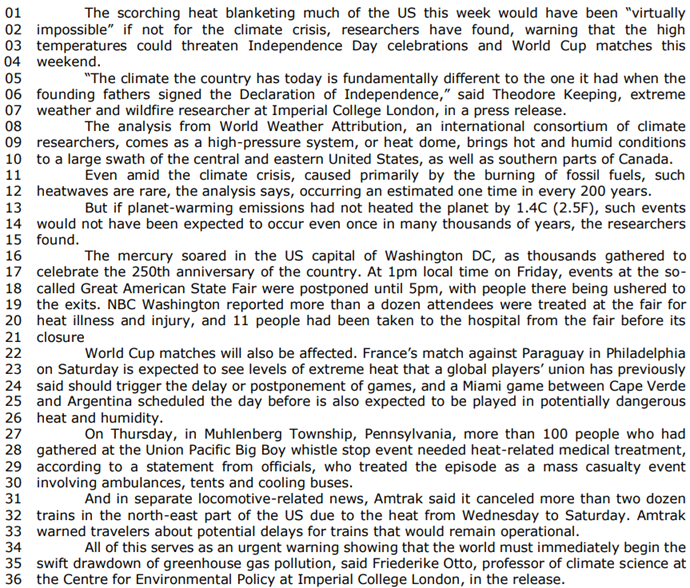

US heatwave threatens 250th anniversary events and World Cup
By Dharna Noor
(Available at: https://www.theguardian.com/us-news/2026/jul/03/heatwave-world-cup-250th-anniversary –
text specially adapted for this test).
In the excerpt “But if planet-warming emissions had not heated the planet by 1.4 °C
(2.5 °F), such events would not have been expected to occur [...]” (l. 13–14), the conditional sentence
indicates that the researchers suggest that
Ano: 2026
Banca:
FUNDATEC
Órgão:
Prefeitura de Água Doce - SC
Prova:
FUNDATEC - 2026 - Prefeitura de Água Doce - SC - Professor de Português / Inglês |
Q4226411
Inglês
Texto associado
US heatwave threatens 250th anniversary events and World Cup
By Dharna Noor
(Available at: https://www.theguardian.com/us-news/2026/jul/03/heatwave-world-cup-250th-anniversary –
text specially adapted for this test).
In the sentence "[...] it will continue to get worse the longer we drag out the
inevitable transition to net zero emissions." (l. 41–42), the expression in bold means:
Ano: 2026
Banca:
FUNDATEC
Órgão:
Prefeitura de Água Doce - SC
Prova:
FUNDATEC - 2026 - Prefeitura de Água Doce - SC - Professor de Português / Inglês |
Q4226410
Inglês
Texto associado
US heatwave threatens 250th anniversary events and World Cup
By Dharna Noor
(Available at: https://www.theguardian.com/us-news/2026/jul/03/heatwave-world-cup-250th-anniversary –
text specially adapted for this test).
What is the main purpose of the text?
Ano: 2026
Banca:
Ápice Consultoria
Órgão:
Prefeitura de Sobrado - PB
Prova:
Ápice Consultoria - 2026 - Prefeitura de Sobrado - PB - Professor B - Inglês |
Q4221006
Inglês
Analise o enunciado abaixo:
"The laboratory secured a substantial federal grant for its cutting-edge epidemiological research; moreover, the university state-of-the-art facility was fully integrated into the project."
O conector sublinhado estabelece uma relação semântica de:
"The laboratory secured a substantial federal grant for its cutting-edge epidemiological research; moreover, the university state-of-the-art facility was fully integrated into the project."
O conector sublinhado estabelece uma relação semântica de:
Ano: 2026
Banca:
Ápice Consultoria
Órgão:
Prefeitura de Sobrado - PB
Prova:
Ápice Consultoria - 2026 - Prefeitura de Sobrado - PB - Professor B - Inglês |
Q4221004
Inglês
Analise a sentença ativa a seguir:
"The sudden spike in inflation has severely undermined the purchasing power of the middle class."
Assinale a alternativa que apresenta a transposição correta e equivalente para a voz passiva:
"The sudden spike in inflation has severely undermined the purchasing power of the middle class."
Assinale a alternativa que apresenta a transposição correta e equivalente para a voz passiva:
Ano: 2026
Banca:
Ápice Consultoria
Órgão:
Prefeitura de Sobrado - PB
Prova:
Ápice Consultoria - 2026 - Prefeitura de Sobrado - PB - Professor B - Inglês |
Q4221003
Inglês
A morfologia da língua inglesa frequentemente
recorre a processos complexos como prefixação
produtiva, sufixação derivacional de mudança de
classe e conversão (derivação imprópria). Analise
o vocábulo "DECENTRALIZING" quando
empregado na função de adjetivo em um sintagma
nominal. O processo de formação dessa palavra e
a função de seus afixos são corretamente
descritos como:
Ano: 2026
Banca:
Ápice Consultoria
Órgão:
Prefeitura de Sobrado - PB
Prova:
Ápice Consultoria - 2026 - Prefeitura de Sobrado - PB - Professor B - Inglês |
Q4221002
Inglês
Em textos formais de nível acadêmico e
jornalístico, o verbo "to underscore" e o adjetivo
"pivotal" são amplamente utilizados. Assinale a
alternativa que apresenta sinônimos precisos e de
alto nível para esses termos, respectivamente:

 Conheça nossos planos