Questões de Concurso Sobre inglês
Foram encontradas 26.001 questões


Leia a tira a seguir para responder a questão.

Fonte: https://www.portallos.com.br/2011/12/21/tirinhas-garfield-e-onatal/
Leia a tira a seguir para responder a questão.
Fonte: https://www.portallos.com.br/2011/12/21/tirinhas-garfield-e-onatal/
Leia a tira a seguir para responder a questão.
Fonte: https://www.portallos.com.br/2011/12/21/tirinhas-garfield-e-onatal/
Leia a tira a seguir para responder a questão.
Fonte: https://www.portallos.com.br/2011/12/21/tirinhas-garfield-e-onatal/
Leia a tira a seguir para responder a questão.
Fonte: https://www.portallos.com.br/2011/12/21/tirinhas-garfield-e-onatal/
Read the following comic strip to answer question

Read the following comic strip to answer question
Read the following text:
How we define culture is highly contested and open to debate (Eagleton, 2000). Brown provides a useful explanation which links culture with thinking and language:
“Cultural patterns, customs, and ways of life are expressed in language: culture specific world views are reflected in language (...) [L]anguage and culture interact so that world views among cultures differ, and that language used to express that world view may be relative and specific to that view”
Coyle, Hood and Marsh. CLIL: Content and Language Integrated Learning, 2010. Adaptado)
The alternative which is closest to Brown’s understanding of culture is:
Examine the following graph.
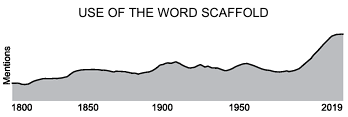
(Dados obtidos a partir da ferramenta de busca Google)
It shows that the word “scaffolding”
Read the following text to answer question
CLIL is an abbreviation for Content and Language Integrated Learning. It is a way of teaching where subject content — such as history, science or physical education — is taught in another language (often English). We like the following definition of CLIL by Coyle, Hood and Marsh (2010, р. 1):
Content and Language Integrated Learning (CLIL) is a dual-focused educational approach in which another language is used for the learning and teaching of both content and language. That is, in the teaching and learning process, there is a focus not only on content, and not only on language. Each is interwoven, even if the emphasis is greater on one or the other at a given time.
(Liz Dale, Rosie Tanner. CLIL activities:
a resource for subjects and language teachers,
2012. Adaptado)
Read the following text to answer question
CLIL is an abbreviation for Content and Language Integrated Learning. It is a way of teaching where subject content — such as history, science or physical education — is taught in another language (often English). We like the following definition of CLIL by Coyle, Hood and Marsh (2010, р. 1):
Content and Language Integrated Learning (CLIL) is a dual-focused educational approach in which another language is used for the learning and teaching of both content and language. That is, in the teaching and learning process, there is a focus not only on content, and not only on language. Each is interwoven, even if the emphasis is greater on one or the other at a given time.
(Liz Dale, Rosie Tanner. CLIL activities:
a resource for subjects and language teachers,
2012. Adaptado)
• Instruction is given in the native language of the students. • The target language is rarely used for communication. • Focus falls on grammatical description, explanation and analysis. • The result of this approach is usually an inability on the part of the student to use the language for communication. • The teacher does not have to be able to speak the target language.
The characteristics are consistent with
Read the following text to answer question
his paper presents the concept of task as the location for learning a foreign language (FL), a space for creation in and with the target language, with the tasks utilized simulating as closely as possible the situations which the students will encounter outside the classroom and which, moreover, emphasize meaning. Throughout the paper, the theory of the use of tasks for the teaching/learning of a FL present in the literature will be discussed, and an approach which is based on the utilization of tasks as the backbone for the planning of course is presented. In addition to emphasizing meaning, the tasks analyzed take a relatively long time to complete, i.e. they last more than a single class. Thus, the input can be remembered and re-worked as it reappears in different ways, thus making it possible for learning to be more long-lasting and significant.
(José Carlos Paes de Almeida Filho e Rita Barbirato.
Ambientes comunicativos para aprender línguas estrangeiras,
2000. Adaptado)
Read the following text to answer question
his paper presents the concept of task as the location for learning a foreign language (FL), a space for creation in and with the target language, with the tasks utilized simulating as closely as possible the situations which the students will encounter outside the classroom and which, moreover, emphasize meaning. Throughout the paper, the theory of the use of tasks for the teaching/learning of a FL present in the literature will be discussed, and an approach which is based on the utilization of tasks as the backbone for the planning of course is presented. In addition to emphasizing meaning, the tasks analyzed take a relatively long time to complete, i.e. they last more than a single class. Thus, the input can be remembered and re-worked as it reappears in different ways, thus making it possible for learning to be more long-lasting and significant.
(José Carlos Paes de Almeida Filho e Rita Barbirato.
Ambientes comunicativos para aprender línguas estrangeiras,
2000. Adaptado)
Read the following text to answer question
his paper presents the concept of task as the location for learning a foreign language (FL), a space for creation in and with the target language, with the tasks utilized simulating as closely as possible the situations which the students will encounter outside the classroom and which, moreover, emphasize meaning. Throughout the paper, the theory of the use of tasks for the teaching/learning of a FL present in the literature will be discussed, and an approach which is based on the utilization of tasks as the backbone for the planning of course is presented. In addition to emphasizing meaning, the tasks analyzed take a relatively long time to complete, i.e. they last more than a single class. Thus, the input can be remembered and re-worked as it reappears in different ways, thus making it possible for learning to be more long-lasting and significant.
(José Carlos Paes de Almeida Filho e Rita Barbirato.
Ambientes comunicativos para aprender línguas estrangeiras,
2000. Adaptado)

 Conheça nossos planos