Questões de Concurso Comentadas sobre inglês
Foram encontradas 19.377 questões


Ano: 2006
Banca:
ESAF
Órgão:
SUSEP
Prova:
ESAF - 2006 - SUSEP - Analista Técnico - Tecnologia da Informação - Prova 1 |
Q394239
Inglês
Financial and Market Conditions
Source: www.iii.org Jan/2006 (Adapted)
Many forces affect the price, availability and security of the insurance product. Some are external, such as changes in interest rates and the stock market, regulatory activity, the number and severity of natural disasters, growth in litigation and rising medical costs. Others are internal, such as the level of competition
The insurance industry is cyclical. Rates and profits fluctuate depending on the phase of the cycle, particularly in commercial coverages. The profitability cycle may be somewhat different for different types of insurance. While the industy as a whole experienced one of its best years in recent history in 2004 and in the first half of 2005, losses associated with Hurricane Katrina, Rita and Wilma may wipe out the profits of many insurers and force some to raise additional capital. None of the major companies are likely to become insolvent, however.
In paragraph 2, the insurance industry is described as cyclical. Thus, it is characterized by elements which
Source: www.iii.org Jan/2006 (Adapted)
Many forces affect the price, availability and security of the insurance product. Some are external, such as changes in interest rates and the stock market, regulatory activity, the number and severity of natural disasters, growth in litigation and rising medical costs. Others are internal, such as the level of competition
The insurance industry is cyclical. Rates and profits fluctuate depending on the phase of the cycle, particularly in commercial coverages. The profitability cycle may be somewhat different for different types of insurance. While the industy as a whole experienced one of its best years in recent history in 2004 and in the first half of 2005, losses associated with Hurricane Katrina, Rita and Wilma may wipe out the profits of many insurers and force some to raise additional capital. None of the major companies are likely to become insolvent, however.
In paragraph 2, the insurance industry is described as cyclical. Thus, it is characterized by elements which
Ano: 2006
Banca:
ESAF
Órgão:
SUSEP
Prova:
ESAF - 2006 - SUSEP - Analista Técnico - Tecnologia da Informação - Prova 1 |
Q394238
Inglês
Financial and Market Conditions
Source: www.iii.org Jan/2006 (Adapted)
Many forces affect the price, availability and security of the insurance product. Some are external, such as changes in interest rates and the stock market, regulatory activity, the number and severity of natural disasters, growth in litigation and rising medical costs. Others are internal, such as the level of competition
The insurance industry is cyclical. Rates and profits fluctuate depending on the phase of the cycle, particularly in commercial coverages. The profitability cycle may be somewhat different for different types of insurance. While the industy as a whole experienced one of its best years in recent history in 2004 and in the first half of 2005, losses associated with Hurricane Katrina, Rita and Wilma may wipe out the profits of many insurers and force some to raise additional capital. None of the major companies are likely to become insolvent, however.
In paragraph 1, the author
Source: www.iii.org Jan/2006 (Adapted)
Many forces affect the price, availability and security of the insurance product. Some are external, such as changes in interest rates and the stock market, regulatory activity, the number and severity of natural disasters, growth in litigation and rising medical costs. Others are internal, such as the level of competition
The insurance industry is cyclical. Rates and profits fluctuate depending on the phase of the cycle, particularly in commercial coverages. The profitability cycle may be somewhat different for different types of insurance. While the industy as a whole experienced one of its best years in recent history in 2004 and in the first half of 2005, losses associated with Hurricane Katrina, Rita and Wilma may wipe out the profits of many insurers and force some to raise additional capital. None of the major companies are likely to become insolvent, however.
In paragraph 1, the author
Ano: 2006
Banca:
ESAF
Órgão:
SUSEP
Prova:
ESAF - 2006 - SUSEP - Analista Técnico - Tecnologia da Informação - Prova 1 |
Q394237
Inglês
Your answers to questions 41-43 must be based on the text below, which is entitled “Insolvencies/Guaranty Funds”:
Insolvencies/Guaranty Funds Source: www.iii.org Feb/ 2006 (Adapted)
The regulation of insurance company solvency is a function of the state. The Gramm-Leach-Bliley Financial Services Modernization Act of 1999, which allowed banks, securities firms, insurance companies and other financial services entities to affiliate and sell one another’s products, continues this practice. State regulators monitor the financial health of companies licensed to provide insurance in their state through analysis of the detailed annual fi nancial statements that insurers are required to file and periodic on-site examinations. When a company is found to be in poor financial condition, regulators can take various actions to try to save it. Insolvencies do occur, however, despite the best efforts of regulators.
In relation to the monitoring of the ?nancial health of companies licensed to provide insurance, the state regulators
Insolvencies/Guaranty Funds Source: www.iii.org Feb/ 2006 (Adapted)
The regulation of insurance company solvency is a function of the state. The Gramm-Leach-Bliley Financial Services Modernization Act of 1999, which allowed banks, securities firms, insurance companies and other financial services entities to affiliate and sell one another’s products, continues this practice. State regulators monitor the financial health of companies licensed to provide insurance in their state through analysis of the detailed annual fi nancial statements that insurers are required to file and periodic on-site examinations. When a company is found to be in poor financial condition, regulators can take various actions to try to save it. Insolvencies do occur, however, despite the best efforts of regulators.
In relation to the monitoring of the ?nancial health of companies licensed to provide insurance, the state regulators
Ano: 2006
Banca:
ESAF
Órgão:
SUSEP
Prova:
ESAF - 2006 - SUSEP - Analista Técnico - Tecnologia da Informação - Prova 1 |
Q394236
Inglês
Your answers to questions 41-43 must be based on the text below, which is entitled “Insolvencies/Guaranty Funds”:
Insolvencies/Guaranty Funds Source: www.iii.org Feb/ 2006 (Adapted)
The regulation of insurance company solvency is a function of the state. The Gramm-Leach-Bliley Financial Services Modernization Act of 1999, which allowed banks, securities firms, insurance companies and other financial services entities to affiliate and sell one another’s products, continues this practice. State regulators monitor the financial health of companies licensed to provide insurance in their state through analysis of the detailed annual fi nancial statements that insurers are required to file and periodic on-site examinations. When a company is found to be in poor financial condition, regulators can take various actions to try to save it. Insolvencies do occur, however, despite the best efforts of regulators.
According to the text, “insolvencies do occur”, which means they
Insolvencies/Guaranty Funds Source: www.iii.org Feb/ 2006 (Adapted)
The regulation of insurance company solvency is a function of the state. The Gramm-Leach-Bliley Financial Services Modernization Act of 1999, which allowed banks, securities firms, insurance companies and other financial services entities to affiliate and sell one another’s products, continues this practice. State regulators monitor the financial health of companies licensed to provide insurance in their state through analysis of the detailed annual fi nancial statements that insurers are required to file and periodic on-site examinations. When a company is found to be in poor financial condition, regulators can take various actions to try to save it. Insolvencies do occur, however, despite the best efforts of regulators.
According to the text, “insolvencies do occur”, which means they
Ano: 2006
Banca:
ESAF
Órgão:
SUSEP
Prova:
ESAF - 2006 - SUSEP - Analista Técnico - Tecnologia da Informação - Prova 1 |
Q394235
Inglês
Your answers to questions 41-43 must be based on the text below, which is entitled “Insolvencies/Guaranty Funds”:
Insolvencies/Guaranty Funds Source: www.iii.org Feb/ 2006 (Adapted)
The regulation of insurance company solvency is a function of the state. The Gramm-Leach-Bliley Financial Services Modernization Act of 1999, which allowed banks, securities firms, insurance companies and other financial services entities to affiliate and sell one another’s products, continues this practice. State regulators monitor the financial health of companies licensed to provide insurance in their state through analysis of the detailed annual fi nancial statements that insurers are required to file and periodic on-site examinations. When a company is found to be in poor financial condition, regulators can take various actions to try to save it. Insolvencies do occur, however, despite the best efforts of regulators.
According to the text, the regulation of insurance company solvency
Insolvencies/Guaranty Funds Source: www.iii.org Feb/ 2006 (Adapted)
The regulation of insurance company solvency is a function of the state. The Gramm-Leach-Bliley Financial Services Modernization Act of 1999, which allowed banks, securities firms, insurance companies and other financial services entities to affiliate and sell one another’s products, continues this practice. State regulators monitor the financial health of companies licensed to provide insurance in their state through analysis of the detailed annual fi nancial statements that insurers are required to file and periodic on-site examinations. When a company is found to be in poor financial condition, regulators can take various actions to try to save it. Insolvencies do occur, however, despite the best efforts of regulators.
According to the text, the regulation of insurance company solvency
Ano: 2006
Banca:
CESPE / CEBRASPE
Órgão:
ANCINE
Provas:
CESPE - 2006 - ANCINE - Analista Administrativo - Ciências Contábeis
|
CESPE - 2006 - ANCINE - Analista Administrativo - Informática |
CESPE - 2006 - ANCINE - Analista Administrativo |
Q254353
Inglês

Based on the text above, judge the following items.
The access providers get together with anyone who could make them able to offer lawful downloading just as a public gesture.
The access providers get together with anyone who could make them able to offer lawful downloading just as a public gesture.
Q214759
Inglês

*Choose the right word to complete exercises 44 and 45. All those words can be found in “Wolves”.
They _________________ walk along the stream. They frequently do that.
They _________________ walk along the stream. They frequently do that.
Q214757
Inglês
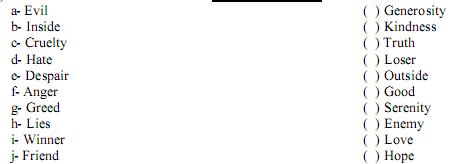
Match the columns with words of opposite meanings:
Ano: 2006
Banca:
CESGRANRIO
Órgão:
Transpetro
Provas:
CESGRANRIO - 2006 - Transpetro - Contador Júnior - Contábil
|
CESGRANRIO - 2006 - Transpetro - Contador Júnior - Auditoria Interna |
CESGRANRIO - 2006 - Transpetro - Administrador Júnior |
CESGRANRIO - 2006 - Transpetro - Médico do Trabalho Júnior |
CESGRANRIO - 2006 - Transpetro - Economista Júnior |
CESGRANRIO - 2006 - Transpetro - Profissional de Meio Ambiente Júnior |
Q114189
Inglês


The only pair of antonyms is:
Ano: 2006
Banca:
CESGRANRIO
Órgão:
Transpetro
Provas:
CESGRANRIO - 2006 - Transpetro - Contador Júnior - Contábil
|
CESGRANRIO - 2006 - Transpetro - Contador Júnior - Auditoria Interna |
CESGRANRIO - 2006 - Transpetro - Administrador Júnior |
CESGRANRIO - 2006 - Transpetro - Médico do Trabalho Júnior |
CESGRANRIO - 2006 - Transpetro - Economista Júnior |
CESGRANRIO - 2006 - Transpetro - Profissional de Meio Ambiente Júnior |
Q114188
Inglês
The only correct statement concerning reference is:
Ano: 2006
Banca:
CESPE / CEBRASPE
Órgão:
DATAPREV
Provas:
CESPE - 2006 - DATAPREV - Analista de Tecnologia da Informação - Desenvolvimento de Sistemas
|
CESPE - 2006 - DATAPREV - Analista de Tecnologia da Informação - Redes |
CESPE - 2006 - DATAPREV - Analista de Tecnologia da Informação - Banco de Dados |
CESPE - 2006 - DATAPREV - Analista de Tecnologia da Informação - Análise de Produção |
Q113427
Inglês

Based on the text above, judge the following items
The bigger the project, the fewer people are demanded.
The bigger the project, the fewer people are demanded.
Ano: 2006
Banca:
CESPE / CEBRASPE
Órgão:
DATAPREV
Provas:
CESPE - 2006 - DATAPREV - Analista de Tecnologia da Informação - Desenvolvimento de Sistemas
|
CESPE - 2006 - DATAPREV - Analista de Tecnologia da Informação - Redes |
CESPE - 2006 - DATAPREV - Analista de Tecnologia da Informação - Banco de Dados |
CESPE - 2006 - DATAPREV - Analista de Tecnologia da Informação - Análise de Produção |
Q113420
Inglês

Based on the text above, judge the following items.
In the text,
“volunteers” ( .23) is a noun.
In the text,
“volunteers” (
.23) is a noun.
Ano: 2006
Banca:
CESPE / CEBRASPE
Órgão:
DATAPREV
Provas:
CESPE - 2006 - DATAPREV - Analista de Tecnologia da Informação - Desenvolvimento de Sistemas
|
CESPE - 2006 - DATAPREV - Analista de Tecnologia da Informação - Redes |
CESPE - 2006 - DATAPREV - Analista de Tecnologia da Informação - Banco de Dados |
CESPE - 2006 - DATAPREV - Analista de Tecnologia da Informação - Análise de Produção |
Q113419
Inglês
Based on the text above, judge the following items.
In the text,
“parents” (.21) refers to mother and father.
In the text,
“parents” (
.21) refers to mother and father.
Ano: 2006
Banca:
CESPE / CEBRASPE
Órgão:
DATAPREV
Provas:
CESPE - 2006 - DATAPREV - Analista de Tecnologia da Informação - Desenvolvimento de Sistemas
|
CESPE - 2006 - DATAPREV - Analista de Tecnologia da Informação - Análise de Informações |
CESPE - 2006 - DATAPREV - Analista de Tecnologia da Informação - Ambiente Operacional |
CESPE - 2006 - DATAPREV - Analista de Tecnologia da Informação - Redes |
CESPE - 2006 - DATAPREV - Analista de Tecnologia da Informação - Banco de Dados |
Q113418
Inglês
Based on the text above, judge the following items.
Virus writers know more about computers than hackers.
Virus writers know more about computers than hackers.
Ano: 2006
Banca:
CESPE / CEBRASPE
Órgão:
Instituto Rio Branco
Prova:
CESPE / CEBRASPE - 2006 - Instituto Rio Branco - Diplomata - 1ª Etapa ALFA |
Q10651
Inglês

In the context of the last paragraph, the phrase "visited on Britain, too" (l.27) suggests that
Ano: 2006
Banca:
CESPE / CEBRASPE
Órgão:
Instituto Rio Branco
Prova:
CESPE / CEBRASPE - 2006 - Instituto Rio Branco - Diplomata - 1ª Etapa ALFA |
Q10635
Inglês

Ano: 2006
Banca:
CESGRANRIO
Órgão:
DECEA
Prova:
CESGRANRIO - 2006 - DECEA - Técnico de Defesa Aérea e Controle de Tráfego Aéreo - Análise de Sistemas |
Q9509
Inglês
Texto associado
Repliee is more than a humanoid robot ? it is an
honest-to-goodness android, so lifelike that it seems like
a real person. It has moist lips, glossy hair and vivid
eyes that blink slowly. Seated on a stool with hands
5 folded primly on its lap at the 2005 World Exposition in
Japan's Aichi prefecture, it wore a bright pink blazer and
gray slacks. For a mesmerizing few seconds from several
meters away, Repliee was virtually indistinguishable from
an ordinary woman in her 30s. In fact, it was a copy of
10 one.
Japan is proud of the most advanced humanoids in
the world, which are expected to eventually be used as
the workforce diminishes among the decreasing and aging
population. But why build a robot with pigmented silicone
15 skin, smooth gestures and even makeup? To Repliee's
creator, Hiroshi Ishiguro, Director of Osaka University's
Intelligent Robotics Laboratory, the answer is simple:
"Android science."
Besides the justification for making robots
20 anthropomorphic and bipedal so they can work in human
environments with architectural features such as stairs,
Ishiguro believes that people respond better to very
humanlike automatons. Androids can thus elicit the most
natural communication. "Appearance is very important
25 to have better interpersonal relationships with a robot,"
says the 42-year-old Ishiguro. "Robots are information
media, especially humanoid robots. Their main role in
our future is to interact naturally with people."
Mild colorblindness forced Ishiguro to abandon his
30 aspirations of a career as an oil painter. Drawn to
computer and robot vision instead, he built a guide robot
for the blind as an undergraduate at the University of
Yamanashi. A fan of the android character Data from the
Star Trek franchise, he sees robots as the ideal vehicle
35 to understand more about ourselves.
To imitate human looks and behavior successfully,
Ishiguro combines robotics with cognitive science. In turn,
cognitive science research can use the robot to study
human perception, communication and other faculties.
40 This novel cross-fertilization is what Ishiguro describes
as android science. In a 2005 paper, he and his
collaborators explained it thus: "To make the android
humanlike, we must investigate human activity from the
standpoint of cognitive science, behavioral science and
45 neuroscience, and to evaluate human activity, we need
to implement processes that support it in the android."
One key strategy in Ishiguro's approach is to model
his artificial creations on real people. He began research
four years ago with his then four-year-old daughter,
50 casting a rudimentary android from her body, but its
mechanisms resulted in strange, unnatural motion.
Humanlike robots run the risk of compromising
people's comfort zones. Because the android's
appearance is very similar to that of a human, any subtle
55 differences in motion and responses will make it seem
strange. Repliee, though, is so lifelike that it has
overcome the creepiness factor, partly because of the
natural way it moves.
Ishiguro wants his next android, a male, to be as
60 authentic as possible. The model? Himself. The scientist
thinks having a robot clone could ease his busy schedule:
he could dispatch it to classes and meetings and then
teleconference through it. "My question has always been,
Why are we living, and what is human?" he says. An
65 Ishiguro made of circuitry and silicone might soon be
answering his own questions.
adapted from www.scientificamerican.com - May 2006
honest-to-goodness android, so lifelike that it seems like
a real person. It has moist lips, glossy hair and vivid
eyes that blink slowly. Seated on a stool with hands
5 folded primly on its lap at the 2005 World Exposition in
Japan's Aichi prefecture, it wore a bright pink blazer and
gray slacks. For a mesmerizing few seconds from several
meters away, Repliee was virtually indistinguishable from
an ordinary woman in her 30s. In fact, it was a copy of
10 one.
Japan is proud of the most advanced humanoids in
the world, which are expected to eventually be used as
the workforce diminishes among the decreasing and aging
population. But why build a robot with pigmented silicone
15 skin, smooth gestures and even makeup? To Repliee's
creator, Hiroshi Ishiguro, Director of Osaka University's
Intelligent Robotics Laboratory, the answer is simple:
"Android science."
Besides the justification for making robots
20 anthropomorphic and bipedal so they can work in human
environments with architectural features such as stairs,
Ishiguro believes that people respond better to very
humanlike automatons. Androids can thus elicit the most
natural communication. "Appearance is very important
25 to have better interpersonal relationships with a robot,"
says the 42-year-old Ishiguro. "Robots are information
media, especially humanoid robots. Their main role in
our future is to interact naturally with people."
Mild colorblindness forced Ishiguro to abandon his
30 aspirations of a career as an oil painter. Drawn to
computer and robot vision instead, he built a guide robot
for the blind as an undergraduate at the University of
Yamanashi. A fan of the android character Data from the
Star Trek franchise, he sees robots as the ideal vehicle
35 to understand more about ourselves.
To imitate human looks and behavior successfully,
Ishiguro combines robotics with cognitive science. In turn,
cognitive science research can use the robot to study
human perception, communication and other faculties.
40 This novel cross-fertilization is what Ishiguro describes
as android science. In a 2005 paper, he and his
collaborators explained it thus: "To make the android
humanlike, we must investigate human activity from the
standpoint of cognitive science, behavioral science and
45 neuroscience, and to evaluate human activity, we need
to implement processes that support it in the android."
One key strategy in Ishiguro's approach is to model
his artificial creations on real people. He began research
four years ago with his then four-year-old daughter,
50 casting a rudimentary android from her body, but its
mechanisms resulted in strange, unnatural motion.
Humanlike robots run the risk of compromising
people's comfort zones. Because the android's
appearance is very similar to that of a human, any subtle
55 differences in motion and responses will make it seem
strange. Repliee, though, is so lifelike that it has
overcome the creepiness factor, partly because of the
natural way it moves.
Ishiguro wants his next android, a male, to be as
60 authentic as possible. The model? Himself. The scientist
thinks having a robot clone could ease his busy schedule:
he could dispatch it to classes and meetings and then
teleconference through it. "My question has always been,
Why are we living, and what is human?" he says. An
65 Ishiguro made of circuitry and silicone might soon be
answering his own questions.
adapted from www.scientificamerican.com - May 2006
In "An Ishiguro made of circuitry and silicone might soon be answering his own questions." (lines 64-66), "might" can be correctly substituted by:
Ano: 2006
Banca:
CESGRANRIO
Órgão:
DECEA
Prova:
CESGRANRIO - 2006 - DECEA - Técnico de Defesa Aérea e Controle de Tráfego Aéreo - Análise de Sistemas |
Q9508
Inglês
Texto associado
Repliee is more than a humanoid robot ? it is an
honest-to-goodness android, so lifelike that it seems like
a real person. It has moist lips, glossy hair and vivid
eyes that blink slowly. Seated on a stool with hands
5 folded primly on its lap at the 2005 World Exposition in
Japan's Aichi prefecture, it wore a bright pink blazer and
gray slacks. For a mesmerizing few seconds from several
meters away, Repliee was virtually indistinguishable from
an ordinary woman in her 30s. In fact, it was a copy of
10 one.
Japan is proud of the most advanced humanoids in
the world, which are expected to eventually be used as
the workforce diminishes among the decreasing and aging
population. But why build a robot with pigmented silicone
15 skin, smooth gestures and even makeup? To Repliee's
creator, Hiroshi Ishiguro, Director of Osaka University's
Intelligent Robotics Laboratory, the answer is simple:
"Android science."
Besides the justification for making robots
20 anthropomorphic and bipedal so they can work in human
environments with architectural features such as stairs,
Ishiguro believes that people respond better to very
humanlike automatons. Androids can thus elicit the most
natural communication. "Appearance is very important
25 to have better interpersonal relationships with a robot,"
says the 42-year-old Ishiguro. "Robots are information
media, especially humanoid robots. Their main role in
our future is to interact naturally with people."
Mild colorblindness forced Ishiguro to abandon his
30 aspirations of a career as an oil painter. Drawn to
computer and robot vision instead, he built a guide robot
for the blind as an undergraduate at the University of
Yamanashi. A fan of the android character Data from the
Star Trek franchise, he sees robots as the ideal vehicle
35 to understand more about ourselves.
To imitate human looks and behavior successfully,
Ishiguro combines robotics with cognitive science. In turn,
cognitive science research can use the robot to study
human perception, communication and other faculties.
40 This novel cross-fertilization is what Ishiguro describes
as android science. In a 2005 paper, he and his
collaborators explained it thus: "To make the android
humanlike, we must investigate human activity from the
standpoint of cognitive science, behavioral science and
45 neuroscience, and to evaluate human activity, we need
to implement processes that support it in the android."
One key strategy in Ishiguro's approach is to model
his artificial creations on real people. He began research
four years ago with his then four-year-old daughter,
50 casting a rudimentary android from her body, but its
mechanisms resulted in strange, unnatural motion.
Humanlike robots run the risk of compromising
people's comfort zones. Because the android's
appearance is very similar to that of a human, any subtle
55 differences in motion and responses will make it seem
strange. Repliee, though, is so lifelike that it has
overcome the creepiness factor, partly because of the
natural way it moves.
Ishiguro wants his next android, a male, to be as
60 authentic as possible. The model? Himself. The scientist
thinks having a robot clone could ease his busy schedule:
he could dispatch it to classes and meetings and then
teleconference through it. "My question has always been,
Why are we living, and what is human?" he says. An
65 Ishiguro made of circuitry and silicone might soon be
answering his own questions.
adapted from www.scientificamerican.com - May 2006
honest-to-goodness android, so lifelike that it seems like
a real person. It has moist lips, glossy hair and vivid
eyes that blink slowly. Seated on a stool with hands
5 folded primly on its lap at the 2005 World Exposition in
Japan's Aichi prefecture, it wore a bright pink blazer and
gray slacks. For a mesmerizing few seconds from several
meters away, Repliee was virtually indistinguishable from
an ordinary woman in her 30s. In fact, it was a copy of
10 one.
Japan is proud of the most advanced humanoids in
the world, which are expected to eventually be used as
the workforce diminishes among the decreasing and aging
population. But why build a robot with pigmented silicone
15 skin, smooth gestures and even makeup? To Repliee's
creator, Hiroshi Ishiguro, Director of Osaka University's
Intelligent Robotics Laboratory, the answer is simple:
"Android science."
Besides the justification for making robots
20 anthropomorphic and bipedal so they can work in human
environments with architectural features such as stairs,
Ishiguro believes that people respond better to very
humanlike automatons. Androids can thus elicit the most
natural communication. "Appearance is very important
25 to have better interpersonal relationships with a robot,"
says the 42-year-old Ishiguro. "Robots are information
media, especially humanoid robots. Their main role in
our future is to interact naturally with people."
Mild colorblindness forced Ishiguro to abandon his
30 aspirations of a career as an oil painter. Drawn to
computer and robot vision instead, he built a guide robot
for the blind as an undergraduate at the University of
Yamanashi. A fan of the android character Data from the
Star Trek franchise, he sees robots as the ideal vehicle
35 to understand more about ourselves.
To imitate human looks and behavior successfully,
Ishiguro combines robotics with cognitive science. In turn,
cognitive science research can use the robot to study
human perception, communication and other faculties.
40 This novel cross-fertilization is what Ishiguro describes
as android science. In a 2005 paper, he and his
collaborators explained it thus: "To make the android
humanlike, we must investigate human activity from the
standpoint of cognitive science, behavioral science and
45 neuroscience, and to evaluate human activity, we need
to implement processes that support it in the android."
One key strategy in Ishiguro's approach is to model
his artificial creations on real people. He began research
four years ago with his then four-year-old daughter,
50 casting a rudimentary android from her body, but its
mechanisms resulted in strange, unnatural motion.
Humanlike robots run the risk of compromising
people's comfort zones. Because the android's
appearance is very similar to that of a human, any subtle
55 differences in motion and responses will make it seem
strange. Repliee, though, is so lifelike that it has
overcome the creepiness factor, partly because of the
natural way it moves.
Ishiguro wants his next android, a male, to be as
60 authentic as possible. The model? Himself. The scientist
thinks having a robot clone could ease his busy schedule:
he could dispatch it to classes and meetings and then
teleconference through it. "My question has always been,
Why are we living, and what is human?" he says. An
65 Ishiguro made of circuitry and silicone might soon be
answering his own questions.
adapted from www.scientificamerican.com - May 2006
Check the item in which there is a correct correspondence between the idea expressed by the word in bold type and the idea in italics.
Ano: 2006
Banca:
CESGRANRIO
Órgão:
DECEA
Prova:
CESGRANRIO - 2006 - DECEA - Técnico de Defesa Aérea e Controle de Tráfego Aéreo - Análise de Sistemas |
Q9507
Inglês
Texto associado
Repliee is more than a humanoid robot ? it is an
honest-to-goodness android, so lifelike that it seems like
a real person. It has moist lips, glossy hair and vivid
eyes that blink slowly. Seated on a stool with hands
5 folded primly on its lap at the 2005 World Exposition in
Japan's Aichi prefecture, it wore a bright pink blazer and
gray slacks. For a mesmerizing few seconds from several
meters away, Repliee was virtually indistinguishable from
an ordinary woman in her 30s. In fact, it was a copy of
10 one.
Japan is proud of the most advanced humanoids in
the world, which are expected to eventually be used as
the workforce diminishes among the decreasing and aging
population. But why build a robot with pigmented silicone
15 skin, smooth gestures and even makeup? To Repliee's
creator, Hiroshi Ishiguro, Director of Osaka University's
Intelligent Robotics Laboratory, the answer is simple:
"Android science."
Besides the justification for making robots
20 anthropomorphic and bipedal so they can work in human
environments with architectural features such as stairs,
Ishiguro believes that people respond better to very
humanlike automatons. Androids can thus elicit the most
natural communication. "Appearance is very important
25 to have better interpersonal relationships with a robot,"
says the 42-year-old Ishiguro. "Robots are information
media, especially humanoid robots. Their main role in
our future is to interact naturally with people."
Mild colorblindness forced Ishiguro to abandon his
30 aspirations of a career as an oil painter. Drawn to
computer and robot vision instead, he built a guide robot
for the blind as an undergraduate at the University of
Yamanashi. A fan of the android character Data from the
Star Trek franchise, he sees robots as the ideal vehicle
35 to understand more about ourselves.
To imitate human looks and behavior successfully,
Ishiguro combines robotics with cognitive science. In turn,
cognitive science research can use the robot to study
human perception, communication and other faculties.
40 This novel cross-fertilization is what Ishiguro describes
as android science. In a 2005 paper, he and his
collaborators explained it thus: "To make the android
humanlike, we must investigate human activity from the
standpoint of cognitive science, behavioral science and
45 neuroscience, and to evaluate human activity, we need
to implement processes that support it in the android."
One key strategy in Ishiguro's approach is to model
his artificial creations on real people. He began research
four years ago with his then four-year-old daughter,
50 casting a rudimentary android from her body, but its
mechanisms resulted in strange, unnatural motion.
Humanlike robots run the risk of compromising
people's comfort zones. Because the android's
appearance is very similar to that of a human, any subtle
55 differences in motion and responses will make it seem
strange. Repliee, though, is so lifelike that it has
overcome the creepiness factor, partly because of the
natural way it moves.
Ishiguro wants his next android, a male, to be as
60 authentic as possible. The model? Himself. The scientist
thinks having a robot clone could ease his busy schedule:
he could dispatch it to classes and meetings and then
teleconference through it. "My question has always been,
Why are we living, and what is human?" he says. An
65 Ishiguro made of circuitry and silicone might soon be
answering his own questions.
adapted from www.scientificamerican.com - May 2006
honest-to-goodness android, so lifelike that it seems like
a real person. It has moist lips, glossy hair and vivid
eyes that blink slowly. Seated on a stool with hands
5 folded primly on its lap at the 2005 World Exposition in
Japan's Aichi prefecture, it wore a bright pink blazer and
gray slacks. For a mesmerizing few seconds from several
meters away, Repliee was virtually indistinguishable from
an ordinary woman in her 30s. In fact, it was a copy of
10 one.
Japan is proud of the most advanced humanoids in
the world, which are expected to eventually be used as
the workforce diminishes among the decreasing and aging
population. But why build a robot with pigmented silicone
15 skin, smooth gestures and even makeup? To Repliee's
creator, Hiroshi Ishiguro, Director of Osaka University's
Intelligent Robotics Laboratory, the answer is simple:
"Android science."
Besides the justification for making robots
20 anthropomorphic and bipedal so they can work in human
environments with architectural features such as stairs,
Ishiguro believes that people respond better to very
humanlike automatons. Androids can thus elicit the most
natural communication. "Appearance is very important
25 to have better interpersonal relationships with a robot,"
says the 42-year-old Ishiguro. "Robots are information
media, especially humanoid robots. Their main role in
our future is to interact naturally with people."
Mild colorblindness forced Ishiguro to abandon his
30 aspirations of a career as an oil painter. Drawn to
computer and robot vision instead, he built a guide robot
for the blind as an undergraduate at the University of
Yamanashi. A fan of the android character Data from the
Star Trek franchise, he sees robots as the ideal vehicle
35 to understand more about ourselves.
To imitate human looks and behavior successfully,
Ishiguro combines robotics with cognitive science. In turn,
cognitive science research can use the robot to study
human perception, communication and other faculties.
40 This novel cross-fertilization is what Ishiguro describes
as android science. In a 2005 paper, he and his
collaborators explained it thus: "To make the android
humanlike, we must investigate human activity from the
standpoint of cognitive science, behavioral science and
45 neuroscience, and to evaluate human activity, we need
to implement processes that support it in the android."
One key strategy in Ishiguro's approach is to model
his artificial creations on real people. He began research
four years ago with his then four-year-old daughter,
50 casting a rudimentary android from her body, but its
mechanisms resulted in strange, unnatural motion.
Humanlike robots run the risk of compromising
people's comfort zones. Because the android's
appearance is very similar to that of a human, any subtle
55 differences in motion and responses will make it seem
strange. Repliee, though, is so lifelike that it has
overcome the creepiness factor, partly because of the
natural way it moves.
Ishiguro wants his next android, a male, to be as
60 authentic as possible. The model? Himself. The scientist
thinks having a robot clone could ease his busy schedule:
he could dispatch it to classes and meetings and then
teleconference through it. "My question has always been,
Why are we living, and what is human?" he says. An
65 Ishiguro made of circuitry and silicone might soon be
answering his own questions.
adapted from www.scientificamerican.com - May 2006
In the text, the writer refers to "robots" using all the synonyms below, EXCEPT:
Ano: 2006
Banca:
CESGRANRIO
Órgão:
DECEA
Prova:
CESGRANRIO - 2006 - DECEA - Técnico de Defesa Aérea e Controle de Tráfego Aéreo - Análise de Sistemas |
Q9506
Inglês
Texto associado
Repliee is more than a humanoid robot ? it is an
honest-to-goodness android, so lifelike that it seems like
a real person. It has moist lips, glossy hair and vivid
eyes that blink slowly. Seated on a stool with hands
5 folded primly on its lap at the 2005 World Exposition in
Japan's Aichi prefecture, it wore a bright pink blazer and
gray slacks. For a mesmerizing few seconds from several
meters away, Repliee was virtually indistinguishable from
an ordinary woman in her 30s. In fact, it was a copy of
10 one.
Japan is proud of the most advanced humanoids in
the world, which are expected to eventually be used as
the workforce diminishes among the decreasing and aging
population. But why build a robot with pigmented silicone
15 skin, smooth gestures and even makeup? To Repliee's
creator, Hiroshi Ishiguro, Director of Osaka University's
Intelligent Robotics Laboratory, the answer is simple:
"Android science."
Besides the justification for making robots
20 anthropomorphic and bipedal so they can work in human
environments with architectural features such as stairs,
Ishiguro believes that people respond better to very
humanlike automatons. Androids can thus elicit the most
natural communication. "Appearance is very important
25 to have better interpersonal relationships with a robot,"
says the 42-year-old Ishiguro. "Robots are information
media, especially humanoid robots. Their main role in
our future is to interact naturally with people."
Mild colorblindness forced Ishiguro to abandon his
30 aspirations of a career as an oil painter. Drawn to
computer and robot vision instead, he built a guide robot
for the blind as an undergraduate at the University of
Yamanashi. A fan of the android character Data from the
Star Trek franchise, he sees robots as the ideal vehicle
35 to understand more about ourselves.
To imitate human looks and behavior successfully,
Ishiguro combines robotics with cognitive science. In turn,
cognitive science research can use the robot to study
human perception, communication and other faculties.
40 This novel cross-fertilization is what Ishiguro describes
as android science. In a 2005 paper, he and his
collaborators explained it thus: "To make the android
humanlike, we must investigate human activity from the
standpoint of cognitive science, behavioral science and
45 neuroscience, and to evaluate human activity, we need
to implement processes that support it in the android."
One key strategy in Ishiguro's approach is to model
his artificial creations on real people. He began research
four years ago with his then four-year-old daughter,
50 casting a rudimentary android from her body, but its
mechanisms resulted in strange, unnatural motion.
Humanlike robots run the risk of compromising
people's comfort zones. Because the android's
appearance is very similar to that of a human, any subtle
55 differences in motion and responses will make it seem
strange. Repliee, though, is so lifelike that it has
overcome the creepiness factor, partly because of the
natural way it moves.
Ishiguro wants his next android, a male, to be as
60 authentic as possible. The model? Himself. The scientist
thinks having a robot clone could ease his busy schedule:
he could dispatch it to classes and meetings and then
teleconference through it. "My question has always been,
Why are we living, and what is human?" he says. An
65 Ishiguro made of circuitry and silicone might soon be
answering his own questions.
adapted from www.scientificamerican.com - May 2006
honest-to-goodness android, so lifelike that it seems like
a real person. It has moist lips, glossy hair and vivid
eyes that blink slowly. Seated on a stool with hands
5 folded primly on its lap at the 2005 World Exposition in
Japan's Aichi prefecture, it wore a bright pink blazer and
gray slacks. For a mesmerizing few seconds from several
meters away, Repliee was virtually indistinguishable from
an ordinary woman in her 30s. In fact, it was a copy of
10 one.
Japan is proud of the most advanced humanoids in
the world, which are expected to eventually be used as
the workforce diminishes among the decreasing and aging
population. But why build a robot with pigmented silicone
15 skin, smooth gestures and even makeup? To Repliee's
creator, Hiroshi Ishiguro, Director of Osaka University's
Intelligent Robotics Laboratory, the answer is simple:
"Android science."
Besides the justification for making robots
20 anthropomorphic and bipedal so they can work in human
environments with architectural features such as stairs,
Ishiguro believes that people respond better to very
humanlike automatons. Androids can thus elicit the most
natural communication. "Appearance is very important
25 to have better interpersonal relationships with a robot,"
says the 42-year-old Ishiguro. "Robots are information
media, especially humanoid robots. Their main role in
our future is to interact naturally with people."
Mild colorblindness forced Ishiguro to abandon his
30 aspirations of a career as an oil painter. Drawn to
computer and robot vision instead, he built a guide robot
for the blind as an undergraduate at the University of
Yamanashi. A fan of the android character Data from the
Star Trek franchise, he sees robots as the ideal vehicle
35 to understand more about ourselves.
To imitate human looks and behavior successfully,
Ishiguro combines robotics with cognitive science. In turn,
cognitive science research can use the robot to study
human perception, communication and other faculties.
40 This novel cross-fertilization is what Ishiguro describes
as android science. In a 2005 paper, he and his
collaborators explained it thus: "To make the android
humanlike, we must investigate human activity from the
standpoint of cognitive science, behavioral science and
45 neuroscience, and to evaluate human activity, we need
to implement processes that support it in the android."
One key strategy in Ishiguro's approach is to model
his artificial creations on real people. He began research
four years ago with his then four-year-old daughter,
50 casting a rudimentary android from her body, but its
mechanisms resulted in strange, unnatural motion.
Humanlike robots run the risk of compromising
people's comfort zones. Because the android's
appearance is very similar to that of a human, any subtle
55 differences in motion and responses will make it seem
strange. Repliee, though, is so lifelike that it has
overcome the creepiness factor, partly because of the
natural way it moves.
Ishiguro wants his next android, a male, to be as
60 authentic as possible. The model? Himself. The scientist
thinks having a robot clone could ease his busy schedule:
he could dispatch it to classes and meetings and then
teleconference through it. "My question has always been,
Why are we living, and what is human?" he says. An
65 Ishiguro made of circuitry and silicone might soon be
answering his own questions.
adapted from www.scientificamerican.com - May 2006
Check the only correct statement.

 Conheça nossos planos