Questões de Concurso Sobre inglês

Foram encontradas 26.151 questões

Q4155793 Inglês
Leia o texto a seguir para responder à questão.

One of the objectives of the project, Re-imagining Multilingualisms, was to reimagine. The term ‘reimagining’ is something extremely important because imagining and being creative are not things we are used to doing in the academy, not in Linguistics at least! We believe that we are empiricists, that we only look at facts and we make conclusions. We are pseudo-scientists. We make conclusions about what we observe, and we think that what we observe has got nothing to do with what we imagine. On the contrary, it has everything to do with what we imagine. So, when we analyse things ideologically, what is ideology? It’s exactly an imagination which has been naturalised and institutionalised. And so, whenever we look at the world, we’re looking at it from the eyes of a particular learned knowledge, an ideology. When we are asked to be able to imagine things, it’s a point of being able to break out of our established learning and looking for something new. Imagining is extremely important in the learning process. If it doesn’t happen, there is no learning. This is one of the important things of Freirean pedagogy. For example, he made the distinction between what he called ‘banking pedagogies’ or ‘transmission pedagogies’ where there’s just reproduction and repetition, and ‘transformative pedagogies’, what he called ‘liberatory pedagogies’, which is where creativity is involved, where you break the simple linearity of repetition and transmission. So how does this work? How do you promote creativity? It is by breaking what previously seemed natural and normal.

(MENEZES DE SOUZA, 2019, p. 9, ênfase no original) MENEZES DE SOUZA, L. M. Decolonial pedagogies, multilingualism and literacies. Multilingual Margins, vol. 6 (1), 2019. p. 9-13. 
According to the text, 
Alternativas
Q4155792 Inglês
Leia o texto a seguir para responder à questão.

One of the objectives of the project, Re-imagining Multilingualisms, was to reimagine. The term ‘reimagining’ is something extremely important because imagining and being creative are not things we are used to doing in the academy, not in Linguistics at least! We believe that we are empiricists, that we only look at facts and we make conclusions. We are pseudo-scientists. We make conclusions about what we observe, and we think that what we observe has got nothing to do with what we imagine. On the contrary, it has everything to do with what we imagine. So, when we analyse things ideologically, what is ideology? It’s exactly an imagination which has been naturalised and institutionalised. And so, whenever we look at the world, we’re looking at it from the eyes of a particular learned knowledge, an ideology. When we are asked to be able to imagine things, it’s a point of being able to break out of our established learning and looking for something new. Imagining is extremely important in the learning process. If it doesn’t happen, there is no learning. This is one of the important things of Freirean pedagogy. For example, he made the distinction between what he called ‘banking pedagogies’ or ‘transmission pedagogies’ where there’s just reproduction and repetition, and ‘transformative pedagogies’, what he called ‘liberatory pedagogies’, which is where creativity is involved, where you break the simple linearity of repetition and transmission. So how does this work? How do you promote creativity? It is by breaking what previously seemed natural and normal.

(MENEZES DE SOUZA, 2019, p. 9, ênfase no original) MENEZES DE SOUZA, L. M. Decolonial pedagogies, multilingualism and literacies. Multilingual Margins, vol. 6 (1), 2019. p. 9-13. 
Considering the linguistic elements in the text, 
Alternativas
Q4155790 Inglês
A Base Nacional Comum Curricular (BNCC), em seu componente sobre a língua inglesa, destaca uma problemática referente ao status do inglês na contemporaneidade e traz conceitos atuais que abordam, entre outros aspectos, as relações entre língua, território e cultura. Priorizando o foco da função social e política da língua inglesa, o documento passa a tratá-la em seu status de 
Alternativas
Q4155789 Inglês

Leia a charge a seguir para responder à questão.

Imagem associada para resolução da questão


The sentence “If you followed me on Twitter you’d know” shows 

Alternativas
Q4155785 Inglês
The following excerpts are titles of talks, webinars, texts or web pages related to language teaching. Read them to answer question.

‘1966 and all that: a critical history of ELT’

‘Travelling back through our profession’

‘A trip down the memory lane of methodology’

‘A brief history of
In ‘A trip down the memory lane of methodology’, the underlined group of words is 
Alternativas
Q4155784 Inglês
The following excerpts are titles of talks, webinars, texts or web pages related to language teaching. Read them to answer question.

‘1966 and all that: a critical history of ELT’

‘Travelling back through our profession’

‘A trip down the memory lane of methodology’

‘A brief history of
All the titles share a common topic which can be linked to the argument that the study of language teaching methods and approaches
Alternativas
Q4155783 Inglês
Baseando-se na charge que segue, responda à questão.

No que concerne aos elementos linguísticos desta charge,
Alternativas
Q4139724 Inglês

Instruction: Answer the question based on the following text. The highlighted excerpt from the text is quoted in the question.


How gender bends gender 
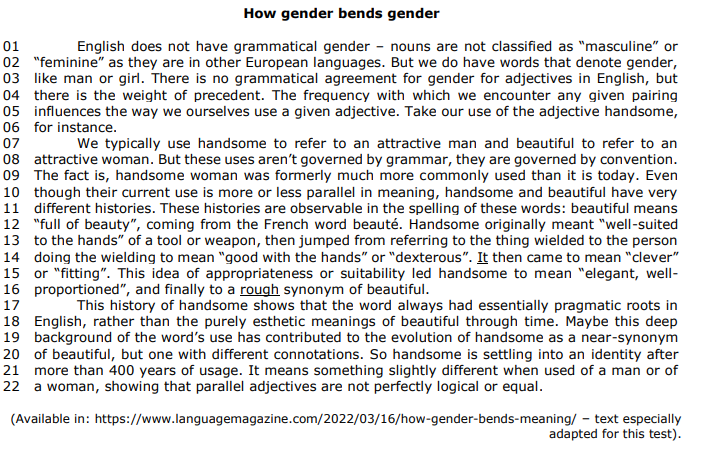


(Available in: https://www.languagemagazine.com/2022/03/16/how-gender-bends-meaning/ – text especially

adapted for this test).

The pronoun “It” (l. 14) refers to: 
Alternativas
Q4139723 Inglês

Instruction: Answer the question based on the following text. The highlighted excerpt from the text is quoted in the question.


How gender bends gender 


(Available in: https://www.languagemagazine.com/2022/03/16/how-gender-bends-meaning/ – text especially

adapted for this test).

In English, past tense verbs with an “ed" ending are pronounced in three different ways. According to the rule, the “ed” may be pronounced as listed in Column 1. About that, match the correct pronunciation of “ed” in Column 1 to the verbs in Column 2.

Column 1
1. /t/.
2. /d/.
3. /ɪd/.

Column 2
(  ) Used.
(  ) Jumped.
(  ) Contributed.

The correct order of filling the parentheses, from top to bottom, is: 
Alternativas
Q4139722 Inglês

Instruction: Answer the question based on the following text. The highlighted excerpt from the text is quoted in the question.


How gender bends gender 


(Available in: https://www.languagemagazine.com/2022/03/16/how-gender-bends-meaning/ – text especially

adapted for this test).

“But these uses aren’t governed by grammar, they are governed by convention”. The underlined structures are in the:
Alternativas
Q4139721 Inglês

Instruction: Answer the question based on the following text. The highlighted excerpt from the text is quoted in the question.


How gender bends gender 


(Available in: https://www.languagemagazine.com/2022/03/16/how-gender-bends-meaning/ – text especially

adapted for this test).

In which of the sentences below the word “rough” (l. 16) is used with the most similar meaning as the underlined word in the text? 
Alternativas
Q4139720 Inglês

Instruction: Answer the question based on the following text. The highlighted excerpt from the text is quoted in the question.


How gender bends gender 


(Available in: https://www.languagemagazine.com/2022/03/16/how-gender-bends-meaning/ – text especially

adapted for this test).

Analyse the following statements about the text:


I. Unlike European languages, English nouns referring to people do not have separate forms for men and women.


II. The adjective “handsome” was never used to refer to an attractive woman.


III. Both “beautiful” and “handsome” have very similar histories, associated with esthetic meanings.


Which statements are correct?

Alternativas
Q4116296 Inglês
Assinale a alternativa que apresenta uma competência específica de Língua Inglesa para o Ensino Fundamental a partir da Base Nacional Comum Curricular (BNCC).
Alternativas
Q4116293 Inglês
(1º§)Volcanoes can impact climate change. During major explosive eruptions huge amounts__volcanic gas, aerosol droplets, and ash are injected into the stratosphere. Injected ash falls rapidly from the stratosphere -- most of it is removed within several days to weeks -- and has little impact on climate change. But volcanic gases like sulfur dioxide can cause global cooling, while volcanic carbon dioxide, a greenhouse gas, has the potential to promote global warming.


(2º§)The most significant climate impacts from volcanic injections into the stratosphere come from the conversion of sulfur dioxide to sulfuric acid, which condenses rapidly in the stratosphere to form fine sulfate aerosols. The aerosols increase the reflection of radiation from the Sun back into space, cooling the Earth's lower atmosphere or troposphere.


(3º§)Several eruptions during the past century have caused a decline in the average temperature at the Earth's surface of up to half a degree (Fahrenheit scale) for periods of one to three years. The climactic eruption of Mount Pinatubo on June 15, 1991, was one of the largest eruptions of the twentieth century and injected a 20-million ton (metric scale) sulfur dioxide cloud into the stratosphere at an altitude of more than 20 miles. The Pinatubo cloud was the largest sulfur dioxide cloud ever observed in the stratosphere since the beginning of such observations by satellites in 1978. It caused what is believed to be the largest aerosol disturbance of the stratosphere in the twentieth century, though probably smaller than the disturbances from eruptions of Krakatau in 1883 and Tambora in 1815. Consequently, it was a standout in its climate impact and cooled the Earth's surface for three years following the eruption, by as much as 1.3 degrees F at the height of the impact.


(4º§)The large 1783-1784 Laki fissure eruption in Iceland released a staggering amount more sulfur dioxide than Pinatubo (approximately 120-million ton vs. 20). Although the two eruptions were significantly different__length and style, the added atmospheric SO2 caused regional cooling of Europe and North America by similar amounts for similar periods of time.


(5º§)Carbon dioxide (CO2) is a greenhouse gas and is the primary gas blamed for climate change. While sulfur dioxide released in contemporary volcanic eruptions has occasionally caused detectable global cooling of the lower atmosphere, the carbon dioxide released in contemporary volcanic eruptions has never caused detectable global warming of the atmosphere. In 2010, human activities were responsible for a projected 35 billion metric tons (gigatons) of CO2 emissions. All studies to date of global volcanic carbon dioxide emissions indicate that present-day subaerial and submarine volcanoes release less than a percent of the carbon dioxide released currently by human activities. While it has been proposed that intense volcanic release of carbon dioxide in the deep geologic past did cause global warming, and possibly some mass extinctions, this is a topic of scientific debate at present.


(6º§)Published scientific estimates of the global CO2 emission rate for all degassing subaerial (on land) and submarine volcanoes lie in a range from 0.13 gigaton to 0.44 gigaton per year. The 35-gigaton projected anthropogenic CO2 emission for 2010 is about 80 to 270 times larger than the respective maximum and minimum annual global volcanic CO2 emission estimates.


(7º§)There is no question that very large volcanic eruptions can inject significant amounts of carbon dioxide into the atmosphere. The 1980 eruption of Mount St. Helens vented approximately 10 million tons of CO2 into the atmosphere in only 9 hours. However, it currently takes humanity only 2.5 hours to put out the same amount. While large explosive eruptions like this are rare and only occur globally every 10 years or so, humanity's emissions are ceaseless and increasing every year.


(8º§)There continues to be efforts to reduce uncertainties and improve estimates of present-day global volcanic CO2 emissions, but there is little doubt among volcanic gas scientists that the anthropogenic CO2 emissions dwarf global volcanic CO2 emissions.


(9º§)For additional information about this subject, please read the American Geophysical Union's Eos article "Volcanic Versus Anthropogenic Carbon Dioxide" written__USGS scientist Terrence M. Gerlach.


https://www.usgs.gov/programs/VHP/
Mark the alternative that correctly fills in the blanks of paragraphs 01, 04 and 09.
Alternativas
Q4116292 Inglês
(1º§)Volcanoes can impact climate change. During major explosive eruptions huge amounts__volcanic gas, aerosol droplets, and ash are injected into the stratosphere. Injected ash falls rapidly from the stratosphere -- most of it is removed within several days to weeks -- and has little impact on climate change. But volcanic gases like sulfur dioxide can cause global cooling, while volcanic carbon dioxide, a greenhouse gas, has the potential to promote global warming.


(2º§)The most significant climate impacts from volcanic injections into the stratosphere come from the conversion of sulfur dioxide to sulfuric acid, which condenses rapidly in the stratosphere to form fine sulfate aerosols. The aerosols increase the reflection of radiation from the Sun back into space, cooling the Earth's lower atmosphere or troposphere.


(3º§)Several eruptions during the past century have caused a decline in the average temperature at the Earth's surface of up to half a degree (Fahrenheit scale) for periods of one to three years. The climactic eruption of Mount Pinatubo on June 15, 1991, was one of the largest eruptions of the twentieth century and injected a 20-million ton (metric scale) sulfur dioxide cloud into the stratosphere at an altitude of more than 20 miles. The Pinatubo cloud was the largest sulfur dioxide cloud ever observed in the stratosphere since the beginning of such observations by satellites in 1978. It caused what is believed to be the largest aerosol disturbance of the stratosphere in the twentieth century, though probably smaller than the disturbances from eruptions of Krakatau in 1883 and Tambora in 1815. Consequently, it was a standout in its climate impact and cooled the Earth's surface for three years following the eruption, by as much as 1.3 degrees F at the height of the impact.


(4º§)The large 1783-1784 Laki fissure eruption in Iceland released a staggering amount more sulfur dioxide than Pinatubo (approximately 120-million ton vs. 20). Although the two eruptions were significantly different__length and style, the added atmospheric SO2 caused regional cooling of Europe and North America by similar amounts for similar periods of time.


(5º§)Carbon dioxide (CO2) is a greenhouse gas and is the primary gas blamed for climate change. While sulfur dioxide released in contemporary volcanic eruptions has occasionally caused detectable global cooling of the lower atmosphere, the carbon dioxide released in contemporary volcanic eruptions has never caused detectable global warming of the atmosphere. In 2010, human activities were responsible for a projected 35 billion metric tons (gigatons) of CO2 emissions. All studies to date of global volcanic carbon dioxide emissions indicate that present-day subaerial and submarine volcanoes release less than a percent of the carbon dioxide released currently by human activities. While it has been proposed that intense volcanic release of carbon dioxide in the deep geologic past did cause global warming, and possibly some mass extinctions, this is a topic of scientific debate at present.


(6º§)Published scientific estimates of the global CO2 emission rate for all degassing subaerial (on land) and submarine volcanoes lie in a range from 0.13 gigaton to 0.44 gigaton per year. The 35-gigaton projected anthropogenic CO2 emission for 2010 is about 80 to 270 times larger than the respective maximum and minimum annual global volcanic CO2 emission estimates.


(7º§)There is no question that very large volcanic eruptions can inject significant amounts of carbon dioxide into the atmosphere. The 1980 eruption of Mount St. Helens vented approximately 10 million tons of CO2 into the atmosphere in only 9 hours. However, it currently takes humanity only 2.5 hours to put out the same amount. While large explosive eruptions like this are rare and only occur globally every 10 years or so, humanity's emissions are ceaseless and increasing every year.


(8º§)There continues to be efforts to reduce uncertainties and improve estimates of present-day global volcanic CO2 emissions, but there is little doubt among volcanic gas scientists that the anthropogenic CO2 emissions dwarf global volcanic CO2 emissions.


(9º§)For additional information about this subject, please read the American Geophysical Union's Eos article "Volcanic Versus Anthropogenic Carbon Dioxide" written__USGS scientist Terrence M. Gerlach.


https://www.usgs.gov/programs/VHP/
Choose the alternative that presents a synonym for the word "dwarf" (8º§).
Alternativas
Q4116291 Inglês
(1º§)Volcanoes can impact climate change. During major explosive eruptions huge amounts__volcanic gas, aerosol droplets, and ash are injected into the stratosphere. Injected ash falls rapidly from the stratosphere -- most of it is removed within several days to weeks -- and has little impact on climate change. But volcanic gases like sulfur dioxide can cause global cooling, while volcanic carbon dioxide, a greenhouse gas, has the potential to promote global warming.


(2º§)The most significant climate impacts from volcanic injections into the stratosphere come from the conversion of sulfur dioxide to sulfuric acid, which condenses rapidly in the stratosphere to form fine sulfate aerosols. The aerosols increase the reflection of radiation from the Sun back into space, cooling the Earth's lower atmosphere or troposphere.


(3º§)Several eruptions during the past century have caused a decline in the average temperature at the Earth's surface of up to half a degree (Fahrenheit scale) for periods of one to three years. The climactic eruption of Mount Pinatubo on June 15, 1991, was one of the largest eruptions of the twentieth century and injected a 20-million ton (metric scale) sulfur dioxide cloud into the stratosphere at an altitude of more than 20 miles. The Pinatubo cloud was the largest sulfur dioxide cloud ever observed in the stratosphere since the beginning of such observations by satellites in 1978. It caused what is believed to be the largest aerosol disturbance of the stratosphere in the twentieth century, though probably smaller than the disturbances from eruptions of Krakatau in 1883 and Tambora in 1815. Consequently, it was a standout in its climate impact and cooled the Earth's surface for three years following the eruption, by as much as 1.3 degrees F at the height of the impact.


(4º§)The large 1783-1784 Laki fissure eruption in Iceland released a staggering amount more sulfur dioxide than Pinatubo (approximately 120-million ton vs. 20). Although the two eruptions were significantly different__length and style, the added atmospheric SO2 caused regional cooling of Europe and North America by similar amounts for similar periods of time.


(5º§)Carbon dioxide (CO2) is a greenhouse gas and is the primary gas blamed for climate change. While sulfur dioxide released in contemporary volcanic eruptions has occasionally caused detectable global cooling of the lower atmosphere, the carbon dioxide released in contemporary volcanic eruptions has never caused detectable global warming of the atmosphere. In 2010, human activities were responsible for a projected 35 billion metric tons (gigatons) of CO2 emissions. All studies to date of global volcanic carbon dioxide emissions indicate that present-day subaerial and submarine volcanoes release less than a percent of the carbon dioxide released currently by human activities. While it has been proposed that intense volcanic release of carbon dioxide in the deep geologic past did cause global warming, and possibly some mass extinctions, this is a topic of scientific debate at present.


(6º§)Published scientific estimates of the global CO2 emission rate for all degassing subaerial (on land) and submarine volcanoes lie in a range from 0.13 gigaton to 0.44 gigaton per year. The 35-gigaton projected anthropogenic CO2 emission for 2010 is about 80 to 270 times larger than the respective maximum and minimum annual global volcanic CO2 emission estimates.


(7º§)There is no question that very large volcanic eruptions can inject significant amounts of carbon dioxide into the atmosphere. The 1980 eruption of Mount St. Helens vented approximately 10 million tons of CO2 into the atmosphere in only 9 hours. However, it currently takes humanity only 2.5 hours to put out the same amount. While large explosive eruptions like this are rare and only occur globally every 10 years or so, humanity's emissions are ceaseless and increasing every year.


(8º§)There continues to be efforts to reduce uncertainties and improve estimates of present-day global volcanic CO2 emissions, but there is little doubt among volcanic gas scientists that the anthropogenic CO2 emissions dwarf global volcanic CO2 emissions.


(9º§)For additional information about this subject, please read the American Geophysical Union's Eos article "Volcanic Versus Anthropogenic Carbon Dioxide" written__USGS scientist Terrence M. Gerlach.


https://www.usgs.gov/programs/VHP/
According to the text, it is correct to say that:
Alternativas
Q4116290 Inglês
(1º§)Volcanoes can impact climate change. During major explosive eruptions huge amounts__volcanic gas, aerosol droplets, and ash are injected into the stratosphere. Injected ash falls rapidly from the stratosphere -- most of it is removed within several days to weeks -- and has little impact on climate change. But volcanic gases like sulfur dioxide can cause global cooling, while volcanic carbon dioxide, a greenhouse gas, has the potential to promote global warming.


(2º§)The most significant climate impacts from volcanic injections into the stratosphere come from the conversion of sulfur dioxide to sulfuric acid, which condenses rapidly in the stratosphere to form fine sulfate aerosols. The aerosols increase the reflection of radiation from the Sun back into space, cooling the Earth's lower atmosphere or troposphere.


(3º§)Several eruptions during the past century have caused a decline in the average temperature at the Earth's surface of up to half a degree (Fahrenheit scale) for periods of one to three years. The climactic eruption of Mount Pinatubo on June 15, 1991, was one of the largest eruptions of the twentieth century and injected a 20-million ton (metric scale) sulfur dioxide cloud into the stratosphere at an altitude of more than 20 miles. The Pinatubo cloud was the largest sulfur dioxide cloud ever observed in the stratosphere since the beginning of such observations by satellites in 1978. It caused what is believed to be the largest aerosol disturbance of the stratosphere in the twentieth century, though probably smaller than the disturbances from eruptions of Krakatau in 1883 and Tambora in 1815. Consequently, it was a standout in its climate impact and cooled the Earth's surface for three years following the eruption, by as much as 1.3 degrees F at the height of the impact.


(4º§)The large 1783-1784 Laki fissure eruption in Iceland released a staggering amount more sulfur dioxide than Pinatubo (approximately 120-million ton vs. 20). Although the two eruptions were significantly different__length and style, the added atmospheric SO2 caused regional cooling of Europe and North America by similar amounts for similar periods of time.


(5º§)Carbon dioxide (CO2) is a greenhouse gas and is the primary gas blamed for climate change. While sulfur dioxide released in contemporary volcanic eruptions has occasionally caused detectable global cooling of the lower atmosphere, the carbon dioxide released in contemporary volcanic eruptions has never caused detectable global warming of the atmosphere. In 2010, human activities were responsible for a projected 35 billion metric tons (gigatons) of CO2 emissions. All studies to date of global volcanic carbon dioxide emissions indicate that present-day subaerial and submarine volcanoes release less than a percent of the carbon dioxide released currently by human activities. While it has been proposed that intense volcanic release of carbon dioxide in the deep geologic past did cause global warming, and possibly some mass extinctions, this is a topic of scientific debate at present.


(6º§)Published scientific estimates of the global CO2 emission rate for all degassing subaerial (on land) and submarine volcanoes lie in a range from 0.13 gigaton to 0.44 gigaton per year. The 35-gigaton projected anthropogenic CO2 emission for 2010 is about 80 to 270 times larger than the respective maximum and minimum annual global volcanic CO2 emission estimates.


(7º§)There is no question that very large volcanic eruptions can inject significant amounts of carbon dioxide into the atmosphere. The 1980 eruption of Mount St. Helens vented approximately 10 million tons of CO2 into the atmosphere in only 9 hours. However, it currently takes humanity only 2.5 hours to put out the same amount. While large explosive eruptions like this are rare and only occur globally every 10 years or so, humanity's emissions are ceaseless and increasing every year.


(8º§)There continues to be efforts to reduce uncertainties and improve estimates of present-day global volcanic CO2 emissions, but there is little doubt among volcanic gas scientists that the anthropogenic CO2 emissions dwarf global volcanic CO2 emissions.


(9º§)For additional information about this subject, please read the American Geophysical Union's Eos article "Volcanic Versus Anthropogenic Carbon Dioxide" written__USGS scientist Terrence M. Gerlach.


https://www.usgs.gov/programs/VHP/
Which one could be better for the title of the text?
Alternativas
Q4115383 Inglês
No Ensino Médio, a área de Linguagens e suas Tecnologias tem a responsabilidade de propiciar oportunidades para a consolidação e a ampliação das habilidades de uso e de reflexão sobre as linguagens – artísticas, corporais e verbais (oral ou visual-motora, como Libras e escrita) –, que são objeto de seus diferentes componentes (Arte, Educação Física, Língua Inglesa e Língua Portuguesa).
(BRASIL. Ministério da Educação. Base Nacional Comum Curricular. Brasília, 2018, p. 482.)

No Ensino Médio, abrem-se possibilidades de aproximação e integração dos estudantes com grupos multilíngues e multiculturais no mundo globalizado, no qual a língua inglesa se apresenta como língua comum para a interação. Trata-se, portanto, de
Alternativas
Q4115379 Inglês
There are different varieties of non-lexical-item words. One of these varieties is: words that do not have to be listed in a dictionary because they are merely grammatically conditioned variants of a word that is more basic, in some sense – and which itself may or may not be listed, depending on whether its meaning is predictable or not.

(CARSTAIRS-MCCARTHY, Andrew. An Introduction to English Morphology: Words and Their Structure. Edinburgh: Edinburgh, 2018. p. 28.)

Analise as asserções a seguir e a relação proposta entre elas.

I - Sentences: “This pianist perform in the local hall every week” and “These pianists performs in the local hall every week” are grammatically unacceptable

BECAUSE

II - they violate a grammatical rule of English concerning agreement between a verb and its subject.

Sobre as asserções, é correto afirmar que
Alternativas
Q4115376 Inglês
The English language would, if proper care were devoted to its advancement, stand an excellent chance of becoming more universally diffused, read, and spoken, than any other now is, or ever has been.

(CRYSTAL, D. English as a global language. Cambridge: Cambridge University Press, 2012, p. 75.)

Informe se é verdadeiro (V) ou falso (F) o que se afirma sobre a língua inglesa e o acesso ao conhecimento.
( ) By the beginning of the nineteenth century, America had become the world’s leading industrial and trading nation.
( ) Britain, by the end of the nineteenth century, overtook America as the world’s fastest growing economy.
( ) The linguistic consequences of British achievement were far-reaching: the new terminology of technological and scientific advance had an immediate impact on the language, adding tens of thousands of words to the English lexicon.
( ) The innovations pouring out of an English-speaking country meant that those from abroad who wished to learn about them would need to learn English.

De acordo com as afirmações, a sequência correta é:

Alternativas
Respostas
12861: C
12862: D
12863: C
12864: B
12865: A
12866: A
12867: B
12868: B
12869: C
12870: C
12871: E
12872: A
12873: C
12874: A
12875: D
12876: D
12877: B
12878: B
12879: D
12880: A