Questões de Concurso
Sobre pronúncia e som | pronunciation and sound em inglês
Foram encontradas 232 questões


This connected-speech phenomenon is known as:
Judge the statements below as True (T) or False (F):
(__)In a non-rhotic accent, far away may contain a linking /r/ even though word-final /r/ would not normally be pronounced before a pause.
(__)In ten people, /n/ may be realized with a bilabial place of articulation before /p/, illustrating anticipatory assimilation.
(__)When /t/ is omitted from a cluster in a rapid pronunciation of next day, the process is properly classified as epenthesis.
(__)In connected speech, the sequence /d/ + /j/ in would you may undergo coalescence and be realized with a sound resembling /dʒ/.
The correct sequence, from top to bottom, is:
Judge the statements below as True (T) or False (F):
(__)In a non-rhotic variety of British English, the final letter r in far is normally silent when the word occurs alone, but the corresponding sound may be pronounced in far away because the following word begins with a vowel.
(__)In rapid speech, the t sound in next day may be omitted because of the complex consonant sequence, illustrating elision rather than the addition of a new sound.
(__)In did you, the final sound of did and the initial sound represented by y in you may interact and produce a pronunciation similar to the beginning of the word June.
(__)The words photograph and photography maintain primary stress on the same syllable because words belonging to the same lexical family normally preserve identical stress patterns.
The correct sequence, from top to bottom, is:
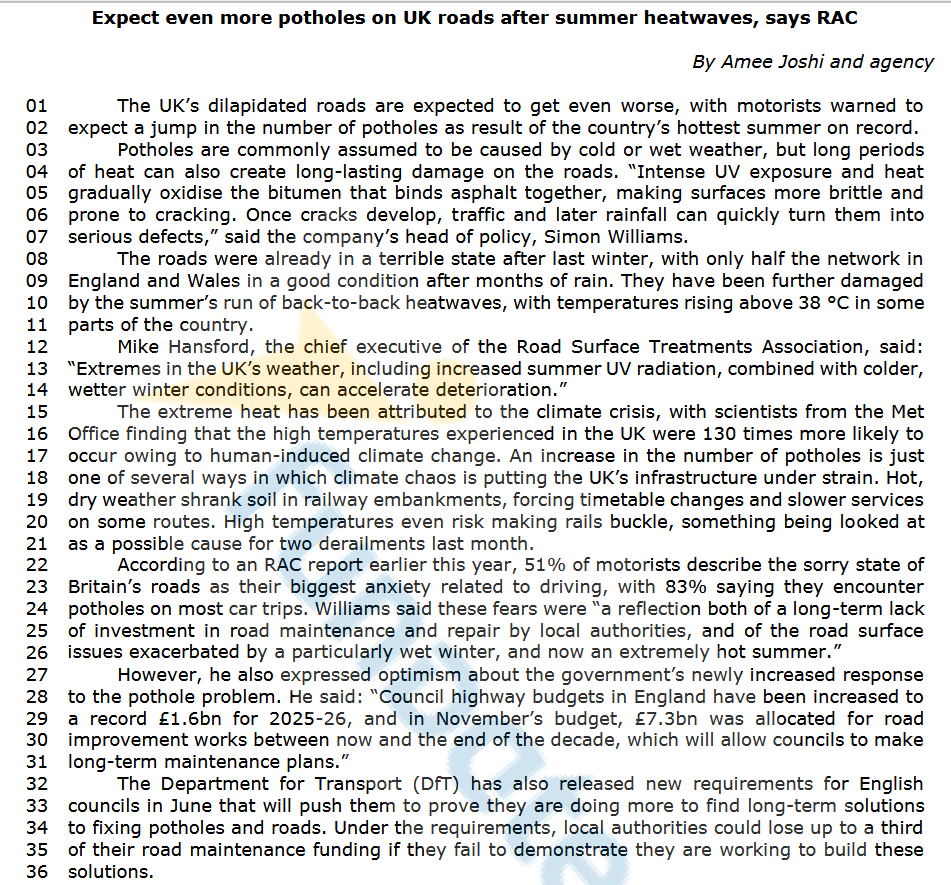
(Available at: https://www.theguardian.com/uk-news/2026/sep/16/expect-more-potholes-uk-roads-summer-
heatwaves-rac - text specially adapted for this test).
Which statement is CORRECT?
TEXT I
The Multimodal Approach in English Language Teaching
In today’s media-rich environment, the vast majority of texts students engage with daily — such as YouTube videos, Instagram reels, TikTok clips, streaming series, video games and blog posts — are not only digital but also multimodal. These texts combine language with image, sound, movement and spatial design to convey meaning, often requiring learners to interpret and respond across multiple modes simultaneously. As digital technologies evolve, the pervasiveness and complexity of multimodal communication grow, reshaping both how we communicate and what it means to be literate.
Contemporary communication extends far beyond speech and writing; it is a layered, dynamic process that includes visual, aural, gestural and spatial elements. As such, literacy can no longer be understood solely as a linguistic skill. To participate fully in today’s social, academic and professional contexts, learners need more than the ability to read and write alphabetic text — they need to view, interpret, evaluate and represent meaning through a range of semiotic resources. In this context, traditional notions of literacy are insufficient and language education must evolve to reflect the multimodal nature of communication in the 21st century […]
Importantly, multimodal literacy also promotes accessibility and inclusion. Learners with reading difficulties, sensory impairments or diverse learning needs often struggle with traditional printbased instruction. Multimodal texts provide alternative pathways to meaning, allowing information to be accessed and expressed through visuals, sound, movement and space. This not only supports learners with special educational needs but benefits all students by offering multiple modes for engagement and expression. By embedding multimodal materials and encouraging students to compose multimodal texts, teachers create more equitable and inclusive classrooms. Multimodal learning reflects how people communicate in real life — and, crucially, supports the development of diverse literacies needed for participation in contemporary society.
In summary, integrating multimodal literacy into language teaching fosters deeper engagement, enhances learning outcomes and equips students with the skills to navigate and contribute meaningfully to today’s complex communicative landscape.
Adapted from https://film-english.com/wp-content/uploads/2025/09/themultimodal-approach-in-language-teaching.pdf
COLUMN I
1.Weak-form reduction. 2.Assimilation. 3.Elision. 4.Resyllabification/linking.
COLUMN II
(__)A segment changes some of its phonetic properties under the influence of a neighboring segment.
(__)A function word that has a full citation form is realized with reduced prominence and frequently with a centralized vowel in unstressed speech.
(__)A segment expected from the citation form is omitted in a phonologically favorable connected-speech environment.
(__)A consonantal segment at the edge of one word is perceptually associated with the following vowel-initial syllable in fluent speech.
The correct sequence, from top to bottom, is:
(__)The contrast between ship and sheep shows that a change in a vowel sound may distinguish word meaning in English.
(__)The plural ending written as -s may be pronounced differently depending on the final sound of the noun, as in cats, dogs and buses.
(__)Stress placement can contribute to differences in pronunciation between some nouns and verbs, as in certain uses of record.
(__)English rhythm is based on giving approximately equal duration and prominence to every syllable in an utterance.
After analyzing the statements, choose the alternative that presents the correct sequence from top to bottom.
(__)In standard descriptions of English, the noun record and the verb record may be distinguished by a shift in primary stress.
(__)Unstressed grammatical words may undergo vowel reduction in connected speech, which helps explain pronunciations involving schwa.
(__)Words with similar spelling necessarily preserve the same stressed syllable when derivational suffixes are added.
(__)English spelling provides useful information about pronunciation, but grapheme-to-sound relationships are not consistently one-to-one.
The correct sequence, from top to bottom, is:
Consider the commenter's question quoted in the article.
"30 minutes a day, really?"
If spoken as an expression of disbelief rather than a neutral request for information, which prosodic interpretation is appropriate?
Considering the relationship between English letter names and pronunciation, mark T, for true, and F, for false.
(__) The name of the letter "B" begins with the consonant sound found at the beginning of "ball."
(__) When pronounced as the name of the letter, "G" begins with the same consonant sound heard at the beginning of "game."
(__) The name of the letter "J" begins with the same consonant sound found at the beginning of "juice."
(__) Activities involving alphabet knowledge can distinguish letter names from sounds occurring in words without requiring formal phonetic terminology from children.
After analysis, select the alternative that presents the CORRECT sequence of the items above, from top to bottom.
Which linguistic feature is predominantly explored?
Analyze the statements below.
I."Cat," "cow," and "cake" begin with the same consonant sound.
II."City" begins with the same consonant sound as "cat."
III.The examples can support awareness that letter-sound relationships in English are not always one-to-one.
It is CORRECT what is stated in:
Analyze the statements below.
I."Chain" and "chicken" begin with the same consonant phoneme.
II.The plural ending in "fries" is pronounced /z/, whereas the plural ending in "chips" is pronounced /s/.
III.The vowel sound represented by the letter "i" is identical in "fries" and "chicken."
IV.Attention to sound similarities can be developed through oral games without requiring children to explain phonological rules explicitly.
It is CORRECT what is stated in:
Considering English phonology in oral interaction, mark T, for true, and F, for false.
(__)In "Emma sent A draft, but not the final one," prominence on "a" can contribute to a contrast between an unspecified draft and the expected final version.
(__)A rising intonation contour gives an utterance interrogative grammatical structure independently of its syntax and communicative context.
(__)Reduced or coalescent forms in sequences such as "did you" may make segmentation difficult for learners who recognize the words more easily in isolation.
(__)Maintaining full vowels in unstressed grammatical words is necessary for an utterance to remain intelligible in spontaneous English speech.
After analysis, select the alternative that presents the CORRECT sequence of the items above, from top to bottom.
Match the items in Column I with the words in Column II.
COLUMN I
1.Plural "-s" pronounced with an "s" sound, as in cats.
2.Plural "-s" pronounced with a "z" sound, as in dogs.
3.Past "-ed" pronounced as an extra syllable, as in needed.
4.Past "-ed" pronounced with a "t" sound, as in worked.
COLUMN II
(__)roads.
(__)worked.
(__)maps.
(__)wanted.
Select the alternative that presents the CORRECT association, from top to bottom.
Considering English orthography and pronunciation, mark T, for true, and F, for false.
(__)The letter name "G" begins with the same consonant phoneme found at the beginning of "job."
(__)The conventional English name of the letter "H" begins with the phoneme /h/.
(__)The grapheme "c" represents the same consonant phoneme in "city" and "cat."
(__)The words "though," "through," and "thought" illustrate that similar orthographic sequences may correspond to different phonological patterns.
After analysis, select the alternative that presents the CORRECT sequence of the items above, from top to bottom.
Considering standard English pronunciation, mark T, for true, and F, for false.
(__)In lived , the -ed ending is typically realized as /d/.
(__)In linked , the -ed ending is typically realized as /tu/.
(__)In uncovered , the final -ed normally forms an additional syllable pronounced /yd/.
(__)The different realizations of -ed demonstrate that identical orthographic endings may correspond to different phonetic forms.
After analysis, select the alternative that presents the CORRECT sequence of the items above, from top to bottom.

 Conheça nossos planos