Questões de Concurso
Sobre pronomes | pronouns em inglês
Foram encontradas 1.068 questões


I.Defining relative clauses provide essential information about the noun they modify and are never separated from the rest of the sentence by commas.
II.Non-defining relative clauses provide extra information and must be enclosed in commas, but the relative pronoun "that" cannot be used in these structures.
III.In informal English, it is grammatically incorrect to end a sentence with a preposition, even in relative clauses where the pronoun is omitted.
Which of the statements above is/are CORRECT?
Read the following passage from Passing, by Nella Larsen, and answer the question.
Stepping out of the elevator that had brought her to the roof, she was led to a table just in front of a long window whose gently moving curtains suggested a cool breeze. It was, she thought, like being wafted upward on a magic carpet to another world, pleasant, quiet, and strangely remote from the sizzling one that she had left below.
LARSEN, Nella. Passing. In: The Complete Fiction of Nella Larsen – Passing, Quicksand and The Stories. New York: Anchor Books, 2001, p. 164.
Text for question
Hero boy swims for four hours to save his family (9th February 2026)
A 13-year-old Australian boy has been hailed a hero after an epic swim that saved his family. The boy, Austin Appelbee, and his family were on a beach holiday in Western Australia. They were kayaking and paddleboarding in shallow water when strong winds pushed them farther offshore. They ended up over four kilometres away from land, and the daylight was fading. Austin decided to kayak to shore to get help. However, the waves had damaged his kayak, which had taken in water and flipped over. He said he then lost an oar and knew he was in trouble. He decided he had no alternative but to swim back to land. He swam through shark-frequented waters to raise the alarm.
Austin made it to the beach and phoned for help. This sparked a huge rescue operation, which resulted in coastguards finding the teenager's mother and two younger sisters. The boy said: "I hit the bottom of the beach and I just collapsed, and then, after that, I had to “ sprint two kilometres to get to the phone." Rescuers called his efforts "superhuman". One rescuer said Austin's actions could not "be praised highly enough." He added that the teenager's "determination and courage ultimately saved the lives of his mother and siblings." Austin's mother Joanne, 47, told reporters: "The wind picked up. We lost oars, and we drifted out further. It was an absolute nightmare."

“ This sparked a huge rescue operation, which resulted in coastguards finding the teenager s mother and two younger sisters . The boy said: I hit the bottom of the beach and I just collapsed, and then, after that, I had to sprint two kilometres to get to the phone. Rescuers called his efforts ‘superhuman’.”
The claim to reason or rationality is the ultimate validation of the affirmation and assertion of the human condition. Aristotle’s definition of man as "a rational animal" was not spoken of the African and the Amerindian. Little did he realise that his definition of "man" laid down the foundation for the struggle for reason between colonialists and colonized peoples.
Aristotle’s definition of man was deeply inscribed in the social ethos of those communities and societies which undertook the so-called voyages of discovery apparently driven by innocent curiosity. It seems then that the entire process of decolonisation has upheld and not jettisoned the questionable belief that "man is a rational animal" was not spoken of the African and of the Amerindian.
The term African philosophy renders the idea that history repeats itself easy to believe. The term tends to revive innate skepticism on the one hand and to stimulate ingrained condescension on the other. The skeptic, unswervingly committed to the will to remain ignorant, is simply dismissive of any possibility let alone the probability of African philosophy. Impelled by the will to dominate, the condescendor is often ready to entertain the probability of African philosophy provided the judgement pertaining to the experience, knowledge and truth about African philosophy is recognised as the sole and exclusive right of the condescendor. The self-appointed heirs to the right to reason have thus established themselves as the producers of all knowledge and the only holders of the truth.
Mogobe B. Ramose. African philosophy through Ubuntu.
Harare, Zimbabwe: Mond Books Publishers, 2005, pp. 5-6 (adapted).
Considering the preceding text, judge the following item.
Due to the grammatical function the pronoun "which" has in the first sentence of the second paragraph, it would be grammatically correct to add a comma after "societies".
Choose the alternative that correctly completes the sentence. The correct answer must be a possessive pronoun that replaces the noun and avoids repetition.
That house is not ours; it is ______.
The correct relative determiner that completes the clause is:
Text 10A2-I
Everyone ages, but, sometimes, people outlive all predictions. Previous research has uncovered an unlikely factor related to longevity: intelligence. However, intelligence isn‟t a simple characteristic. There are many traits that contribute to it that can be tested — from memory to mathematical logic. In a 2024 clinical psychological science study, Paolo Ghisletta, of the University of Geneva, linked longevity specifically to one of those traits: verbal fluency, the measure of one‟s vocabulary and their ability to use it. Ghisletta‟s research used samples from the Berlin Aging Study, which started collecting data shortly before the Berlin Wall came down in 1989. It tracked 516 people aged 70 to 105 from enrollment to their death, over as long as 18 years in some cases. The study measured factors like dental health, stress levels, and economic well-being, as well as cognition. This makes it a “rich and rare data set,” said Ghisletta in an interview.
Internet: http://www.sciencedaily.com/
“Professor House calls for continuing research on ELF in Europe and elsewhere, but concludes that it is ‘not, for the present time, a threat to multilingualism’.”
With respect to the use of pronouns and prepositional expressions in the excerpt, choose the correct alternative.
Text 1
A Message Across Screens
Every morning, Emma checked her phone before getting out of bed. Messages, videos, and stories filled her screen, connecting her to people from different parts of the world. One day, she came across a short digital story shared by a student from another country. It talked about learning English through music, social media, and online friendships.
Curious, Emma replied to the post. Soon, they started exchanging messages and videos, sharing their daily routines, cultures, and challenges. Through these digital interactions, Emma realized that storytelling was no longer limited to books. It now lived on screens, combining images, sounds, and words to create meaning.
Over time, their stories helped them understand each other better. Digital storytelling became a bridge between cultures, showing that language learning is also about empathy, communication, and connection.
Analyze the following sentences according to vocabulary and grammar use, from text 1.
1. get out, come across (paragraph 1), and live on (paragraph 2), are examples of phrasal verbs.
2. The word better (paragraph 3), is the superlative form of the adjective bad.
3. The following pronouns: they (paragraph 2), their and them (paragraph 3) are, respectively: a personal pronoun, a possessive adjective and an object pronoun.
4. The underlined word in Soon, they started exchanging messages and videos, sharing their daily routines, cultures, and challenges., is an example of a discourse marker.
5. The underlined word in Through these digital interactions, Emma realized that storytelling was no longer limited to books.” can be replaced by carried out without changing its meaning.
Choose the alternative which contains the correct sentences about vocabulary and grammar use.
(__) O pronome 'whose' é utilizado para indicar posse, substituindo adjetivos possessivos como 'his', 'her' ou 'its'.
(__) Em orações restritivas (defining), o pronome relativo objeto pode ser omitido (Zero Relative Pronoun).
(__) O pronome 'which' é utilizado exclusivamente para referir-se a pessoas em contextos formais.
(__) As orações explicativas (non-defining) fornecem informações adicionais e devem vir entre vírgulas.
Após análise, assinale a alternativa que apresenta a sequência CORRETA dos itens acima, de cima para baixo:
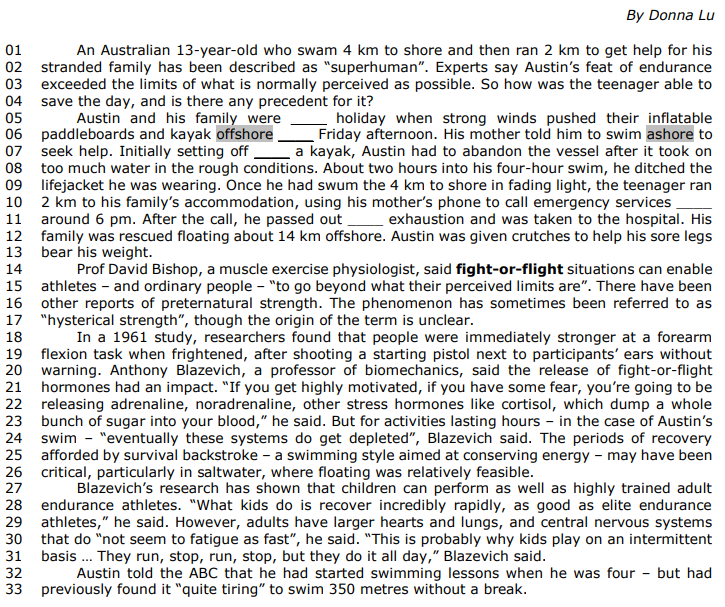
( ) In the sentence “An Australian 13-year-old who swam 4 km to shore” (l. 01), the relative pronoun “who” could be replaced by “that” without changing the meaning.
( ) The sentence “In a 1961 study, researchers found that people were immediately stronger” (l. 18) could be rewritten using the present perfect tense without any change in meaning.
( ) In the sentence “Once he had swum the 4 km to shore in fading light” (l. 09), the verb tense used expresses an action completed before another action in the past.
( ) In the sentence “His family was rescued floating about 14 km offshore” (l. 11-12), the verb form indicates an action performed by the subject “his family”.
The correct order of filling in the parentheses, from top to bottom, is:
Read the text below and answer the questions:
New beginnings in Wrocław: The refugee students building brighter futures
Eighteen-year-old Daria hopes to begin studying psychology at the university in Wroclaw, Poland in the autumn. She already knows what career she wants to pursue: working with formerly incarcerated individuals to support their reintegration into society.
“I want to help people start a new life after having made mistakes,” Daria says. “I believe everyone deserves a chance to change, and I want to support them.” Three years ago, it wasn’t clear that Daria would be able to study psychology at all – or even graduate from secondary school. In early 2022, with the escalation of the war in Ukraine, she was forced to leave her home of Kryvyi Rih in central Ukraine for Wroclaw, together with her mother and younger brother.
Daria was one of hundreds of Ukrainians who ended up at the same high school in Wroclaw. Wrocław’s multicultural identity has long been a source of pride, and the school is no different: out of its 1,500 students, 500 are from Ukraine. There are also students from Belarus, Kyrgyzstan and Kenya, among other countries.
Still, the transition to life in a different country, while being separated from loved ones who remained in Ukraine, was not easy. In the first few months, Daria herself needed psychological support.
Eighteen-year-old Daria hopes to study psychology at university. If that doesn’t work out, she is also considering game design as a backup plan, inspired by her strong interest in video games.
Eighteen-year-old Daria hopes to study psychology at university. If that doesn’t work out, she is also considering game design as a backup plan, inspired by her strong interest in video games.
Fortunately, she found support from the educators and staff at her school. This included the school psychologist, who is Polish but speaks Ukrainian. Her teachers also helped. “They genuinely do everything they can to help us adapt,” Daria says.
“They show us that they are learning together with us – they’re not pretending to know everything. They make mistakes too, they apologize, and everything feels very natural and supportive.”
For 18-year-old Kamila, who graduated from the same high school this year, the language barrier was the greatest challenge. “You don’t immediately understand what the teachers are saying, and you have to ask several times,” she says. “They couldn’t really explain either, because they didn’t speak Ukrainian. That was very hard for me.”
Kamila recalls that during her first months at the new secondary school, she had little time for her hobbies – she spent nearly all her free time learning Polish and keeping up with school assignments. Kamila recalls that during her first months at the new secondary school, she had little time for her hobbies – she spent nearly all her free time learning Polish and keeping up with school assignments.
Subjects like physics and biology were especially difficult because of the complex technical vocabulary. “I had to learn every term from scratch,” says Kamila, who came from IvanoFrankivsk, western Ukraine, with her family in 2022.
Learning Polish wasn’t only key to succeeding in school, but to feeling connected. “Only after I overcame the language barrier I did start participating in extracurricular activities at school,” Kamila explains. “It was important for me to build friendships with Polish students too.”
Despite these difficulties, Kamila now dreams of becoming a translator and is currently learning English and German in addition to Polish.
Seventeen-year-old Sofia, another graduate of the high school, shares this love of language. She studies English, Polish and German. “Aside from languages, I also love history,” she says.
Seventeen-year-old Sofia, who graduated this year from a secondary school in Wrocław, dreams of a career as a translator. She has applied to several universities in Wrocław to pursue her studies.
Seventeen-year-old Sofia, who graduated this year from a secondary school in Wrocław, dreams of a career as a translator. She has applied to several universities in Wrocław to pursue her studies.
Sofia’s passion for history deepened her connection to Wrocław, one of Poland’s oldest and most culturally rich cities. “I really like Wrocław, and right now I think that if my future is in Poland, it will be in this city,” she says.
Like many of her peers, Sofia’s first steps in a new country were filled with fear and uncertainty.
“At the beginning, it was a bit scary – a different country, a different culture, a different language,” she recalls. “But there were actually many kind people who were ready to help. Thanks to them, I managed to adapt, and now I feel quite good living here.”
As well as graduating with honors from her school in Ukraine, in Wroclaw, Sofia received the red stripe distinction, a special recognition for outstanding academic results in Polish schools. She also earned a scholarship for being the top-performing student in the school last year.
Seventeen-year-old Sofia and her mother, Tetiana. The family plans to stay in Poland, as Sofia sees her future in this country.
Sofia and her mother, Tetiana. The family plans to stay in Poland, as Sofia sees her future in this country.
Her family has recently decided to stay in Poland.
“Our daughter sees her future here, and we are ready to support her decision,” her mother Tetiana says.
These stories are a powerful reminder of the resilience and potential of young people when they are given the right opportunities and support.
As we mark International Youth Day, UNICEF celebrates youth like Daria, Kamila and Sofia – who, despite the trauma of war and displacement, are building their futures through education, courage, and determination.
UNICEF, in partnership with local governments and civil society, remains committed to ensuring that every young person has access to quality education and support, no matter their background or circumstances.
This work for refugee children and caregivers from Ukraine in Poland is made possible thanks to the generous support of the Bureau of Population, Refugees, and Migration of the US Department of State (PRM) and the Government of the Republic of Korea and the Government of Japan.
Source: https://www.unicef.org/eca/stories/new-beginnings-in-Wroclaw
The sentence "Their family plans to stay in Poland, as Sofia sees her future in this country" contains multiple pronominal forms that require grammatical analysis. Each pronoun performs specific syntactic and semantic functions within the sentence structure.
Examine the morphosyntactic functions and referential properties of the pronouns in this construction. Which alternative accurately characterizes the grammatical architecture?
Escolha a alternativa que substitui corretamente o termo sublinhado:
"The principal called THE TEACHERS for a meeting."

 Conheça nossos planos