Questões de Concurso
Sobre pronomes | pronouns em inglês
Foram encontradas 1.068 questões


Text for the item.
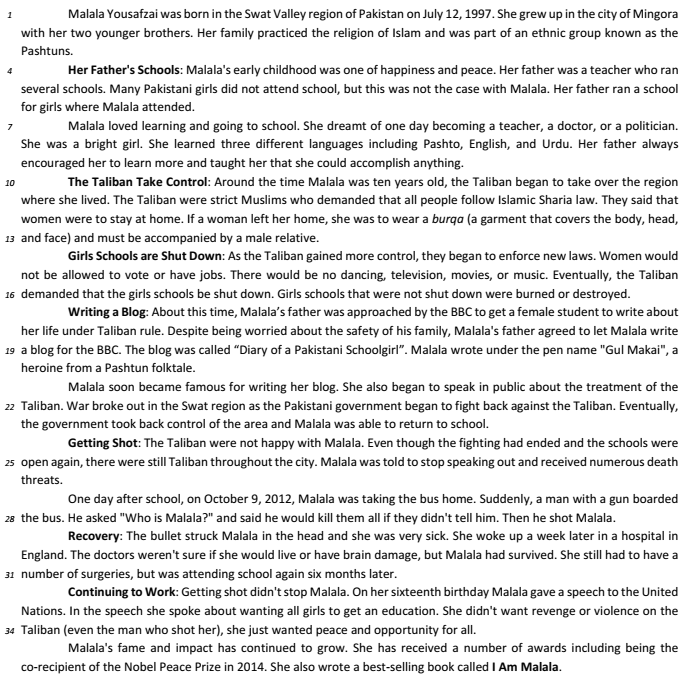
Internet: <www.ducksters.com> (adapted).
According to the text, judge the item.
In the sentence “He asked ‘Who is Malala?’ and said he
would kill them all if they didn't tell him.” (line 28), “He”
and “they” are examples of subject pronouns and work
as the subject of the verb, while “them” and “him” are
object pronouns.

According to the text, judge the item
The relative pronoun “who” (line 5) can be correctly replaced with that.

Regarding the vocabulary of the text, decide whether the statements below are right (C) or wrong (E).
In line 14, the word “both” is used as a pronoun for the
antecedent “double business bound” (line 12).
“In Japan, they call them ‘manga’; in Latin America, ‘histotietas’; in Italy, ‘fumetti’; in Brazil, ‘história em quadrinhos’; and in the U.S., ‘comics’.”; ” All of Mexico’s comic titles together.
The words in bold are respectively:
Manga account_______. nearly fifty percent of all the books and magazines published in Japan each year. And few magazines of any kind in the world can match this number: Shonen Jump, the leading comic title, has a circulation of 6.5 million copies week!
“Ever since comics first appeared, there have been(1) people who(2) have criticized(3) them(4).”
Pay attention to the underlined words and decide if they are true ( T ) or false ( F ).
( ) the word who(2) is a relative pronoun.
( ) there have been(1) is the present perfect tense of there to be.
( ) the word them(4) is an example of personal pronoun.
( ) the underlined words have criticized(3) is being used in the simple past tense.
Choose the alternative which presents the correct sequence, from top to bottom.

Consider on the text, judge the item.
The relative pronoun “which” (line 6 and line 14) can be
substituted by that. The same way that “that” (line 16)
can be substituted by which.
Consider on the text, judge the item.
In the sentence “what lies above and below it, what is
permanently attached to it” (lines 9 and 10) both
occurrences of the pronoun “it” are related to the same
noun.
Considering the text above, judge the following item.
In the third sentence of the fourth paragraph, the pronoun “it” refers to Intel.
Observe as sentenças a seguir:
I - For now on you have your own bedroom.
II - My father was a bus driver for 10 years.
III - My mother-in-law is very sweet.
Assinale a alternativa correta:
Observe a tabela a seguir:
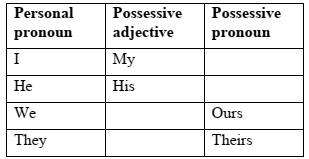
Assinale a alternativa que preenche corretamente os espaços em branco na tabela acima:
Instruction: answer the question based on the following text.
The Ultimate Packing List for Expatriates Moving Abroad
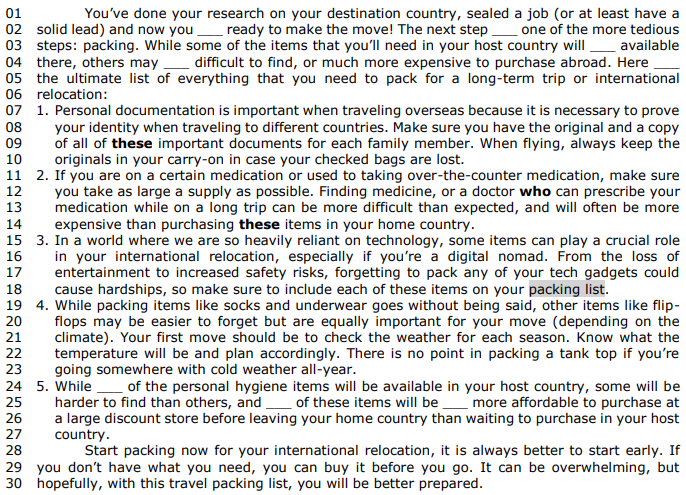
(Available in: https://www.internationalcitizens.com/moving-abroad/ultimate-packing-list.php – text specially adapted for this test).
Fill in the blanks with the correct pronoun.
They are late. Can you call ______?
This is the car. Can you fix it for _____?
Claudia is sick. I will make soup for _____.
Select the CORRECT answer.
Complete the following sentences with the correct conjunction.
Give this letter to Anne __________ you see her.
Do you know _______could give me better instructions?
It started to rain _____ I washed the clothes.
We have to work ______ the day before the sun goes down.
Select the CORRECT answer.
Match Column A with Column B to fill in with the appropriate question word.
COLUMN A
I. Where.
II. Who.
III. When.
IV. How.
V. How much.
COLUMN B
( ) ______ do you live? In Icapuí.
( ) ______ is your best friend? It’s Sam.
( ) ______ old are you? I am 19
( ) ______ is your party? Tomorrow morning.
( ) ______ is the ticket? It's free.
Select the CORRECT answer
“One of these is the world’s largest land predator, the polar bear.”
Study the affirmatives below:
1. ‘these’ is a relative pronoun. 2. ‘largest’ is the comparative of superiority form of the adjective ‘ large’. 3. ‘world’s’ means ‘world is’. 4. ‘largest’ is the superlative of superiority form of the adjective ‘ large’. 5. ‘these’ is a demonstrative pronoun.
Choose the alternative which contains all the correct affirmatives.

 Conheça nossos planos