Questões de Concurso
Sobre pronome subjetivo | subjective pronoun em inglês
Foram encontradas 105 questões


Ano: 2015
Banca:
CESPE / CEBRASPE
Órgão:
Instituto Rio Branco
Prova:
CESPE - 2015 - Instituto Rio Branco - Diplomata - Prova 2 |
Q542364
Inglês

In reference to the content of the text, its vocabulary and syntactic structure, decide whether the following statements are right (C) or wrong (E).
In lines 4, 7 and 9, although with different syntactic functions,
the word it refers to the same thing: “the head of an enemy
which swung from the rafters” (l. 3 and 4).
Ano: 2015
Banca:
CEPERJ
Órgão:
SEEDUC-RJ
Prova:
CEPERJ - 2015 - SEDUC-RJ - Professor Docente I - Inglês |
Q503722
Inglês

In the sentence “It would be nice if teachers who work in the most challenging schools could be paid more." (l. 43), the personal pronoun 'it' functions as an:
Ano: 2015
Banca:
CESGRANRIO
Órgão:
Petrobras
Provas:
CESGRANRIO - 2015 - Petrobras - Profissional Júnior - Serviço Social
|
CESGRANRIO - 2015 - Petrobras - Profissional Júnior - Administração |
CESGRANRIO - 2015 - Petrobras - Profissional Júnior - Direito |
CESGRANRIO - 2015 - Petrobras - Profissional Júnior - Engenharia Mecânica |
CESGRANRIO - 2015 - Petrobras - Profissional Júnior - Ciências Contábeis |
CESGRANRIO - 2015 - Petrobras - Profissional Júnior - Engenharia Elétrica |
CESGRANRIO - 2015 - Petrobras - Profissional Júnior - Comunicação/Relações Públicas |
CESGRANRIO - 2015 - Petrobras - Profissional Júnior - Engenharia de Produção |
CESGRANRIO - 2015 - Petrobras - Profissional Júnior - Engenharia do Meio Ambiente |
CESGRANRIO - 2015 - Petrobras - Profissional Júnior - Engenharia de Segurança do Trabalho |
Q483202
Inglês

The personal pronoun it in “so if it is burned in an engine designed to run on conventional fuel” (lines 55-56) refers to
Q475110
Inglês
Complete o texto a seguir com os pronomes mais adequados. This is Mark. ______ is a good friend of mine.
That is Paula, _____ is his girlfriend. Mark and Paula are from Germany. _____ are german. I live with my brother and ___ have a pet. ____ is a dog called Otto.
A sequência correta é:
That is Paula, _____ is his girlfriend. Mark and Paula are from Germany. _____ are german. I live with my brother and ___ have a pet. ____ is a dog called Otto.
A sequência correta é:
Q465478
Inglês
Texto associado
Read the text below and answer the questions that follow:
Teaching English as a foreign language teacher: job description
Teaching English as a foreign language (TEFL) involves teaching adults and children whose first or main language is not English. This can be done in the UK or abroad and the students may be learning English for either business or leisure reasons.
Teaching English to speakers of other languages (TESOL) is also a widely used term and often means the same thing as TEFL. It’s sometimes specifically used to refer to teaching English to people who are living in the UK but who do not speak English as a first language. These students are most commonly refugees and immigrants and need to learn the language in order to help them settle into the UK society.Their courses are often government funded.
Teaching English as a second language (TESL) or teaching English as an additional language (TEAL) may also be terms that are used but they generally all refer to the same thing - teaching English to someone whose native language is not English.
Teachers of English as a foreign language can work in a variety of settingswith different age ranges. This can include commercial language schools, schools and institutions of further and higher education throughout the UK and overseas. Some may also teach in industry, while others are self-employed. Classes are usually taught in English, evenwith beginners. Teaching English as a foreign language teacher: job description
Adapted from: < www.prospects.ac.uk/case-studies-working- abroad>
Teaching English as a foreign language teacher: job description
Teaching English as a foreign language (TEFL) involves teaching adults and children whose first or main language is not English. This can be done in the UK or abroad and the students may be learning English for either business or leisure reasons.
Teaching English to speakers of other languages (TESOL) is also a widely used term and often means the same thing as TEFL. It’s sometimes specifically used to refer to teaching English to people who are living in the UK but who do not speak English as a first language. These students are most commonly refugees and immigrants and need to learn the language in order to help them settle into the UK society.Their courses are often government funded.
Teaching English as a second language (TESL) or teaching English as an additional language (TEAL) may also be terms that are used but they generally all refer to the same thing - teaching English to someone whose native language is not English.
Teachers of English as a foreign language can work in a variety of settingswith different age ranges. This can include commercial language schools, schools and institutions of further and higher education throughout the UK and overseas. Some may also teach in industry, while others are self-employed. Classes are usually taught in English, evenwith beginners. Teaching English as a foreign language teacher: job description
Adapted from: < www.prospects.ac.uk/case-studies-working- abroad>
The pronoun THEY in “they generally all refer to the same thing” (third paragraph) refers to:
Ano: 2014
Banca:
FUNCAB
Órgão:
PRODAM-AM
Provas:
FUNCAB - 2014 - PRODAM-AM - Assistente de Hardware
|
FUNCAB - 2014 - PRODAM-AM - Programador - Desenvolvedor |
FUNCAB - 2014 - PRODAM-AM - Programador - Desenvolvedor Especialista |
Q422606
Inglês
Texto associado
WELCOME!
And congratulations on your new purchase. You’re now entitled to an unsurpassed service and a number of benefits as part of the Ericsson warranty and service program. Your Ericsson mobile phone was designed to offer you the ultimate in quality, convenience and performance. And of course, we guarantee it. From now on, as the new owner of an Ericsson mobile phone, you’ll have access to a number of exclusive advantages such as: a vast network of Ericsson service centers; a limited 1 year warranty and service agreement, and a toll-free customer service hotline.
WARRANTY CONDITIONS
Dear Customer,
If your Ericsson product needs warranty service, you should send the product to any company authorized service facility. For information contact the store from which you purchased the product. The product in all cases must be accompanied by the following items: your name, address, telephone number, warranty card, bill of sale bearing the serial number, date of delivery, or reasonable proof of these dates, and a detailed description of the problem.
Our warranty
This warranty is extended by Ericsson Inc. (“The Company”) to the original purchaser for use only. Ericsson warrants this product to be free of defects in material and workmanship at the time of its original purchase and for the subsequent period of one (1) year. All accessories for the product are covered for a period of one (1) year fromthe date of purchase.
What we will do
If, during the period of warranty, this product proves defective under normal use and service due to improper materials or workmanship, the company will repair or replace the defective item with a new or factory rebuilt replacement.
(Taken from Ericsson - One yearWarranty and ServiceAgreement)
And congratulations on your new purchase. You’re now entitled to an unsurpassed service and a number of benefits as part of the Ericsson warranty and service program. Your Ericsson mobile phone was designed to offer you the ultimate in quality, convenience and performance. And of course, we guarantee it. From now on, as the new owner of an Ericsson mobile phone, you’ll have access to a number of exclusive advantages such as: a vast network of Ericsson service centers; a limited 1 year warranty and service agreement, and a toll-free customer service hotline.
WARRANTY CONDITIONS
Dear Customer,
If your Ericsson product needs warranty service, you should send the product to any company authorized service facility. For information contact the store from which you purchased the product. The product in all cases must be accompanied by the following items: your name, address, telephone number, warranty card, bill of sale bearing the serial number, date of delivery, or reasonable proof of these dates, and a detailed description of the problem.
Our warranty
This warranty is extended by Ericsson Inc. (“The Company”) to the original purchaser for use only. Ericsson warrants this product to be free of defects in material and workmanship at the time of its original purchase and for the subsequent period of one (1) year. All accessories for the product are covered for a period of one (1) year fromthe date of purchase.
What we will do
If, during the period of warranty, this product proves defective under normal use and service due to improper materials or workmanship, the company will repair or replace the defective item with a new or factory rebuilt replacement.
(Taken from Ericsson - One yearWarranty and ServiceAgreement)
The pronoun WE in “And of course, we guarantee it” refers to:
Ano: 2014
Banca:
CESGRANRIO
Órgão:
EPE
Provas:
CESGRANRIO - 2014 - EPE - Advogado
|
CESGRANRIO - 2014 - EPE - Analista de Pesquisa Energética - Conhecimentos Básicos |
CESGRANRIO - 2014 - EPE - Analista de Pesquisa Energética - Projetos da Geração de Energia |
CESGRANRIO - 2014 - EPE - Analista de Pesquisa Energética - Recursos Energéticos |
CESGRANRIO - 2014 - EPE - Analista de Pesquisa Energética - Petróleo Abastecimento |
CESGRANRIO - 2014 - EPE - Analista de Pesquisa Energética - Gás e Bioenergia |
CESGRANRIO - 2014 - EPE - Analista de Pesquisa Energética - Meio Ambiente - Recursos Hídricos |
CESGRANRIO - 2014 - EPE - Analista de Pesquisa Energética - Economia de Energia |
Q402328
Inglês

In Text I, in terms of reference, the boldfaced word
Ano: 2014
Banca:
CESGRANRIO
Órgão:
EPE
Prova:
CESGRANRIO - 2014 - EPE - Assistente Administrativo - Apoio Administrativo |
Q389538
Inglês

In Text II, the word it (line 31) refers to
Ano: 2014
Banca:
FUMARC
Órgão:
AL-MG
Provas:
FUMARC - 2014 - AL-MG - Analista de Sistemas - Desenvolvimento
|
FUMARC - 2014 - AL-MG - Analista de Sistemas - Administração de Rede |
Q383667
Inglês
Texto associado
TEXT 1
When was the first computer unvented?
The word "computer" was first recorded as being used in 1613 and was originally used to describe a human who performed calculations or computations. The definition of a computer remained the same until the end of the 19th century when people began to realize machines never get tired and can perform calculations much faster and more accurately than any team of human computers ever could.
In 1822, Charles Babbage began developing the Difference Engine, which was considered to be the first automatic computing engine. It was capable of computing several sets of numbers and making hard copies of the results. Unfortunately, because of funding he was never able to complete a full-scale functional version of this machine. In June of 1991, the London Science Museum completed the Difference Engine Nº 2 for the bicentenni- al year of Babbage's birth and later completed the printing mechanism in 2000.
Fonte: http://www.computerhope.com/issues/ch000984.htm Acesso em: 15/10/2013
When was the first computer unvented?
The word "computer" was first recorded as being used in 1613 and was originally used to describe a human who performed calculations or computations. The definition of a computer remained the same until the end of the 19th century when people began to realize machines never get tired and can perform calculations much faster and more accurately than any team of human computers ever could.
In 1822, Charles Babbage began developing the Difference Engine, which was considered to be the first automatic computing engine. It was capable of computing several sets of numbers and making hard copies of the results. Unfortunately, because of funding he was never able to complete a full-scale functional version of this machine. In June of 1991, the London Science Museum completed the Difference Engine Nº 2 for the bicentenni- al year of Babbage's birth and later completed the printing mechanism in 2000.
Fonte: http://www.computerhope.com/issues/ch000984.htm Acesso em: 15/10/2013
The word it in “It was capable of computing several sets of numbers” refers to
Ano: 2014
Banca:
CESGRANRIO
Órgão:
FINEP
Prova:
CESGRANRIO - 2014 - FINEP - Nível Superior - Conhecimentos Básicos - Cargos 1 a 6 |
Q375261
Inglês

In the sentence of the text: “They will then be motivated to continue and keep learning” (lines 9-10), the pronoun they refers to
Ano: 2014
Banca:
FCC
Órgão:
AL-PE
Provas:
FCC - 2014 - AL-PE - Analista Legislativo - Direito Tributário, Financeiro e Cidadania
|
FCC - 2014 - AL-PE - Analista Legislativo - Infraestrutura |
FCC - 2014 - AL-PE - Analista Legislativo - Orçamento Público e Desenvolvimento Econômico |
FCC - 2014 - AL-PE - Analista Legislativo - Sistemas |
FCC - 2014 - AL-PE - Analista Legislativo - Contabilidade |
FCC - 2014 - AL-PE - Analista Legislativo - Comunicação Social - Mídia Impressa |
FCC - 2014 - AL-PE - Agente Legislativo - Consultoria Administrativa - Administração e Políticas Públicas |
Q368774
Inglês
Texto associado
House Approves Higher Debt Limit Without Condition
By JONATHAN WEISMAN and ASHLEY PARKER
Feb. 11, 2014
WASHINGTON - Ending three years of brinkmanship in which the threat of a devastating default on the nation’s debt was used to wring conservative concessions from President Obama, the House on Tuesday voted to raise the government’s borrowing limit until March 2015, without any conditions.
The vote - 221 to 201 - relied almost entirely on Democrats in the Republican-controlled House to carry the measure and represented the first debt ceiling increase since 2009 that was not attached to other legislation. Only 28 Republicans voted yes, and only two Democrats voted no.
Simply by holding the vote, Speaker John A. Boehner of Ohio effectively ended a three-year Tea Party-inspired era of budget showdowns that had raised the threat of default and government shutdowns, rattled economic confidence and brought serious scrutiny from other nations questioning Washington’s ability to govern. In the process, though, Mr. Boehner also set off a series of reprisals from fellow Republican congressmen and outside groups that showcased the party’s deep internal divisions.
During the October 2013 government shutdown, The Times’s David Leonhardt explained the debt limit and how a failure to raise it could have affected the economy both at home and abroad.
"He gave the president exactly what he wanted, which is exactly what the Republican Party said we did not want,” said a Republican representative, Tim Huelskamp of Kansas, who last year unsuccessfully tried to rally enough support to derail Mr. Boehner’s re-election as speaker. “It’s going to really demoralize the base.”
The vote was a victory for President Obama, Democrats and those Senate Republicans who have argued that spending money for previously incurred obligations was essential for the financial standing of the federal government. “Tonight’s vote is a positive step in moving away from the political brinkmanship that’s a needless drag on our economy,” Jay Carney, the White House press secretary, said in a statement.
"A clean debt ceiling is a complete capitulation on the speaker’s part and demonstrates that he has lost the ability to lead the House of Representatives, let alone his own party,” said Jenny Beth Martin, co-founder of the Tea Party Patriots. “It is time for him to go.”
Senator Harry Reid of Nevada, the majority leader, commended the speaker and promised to pass the bill as soon as possible. “We’re happy to see the House is legislating the way they should have legislated for a long time,” he said.
(Adapted from http://www.nytimes.com/2014/02/12/us/politics/ boehner-to-bring-debt-ceiling-to-vote-without-policy- attachments. html?nl=todaysheadlines&emc=edit_th_2014021 2&_r=0)
By JONATHAN WEISMAN and ASHLEY PARKER
Feb. 11, 2014
WASHINGTON - Ending three years of brinkmanship in which the threat of a devastating default on the nation’s debt was used to wring conservative concessions from President Obama, the House on Tuesday voted to raise the government’s borrowing limit until March 2015, without any conditions.
The vote - 221 to 201 - relied almost entirely on Democrats in the Republican-controlled House to carry the measure and represented the first debt ceiling increase since 2009 that was not attached to other legislation. Only 28 Republicans voted yes, and only two Democrats voted no.
Simply by holding the vote, Speaker John A. Boehner of Ohio effectively ended a three-year Tea Party-inspired era of budget showdowns that had raised the threat of default and government shutdowns, rattled economic confidence and brought serious scrutiny from other nations questioning Washington’s ability to govern. In the process, though, Mr. Boehner also set off a series of reprisals from fellow Republican congressmen and outside groups that showcased the party’s deep internal divisions.
During the October 2013 government shutdown, The Times’s David Leonhardt explained the debt limit and how a failure to raise it could have affected the economy both at home and abroad.
"He gave the president exactly what he wanted, which is exactly what the Republican Party said we did not want,” said a Republican representative, Tim Huelskamp of Kansas, who last year unsuccessfully tried to rally enough support to derail Mr. Boehner’s re-election as speaker. “It’s going to really demoralize the base.”
The vote was a victory for President Obama, Democrats and those Senate Republicans who have argued that spending money for previously incurred obligations was essential for the financial standing of the federal government. “Tonight’s vote is a positive step in moving away from the political brinkmanship that’s a needless drag on our economy,” Jay Carney, the White House press secretary, said in a statement.
"A clean debt ceiling is a complete capitulation on the speaker’s part and demonstrates that he has lost the ability to lead the House of Representatives, let alone his own party,” said Jenny Beth Martin, co-founder of the Tea Party Patriots. “It is time for him to go.”
Senator Harry Reid of Nevada, the majority leader, commended the speaker and promised to pass the bill as soon as possible. “We’re happy to see the House is legislating the way they should have legislated for a long time,” he said.
(Adapted from http://www.nytimes.com/2014/02/12/us/politics/ boehner-to-bring-debt-ceiling-to-vote-without-policy- attachments. html?nl=todaysheadlines&emc=edit_th_2014021 2&_r=0)
No texto, o pronome sublinhado he refere-se a
Ano: 2013
Banca:
CESPE / CEBRASPE
Órgão:
SEDUC-CE
Prova:
CESPE - 2013 - SEDUC-CE - Professor Pleno I - Língua Inglesa |
Q866986
Inglês

In “But over the years as I’ve gotten to know her better” (ℓ.7) “I”
and “her” are respectively
Ano: 2013
Banca:
FCC
Órgão:
MPE-CE
Prova:
FCC - 2013 - MPE-CE - Analista Ministerial - Ciências da Computação |
Q408452
Inglês
Texto associado
Atenção: Para responder às questões de números 17 a 19, considere o texto abaixo.
Facebook and mobile phones
Will Home work?
Apr 4th 2013, 23:24 by M.G | SAN FRANCISCO

A DAY after the mobile phone celebrated its 40th birthday, Facebook has produced something that it hopes will make certain of the devices even more useful. On April 4th the giant social network unveiled Home, new software that is designed to give it more prominence on mobile phones powered by Android, an operating system developed by Google.
This matters because more and more folk are now accessing social networks from mobile devices rather than from desktop computers and because mobile advertising revenues are growing fast, albeit from a low base. Without a robust mobile presence, Facebook could see some of its users siphoned off by rivals born in the mobile era. And it could miss out on a potentially massive source of new revenue.
There had been speculation that Facebook was working on a phone of its own, or at least on a mobile operating system to rival Android or Apple’s iOS. But dabbling in hardware at this stage of its development would be a huge risk for Facebook and developing a rival operating system would risk alienating Apple and Google, whose mobile platforms have helped power its advertising growth. EMarketer, a research firm, reckons Facebook is on track to win 11% of the $13.6 billion likely to be spent around the world on mobile ads this year.
(Adaptado de http://www.economist.com/blogs/babbage/2013/04/facebook-and-mobile-phones; Acessado em 08/04/2013)
Facebook and mobile phones
Will Home work?
Apr 4th 2013, 23:24 by M.G | SAN FRANCISCO
A DAY after the mobile phone celebrated its 40th birthday, Facebook has produced something that it hopes will make certain of the devices even more useful. On April 4th the giant social network unveiled Home, new software that is designed to give it more prominence on mobile phones powered by Android, an operating system developed by Google.
This matters because more and more folk are now accessing social networks from mobile devices rather than from desktop computers and because mobile advertising revenues are growing fast, albeit from a low base. Without a robust mobile presence, Facebook could see some of its users siphoned off by rivals born in the mobile era. And it could miss out on a potentially massive source of new revenue.
There had been speculation that Facebook was working on a phone of its own, or at least on a mobile operating system to rival Android or Apple’s iOS. But dabbling in hardware at this stage of its development would be a huge risk for Facebook and developing a rival operating system would risk alienating Apple and Google, whose mobile platforms have helped power its advertising growth. EMarketer, a research firm, reckons Facebook is on track to win 11% of the $13.6 billion likely to be spent around the world on mobile ads this year.
(Adaptado de http://www.economist.com/blogs/babbage/2013/04/facebook-and-mobile-phones; Acessado em 08/04/2013)
As palavras it e whose, que aparecem sublinhadas no texto, referem-se, respectivamente, a
Ano: 2013
Banca:
CESPE / CEBRASPE
Órgão:
Instituto Rio Branco
Prova:
CESPE - 2013 - Instituto Rio Branco - Diplomata - Prova 2 |
Q359332
Inglês
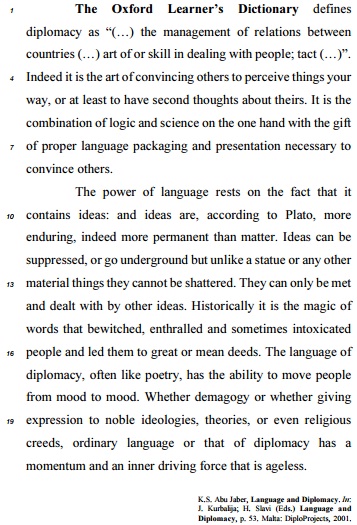
In relation to the pronouns shown in bold in the text above, judge if the items below are right (C) or wrong (E).
The pronoun “they” (l.13) refers to “Ideas” (l.11)
The pronoun “they” (l.13) refers to “Ideas” (l.11)
Ano: 2013
Banca:
CESPE / CEBRASPE
Órgão:
Instituto Rio Branco
Prova:
CESPE - 2013 - Instituto Rio Branco - Diplomata - Prova 2 |
Q359331
Inglês
In relation to the pronouns shown in bold in the text above, judge if the items below are right (C) or wrong (E).
The pronoun “It” (l.5) refers to “diplomacy” (l.2).
The pronoun “It” (l.5) refers to “diplomacy” (l.2).
Ano: 2013
Banca:
FUNCAB
Órgão:
CODATA
Prova:
FUNCAB - 2013 - CODATA - Analista de Informática - Banco de Dados |
Q307609
Inglês

The pronoun IT in “It also lists the hardware setup procedures” refers in the text to:
Ano: 2013
Banca:
FUNCAB
Órgão:
CODATA
Prova:
FUNCAB - 2013 - CODATA - Analista de Informática - Banco de Dados |
Q307608
Inglês
The pronoun IT in “the new technology it supports” refers in the text to:
Ano: 2013
Banca:
FCC
Órgão:
TRT - 9ª REGIÃO (PR)
Prova:
FCC - 2013 - TRT - 9ª REGIÃO (PR) - Analista Judiciário - Tecnologia da Informação |
Q302116
Inglês
December 12, 2012
If It’s for Sale, His Lines Sort It
By MARGALIT FOX
It was born on a beach six decades ago, the product of a pressing need, an intellectual spark and the sweep of a young man’s
fingers through the sand.
The result adorns almost every product of contemporary life, including groceries, wayward luggage and, if you are a
traditionalist, the newspaper you are holding.
The man on the beach that day was a mechanical-engineer-in-training named N. Joseph Woodland. With that transformative
stroke of his fingers − yielding a set of literal lines in the sand − Mr. Woodland, who died on Sunday at 91, conceived the modern bar
code.
Mr. Woodland was a graduate student when he and a classmate, Bernard Silver, created a technology, based on a printed
series of wide and narrow striations, that encoded consumer-product information for optical scanning.
Their idea, developed in the late 1940s and patented 60 years ago this fall, turned out to be ahead of its time, and the two men
together made only $15,000 from it, when they sold their patent to Philco. But the curious round symbol they devised would ultimately
give rise to the universal product code, or U.P.C., as the staggeringly prevalent rectangular bar code (it graces tens of millions of
different items) is officially known.

Here is part of the story behind the invention:
To represent information visually, he realized, he would need a code. The only code he knew was the one he had learned in the
Boy Scouts.
What would happen, Mr. Woodland wondered one day, if Morse code, with its elegant simplicity and limitless combinatorial
potential, were adapted graphically? He began trailing his fingers idly through the sand.
“What I’m going to tell you sounds like a fairy tale,” Mr. Woodland told Smithsonian magazine in 1999. “I poked my four fingers
into the sand and for whatever reason − I didn’t know − I pulled my hand toward me and drew four lines. I said: ‘Golly! Now I have four
lines, and they could be wide lines and narrow lines instead of dots and dashes.’ ”
That consequential pass was merely the beginning. “Only seconds later,” Mr. Woodland continued, “I took my four fingers − they
were still in the sand − and I swept them around into a full circle.”
Mr. Woodland favored the circular pattern for its omnidirectionality: a checkout clerk, he reasoned, could scan a product without
regard for its orientation.
But that method − a variegated bull’s-eye of wide and narrow bands −, which depended on an immense scanner equipped with
a 500-watt light, was expensive and unwieldy, and it languished for years.
The two men eventually sold their patent to Philco for $15,000 − all they ever made from their invention.
By the time the patent expired at the end of the 1960s, Mr. Woodland was on the staff of I.B.M., where he worked from 1951
until his retirement in 1987.
Over time, laser scanning technology and the advent of the microprocessor made the bar code viable. In the early 1970s, an
I.B.M. colleague, George J. Laurer, designed the familiar black-and-white rectangle, based on the Woodland-Silver model and drawing
on Mr. Woodland’s considerable input.
(Adapted from http://www.nytimes.com/2012/12/13/business/n-joseph-woodland-inventor-of-the-bar-code-dies-at-91.html?nl=todaysheadlines
&emc=edit_th_20121214&_r=0)
O pronome “It”, no início do texto, refere-se a
If It’s for Sale, His Lines Sort It
By MARGALIT FOX
It was born on a beach six decades ago, the product of a pressing need, an intellectual spark and the sweep of a young man’s
fingers through the sand.
The result adorns almost every product of contemporary life, including groceries, wayward luggage and, if you are a
traditionalist, the newspaper you are holding.
The man on the beach that day was a mechanical-engineer-in-training named N. Joseph Woodland. With that transformative
stroke of his fingers − yielding a set of literal lines in the sand − Mr. Woodland, who died on Sunday at 91, conceived the modern bar
code.
Mr. Woodland was a graduate student when he and a classmate, Bernard Silver, created a technology, based on a printed
series of wide and narrow striations, that encoded consumer-product information for optical scanning.
Their idea, developed in the late 1940s and patented 60 years ago this fall, turned out to be ahead of its time, and the two men
together made only $15,000 from it, when they sold their patent to Philco. But the curious round symbol they devised would ultimately
give rise to the universal product code, or U.P.C., as the staggeringly prevalent rectangular bar code (it graces tens of millions of
different items) is officially known.
Here is part of the story behind the invention:
To represent information visually, he realized, he would need a code. The only code he knew was the one he had learned in the
Boy Scouts.
What would happen, Mr. Woodland wondered one day, if Morse code, with its elegant simplicity and limitless combinatorial
potential, were adapted graphically? He began trailing his fingers idly through the sand.
“What I’m going to tell you sounds like a fairy tale,” Mr. Woodland told Smithsonian magazine in 1999. “I poked my four fingers
into the sand and for whatever reason − I didn’t know − I pulled my hand toward me and drew four lines. I said: ‘Golly! Now I have four
lines, and they could be wide lines and narrow lines instead of dots and dashes.’ ”
That consequential pass was merely the beginning. “Only seconds later,” Mr. Woodland continued, “I took my four fingers − they
were still in the sand − and I swept them around into a full circle.”
Mr. Woodland favored the circular pattern for its omnidirectionality: a checkout clerk, he reasoned, could scan a product without
regard for its orientation.
But that method − a variegated bull’s-eye of wide and narrow bands −, which depended on an immense scanner equipped with
a 500-watt light, was expensive and unwieldy, and it languished for years.
The two men eventually sold their patent to Philco for $15,000 − all they ever made from their invention.
By the time the patent expired at the end of the 1960s, Mr. Woodland was on the staff of I.B.M., where he worked from 1951
until his retirement in 1987.
Over time, laser scanning technology and the advent of the microprocessor made the bar code viable. In the early 1970s, an
I.B.M. colleague, George J. Laurer, designed the familiar black-and-white rectangle, based on the Woodland-Silver model and drawing
on Mr. Woodland’s considerable input.
(Adapted from http://www.nytimes.com/2012/12/13/business/n-joseph-woodland-inventor-of-the-bar-code-dies-at-91.html?nl=todaysheadlines
&emc=edit_th_20121214&_r=0)
O pronome “It”, no início do texto, refere-se a
Ano: 2012
Banca:
CESGRANRIO
Órgão:
Petrobras
Provas:
CESGRANRIO - 2012 - BR Distribuidora - Profissional Júnior - Formação Administração
|
CESGRANRIO - 2012 - BR Distribuidora - Profissional Júnior - Formação Engenharia Mecânica |
CESGRANRIO - 2012 - BR Distribuidora - Profissional Júnior - Formação Ciências Contábeis |
CESGRANRIO - 2012 - BR Distribuidora - Profissional Júnior - Formação Analista de Sistemas - Ênfase em Java - Crm e Web |
Q460777
Inglês

The pronoun they in “they don’t have time to train for those key skills.” (lines 38-39) refers to
Ano: 2012
Banca:
CESGRANRIO
Órgão:
TERMOBAHIA
Provas:
CESGRANRIO - 2012 - TERMOBAHIA - Técnico de Administração e Controle Júnior
|
CESGRANRIO - 2012 - TERMOBAHIA - Técnico de Segurança Júnior |
Q326241
Inglês

In the text, “They” (line 28) refers to the:

 Conheça nossos planos