Questões de Concurso
Sobre pronome subjetivo | subjective pronoun em inglês
Foram encontradas 105 questões


“Do ____ know Andy?”
Sure, he is in my class, I study with ____. Why?”
“Oh, nothing. I want ____ to help me, that's all.”
“I have ____ 'phone number. Call him!”
“Ok, thanks!"
The difficult journey to Olympic success
For Jessica Morgan, a young athlete New Zealand, a typical day starts early. Most mornings, she gets up 4:30 a.m., while her family is still bed, and trains before school. As an elite rower, she is one the best in her country, and she aims to compete in the next Olympic Games.
Jessica’s weekly schedule is grueling. She trains twice
a day, six days a week, and competes in rowing events
on the weekends. However, she’s also a normal
schoolgirl, and like every other sixteen-year-old at
high school, she regularly does her homework, too.
Jessica’s motivation is impressive. She never hangs
out with friends or takes a vacation. She isn’t only an
amazing athlete – she usually gets good grades in
school, too. Of course, it isn’t easy to become successful. Being the best at your sport requires hard work,
determination, and the help of family and coaches.
Young athletes’ relationships with their family and
coaches can influence their success in the future. Jessica’s parents usually spend hours every week taking
her to training and competitions, and they help her
to eat a healthy diet. Her coach plans her training
and enters her for competitions. But both parents
and coach must offer emotional support, too – for
example, when Jessica loses a competition or she gets
an injury. Luckily for Jessica, she has a good relationship with both her coach and family. But in other cases,
these relationships can place too much pressure on
young athletes. For this reason, some of them lose
their motivation to do well.
For Jessica, the most important factor in her future
success is her own desire to win. “I know talented
young athletes who give up because they feel lonely
without their friends,” she says. “But I prefer not to
think negatively.” Jessica believes she is responsible
for securing her future success. “It’s my decision to
train every morning and go back to it again every
afternoon. It’s my decision not to have a social life, and
never to take a vacation.” Not everyone can cope with
this kind of lifestyle. But each day Jessica moves one
step closer to achieving her Olympic dream.
1. The negative form of the following sentence: “ Luckily for Jessica, she has a good relationship with both her coach and family” is “Luckily for Jessica, she hasn’t a good relationship with both her coach and family.” 2. The words ‘however, but, for these reason’, in bold in the text are adverbs. 3. In the following sentence: “For Jessica, the most important factor in her future success is her own desire to win.” The underlined words are in the superlative form. 4. The underlined words in the text: “it, they, her, them” are personal pronouns.
Choose the alternative with all the correct sentences
Read the text and mark the CORRECT alternative form question:
Windsurfing around Britain
Kevin Cookston, a 23-year-old engineering student, has been keen on windsurfing for many years. Recently, he set a new record for travelling all the way round the coast of Great Britain on a windsurf board.
'I don‟t really know why I did it,‟ says Kevin, ‟just for the fun of it, I suppose. It was there to be done, that was all.‟ Despite lacking both the obsessive ambition and the funds that normally go with attempts to break records, Kevin made the journey in eight weeks and six days, knocking one week off the previous record set in 1984.
Leaving from Exmouth in the south-west of England, Kevin travelled up the west coast of England and Wales, before going round the top of Scotland and then coming back down the other side. The journey officially covered 2.896 kilometres, although given the changes of direction to find the right wind paths, the actual distance Kevin travelled is probably closer to 4.000 km.
Kevin fitted his fitness training in around his final year university examinations. ‟I didn‟t have that much time to prepare,‟ he explains. ‟But I went running often and supplemented that with trips to the gym to do weight training. I found I got a lot better during the trip itself actually. At the start, I was tired and needed a rest after four hours, but by the end I found I could do ten hours in a row no trouble.‟
Kevin had a budget of £7.000 to cover the whole expedition. The previous record had been set with a budget twice that size, while a recent unsuccessful attempt had cost £40.000. Budgets have to meet the cost of fuel, food and accommodation for the support team, as well as the windsurfer's own equipment and expenses.
Previous contenders had been accompanied by a boat on which they slept at night, as well as a fleet of vehicles on land to carry their supplies. Kevin made do with an inflatable rubber boat and an old van manned by four friends who followed his progress. Overnight arrangements had to be found along the way. Apart from the odd occasion when they enjoyed the hospitality of friends, the team made use of the camping equipment carried in the van, and slept on the beach.
When asked if his athlete‟s diet was a closely kept secret, Kevin replied that he ate a lot of pasta and added the odd tin of tuna to keep up his energy. ‟Basically, we had anything that was on special offer in the nearest supermarket, he confided.
Such a prolongued period of gruelling windsurfing made relaxation important however, and for this, Kevin favoured the pub method. This also provided social opportunities.“The people we met were really encouraging he recalls“. 'They thought what we were doing was really great. It was hard work, but we had a lot of fun along the way“.
Kevin has been windsurfing since he was thirteen years old and he is also a highly-ranked competitor at national level. ‟I don‟t know where I‟m ranked now,‟ he says, `because I‟ve missed a lot of important competitions this year. But what I did has more than made up for that and I‟ll be doing my best to be up there amongst the winners once I get back into the competitive sport next season‟. Given his unique achievement this year, Kevin seems well-placed to take on the world‟s top windsurfers.
Fonte: First Certificate Practice Tests Plus 1, pg 116 Kenny/ Luque-Mortimer, Ed. Longman
Texto 01
Going Mobile, Going Further!
By Anderson Francisco Guimarães Maia – October 28, 2016
So what happens to “learning” if we add the word “mobile” to it? The increasing and rapidly developing use of mobile technology by English language learners is an unquestionable aspect of today’s classroom. However, the attitude EFL teachers develop towards the use of mobile devices as an aid for language teaching varies greatly.
The unique benefits of mobile learning for EFL teachers include the ability to bridge formal and informal learning, which for language learners may be realized through supplementary out-of-classroom practice, translation support when communicating with target language speakers and the capture of difficulties and discoveries which can be instantly shared as well as being brought back into the classroom. Mobile learning can deliver, supplement and extend formal language learning; or it can be the primary way for learners to explore a target language informally and direct their own development through immediacy of encounter and challenge within a social setting. We still miss sufficient explicit connection between these two modes of learning, one of which is mainly formal and the other informal. Consequently, there are missed opportunities in terms of mutual benefit: formal education remains somewhat detached from rapid socio-technological change, and informal learning is frequently sidelined or ignored when it could be used as a resource and a way to discover more about evolving personal and social motivations for learning.
One example of how mobile devices can bridge formal and informal learning is through instantmessaging applications. Both synchronous and asynchronous activities can be developed for language practice outside the classroom. For example, in a discussion group on Whatsapp, students can discuss short videos, practice vocabulary with picture collages, share recent news, create captions and punch lines for memes, and take turns to create a multimodal story. Teachers can also create applications specifically to practice new vocabulary and grammar to support classroom learning.
Digital and mobile media are changing and extending language use to new environments as well as creating opportunities to learn in different ways. Mobile technology enables us to get physically closer to social contexts of language use which will ultimately influence the ways that language is used and learned. Therefore, let us incorporate mobile learning into our EFL lessons and literally “have the world in our hands”.
(Disponível em http://www.richmondshare.com.br/going-mobile-going-further/)

Based on the text, judge the following item.
“They” in “They’re all” (line 4) refers to “two
superheroes” (line 1).


Read the text about Nobel Prize for the question.
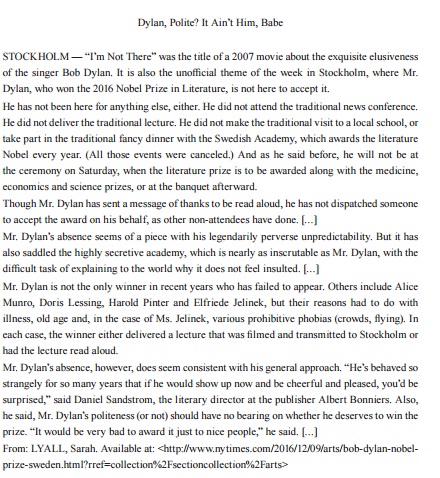
Read the text about Nobel Prize for the question.
Based on the article, it is correct to affirm that the pronouns “it” (l.2), “it” (l.14), and “he” (l.23), RESPECTIVELY, refer to:
Based on text 2, an adapted forum discussion, answer question below.
Teaching with no books
Dianne Bell
I have started teaching in a language school suggesting no books to teach except for some magazines. These show the framework what should be worked on, for example, countability and that’s it. When it was offered I accepted the job easily because it seemed challenging and at the same time simple but now I’m out of reliable materials. Please help me out in what ways I can find materials for all the suggested frameworks.
Comments

Mila Junior and Senior Teacher
Posted on 02/22/2015
What exactly are you supposed to be teaching (i.e., conversation, grammar, business English, etc.)? Can you give more examples of the “frameworks”? If there are no books or resources, it sounds like the school wants you to do conversation classes. These can be easy to prepare if you tell the students to come prepared with a topic to discuss. Then, you can assist them with keeping a conversation going, asking questions, giving opinions, etc.

Flore
Secondary Teacher
Posted on 01/07/2015
Hi, I think it really does depend on the students and the level you are teaching to. I have found a lot of online resources are useful, especially news articles. If you just type in “Free online English lessons” or something similar you are bound to find resources. I had to teach like that once. They give you a book with a list of what you should be teaching in each lesson but nothing else. The teacher has to make the lesson up out of thin air each time, and it’s pretty time-consuming.

Jake
Science Educator
Posted on 11/22/2015
There are so many other resources out there for teachers to use, online and off, that teaching without textbooks is becoming more and more acceptable including websites, iPod lectures and field trips — that will encourage you to toss out your textbooks. Before you can toss out the textbook and replace it with technology tools, you’ll need to understand how your students — whatever their age — respond to and work with technology.
(Adapted from https://www.englishclub.com/)
Read TEXT 3 and answer question.
TEXT 3
THE PAPERLESS CLASSROOM IS COMING
Michael Scherer
Back-to-school night this year in Mr. G’s sixth-grade classroom felt a bit like an inquisition.
Teacher Matthew Gudenius, a boyish, 36-year-old computer whiz who runs his class like a preteen tech startup, had prepared 26 PowerPoint slides filled with facts and footnotes to deflect the concerns of parents. But time was short, the worries were many, and it didn’t take long for the venting to begin.
“I like a paper book. I don’t like an e-book,” one father told him, as about 30 adults squeezed into a room for 22 students. Another dad said he could no longer help his son with homework because all the assignments were online. “I’m now kind of taking out of the routine.”, he complained. Rushing to finish, Gudenius passed a slide about the debate over teaching cursive, mumbling, “We don’t care about handwriting.” In a flash a mother objected: “Yeah, we do.”
At issue was far more than penmanship. The future of K-12 education is arriving fast, and it looks a lot like Mr. G’s classroom in the northern foothills of California’s wine country. Last year, President Obama announced a federal effort to get a laptop, tablet or smartphone into the hands of every student in every school in the U.S. and to pipe in enough bandwidth to get all 49.8 million American kids online simultaneously by 2017. Bulky textbooks will be replaced by flat screens. Worksheets will be stored in the cloud, not clunky Trapper Keepers. The Dewey decimal system will give way to Google. “This one is a big, big deal,” says Secretary of Education Arne Duncan.
It’s a deal Gudenius has been working to realize for years. He doesn’t just teach a computer on every student’s desk; he also tries to do it without any paper at all, saving, by his own estimate, 46,800 sheets a year, or about four trees. The paperless learning environment, while not the goals of most fledgling programs, represents the ultimate result of technology transforming classroom.
Gudenius started teaching as a computer-lab instructor, seeing students for just a few hours each month. That much time is still the norm for most kids. American schools have about 3.6 students for every classroom computing device, according to Education Market Research, and only 1 in 5 school buildings has the wiring to get all students online at once. But Gudenius always saw computers as a tool, not a subject. “We don’t have a paper-and-pencil lab, he says. When you are learning to be a mechanic, you don’t go to a wrench lab.”
Ask his students if they prefer the digital to the tree-based technology and everyone will say yes. It is not unusual for kids to groan when the bell rings because they don’t want to leave their work, which is often done in ways that were impossible just a few years ago. Instead of telling his students to show their work when they do an algebra equation, Gudenius asks them to create and narrate a video about the process, which can then be shown in class. History lessons are enlivened by brief videos that run on individual tablets. And spelling, grammar and vocabulary exercises have the feel of a game, with each student working at his own speed, until Gudenius – who tracks the kids’ progress on a smartphone – gives commands like “Spin it” to let the kids know to flip the screens of their devices around so that he can see their work and begin the next lesson.
Source: TIME- How to Eat Now. Education: The Paperless Classroom is Coming, p. 36-37; October 20, 2014
TEXT 1
WHY MILLENIALS WILL SAVE US ALL
By Joel Stein
I am about to do what old people have done throughout history: call those younger than me lazy, entitled, selfish and shallow. But I have studies! I have statistics! I have quotes from respected academics! Unlike my parents, my grandparents and my great-grandparents, I have proof.
Here’s the code, hard data: the incident of narcissistic personality disorder in nearly three times as high for people in their 20s as for the generation that’s now 65 or older, according to the National Institutes of Health; 58% more college students scored higher on a narcissism scale in 2009 than in 1982. Millennials got so many participation trophies growing up that a recent study showed that 40% believe they should be promoted every two years, regardless of performance. They are fame obsessed: three times as many middle school girls want to grow up to be a personal assistant to a famous person as want to be a senator, according to a 2007 survey; four time as many would pick the assistant job over CEO of a major corporation. They’re so convinced of their own greatness that the National Study of Youth and Religion found the guiding morality of 60% of millennials in any situation as that they’ll just be able to feel what’s right. Their development is stunted: more people ages 18 to 29 live with their parents than with a spouse, according to the 2012 Clarck University Poll of Emerging Adults. And they are lazy. In 1992, the non-profit Families and Work Institute reported that 80% of people under 23 wanted to one day have a job with greater responsibility; 10 years later, only 60% did.
Millennials consist, depending on whom you ask, of people born from 1980 to 2000. To put it more simply for them, since they grew up not having to do a lot of math in their heads, thanks to computers, the group is made up mostly of teens and 20-somethings. At 80 million strong, they are the biggest age grouping in American history. Each country’s millennials are different, but because of globalization, social media, the export of Western culture and the speed of change, millennials worldwide are more similar to one another than to old generations within their nations. Even in China, where family history is more important than any individual, the internet, urbanization and the onechild policy have created a generation as overconfident and self-involved as the Western one. And these aren’t just rich-kid problems: poor millennials have even higher rates of narcissism, materialism and technology addiction in their ghetto-fabulous lives.
They are the most threatening and exciting generation since the baby boomers brought about social revolution, not because they’re trying to take over the Establishment but because they’re growing up without one. The Industrial Revolution made individuals far more powerful - they could move to a city, start a business, read and form organizations. The information revolution has further empowered individuals by handing them the technology to compete against huge organizations: hackers vs. corporations, bloggers vs. newspapers, terrorists vs. Nation-states, YouTube directors vs. studios, app-makers vs. entire industries. Millennials don’t need us. That’s why we’re scared of them.
In the U.S, millennials are the children of baby boomers, who are also known as the Me Generation, who then produced the Me Me Me Generation, whose selfishness technology has only exarcebated. Whereas in the 1950s families displayed a wedding photo, a school photo and maybe a military photo in their homes, the average middle-class American family today walks amid 85 pictures of themselves and their pets. Millennials have come of age in the era of the quantified self, recording their daily steps on FitBit, their whereabouts every hour of every day on PlaceMe and their genetic data on 23 and Me. They have less civic engagement and lower political participation than any previous group. This is a generation that would have made Walt Whitman wonder if maybe they should try singing a song of someone else.
They got this way partly because in the 1970s, people wanted to improve kids’ chances of success by instilling self-esteem. It turns out that self-esteem is great for getting a job or hooking up at a bar but not so great for keeping a job or a relationship. “It was an honest mistake,” says Roy Baumeister, a psychology professor at Florida State University and the editor of Self-Esteem: The puzzle of Low Self-Regard. “The early findings showed that, indeed, kids with high self-esteem did better in school and were less likely to be in various kinds of trouble. It’s just that we’ve learned latter that self-esteem is a result, not a cause.” The problem is that when people try to boost self-esteem, they accidentally boost narcissism instead. “Just tell your kids you love them. It’s a better message,” says Jean Twenge, a psychology professor at San Diego State University, who wrote Generation Me and The Narcissism Epidemic. “When they’re little it seems cute to tell them they’re special or a princess or a rock star or whatever their T-shirt says. When they’re 14 it’s no longer cute.” All that self-esteem leads them to be disappointed when the world refuses to affirm how great they know they are. “This generation has the highest likelihood of having unmet expectations with respect to their careers and the lowest levels of satisfaction with their careers at the stage that they’re at,” says Sean Lyons, co-editor of Managing the New Workforce: International Perspectives on the Millennial Generation. “It is sort of a crisis of unmet expectations.”
What millennials are most famous for, besides narcissism is its effect: entitlement. If you want to sell seminars to middle managers, make them about how to deal with young employees who email the CEO directly and beg off projects they find boring. English teacher David McCullough Jr.’s address last year to Wellesley High School’s graduating class, a 12-minute reality check titled “You Are Not Special,” has nearly 2 million hits on YouTube. “Climb the mountain so you can see the world, not so the world can see you,” McCullough told the graduates. He says nearly all the response to the video has been positive, especially from millennials themselves; the video has 57 likes for every dislike. Though they’re cocky about their place in the world, millennials are also stunted, having prolonged a life stage between teenager and adult that this magazine once called twixters and will now use once again in an attempt to get that term to catch on. The idea of the teenager started in the 1920s; in 1910, only a tiny percentage of kids went to high school, so most people’s social interactions were with adults in their families or in the workplace. Now that cell phones allow kids to socialize at every hour – they send and receive an average of 88 texts a day, according to Pew – they’re living under the constant influence of their friends. “Peer pressure is anti-intellectual. It is anti-historical. It is anti-eloquence,” says Mark Bauerlein, an English professor at Emory, who wrote The Dumbest Generation: How the Digital Age Stupefies Young Americans and Jeopardizes Our Future (or, Don’t Trust Anyone Under 30). “Never before in history have people been able to grow up and reach age 23 so dominated by peers. To develop intellectually you’ve got to relate to older people, older things: 17-year-olds never grow up if they’re just hanging around other 17-year-olds.” Of all the objections to Obamacare, not a lot of people argued against parents’ need to cover their kids’ health insurance until they’re 26.
Millennials are interacting all day but almost entirely through a screen. You’ve seen them at bars, sitting next to one another and texting. They might look calm, but they’re deeply anxious about missing out on something better. Seventy percent of them check their phones every hour, and many experience phantom pocket-vibration syndrome. “They’re doing a behavior to reduce their anxiety,” says Larry Rosen, a psychology professor at California State University at Dominguez Hills and the author of iDisorder. That constant search of a hit of dopamine (“Someone liked my status update!”) reduces creativity. From 1966, when the Torrance Tests of Creativity Thinking were first administered, through the mid-1980s, creativity scores in children increased. Then they dropped, falling sharply in 1998. Scores on tests of empathy similarly fell sharply, starting in 2000, likely because of both a lack to face-to-face time and higher degrees of narcissism. Not do only millennials lack the kind of empathy that allows them to feel concerned for others, but they also have trouble even intellectually understanding others’ points of view.
So, yes, we have all that data about narcissism and laziness and entitlement. But a generation’s greatness isn’t determined by data; it’s determined by how they react to the challenges that befall them. And, just as important, by how we react to them. Whether you think millennials are the new greatest generation of optimistic entrepreneurs or a group of 80 million people about to implode in a dwarf star of tears when their expectations are unmet depends largely on how you view change. Me, I choose to believe in the children. God knows they do.
Source: Time. Available at http://time.com/247/millennials-the-me-me-me-generation/
Accessed on October 24, 2016.
Atenção: A questão refere-se ao texto abaixo.
Judges Push Brevity in Briefs, and Get a Torrent of Arguments
By ELIZABETH OLSON
OCT. 3, 2016
The Constitution of the United States clocks in at 4,543 words. Yet a number of lawyers contend that 14,000 words are barely enough to lay out their legal arguments.
That’s the maximum word count for briefs filed in federal appellate courts. For years, judges have complained that too many briefs are repetitive and full of outmoded legal jargon, and that they take up too much of their time.
A recent proposal to bring the limit down by 1,500 words unleashed an outcry among lawyers.
Lawyers in criminal, environmental and securities law insisted that briefs’ lengths should not be shortened because legal issues and statutes are more complex than ever
As a result, the new word limit − which takes effect on Dec. 1 − will be 13,500 words, a reduction of only 500 words. And appellate judges will have the freedom to opt out of the limits.
The new limit may not provide much relief for judges deluged with verbose briefs.
While workloads vary, according to federal court data, the average federal appeals court judge, for example, might need to read filings for around 1,200 cases annually.
That amount of reading − especially bad reading − can thin the patience of even the most diligent judge.
Briefs “are too long to be persuasive,” said Laurence H. Silberman, a judge on the United States Court of Appeals for the District of Columbia Circuit
In arguing against a reduction of words, the American Academy of Appellate Lawyers urged singling out “bad briefs” rather than only lengthy ones. It advised courts to “post on their court websites short videos outlining how to write a decent brief.”
Robert N. Markle, a federal appellate lawyer, has argued − in his own personal view, not the government’s − that the limit should be reduced to 10,000 words. In a typical case, he said, “nothing justifies even approaching, much less reaching or exceeding 14,000 words.”
Still, he acknowledged that the cut of 500 words “was at least a start.”
(Adapted from http://www.nytimes.com/2016/10/04/business/dealbook/judges-push-brevity-in-briefs-and-get-a-torrent-of-arguments. html?_r=0)
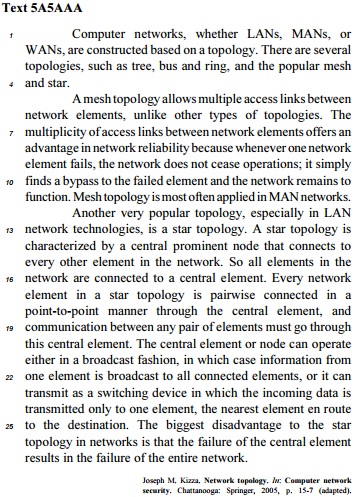
In the text 5A5AAA,
“it” ( .9) refers to “network element” (
 . 8 and 9).
The advantage
1 CARE Acquiring a new aircraft is already a complex enough process. Acquiring a pre-owned aircraft can be an even more challenging task. The industry has its fair share of brokers and experts all willing to offer you the best deal in town but, regrettably, once you have signed and the aircraft is delivered, they tend to vanish as they move onto the next deal. Our philosophy is very different. Every Embraer aircraft we lease has passed through our own Embraer facilities. Every aircraft is treated with a level of service and care that can only come from those who built them in the first place.
2 SUPPORT In choosing one of our pre-owned aircraft, all of our customers share a common goal: to ensure that the aircraft delivered perform seamlessly from day one and continue to perform for many years to come. In response to this, we offer the Lifetime Program by Embraer. This program represents a first in the industry and is the result of a very detailed review between ECC and Embraer on how best to support our customers. The Lifetime Program is unique to pre-owned Embraer aircraft and offers a wide range of services from startup through operation.
3 RELIABLE So when an ECC pre-owned aircraft is offered for delivery to its new home you can rest assured that it will provide many years of happy, reliable service. Our focus does not end there since we value the relationships we build with our customers. Our Lifetime Program is testament to this. This is a unique and new service from Embraer to support our used aircraft. We invite you to learn, in greater detail, how it will not only enhance your operation, but also keep your Chief Financial Officer happy. Transparency in costs and flexibility in adapting to your needs. It is our way of showing that every Embraer aircraft we offer has our seal of approval. Coming from the manufacturer, that's no small thing.
Source: http://www.eccleasing.com/Pages/fator.aspx [slightly adapted]
A design pattern is often posed as a question: how do we solve some design problem? However a design problem is, by its nature, nonspecific, and rarely has a single straight-forward answer. There might be several ways to solve the same problem, some better than others depending on the specific situation and the specific context of the problem. A design pattern is intended to share not just solutions but a better understanding of both the problem and how it might be solved. Firstly, patterns have a well-defined structure. This consistent layout makes it easy to browse through a collection of patterns to find relevant help and then dive further into the material. The structure encourages the author of the pattern to think carefully about the knowledge they're sharing, whilst making the material more consistently accessible to a reader.
(http://www.cambridgesemantics.com/semantic-university/semantic-web-design-patterns)
Na expressão: “… how it might be solved…”, a palavra sublinhada refere-se a:

Based on the text above, judge the following items.
In the first paragraph, the word “it” (l. 2 and 3) refers to
“technology” (l.2) both in “when it comes” (l.2) and in “it is
more” (l.3).

The words “their" (
 13) and “they" (14) refer, respectively,
to “people" (13) and “roles" (13).
13) and “they" (14) refer, respectively,
to “people" (13) and “roles" (13).
Based on the text, judge the following items.
In the excerpt “it takes place before an action is carried out”
(l. 38 and 39), the pronoun “it” refers to “anticipatory tool”
(l.38).

 Conheça nossos planos