🎯 Saiba o que estudar

Avançado com Treinador a partir de R$ 0,76/dia

Questões de Concurso Sobre pronome subjetivo | subjective pronoun em inglês

Foram encontradas 105 questões

Q4242180 Inglês
Leia o trecho extraído do romance Ulysses, de James Joyce.
"He is gone from mortal haunts: O’Dignam, sun of our morning. Fleet was his foot on the bracken: Patrick of the beamy brow. Wail, Banba, with your wind: and wail, O ocean, with your whirlwind.
—There he is again, says the citizen, staring out. —Who? says I. —Bloom, says he. He’s on point duty up and down there for the last ten minutes. And, begob, I saw his physog do a peep in and then slider off again. Little Alf was knocked bawways. Faith, he was. —Good Christ! says he. I could have sworn it was him. And says Bob Doran, with the hat on the back of his poll, lowest blackguard in Dublin when he’s under the influence: —Who said Christ is good? —I beg your parsnips, says Alf." JOYCE, James. Ulysses. Paris: Shakespeare and Company, 1922, p. 390. 

Considerando-se o uso dos pronomes em Língua Inglesa e seu papel na coesão textual, assinale a alternativa correta.
Alternativas
Q4237502 Inglês
Deaths in France surged 30% during hottest week of record June heatwave

                                                                                                                                                      By Jon Henley 

q_36 i e p.png (679×437)

(Available at: https://www.theguardian.com/world/2026/jul/03/deaths-france-surged-hottest-week-recordheatwave-june – text specially adapted for this test). 
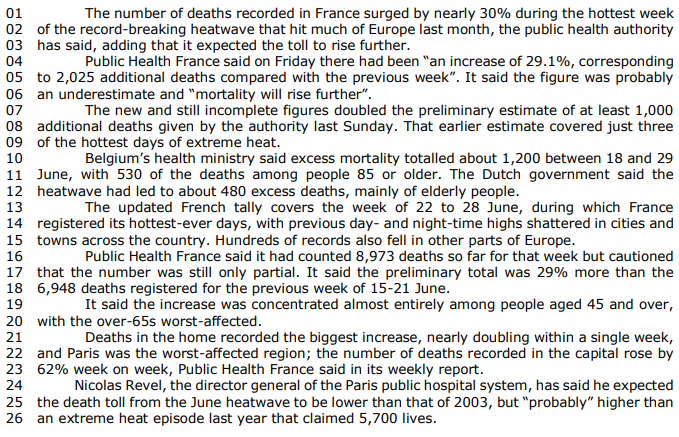
In the sentence “It said the figure was probably an underestimate [...]” (l. 05-06), the pronoun “It” refers to:
Alternativas
Q4221001 Inglês
Assinale a alternativa em que a função sintático-semântica do pronome "it" difere daquela observada nas demais: 
Alternativas
Q4219693 Inglês
Underground library in Warsaw metro invites commuters to trade scrolling for stories

In Warsaw’s Targówek district, a metro ride has become more than a daily routine. Now it offers a chance to escape into a story. Thanks to Metroteka, a newly opened subterranean library inside the Kondratowicza M2 metro station, commuters can now trade mindless scrolling for meaningful reading.

The 150-square-meter space is stocked with more than 16,000 books, all available through a fast self-checkout system. Visitors can also borrow laptops, sip complimentary coffee, and unwind in a cozy communal area, all while waiting for their train.

“Our dream is for Metroteka to become an educational and cultural center, and not just a place where you can borrow your books from,” says Grażyna StrzelczakBatkowska, deputy director of the Targówek library.

A modern space that breathes life into books

Metroteka’s design is as inviting as its mission. A lush hydroponic garden wall filled with herbs and flowers gives the underground space a breath of fresh air, literally. Basil, oregano, and other plants grow without soil or sunlight, infusing the library with an unexpected sense of vitality. The bookshelves, shaped like soft, undulating waves, add to the organic feel.

“I always joke that books are not made of glass,” Strzelczak-Batkowska says. “You can just pop in, grab a few, throw them on a self-checkout machine, and that’s it—you’re out on a new adventure.”

Aiming to reverse a national trend

Poland’s reading habits have been in steady decline for years. A 2024 survey by the National Library of Poland found that only 41 percent of respondents had read at least one book in the past year. According to Tomasz Makowski, director of the National Library, the legacy of war has shaped these numbers. During World War II, Poland lost 70 percent of its libraries.

“We had several generations that did not see their parents or grandparents in front of a wall of books,” Makowski says. “Reading is [also] not something associated with adulthood, but with schools, teachers, librarians, and usually mothers reading to children.”

By placing literature in the path of everyday commuters, Metroteka hopes to shift that cultural perception.

An open invitation to all

For Makowski, the location is just as important as the books. “Opening a library in a metro station is like a dream for us,” he says. “Libraries should be beautiful and open; inviting, not intimidating. It’s not a shrine, but a place where you can spend time freely, take part in discussions, public consultations, or meet people.”

In the coming months, Metroteka plans to host author readings, workshops, and classes to further engage the community. Books can be returned either directly to the library or via parcel lockers outside the station, available around the clock.

As commuters pass through Kondratowicza station with coffee in hand and a novel tucked under one arm, Metroteka quietly transforms daily routines into cultural moments. By meeting people where they are, literally underground, the library isn’t just promoting reading. It’s redefining what public space can offer.


Source: https://www.optimistdaily.com/2025/09/underground-libraryin-warsaw-metro-invites-commuters-to-trade-scrolling-for-stories/. Access on May 4th 2026. 
Read the following quote, taken from paragraph 05 of the text, then analyze the statements about it.

“I always joke that books are not made of glass”

I. ‘I’ is a subject pronoun.
II. The sentence is written in Present Perfect.
III. ‘always’ is an adverb of frequency.
IV. ‘books are not made of glass’ is an example of Passive Voice.

Which statements are completely accurate?
Alternativas
Q4126080 Inglês

TEXT


Adapted from: BBC Ideas and The Open University (2026) Would you want to be cared for by a robot when you are older? [video]. Instagram. Available at: https://www.instagram.com/reel/DX_03WVle-- /?igsh=MXhhdHJ4NzlpeGE5dA%3D%3D. (Accessed: May 31, 2026). 


ANSWER QUESTION ACCORDING TO THE TEXT ABOVE.

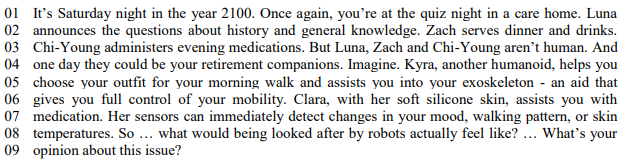
The pronoun they (line 04) refers to 
Alternativas
Q4100905 Inglês
Consider the following pairs of Direct Speech and their corresponding Reported Speech versions. Analyze the accuracy of the transformations regarding backshift of tenses, pronouns, and time expressions:

I. Direct: "I will visit you tomorrow," she said to me.
Reported:She told me that she would visit me the following day.
II. Direct: "Did you finish the lesson?" the teacher asked.
Reported:The teacher asked if I had finished the lesson.
III. Direct: "Don't touch the wire!" he shouted.
Reported: He shouted me to not touch the wire.
IV. Direct: "I have lived here for ten years," Paul mentioned.
Reported:Paul mentioned that he had lived there for ten years.

Which of the statements above present a CORRECTtransformation into Reported Speech?
Alternativas
Q4071948 Inglês
I saw ___ yesterday. (Mary)
Alternativas
Q3829929 Inglês
Cohesion is achieved through grammatical and lexical devices that link parts of a text, establishing semantic unity through reference direction. Identify the alternative that presents a clear case of cataphoric reference, where the pronoun precedes its specific referent. 
Alternativas
Q3685044 Inglês
Education: A Comprehensive Overview


Education encompasses the teaching and acquisition of knowledge, proper conduct, and technical proficiency. It emphasizes the development of skills, trades, or professions, along with mental, moral, and aesthetic growth.

Formal education entails structured instruction, teaching, and training delivered by professional educators. It involves the application of pedagogy and the creation of curricula. 

The right to education is a fundamental human right. Since 1952, Article 2 of the First Protocol to the European Convention on Human Rights has mandated all signatory parties to ensure this right. At the global level, the United Nations’ International Covenant on Economic, Social, and Cultural Rights of 1966 guarantees the right to education under Article 13.

Educational systems are established to provide education and training, often targeting children and youth. A curriculum outlines what students should know, understand, and be capable of doing after completing their education. The teaching profession facilitates learning, and a framework of policies, regulations, examinations, structures, and funding supports educators in delivering high-quality education.

Primary (or elementary) education encompasses the initial years of formal, structured education. Typically lasting six or seven years, primary education begins around the age of 5 or 6, though this timeframe varies among countries. Globally, approximately 70% of primary-age children are enrolled in primary education, with this figure steadily increasing.

In most contemporary educational systems worldwide, secondary education covers the subsequent years of formal education occurring during adolescence. It marks the transition from compulsory, comprehensive primary education for minors to optional, selective tertiary, or higher education (e.g., university, vocational school) for adults.

Higher education, also referred to as tertiary, third stage, or post-secondary education, is the non-compulsory educational level following the completion of secondary schooling, such as high school or secondary school. Tertiary education typically includes undergraduate and postgraduate programs, as well as vocational education and training. Colleges and universities serve as the primary institutions offering tertiary education and are collectively known as tertiary institutions. Completion of tertiary education often leads to the attainment of certificates, diplomas, or academic degrees.


source: myenglishpages-adapted
Study the use of the underlined word in the following sentence from the text:

“A curriculum outlines what students should know, understand, and be capable of doing after completing their education.”

The underlined word:
Alternativas
Q3517840 Inglês
        A lack of women at decision-making tables around the world is hindering progress when it comes to tackling conflicts or improving health and standard of living, the highest-ranking woman in the UN (United Nations) has said.

         “We’re half the population. And what we bring to the table is incredibly important and it’s missing”, said Amina Mohammed, the UN deputy secretary general. “I think it’s why mostly our human development indices are so bad, why we have so many conflicts and we’re unable to come out of the conflicts.”

         Since her appointment in 2017, Mohammed has been a constant voice in pushing back against the under-representation of women in politics, diplomacy and even the UN general assembly. Her efforts have helped cast a spotlight on the fact that women remain relegated to the margins of power around the world; last year the global proportion of female lawmakers stood at 26.9%, according to Switzerland’s Inter-Parliamentary Union.

         Speaking to The Guardian, Mohammed said “flexing muscle and testosterone” often dominated at tables of power around the world. “This win, win, win at all costs — I think that would change if women were at the table”, she said. 

        She acknowledged that the world had seen a handful of female leaders who had not used their position to advocate for greater peace or conflict resolution. “Fair point, we see women in power and they’re sometimes the image of men”, she said. But she described it as unfair to judge women on an individual basis while they were still within the confines of a system dominated by men. “We don’t judge men that way.”

         Mohammed highlighted how many parts of society still view women in power as “about taking away, rather than adding” value. “And we have to change that mentality”, she said.

       “We kept looking at the Band-aid: put the women in office, let’s have affirmative action. And we never connected the dots for women themselves to build the constituencies and to go out and vote”, she said. “So we have to have a conversation with women first. Because if we’re doing this for women, should it not be by women?”

Ashifa Kassam. Lack of women at global tables of power hinders progress, says top UN official.
In: The Guardian, 19/6/2024. Internet:: <www.theguardian.com.>  (adapted). 

Based on the previous text, judge the following item.  


In the fragment ‘And what we bring to the table is incredibly important and it’s missing’ (second sentence of the second paragraph), the pronoun ‘we’ refers specifically to the women that are part of decision-making tables.  

Alternativas
Q3183698 Inglês
        Augmented reality is enhancing the patient experience in dental procedures. Dentists can now use AR technology to create interactive and immersive simulations of dental treatments. Patients can visualize the entire process, from tooth restoration to orthodontic adjustments, before the actual procedure takes place. This not only alleviates anxiety but also allows patients to make informed decisions about their dental care. By incorporating AR into their practices, dentists enhance communication, build trust, and ensure a more comfortable experience for their patients.

Internet:<www.myrobstowndentistry.com>  (adapted).

Based on the text and general knowledge, judge the following item.


The word “their” in “By incorporating AR into their practices” is an object pronoun and indicates that the practices belong to the dentists.

Alternativas
Q3175673 Inglês
Instruction: Answer question based on the following cartoon by Jim Davis. 

Mark the alternative that correctly and respectively fills in the blanks in the text: 
Alternativas
Q3349227 Inglês

Leia o texto para responder à questão.


    Building on the professional consensus that no method could claim supremacy, Prabhu (1990) asks why there is no best method. He suggests that there are three possible explanations: (1) different methods are best for different teaching / learning circumstances; (2) all methods have some truth or validity; and (3) the whole notion of what is a good or a bad method is irrelevant. Prabhu argues for the third possibility and concludes that we need to rethink what is “best” such that classroom teachers and applied linguists can develop shared pedagogical perceptions of what real-world classroom teaching is.

    H.D. Brown (2002), in his critique of methods, adds the following two observations: (1) so-called designer methods seem distinctive at the initial stage of learning but soon come to look like any other learner centered approach; and (2) it has proven impossible to empirically (i.e., quantitatively) demonstrate the superiority of one method over another. Brown (2002) concludes that classroom teachers do best when they ground their pedagogy in “well-established principles of language teaching and learning” (p.17).

    So what are these well-established principles that teachers should apply in the post methods era? One of the early concrete proposals comes from Kamaravadivelu (1994), who offers a framework consisting of 10 macro strategies, some of which are summarized below:

    – Maximize learning opportunities. The teacher’s job is not to transmit knowledge but to create and manage as many learning opportunities as possible.

    – Facilitate negotiated interaction. Learners should initiate classroom talk (not just respond to the teacher’s prompts) by asking for clarification, by confirming, by reacting, and so on, as part of teacher-student and student-student interaction.

    – Activate intuitive heuristics. Teachers should provide enough data for learners to infer underlying grammatical rules, since it is impossible to explicitly teach all rules of the L2.

    – Integrate language skills. The separation of listening, reading, speaking, and writing is artificial. As in the real-world, learners should integrate skills: conversation (listening and speaking), note-taking (listening and writing), self-study (reading and writing), and so on.

    – Raise cultural consciousness. Teachers should allow learners to become sources of cultural information so that knowledge about the culture of the L2 and of other cultures (especially those represented by the students) becomes part of classroom communication.

    – Ensure social relevance: acknowledge that language learning has social, political, economic, and educational dimensions that shape the motivation to learn the L2, determine the uses to which the L2 will be put, and define the skills and proficiency level needed in the L2.


(Celce-Murcia, M. 2001. Adaptado)

No trecho do segundo parágrafo do texto “It has proven impossible to empirically (i.e., quantitatively) demonstrate”, o pronome em negrito não tem um referente. É usado no lugar do sujeito da sentença. O termo em negrito que apresenta o mesmo uso que aquele do exemplo retirado do texto é:
Alternativas
Q3269560 Inglês

Read the following text carefully.


Despite _______desire to explore new places, neither Clara nor Liam is willing to compromise on comfort.______ are both cautious, so______ choose destinations with well-established amenities. However, their differing tastes mean that one of _____often ends up conceding to the other’s preferences, even though _______have similar ideas of what makes a perfect vacation.


Choose the following option with five pronouns that complete the text correctly

Alternativas
Q3269543 Inglês

Since January 2023, the Amazon Fund has received BRL 3.9 billion in new donations. The resumption of the fund was accompanied by and results from the return of effective policies to control deforestation in Brazil, with very significant results. The Fund, which had contributions from Germany and Norway, had been frozen by the previous government. Under President Lula's government, it also received resources from Denmark, the European Union, Switzerland, the United Kingdom and the USA.


Ministry of foreign affairs - September 12th, 2023


 In the sentence, what does the subject "it" refer to?

Alternativas
Q3129903 Inglês
Choose the option that best completes the sentence below:
"The manager asked the team to come up with innovative solutions to improve ______ performance this quarter."
I. our II. their III. your IV. his 
Alternativas
Q3072535 Inglês
For question, choose the best option to fill in the blanks correctly and respectively.
“I asked ______ some questions about ______ new house.”
Alternativas
Q3010798 Inglês
Pronouns make links to what has already been said and help avoid repetition. Pronouns can be used as cohesive devices in order to create cohesion. A pronoun is a word that stands in for a noun, often to avoid the need to repeat the same noun over and over. Like nouns, pronouns can refer to people, things, concepts, and places. Most sentences contain at least one noun or pronoun. Pronouns do more than helping avoid repetitiveness. They provide context, make sentences’ meanings clearer, and shape how we perceive people and things. Read the sentences that follow and do what is required.

I. Her aunt will be vacating next week.
II. That toy on the shelf is mine.
III. Did you do it yourself?
IV. She is the girl I was talking to you about.
V. I am going home today evening.
VI. All my friends are coming home for my birthday party.

In the order they were respectively underlined and written in bold letters, the pronouns written in the sentences above have specific functions, check the answer whose pronouns types are correspondent to the ones read above. 

Alternativas
Q2555352 Inglês
Identify the sentence with the correct personal pronoun:
Alternativas
Q4184237 Enfermagem
De acordo com o Ministério da Saúde (2011, v.3), a apneia é um distúrbio do ritmo da respiração que é caracterizado por pausa respiratória superior a 20 segundos ou entre 10 e 15 segundos, se acompanhado de bradicardia, cianose ou queda de saturação de oxigênio. Os episódios de apneia que ocorrem nas primeiras 72 horas de vida NÃO estão associados a quadros de 
Alternativas
Respostas
1: A
2: D
3: B
4: E
5: C
6: A
7: A
8: C
9: B
10: E
11: E
12: C
13: A
14: C
15: A
16: C
17: A
18: B
19: C
20: D