Questões de Concurso
Sobre palavras conectivas | connective words em inglês
Foram encontradas 642 questões


Ano: 2013
Banca:
CESPE / CEBRASPE
Órgão:
SEDUC-CE
Prova:
CESPE - 2013 - SEDUC-CE - Professor Pleno I - Língua Inglesa |
Q866976
Inglês

The word “But” (ℓ.5) is
Q789419
Inglês

Therefore in “Therefore, post‐method pedagogy” (line 43) can be
replaced, without change in meaning, by
Q789414
Inglês
In relation to the word “Moreover” (line 16), read the following statements:
I. This sentence connective supports the previous opinion. II. This word indicates that further information is added. III. It is a marker that introduces a conclusive statement. Now, choose the correct alternative:
Q789412
Inglês
“While” in “while teachers who think…” (line 12) can be replaced,
without change in meaning, by
Q789410
Inglês
The underlined expression in “This change is mostly due to the
adoption of new teaching approaches and methods” (lines 4 and 5)
is similar in meaning to
Q789392
Inglês

Yet in “yet all that is changing” (lines 2 and 3) can be replaced by:
Ano: 2013
Banca:
VUNESP
Órgão:
CETESB
Prova:
VUNESP - 2013 - CETESB - Analista Ambiental - Engenheiro Sanitarista |
Q696562
Inglês
A expressão As a result em – As a result, sweeteners have
been very widely tested and reviewed for safety and the ones
on the market have an excellent safety track record. – é substituída,
sem alterar o sentido do trecho, por
Ano: 2013
Banca:
CETRO
Órgão:
ANVISA
Prova:
CETRO - 2013 - ANVISA - Especialista em Regulação - Vigilância Sanitária - Conhecimentos Gerais - Todas as Áreas |
Q642185
Inglês
Read the sentence and choose the alternative in which the underlined word does not have the same grammar function as the one in the sentence below.
“Labeling a food as ‘free’ of a certain nutrient, whether salt, sugar, or fat, means it has none, or a ‘physiologically inconsequential’ amount of that nutrient, according to the FDA.”
Available in: http://health.usnews.comnews
Ano: 2013
Banca:
ESPP
Órgão:
COBRA Tecnologia S/A (BB)
Prova:
ESPP - 2013 - COBRA Tecnologia S/A (BB) - Analista de Operações - Conhecimentos Básicos - Todos os Cargos |
Q488116
Inglês
In each of the following text pages, a connective is missing.
I. “Six months ago, saving Libya from potential atrocities inspired by Moammar Gadhafi meant establishing a no- fly zone over the country, all the better to protect Benghazi, the rebel stronghold in the east. ____________ classic mission creep set in and the NATO forces, Canada among them, were bombing Tripoli and clearly trying to eliminate Africa’s longest-standing dictator and his sons (while denying that was the goal).”
II. “Like all early civilisations Ancient Greece was an agricultural society. Most of the people lived by farming and the main form of wealth was owning land. In each city there was an upper class and a middle class of men like substantial farmers, doctors and teachers. ____________ the vast majority of people were peasants and craftsmen or slaves. Slavery was common. (It is estimated that about 30% of the population of Athens was made up of slaves). If they worked in rich peoples homes slaves could be reasonably treated. However by law owners were allowed to flog slaves. Those slaves who worked in mines probably suffered the most.”
III. “Older people are facing a scarcity of qualified nurses to care for them ____________ the Government changes its policy on undergraduate education, a leading nursing organisation has warned. The All-Ireland Gerontological Nurses Association (AIGNa) is calling for the urgent introduction of specialised nursing degree courses in care for older people – as an estimated 700 jobs remain unfilled in the sector.”
The alternative that respectively brings the correct connective for each one is:
I. “Six months ago, saving Libya from potential atrocities inspired by Moammar Gadhafi meant establishing a no- fly zone over the country, all the better to protect Benghazi, the rebel stronghold in the east. ____________ classic mission creep set in and the NATO forces, Canada among them, were bombing Tripoli and clearly trying to eliminate Africa’s longest-standing dictator and his sons (while denying that was the goal).”
II. “Like all early civilisations Ancient Greece was an agricultural society. Most of the people lived by farming and the main form of wealth was owning land. In each city there was an upper class and a middle class of men like substantial farmers, doctors and teachers. ____________ the vast majority of people were peasants and craftsmen or slaves. Slavery was common. (It is estimated that about 30% of the population of Athens was made up of slaves). If they worked in rich peoples homes slaves could be reasonably treated. However by law owners were allowed to flog slaves. Those slaves who worked in mines probably suffered the most.”
III. “Older people are facing a scarcity of qualified nurses to care for them ____________ the Government changes its policy on undergraduate education, a leading nursing organisation has warned. The All-Ireland Gerontological Nurses Association (AIGNa) is calling for the urgent introduction of specialised nursing degree courses in care for older people – as an estimated 700 jobs remain unfilled in the sector.”
The alternative that respectively brings the correct connective for each one is:
Ano: 2013
Banca:
CEPERJ
Órgão:
SEEDUC-RJ
Prova:
CEPERJ - 2013 - SEDUC-RJ - Professor - Língua Inglesa |
Q480620
Inglês
Texto associado
Now, read through the text below, adapted from The New York
Times and based on its contents
answer question.

Conjunctions are items used to mark logical relationships between words, phrases, clauses or sentences. The conjunction which could be inserted before the sentence “I booked two tickets." (line 30) in order to emphasize its logical relationship with the preceding sentence is:
Q478530
Inglês
“This twisted ideology is also behind the current federal government shutdown in the US. An opinion poli at the end ofJune 2012 showed that a majority of Americans, while opposing Obamacare, strongly support most of its provisions. Here we encounter Tea Party ideology at its purest: the majority wants to have its ideological cake and eat the real baking. They want the real benefits of healthcare reform, while rejecting its ideological form, which they perceive as a threat to the “freedom ofchoice". They reject the concept offruit, but they want apples, plums and strawberries". Slavoj Zizek
Choose a good substitute for while in:
“a majority of Americans, while opposing Obamacare, strongly support most of its provisions"
Choose a good substitute for while in:
“a majority of Americans, while opposing Obamacare, strongly support most of its provisions"
Ano: 2013
Banca:
CESPE / CEBRASPE
Órgão:
TRT - 8ª Região (PA e AP)
Prova:
CESPE - 2013 - TRT - 8ª Região (PA e AP) - Analista Judiciário - Tecnologia da Informação |
Q449401
Inglês
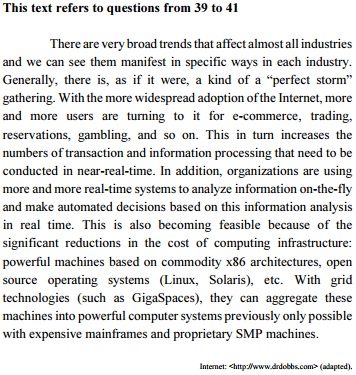
In the text, “In addition” means
Ano: 2013
Banca:
CESGRANRIO
Órgão:
IBGE
Provas:
CESGRANRIO - 2013 - IBGE - Todos os Cargos - Conhecimentos Básicos - Analista
|
CESGRANRIO - 2013 - IBGE - Todos os Cargos - Conhecimentos Básicos - Tecnologista |
CESGRANRIO - 2013 - IBGE - Analista - Arquivologia |
CESGRANRIO - 2013 - IBGE - Tecnologista - Estatística |
CESGRANRIO - 2013 - IBGE - Analista - Análise e Desenvolvimento de Aplicações |
CESGRANRIO - 2013 - IBGE - Analista - Suporte Operacional |
CESGRANRIO - 2013 - IBGE - Analista - Recursos Humanos - Desenvolvimento de Pessoas |
CESGRANRIO - 2013 - IBGE - Analista - Recursos Materiais e Logística |
CESGRANRIO - 2013 - IBGE - Analista - Recursos Humanos - Administração de Pessoal |
CESGRANRIO - 2013 - IBGE - Analista - Designer Institucional |
CESGRANRIO - 2013 - IBGE - Analista - Orçamento e Finanças |
CESGRANRIO - 2013 - IBGE - Analista - Planejamento e Gestão |
CESGRANRIO - 2013 - IBGE - Analista - Suporte à Comunicação e Rede |
CESGRANRIO - 2013 - IBGE - Analista - Ciências Contábeis |
CESGRANRIO - 2013 - IBGE - Analista - Administração Escolar |
CESGRANRIO - 2013 - IBGE - Tecnologista - Análise Agrícola |
CESGRANRIO - 2013 - IBGE - Tecnologista - Análise Pecuária |
CESGRANRIO - 2013 - IBGE - Tecnologista - Análise Socioeconômica |
CESGRANRIO - 2013 - IBGE - Tecnologista - Cartografia |
CESGRANRIO - 2013 - IBGE - Tecnologista - Edição de Vídeo |
CESGRANRIO - 2013 - IBGE - Tecnologista - Geografia |
CESGRANRIO - 2013 - IBGE - Tecnologista - Geoprocessamento |
Q437120
Inglês

In Texts I and II, in terms of meaning, one notices that
Ano: 2013
Banca:
CESGRANRIO
Órgão:
IBGE
Provas:
CESGRANRIO - 2013 - IBGE - Todos os Cargos - Conhecimentos Básicos - Analista
|
CESGRANRIO - 2013 - IBGE - Todos os Cargos - Conhecimentos Básicos - Tecnologista |
CESGRANRIO - 2013 - IBGE - Analista - Arquivologia |
CESGRANRIO - 2013 - IBGE - Tecnologista - Estatística |
CESGRANRIO - 2013 - IBGE - Analista - Análise e Desenvolvimento de Aplicações |
CESGRANRIO - 2013 - IBGE - Analista - Suporte Operacional |
CESGRANRIO - 2013 - IBGE - Analista - Recursos Humanos - Desenvolvimento de Pessoas |
CESGRANRIO - 2013 - IBGE - Analista - Recursos Materiais e Logística |
CESGRANRIO - 2013 - IBGE - Analista - Recursos Humanos - Administração de Pessoal |
CESGRANRIO - 2013 - IBGE - Analista - Designer Institucional |
CESGRANRIO - 2013 - IBGE - Analista - Orçamento e Finanças |
CESGRANRIO - 2013 - IBGE - Analista - Planejamento e Gestão |
CESGRANRIO - 2013 - IBGE - Analista - Suporte à Comunicação e Rede |
CESGRANRIO - 2013 - IBGE - Analista - Ciências Contábeis |
CESGRANRIO - 2013 - IBGE - Analista - Administração Escolar |
CESGRANRIO - 2013 - IBGE - Tecnologista - Análise Agrícola |
CESGRANRIO - 2013 - IBGE - Tecnologista - Análise Pecuária |
CESGRANRIO - 2013 - IBGE - Tecnologista - Análise Socioeconômica |
CESGRANRIO - 2013 - IBGE - Tecnologista - Cartografia |
CESGRANRIO - 2013 - IBGE - Tecnologista - Edição de Vídeo |
CESGRANRIO - 2013 - IBGE - Tecnologista - Geografia |
CESGRANRIO - 2013 - IBGE - Tecnologista - Geoprocessamento |
Q437118
Inglês
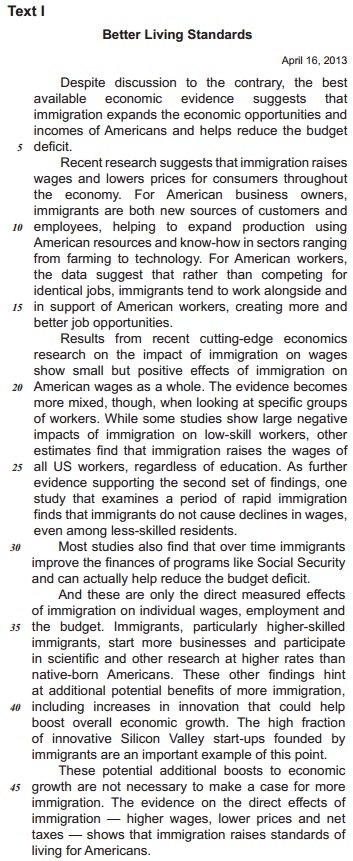
In the excerpt of Text I: “other estimates find that immigration raises the wages of all US workers, regardless of education” (lines 23-25), regardless of,is substituted, without change in meaning, by
Q424792
Inglês
Texto associado
Complications of Replacement Therapy
Complications of replacement therapy include:
- Developing antibodies (proteins) that attack the clotting factor
- Developing viral infections from human clotting factors
- Damage to joints, muscles, or other parts of the body resulting from delays in treatment
Antibodies to the clotting factor.
Antibodies can destroy the clotting factor before it has a chance to work. This is a very serious problem. It prevents the main treatment for hemophilia (replacement therapy) from working. These antibodies, also called inhibitors, develop in about 20-30 percent of people who have severe hemophilia A. Inhibitors develop in 2-5 percent of people who have hemophilia B
When antibodies develop, doctors may use larger doses of clotting factor or try different clotting factor sources. Sometimes the antibodies go away. Researchers are studying new ways to deal with antibodies to clotting factors.
Viruses from human clotting factors.
Clotting factors made from human blood can carry the viruses that cause HIV/AIDS and hepatitis. ....I.... , the risk of getting an infectious disease from human clotting factors is very small due to:
- Careful screening of blood donors
- Testing of donated blood products
- Treating donated blood products with a detergent and heat to destroy viruses - Vaccinating people who have hemophilia for hepatitis A and B
Damage to joints, muscles, and other parts of the body.
Delays in treatment can cause damage such as:
- Bleeding into a joint. If this happens many times, it can lead to changes in the shape of the joint and impair the joint's function.
- Swelling of the membrane around a joint. - Pain, swelling, and redness of a joint.
- Pressure on a joint from swelling, which can destroy the joint.
(Adapted from http://www.nhlbi.nih.gov/health/health-topics/ topics/hemophilia/treatment.html)
Complications of replacement therapy include:
- Developing antibodies (proteins) that attack the clotting factor
- Developing viral infections from human clotting factors
- Damage to joints, muscles, or other parts of the body resulting from delays in treatment
Antibodies to the clotting factor.
Antibodies can destroy the clotting factor before it has a chance to work. This is a very serious problem. It prevents the main treatment for hemophilia (replacement therapy) from working. These antibodies, also called inhibitors, develop in about 20-30 percent of people who have severe hemophilia A. Inhibitors develop in 2-5 percent of people who have hemophilia B
When antibodies develop, doctors may use larger doses of clotting factor or try different clotting factor sources. Sometimes the antibodies go away. Researchers are studying new ways to deal with antibodies to clotting factors.
Viruses from human clotting factors.
Clotting factors made from human blood can carry the viruses that cause HIV/AIDS and hepatitis. ....I.... , the risk of getting an infectious disease from human clotting factors is very small due to:
- Careful screening of blood donors
- Testing of donated blood products
- Treating donated blood products with a detergent and heat to destroy viruses - Vaccinating people who have hemophilia for hepatitis A and B
Damage to joints, muscles, and other parts of the body.
Delays in treatment can cause damage such as:
- Bleeding into a joint. If this happens many times, it can lead to changes in the shape of the joint and impair the joint's function.
- Swelling of the membrane around a joint. - Pain, swelling, and redness of a joint.
- Pressure on a joint from swelling, which can destroy the joint.
(Adapted from http://www.nhlbi.nih.gov/health/health-topics/ topics/hemophilia/treatment.html)
Preenche corretamente a lacuna I do texto:
Ano: 2013
Banca:
VUNESP
Órgão:
CETESB
Prova:
VUNESP - 2013 - CETESB - Analista Administrativo - Recursos Humanos |
Q390448
Inglês
Texto associado
The US Department of Energy is giving $120m (£75m) to set up a new research centre charged with developing new methods of rare earth production.
Rare earths are 17 chemically similar elements crucial to making many hi-tech products, such as phones and PCs. The Critical Materials Institute will be located in Ames, Iowa.
The US wants to reduce its dependency on China, which produces more than 95% of the world’s rare earth elements, and address local shortages. According to the US Geological Survey, there may be deposits of rare earths in 14 US states. Besides being used for hi-tech gadgets, the elements are also crucial for manufacturing low-carbon resources such as wind turbines, solar panels and electric cars, said David Danielson, the US assistant secretary for renewable energy.
Rare earth elements are also used for military applications, such as advanced optics technologies, radar and radiation detection equipment, and advanced communications systems, according to a 2011 research report by the US Government Accountability Office. From the 1960s until the 1980s, the Mountain Pass mine in California made the US the world leader in rare earth production, but it was later closed, largely due to competition with the elements imported from China.
At the moment, the regulations surrounding rare earths mining in the US are very strict, an expert on the materials from Chalmers University of Technology in Sweden told the BBC. “The Mountain Pass mine was [also] closed down for environmental reasons,” said Prof Ekberg.
Rare earths are 17 chemically similar elements crucial to making many hi-tech products, such as phones and PCs. The Critical Materials Institute will be located in Ames, Iowa.
The US wants to reduce its dependency on China, which produces more than 95% of the world’s rare earth elements, and address local shortages. According to the US Geological Survey, there may be deposits of rare earths in 14 US states. Besides being used for hi-tech gadgets, the elements are also crucial for manufacturing low-carbon resources such as wind turbines, solar panels and electric cars, said David Danielson, the US assistant secretary for renewable energy.
Rare earth elements are also used for military applications, such as advanced optics technologies, radar and radiation detection equipment, and advanced communications systems, according to a 2011 research report by the US Government Accountability Office. From the 1960s until the 1980s, the Mountain Pass mine in California made the US the world leader in rare earth production, but it was later closed, largely due to competition with the elements imported from China.
At the moment, the regulations surrounding rare earths mining in the US are very strict, an expert on the materials from Chalmers University of Technology in Sweden told the BBC. “The Mountain Pass mine was [also] closed down for environmental reasons,” said Prof Ekberg.
A expressão due to em – … largely due to competition with the elements imported from China. – é substituída, sem alterar o sentido do trecho, por
Ano: 2013
Banca:
VUNESP
Órgão:
CETESB
Prova:
VUNESP - 2013 - CETESB - Analista Administrativo - Recursos Humanos |
Q390447
Inglês
Texto associado
The US Department of Energy is giving $120m (£75m) to set up a new research centre charged with developing new methods of rare earth production.
Rare earths are 17 chemically similar elements crucial to making many hi-tech products, such as phones and PCs. The Critical Materials Institute will be located in Ames, Iowa.
The US wants to reduce its dependency on China, which produces more than 95% of the world’s rare earth elements, and address local shortages. According to the US Geological Survey, there may be deposits of rare earths in 14 US states. Besides being used for hi-tech gadgets, the elements are also crucial for manufacturing low-carbon resources such as wind turbines, solar panels and electric cars, said David Danielson, the US assistant secretary for renewable energy.
Rare earth elements are also used for military applications, such as advanced optics technologies, radar and radiation detection equipment, and advanced communications systems, according to a 2011 research report by the US Government Accountability Office. From the 1960s until the 1980s, the Mountain Pass mine in California made the US the world leader in rare earth production, but it was later closed, largely due to competition with the elements imported from China.
At the moment, the regulations surrounding rare earths mining in the US are very strict, an expert on the materials from Chalmers University of Technology in Sweden told the BBC. “The Mountain Pass mine was [also] closed down for environmental reasons,” said Prof Ekberg.
Rare earths are 17 chemically similar elements crucial to making many hi-tech products, such as phones and PCs. The Critical Materials Institute will be located in Ames, Iowa.
The US wants to reduce its dependency on China, which produces more than 95% of the world’s rare earth elements, and address local shortages. According to the US Geological Survey, there may be deposits of rare earths in 14 US states. Besides being used for hi-tech gadgets, the elements are also crucial for manufacturing low-carbon resources such as wind turbines, solar panels and electric cars, said David Danielson, the US assistant secretary for renewable energy.
Rare earth elements are also used for military applications, such as advanced optics technologies, radar and radiation detection equipment, and advanced communications systems, according to a 2011 research report by the US Government Accountability Office. From the 1960s until the 1980s, the Mountain Pass mine in California made the US the world leader in rare earth production, but it was later closed, largely due to competition with the elements imported from China.
At the moment, the regulations surrounding rare earths mining in the US are very strict, an expert on the materials from Chalmers University of Technology in Sweden told the BBC. “The Mountain Pass mine was [also] closed down for environmental reasons,” said Prof Ekberg.
O termo besides em – Besides being used for hi-tech gadgets, the elements are also crucial for manufacturing low-carbon resources such as wind turbines… – implica
Q385737
Inglês

Observe the fragments:
Thus, the content needs to cover only the subject matter that supports that objective (L. 32-33)
…the learner has adequate knowledge in order to complete the objective. (L. 35-36)
The underlined connectors convey, respectively, the meanings of:
Thus, the content needs to cover only the subject matter that supports that objective (L. 32-33)
…the learner has adequate knowledge in order to complete the objective. (L. 35-36)
The underlined connectors convey, respectively, the meanings of:
Q381140
Inglês
Texto associado
Brazil’s Average Unemployment Rate Falls to Record Low in 2012
By Dow Jones Business News
January 31, 2013
Brazil’s unemployment rate for 2012 fell to 5.5%, down from the previous record low of 6.0% recorded last year, the Brazilian Institute of Geography and Statistics, or IBGE, said Thursday. In December, unemployment fell to 4.6% compared with 4.9% in November, besting the previous record monthly low of 4.7% registered in December 2011, the IBGE said
The 2012 average unemployment rate was in line with the 5.5% median estimate of economists polled by the local Estado news agency. Analysts had also pegged December’s unemployment rate at 4.4%.
Brazil’s unemployment rate remains at historically low levels despite sluggish economic activity. Salaries have also been on the upswing in an ominous sign for inflation - a key area of concern for the Brazilian Central Bank after a series of interest rate cuts brought local interest rates to record lows last year. Inflation ended 2012 at 5.84%.
The average monthly Brazilian salary retreated slightly to 1,805.00 Brazilian reais ($908.45) in December, down from the record high BRL1,809.60 registered in November, the IBGE said. Wages trended higher in 2012 as employee groups called on Brazilian companies and the government to increase wages and benefits to counter higher local prices. Companies were also forced to pay more to hire and retain workers because of the country’s low unemployment.
The IBGE measures unemployment in six of Brazil’s largest metropolitan areas, including São Paulo, Rio de Janeiro, Salvador, Belo Horizonte, Recife and Porto Alegre. Brazil’s unemployment rate, however, is not fully comparable to jobless rates in developed countries as a large portion of the population is either underemployed or works informally without paying taxes. In addition, workers not actively seeking a job in the month before the survey don’t count as unemployed under the IBGE’s methodology. The survey also doesn’t take into account farm workers.
(www.nasdaq.com. Adaptado)
By Dow Jones Business News
January 31, 2013
Brazil’s unemployment rate for 2012 fell to 5.5%, down from the previous record low of 6.0% recorded last year, the Brazilian Institute of Geography and Statistics, or IBGE, said Thursday. In December, unemployment fell to 4.6% compared with 4.9% in November, besting the previous record monthly low of 4.7% registered in December 2011, the IBGE said
The 2012 average unemployment rate was in line with the 5.5% median estimate of economists polled by the local Estado news agency. Analysts had also pegged December’s unemployment rate at 4.4%.
Brazil’s unemployment rate remains at historically low levels despite sluggish economic activity. Salaries have also been on the upswing in an ominous sign for inflation - a key area of concern for the Brazilian Central Bank after a series of interest rate cuts brought local interest rates to record lows last year. Inflation ended 2012 at 5.84%.
The average monthly Brazilian salary retreated slightly to 1,805.00 Brazilian reais ($908.45) in December, down from the record high BRL1,809.60 registered in November, the IBGE said. Wages trended higher in 2012 as employee groups called on Brazilian companies and the government to increase wages and benefits to counter higher local prices. Companies were also forced to pay more to hire and retain workers because of the country’s low unemployment.
The IBGE measures unemployment in six of Brazil’s largest metropolitan areas, including São Paulo, Rio de Janeiro, Salvador, Belo Horizonte, Recife and Porto Alegre. Brazil’s unemployment rate, however, is not fully comparable to jobless rates in developed countries as a large portion of the population is either underemployed or works informally without paying taxes. In addition, workers not actively seeking a job in the month before the survey don’t count as unemployed under the IBGE’s methodology. The survey also doesn’t take into account farm workers.
(www.nasdaq.com. Adaptado)
No trecho do ultimo parágrafo – In addition, workers not actively seeking a job – a expressão in addition pode ser substituída, sem alteração de sentido, por
Q381138
Inglês
Texto associado
Brazil’s Average Unemployment Rate Falls to Record Low in 2012
By Dow Jones Business News
January 31, 2013
Brazil’s unemployment rate for 2012 fell to 5.5%, down from the previous record low of 6.0% recorded last year, the Brazilian Institute of Geography and Statistics, or IBGE, said Thursday. In December, unemployment fell to 4.6% compared with 4.9% in November, besting the previous record monthly low of 4.7% registered in December 2011, the IBGE said
The 2012 average unemployment rate was in line with the 5.5% median estimate of economists polled by the local Estado news agency. Analysts had also pegged December’s unemployment rate at 4.4%.
Brazil’s unemployment rate remains at historically low levels despite sluggish economic activity. Salaries have also been on the upswing in an ominous sign for inflation - a key area of concern for the Brazilian Central Bank after a series of interest rate cuts brought local interest rates to record lows last year. Inflation ended 2012 at 5.84%.
The average monthly Brazilian salary retreated slightly to 1,805.00 Brazilian reais ($908.45) in December, down from the record high BRL1,809.60 registered in November, the IBGE said. Wages trended higher in 2012 as employee groups called on Brazilian companies and the government to increase wages and benefits to counter higher local prices. Companies were also forced to pay more to hire and retain workers because of the country’s low unemployment.
The IBGE measures unemployment in six of Brazil’s largest metropolitan areas, including São Paulo, Rio de Janeiro, Salvador, Belo Horizonte, Recife and Porto Alegre. Brazil’s unemployment rate, however, is not fully comparable to jobless rates in developed countries as a large portion of the population is either underemployed or works informally without paying taxes. In addition, workers not actively seeking a job in the month before the survey don’t count as unemployed under the IBGE’s methodology. The survey also doesn’t take into account farm workers.
(www.nasdaq.com. Adaptado)
By Dow Jones Business News
January 31, 2013
Brazil’s unemployment rate for 2012 fell to 5.5%, down from the previous record low of 6.0% recorded last year, the Brazilian Institute of Geography and Statistics, or IBGE, said Thursday. In December, unemployment fell to 4.6% compared with 4.9% in November, besting the previous record monthly low of 4.7% registered in December 2011, the IBGE said
The 2012 average unemployment rate was in line with the 5.5% median estimate of economists polled by the local Estado news agency. Analysts had also pegged December’s unemployment rate at 4.4%.
Brazil’s unemployment rate remains at historically low levels despite sluggish economic activity. Salaries have also been on the upswing in an ominous sign for inflation - a key area of concern for the Brazilian Central Bank after a series of interest rate cuts brought local interest rates to record lows last year. Inflation ended 2012 at 5.84%.
The average monthly Brazilian salary retreated slightly to 1,805.00 Brazilian reais ($908.45) in December, down from the record high BRL1,809.60 registered in November, the IBGE said. Wages trended higher in 2012 as employee groups called on Brazilian companies and the government to increase wages and benefits to counter higher local prices. Companies were also forced to pay more to hire and retain workers because of the country’s low unemployment.
The IBGE measures unemployment in six of Brazil’s largest metropolitan areas, including São Paulo, Rio de Janeiro, Salvador, Belo Horizonte, Recife and Porto Alegre. Brazil’s unemployment rate, however, is not fully comparable to jobless rates in developed countries as a large portion of the population is either underemployed or works informally without paying taxes. In addition, workers not actively seeking a job in the month before the survey don’t count as unemployed under the IBGE’s methodology. The survey also doesn’t take into account farm workers.
(www.nasdaq.com. Adaptado)
No trecho do quinto parágrafo – Brazil’s unemployment rate, however, is not fully comparable to jobless rates in developed countries as a large portion of the population is either underemployed or works informally – a palavra as pode ser substituída, sem alteração de sentido, por

 Conheça nossos planos