Questões de Concurso
Sobre interpretação de texto | reading comprehension em inglês
Foram encontradas 13.189 questões


TEXT:
Building Rapport
Establishing strong foundations for teaching and learning
By Stephanie Hirchman
September 2, 2025
How do teachers build rapport with students? I can’t think of a more important question; after all, learning is all about relationships. In fact, I hope the word “rapport” runs through all the blogs I’ve written, like the letters in a stick of rock. However, as the summer holidays draw to a close and with new beginnings in sight, I’m going to focus exclusively on building rapport.
Fostering rapport
Let’s get out the metaphors! If learning is a house, then rapport is the foundation, but because it needs constant maintenance, rapport is also a garden, tended with care on a daily basis. When there is a good rapport, students feel:
• seen – each student is greeted individually, and the teacher makes an eff ort to interact with each one during the lesson.
• confident in the teacher, the course, and themselves - the teacher knows what each student needs and how to deliver it so students make progress. Classroom routines are predictable, fair, and make sense.
• safe – they know the teacher will not embarrass them or expose their sensitivities or weaknesses. Mistakes are dealt with sensitively and treated as learning opportunities.
• accepted – the teacher meets each individual student exactly where they are, without judgment, academically and personally. If someone is called out on their behaviour, this is done in private, and an explanation is given about why this behaviour is unproductive or unacceptable.
Student profiles – the basis for rapport
Whatever your teaching context, you’ve got to get to know each student as an individual. This can be considered as an initial information gathering phase, with several possible pathways.
A good starting point is to test students either before they start the course or in the first few days, making it clear that this is a process that produces information that will help you to plan and them to learn. Try to generate as full a picture as possible, so you have an idea about their abilities in all four skills.
Secondly, you need to conduct a needs analysis, either privately or publicly. You can read more about this process, but bear in mind that a public needs analysis can also serve to make everyone in the class aware of each other’s interests and thus of the rationale for including certain topics, language points, or skills work in the course syllabus.
Finally, use whatever resources you have to identify students with specific learning differences or traumas/triggers. This information may be disclosed at registration, self-disclosed (perhaps at interview) or in a private needs analysis, or tentatively identified through your own observations. Obviously, this information is private, between you and the student (and their parents, if they are under 18).
Classroom activities to build rapport at the start of a course
These rapport-building activities aim to generate information in such a way that students feel well-supported.
In a first lesson, the top priority is to make sure you know everybody’s preferred names and how to pronounce them. I’ve always found it helpful to have small desktop cards with this information on display – at least for a couple of sessions. Why not ask the students to make these themselves, or at least to personalize them? The back of the card could have some classroom language phrases to help prompt students, and there’s also the option of including this useful functional language as an introductory lesson – note that this generates a lot of information about student performance in areas like listening (including following instructions), speaking (including pronunciation) and studentship (including note-taking), facility with vocabulary, grammar and functional language. It can also serve as an introduction to pair and group work and to questioning and correction techniques, and, of course, builds confidence for students to take an active part in lessons.
Rapport thrives on praise
Teachers must remember that students are putting themselves on the line every time they come to class. Every effort carries a risk of failure, and not everyone is robust enough to bounce back easily when this occurs. Praise is the magic ingredient here – individualized, sincere and specific. Even when things have gone a bit wrong, find something that went well. It may be that you’re praising eff ort (“Good try, Haruka, I like that idea, but it isn’t what I’m looking for right now.”) or scaffolding achievement (“That’s a pretty good sentence, Juan, the verb tense is correct. But think again about the subject – should it be singular or plural?”). It may be delivered in written form (“This essay makes some relevant points. You used a lot of new vocabulary and improved your accuracy with punctuation. Next time, put the information into paragraphs.”). And when you make a mistake, as you inevitably will, model a positive reaction – check the information, put it right and thank the person who pointed it out.
Finally, make plenty of space for laughter and smiles, as they not only reduce stress, but have a positive effect on engagement, learning and recall. Rapport really does serve learning.
Adapted from: https://www.linguahouse.com/blog/post/building-rapport Acesso em 18/10/2025
I.One of the goals of the 2014-2024 PNE addresses the quality of basic education and the Índice de Desenvolvimento da Educação Básica (IDEB). One of the elements that support the IDEB is the Sistema de Avaliação da Educação Básica (SAEB), which is promoted by the Instituto Nacional de Estudos e Pesquisas Educacionais Anísio Teixeira (INEP).
II.Among the programs included in the PNE is the PNAE, the Programa Nacional de Alimentação Escolar , which consists of the transfer of federal financial resources to serve students in basic education in municipal, district, state, and federal networks, among other types of institutions.
III.The last valid PNE only covered the decade of 2014-2024. Since this document ceased to be valid at the end of 2024, Brazil currently does not have a valid National Education Plan (PNE) for the year 2025.
IV.The PNE is composed of a total of 10 goals, which include, among other important points, Early Childhood Education, Elementary Education, Secondary Education, Comprehensive Education, and Vocational Education. Higher Education, as well as Postgraduate Studies, are not covered by the PNE, since the document is dedicated to the most basic levels of Education.
V.Among the programs and actions foreseen in the goal of Elevação da Escolaridade/Diversidade presented in the 2014-2024 PNE are programs such as the Programa Nacional de Educação do Campo (Pronacampo) and the Ação Saberes Indígenas na Escola.
I.Any work by children under fourteen years of age is prohibited, except in the condition of apprenticeship.
II.Adolescent employees are prohibited from working at night, between 10 PM and 5 AM, except with authorization from their parents or legal guardians for night shifts.
III.Adolescent employees are allowed to perform insalubrious work only under the supervision of a professional over 18 years of age who is also qualified for such work.
IV.Adolescent apprentices over fourteen years of age are guaranteed labor and social security rights.
V.Adolescents with disabilities are prohibited from working due to possible risks to their physical integrity.
After reading these statements, select the correct alternative:
Biden administration, in its last days, proposes new protections for Arctic Alaska land
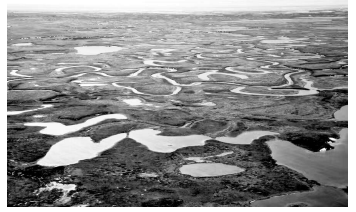
Lakes and connecting streams in the northeastern part of the National Petroleum Reserve in Alaska, June 2014.
Four days before President Joe Biden is set to leave office, his administration recommended that about 3 million more acres in Alaska's western Arctic be protected from development and issued a guideline, effective immediately, requiring additional protections for traditional Native subsistence harvests of fish, caribou and other resources.
The new recommendations and guidance, which apply to the 23-million-acre National Petroleum Reserve in Alaska, run counter to President-elect Donald Trump's expressed plans to expand oil drilling in the Arctic and elsewhere and to overturn Biden administration environmental policies more broadly.
The recommendations for additional land to be protected as part of what are termed "special areas" and the guidance for elevating the importance of subsistence and tribal consultation could be ignored or scrapped by the incoming Trump administration.
The northeastern part of the reserve is the area considered most likely to hold oil and where development has spread in recent years. There is already production in that area, and the most notable production expected in the future is from ConocoPhillips' Willow project. Willow won Biden administration approval in 2023. Production is expected to start by the end of the decade and peak at 180,000 barrels per day; current production from all North Slope fields amounts to less than 470,000 barrels per day.
Like the existing Teshekpuk special area, which holds important habitat for caribou, fish and migratory birds, the village of Nuiqsut is in the general area of the reserve's northeastern corner, where new oil development has occurred. Nuiqsut is so close that oilfield infrastructure can be seen from the village.
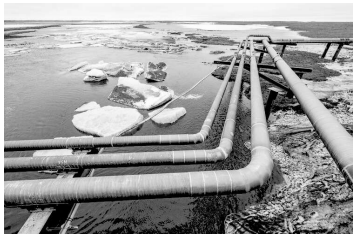
Pipelines extend across the landscape outside Nuiqsut, Alaska, May 2019.
"But at the same time, I think we and our partners have also made it abundantly clear that we're going to keep fighting, and keep fighting for protections in the Western Arctic," she said.
(From ROSEN, Yereth. Biden administration, in its last days, proposes new protections for Arctic Alaska land, Alaska Beacon, January 17, 2025. In alaskabeacon.com/2025/01/17/biden-administration-in-its-last-days-proposes-new-protections-for-arctic-alaska-land/, accessed on February 19th, 2025)
Leia o texto a seguir:
Jobs and Professions
As has been the case for many years, jobs, or forms of employment wherein employees perform a service or duty in exchange for financial compensation, play a prominent role in society. Furthermore, all jobs — even those of seemingly little significance — are important, as they simply wouldn't exist if their specific responsibilities weren't of value to employers (companies or persons that pay others for their work), customers (individuals who pay money for a product or service), and the economy generally.
Teachers, or educational professionals tasked with helping students understand certain subjects and topics, are especially crucial today. In short, teachers help their students to become qualified for their future careers.
Doctors, or medical professionals who specialize in providing health-related assistance to patients, are some of the most respected individuals in America and the world. It's the responsibility of doctors to help those who feel less-than-stellar to determine the underlying health issue(s) and recommend an effective treatment (or remedy to a disease, disorder, or condition).
There are quite a few types of specialty doctors in America (besides MD, which simply means "medical doctor"), all of whom can be referred to simply as "Doctor (Name)." Dentists (mouth/ teeth doctors), dermatologists (skin doctors), and psychiatrists (mental-health doctors) are just a few examples of the many different types of doctors.
Additionally, nurses are medical professionals who help to administer doctor-ordered treatments to patients.
Police officers are law enforcement professionals whose job it is to protect citizens, solve crimes, and assure that rules and regulations are followed. Similarly, firefighters serve the public by responding to fires (and other emergency situations) and using high-tech equipment to extinguish these fires, while bringing any individuals who're in danger to safety.
Farmers maintain fields of crops (or vegetable/fruit plants) and/ or collections of animals with the intention of selling these products as food.
Chefs/cooks prepare meals in professional settings, including restaurants, cafeterias, and other venues wherein food and drink are sold, for customers. Chefs are generally experienced in cooking and managing kitchens.
Waiters bring menus, beverages, meals, and ultimately, the check (or a bill of the foods and drinks purchased in a transaction) to tables in restaurants and other establishments that serve food.
Artists produce art, or works of creative significance, including music, paintings, drawings, poetry, writing, and more.
Fonte: https://pdfcoffee.com/meeting-5-basic-english-for-academic-porposes-pdffree.html. Acessado em 25/08/2025
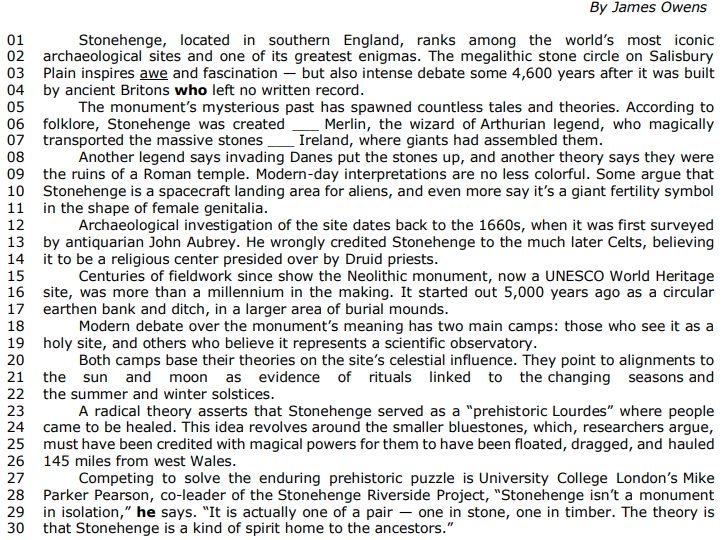
( ) One radical theory suggests that Stonehenge was a kind of “prehistoric Lourdes”, where people came to be healed.
( ) Those who see the monument as a holy site, and those who believe it represents a scientific observatory represent the modern debate over Stonehenge.
( ) Modern-day interpretations for the Stonehenge construction say they were the ruins of a Roman temple.
The correct order of filling in the parentheses, from top to bottom, is:
Read the comic and answer:
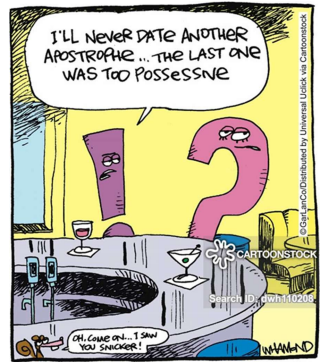
The humor in the comic is based on a play on words. What is the grammatical function of the apostrophe that the character is referring to?
Read the comic strip and answer:
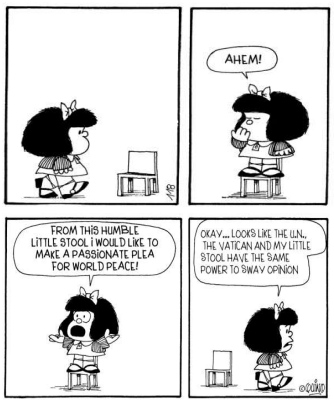
Which of the following sentences uses a relative pronoun correctly and expresses an idea related to the comic?
Which of the following sentences is correctly written in the passive voice and accurately reflects an idea from the text?
"After many months of training, the girls' soccer team pulled off an unexpected victory against their strongest adversary in the finals."

 Conheça nossos planos