Questões de Concurso
Sobre interpretação de texto | reading comprehension em inglês
Foram encontradas 12.687 questões


In developing critical reading skills, which approach most effectively combines textual analysis with cultural awareness and metacognitive strategies?
Match the integrated skills activities with their primary pedagogical focus:
Activities:
1. Digital storytelling with peer collaboration.
2. Debate preparation through research and rehearsal.
3. Literature circles with multimedia presentations.
4. Real-world problem-solving projects.
Pedagogical Focus:
I. Critical thinking and argumentation.
II. Multimodal literacy and social construction.
III. Authentic communication and civic engagement.
IV. Literary analysis and creative expression.
The correct matching is:
O texto seguinte servirá de base para responder à questão.
When rock music met ancient archeology: the enduring power of Pink Floyd Live at Pompeii
The 1972 concert film Pink Floyd Live at Pompeii, back in cinemas this week, remains one of the most unique concert documentaries ever recorded by a rock band.
The movie captured the band on the brink of international stardom, released seven months before their breakout album Dark Side of the Moon, which would go on to sell 50 million copies and spend 778 weeks on the Billboard charts.
The film was the first time a rock concert took place in the ruins of an archaeological site. This intermingling of art and archaeology would change the way many thought of Pompeii.
The amphitheatre of Pompeii
The amphitheatre of Pompeii has quite a history as a venue for spectacles.
Constructed around 70 BCE, it was one of the first permanent constructed amphitheatres in Italy, designed to hold up to 20,000 spectators.
From graffiti and advertisements, we know it was used in antiquity for gladiatorial fights and displays and hunts of wild beasts and athletic contests.
Famously we are told by Roman historian Tactius in 59 CE a deadly brawl occurred between Pompeiians and residents of the nearby town of Nuceria during games, resulting in a ten-year ban on gladiatorial contests at the venue. The amphitheatre was destroyed by the eruption of Vesuvius in 79 CE.
There is a long tradition of authors, artists, filmmakers and designers taking inspiration from the site and its destruction. A 13-year-old Mozart's visit to the Temple of Isis at the site inspired The Magic Flute in 1791.
In the rock music era, Pompeii has inspired numerous artists, especially around themes of death and longing. Cities in Dust (1985) by Siouxsie and the Banshees was perhaps the most famous until Bastille's 2013 hit Pompeii. In The Decemberists' Cocoon (2002), the destruction of Pompeii acts as a metaphor for the guilt and loss in the aftermath of the September 11 attacks.
Since 2016, the amphitheatre has hosted concerts − with audiences this time. Appropriately, one of the first was a performance by Pink Floyd's guitarist David Gilmour. His show over two nights in July 2016 took place 45 years after first playing at the site.
But how did Pink Floyd come to play at Pompeii in 1972?
Rethinking rock concert movies
It was the peak era of rock concert documentaries. Woodstock (1970) and The Rolling Stone's Gimme Shelter (1970), and other documentaries of the era, placed the cameras in the audience, giving the cinema-goer the same perspective as the concert audience.
As a concept, it was getting stale.
Filmmaker Adrian Maben had been interested in combining art with Pink Floyd's music. He initially pitched a film of the band's music over montages of paintings by artists such as Rene Magritte. The band rejected the idea.
Maben returned to them after a holiday in Naples, realising the ambience of Pompeii suited the band's music. A performance without an audience provided the antithesis of the era's concert films.
The performance would become iconic, particularly the scenes of Roger Waters banging a large gong on the upper wall of the amphitheatre, and the cameras panning past the band's black road case to reveal the band in the ancient arena.
It was as far away from Woodstock as possible.
The performance was filmed over six days in October 1971 in the ancient amphitheatre, with the band playing three songs in the ancient venue: Echoes, A Saucerful of Secrets, and One of These Days.
Ancient history professor Ugo Carputi of the University of Naples, a Pink Floyd fan, had persuaded authorities to allow the band to film and to close the site for the duration of filming. Besides the film crew, the band's road crew − and a few children who snuck in to watch − the venue was closed to the public.
In addition to the performance, the four band members were filmed walking over the volcanic mud around Boscoreale, and their performances in the film both were interspersed with images of antiquities from Pompeii.
The movie itself was fleshed out with studio performances in a Paris TV studio and rehearsals at Abbey Road Studios.
Marrying art and music
Famously the Pink Floyd film blends images of antiquities from the Naples Archaeological Museum with the band's performances.
Roman frescoes and mosaics are highlighted during particular songs. Profiles of bronze statues meld with the faces of band members, linking past and present.
Later scenes have the band backdropped by images of frescoes from the famed Villa of the Mysteries and of the plaster casts of eruption victims.
The band's musical themes of death and mystery link with ancient imagery, and it would have been the first time many audience members had seen these masterpieces of Roman art.
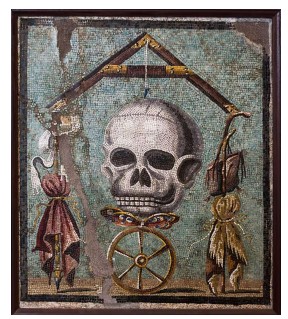
The Memento mori mosaic features significantly during the performance of the song Careful with that Axe, Eugene. Naples National Archaeological Museum/Wikimedia Commons
Pink Floyd Live at Pompeii marked a brave experiment in rock concert movies.
Watching it more than 50 years later, it is a timepiece of early 70s rock and a remarkable document of a band on the brink of fame.
Because of their progressive rock sound, sonic experimentation and philosophical lyrics, it was often said by Pink Floyd's fans that they were "the first band in space". They even eventually had a cassette of their music played in space.
But many are not aware of their earlier roots in the dust of ancient Pompeii. The re-release of the film gives an opportunity to enjoy the site's unlikely role in music history.
Pink Floyd at Pompeii − MCMLXXII is in cinemas from Thursday.
https://theconversation.com/when-rock-music-met-ancient-archeology-t he-enduring-power-of-pink-floyd-live-at-pompeii-252744
Throughout history, Pompeii has served as a source of inspiration across artistic movements and disciplines, from classical music to modern rock. The site's tragic past and preserved ruins continue to influence how creators portray themes of time, loss, and rebirth. According to the text, what does the film's use of Pompeii primarily convey in terms of symbolic meaning?
O texto seguinte servirá de base para responder à questão.
When rock music met ancient archeology: the enduring power of Pink Floyd Live at Pompeii
The 1972 concert film Pink Floyd Live at Pompeii, back in cinemas this week, remains one of the most unique concert documentaries ever recorded by a rock band.
The movie captured the band on the brink of international stardom, released seven months before their breakout album Dark Side of the Moon, which would go on to sell 50 million copies and spend 778 weeks on the Billboard charts.
The film was the first time a rock concert took place in the ruins of an archaeological site. This intermingling of art and archaeology would change the way many thought of Pompeii.
The amphitheatre of Pompeii
The amphitheatre of Pompeii has quite a history as a venue for spectacles.
Constructed around 70 BCE, it was one of the first permanent constructed amphitheatres in Italy, designed to hold up to 20,000 spectators.
From graffiti and advertisements, we know it was used in antiquity for gladiatorial fights and displays and hunts of wild beasts and athletic contests.
Famously we are told by Roman historian Tactius in 59 CE a deadly brawl occurred between Pompeiians and residents of the nearby town of Nuceria during games, resulting in a ten-year ban on gladiatorial contests at the venue. The amphitheatre was destroyed by the eruption of Vesuvius in 79 CE.
There is a long tradition of authors, artists, filmmakers and designers taking inspiration from the site and its destruction. A 13-year-old Mozart's visit to the Temple of Isis at the site inspired The Magic Flute in 1791.
In the rock music era, Pompeii has inspired numerous artists, especially around themes of death and longing. Cities in Dust (1985) by Siouxsie and the Banshees was perhaps the most famous until Bastille's 2013 hit Pompeii. In The Decemberists' Cocoon (2002), the destruction of Pompeii acts as a metaphor for the guilt and loss in the aftermath of the September 11 attacks.
Since 2016, the amphitheatre has hosted concerts − with audiences this time. Appropriately, one of the first was a performance by Pink Floyd's guitarist David Gilmour. His show over two nights in July 2016 took place 45 years after first playing at the site.
But how did Pink Floyd come to play at Pompeii in 1972?
Rethinking rock concert movies
It was the peak era of rock concert documentaries. Woodstock (1970) and The Rolling Stone's Gimme Shelter (1970), and other documentaries of the era, placed the cameras in the audience, giving the cinema-goer the same perspective as the concert audience.
As a concept, it was getting stale.
Filmmaker Adrian Maben had been interested in combining art with Pink Floyd's music. He initially pitched a film of the band's music over montages of paintings by artists such as Rene Magritte. The band rejected the idea.
Maben returned to them after a holiday in Naples, realising the ambience of Pompeii suited the band's music. A performance without an audience provided the antithesis of the era's concert films.
The performance would become iconic, particularly the scenes of Roger Waters banging a large gong on the upper wall of the amphitheatre, and the cameras panning past the band's black road case to reveal the band in the ancient arena.
It was as far away from Woodstock as possible.
The performance was filmed over six days in October 1971 in the ancient amphitheatre, with the band playing three songs in the ancient venue: Echoes, A Saucerful of Secrets, and One of These Days.
Ancient history professor Ugo Carputi of the University of Naples, a Pink Floyd fan, had persuaded authorities to allow the band to film and to close the site for the duration of filming. Besides the film crew, the band's road crew − and a few children who snuck in to watch − the venue was closed to the public.
In addition to the performance, the four band members were filmed walking over the volcanic mud around Boscoreale, and their performances in the film both were interspersed with images of antiquities from Pompeii.
The movie itself was fleshed out with studio performances in a Paris TV studio and rehearsals at Abbey Road Studios.
Marrying art and music
Famously the Pink Floyd film blends images of antiquities from the Naples Archaeological Museum with the band's performances.
Roman frescoes and mosaics are highlighted during particular songs. Profiles of bronze statues meld with the faces of band members, linking past and present.
Later scenes have the band backdropped by images of frescoes from the famed Villa of the Mysteries and of the plaster casts of eruption victims.
The band's musical themes of death and mystery link with ancient imagery, and it would have been the first time many audience members had seen these masterpieces of Roman art.
The Memento mori mosaic features significantly during the performance of the song Careful with that Axe, Eugene. Naples National Archaeological Museum/Wikimedia Commons
Pink Floyd Live at Pompeii marked a brave experiment in rock concert movies.
Watching it more than 50 years later, it is a timepiece of early 70s rock and a remarkable document of a band on the brink of fame.
Because of their progressive rock sound, sonic experimentation and philosophical lyrics, it was often said by Pink Floyd's fans that they were "the first band in space". They even eventually had a cassette of their music played in space.
But many are not aware of their earlier roots in the dust of ancient Pompeii. The re-release of the film gives an opportunity to enjoy the site's unlikely role in music history.
Pink Floyd at Pompeii − MCMLXXII is in cinemas from Thursday.
https://theconversation.com/when-rock-music-met-ancient-archeology-t he-enduring-power-of-pink-floyd-live-at-pompeii-252744
Consider the statement: "It was as far away from Woodstock as possible." This comparison technique helps readers understand that:
O texto seguinte servirá de base para responder à questão.
When rock music met ancient archeology: the enduring power of Pink Floyd Live at Pompeii
The 1972 concert film Pink Floyd Live at Pompeii, back in cinemas this week, remains one of the most unique concert documentaries ever recorded by a rock band.
The movie captured the band on the brink of international stardom, released seven months before their breakout album Dark Side of the Moon, which would go on to sell 50 million copies and spend 778 weeks on the Billboard charts.
The film was the first time a rock concert took place in the ruins of an archaeological site. This intermingling of art and archaeology would change the way many thought of Pompeii.
The amphitheatre of Pompeii
The amphitheatre of Pompeii has quite a history as a venue for spectacles.
Constructed around 70 BCE, it was one of the first permanent constructed amphitheatres in Italy, designed to hold up to 20,000 spectators.
From graffiti and advertisements, we know it was used in antiquity for gladiatorial fights and displays and hunts of wild beasts and athletic contests.
Famously we are told by Roman historian Tactius in 59 CE a deadly brawl occurred between Pompeiians and residents of the nearby town of Nuceria during games, resulting in a ten-year ban on gladiatorial contests at the venue. The amphitheatre was destroyed by the eruption of Vesuvius in 79 CE.
There is a long tradition of authors, artists, filmmakers and designers taking inspiration from the site and its destruction. A 13-year-old Mozart's visit to the Temple of Isis at the site inspired The Magic Flute in 1791.
In the rock music era, Pompeii has inspired numerous artists, especially around themes of death and longing. Cities in Dust (1985) by Siouxsie and the Banshees was perhaps the most famous until Bastille's 2013 hit Pompeii. In The Decemberists' Cocoon (2002), the destruction of Pompeii acts as a metaphor for the guilt and loss in the aftermath of the September 11 attacks.
Since 2016, the amphitheatre has hosted concerts − with audiences this time. Appropriately, one of the first was a performance by Pink Floyd's guitarist David Gilmour. His show over two nights in July 2016 took place 45 years after first playing at the site.
But how did Pink Floyd come to play at Pompeii in 1972?
Rethinking rock concert movies
It was the peak era of rock concert documentaries. Woodstock (1970) and The Rolling Stone's Gimme Shelter (1970), and other documentaries of the era, placed the cameras in the audience, giving the cinema-goer the same perspective as the concert audience.
As a concept, it was getting stale.
Filmmaker Adrian Maben had been interested in combining art with Pink Floyd's music. He initially pitched a film of the band's music over montages of paintings by artists such as Rene Magritte. The band rejected the idea.
Maben returned to them after a holiday in Naples, realising the ambience of Pompeii suited the band's music. A performance without an audience provided the antithesis of the era's concert films.
The performance would become iconic, particularly the scenes of Roger Waters banging a large gong on the upper wall of the amphitheatre, and the cameras panning past the band's black road case to reveal the band in the ancient arena.
It was as far away from Woodstock as possible.
The performance was filmed over six days in October 1971 in the ancient amphitheatre, with the band playing three songs in the ancient venue: Echoes, A Saucerful of Secrets, and One of These Days.
Ancient history professor Ugo Carputi of the University of Naples, a Pink Floyd fan, had persuaded authorities to allow the band to film and to close the site for the duration of filming. Besides the film crew, the band's road crew − and a few children who snuck in to watch − the venue was closed to the public.
In addition to the performance, the four band members were filmed walking over the volcanic mud around Boscoreale, and their performances in the film both were interspersed with images of antiquities from Pompeii.
The movie itself was fleshed out with studio performances in a Paris TV studio and rehearsals at Abbey Road Studios.
Marrying art and music
Famously the Pink Floyd film blends images of antiquities from the Naples Archaeological Museum with the band's performances.
Roman frescoes and mosaics are highlighted during particular songs. Profiles of bronze statues meld with the faces of band members, linking past and present.
Later scenes have the band backdropped by images of frescoes from the famed Villa of the Mysteries and of the plaster casts of eruption victims.
The band's musical themes of death and mystery link with ancient imagery, and it would have been the first time many audience members had seen these masterpieces of Roman art.
The Memento mori mosaic features significantly during the performance of the song Careful with that Axe, Eugene. Naples National Archaeological Museum/Wikimedia Commons
Pink Floyd Live at Pompeii marked a brave experiment in rock concert movies.
Watching it more than 50 years later, it is a timepiece of early 70s rock and a remarkable document of a band on the brink of fame.
Because of their progressive rock sound, sonic experimentation and philosophical lyrics, it was often said by Pink Floyd's fans that they were "the first band in space". They even eventually had a cassette of their music played in space.
But many are not aware of their earlier roots in the dust of ancient Pompeii. The re-release of the film gives an opportunity to enjoy the site's unlikely role in music history.
Pink Floyd at Pompeii − MCMLXXII is in cinemas from Thursday.
https://theconversation.com/when-rock-music-met-ancient-archeology-t he-enduring-power-of-pink-floyd-live-at-pompeii-252744
The word "venue" appears multiple times throughout the text with contextual variations. Analyze the following uses:
I. "The amphitheatre of Pompeii has quite a history as a venue for spectacles."
II. "...resulting in a ten-year ban on gladiatorial contests at the venue."
III. "...the venue was closed to the public."
Which statement best explains how context shapes the meaning of "venue" in these instances?
O texto seguinte servirá de base para responder à questão.
When rock music met ancient archeology: the enduring power of Pink Floyd Live at Pompeii
The 1972 concert film Pink Floyd Live at Pompeii, back in cinemas this week, remains one of the most unique concert documentaries ever recorded by a rock band.
The movie captured the band on the brink of international stardom, released seven months before their breakout album Dark Side of the Moon, which would go on to sell 50 million copies and spend 778 weeks on the Billboard charts.
The film was the first time a rock concert took place in the ruins of an archaeological site. This intermingling of art and archaeology would change the way many thought of Pompeii.
The amphitheatre of Pompeii
The amphitheatre of Pompeii has quite a history as a venue for spectacles.
Constructed around 70 BCE, it was one of the first permanent constructed amphitheatres in Italy, designed to hold up to 20,000 spectators.
From graffiti and advertisements, we know it was used in antiquity for gladiatorial fights and displays and hunts of wild beasts and athletic contests.
Famously we are told by Roman historian Tactius in 59 CE a deadly brawl occurred between Pompeiians and residents of the nearby town of Nuceria during games, resulting in a ten-year ban on gladiatorial contests at the venue. The amphitheatre was destroyed by the eruption of Vesuvius in 79 CE.
There is a long tradition of authors, artists, filmmakers and designers taking inspiration from the site and its destruction. A 13-year-old Mozart's visit to the Temple of Isis at the site inspired The Magic Flute in 1791.
In the rock music era, Pompeii has inspired numerous artists, especially around themes of death and longing. Cities in Dust (1985) by Siouxsie and the Banshees was perhaps the most famous until Bastille's 2013 hit Pompeii. In The Decemberists' Cocoon (2002), the destruction of Pompeii acts as a metaphor for the guilt and loss in the aftermath of the September 11 attacks.
Since 2016, the amphitheatre has hosted concerts − with audiences this time. Appropriately, one of the first was a performance by Pink Floyd's guitarist David Gilmour. His show over two nights in July 2016 took place 45 years after first playing at the site.
But how did Pink Floyd come to play at Pompeii in 1972?
Rethinking rock concert movies
It was the peak era of rock concert documentaries. Woodstock (1970) and The Rolling Stone's Gimme Shelter (1970), and other documentaries of the era, placed the cameras in the audience, giving the cinema-goer the same perspective as the concert audience.
As a concept, it was getting stale.
Filmmaker Adrian Maben had been interested in combining art with Pink Floyd's music. He initially pitched a film of the band's music over montages of paintings by artists such as Rene Magritte. The band rejected the idea.
Maben returned to them after a holiday in Naples, realising the ambience of Pompeii suited the band's music. A performance without an audience provided the antithesis of the era's concert films.
The performance would become iconic, particularly the scenes of Roger Waters banging a large gong on the upper wall of the amphitheatre, and the cameras panning past the band's black road case to reveal the band in the ancient arena.
It was as far away from Woodstock as possible.
The performance was filmed over six days in October 1971 in the ancient amphitheatre, with the band playing three songs in the ancient venue: Echoes, A Saucerful of Secrets, and One of These Days.
Ancient history professor Ugo Carputi of the University of Naples, a Pink Floyd fan, had persuaded authorities to allow the band to film and to close the site for the duration of filming. Besides the film crew, the band's road crew − and a few children who snuck in to watch − the venue was closed to the public.
In addition to the performance, the four band members were filmed walking over the volcanic mud around Boscoreale, and their performances in the film both were interspersed with images of antiquities from Pompeii.
The movie itself was fleshed out with studio performances in a Paris TV studio and rehearsals at Abbey Road Studios.
Marrying art and music
Famously the Pink Floyd film blends images of antiquities from the Naples Archaeological Museum with the band's performances.
Roman frescoes and mosaics are highlighted during particular songs. Profiles of bronze statues meld with the faces of band members, linking past and present.
Later scenes have the band backdropped by images of frescoes from the famed Villa of the Mysteries and of the plaster casts of eruption victims.
The band's musical themes of death and mystery link with ancient imagery, and it would have been the first time many audience members had seen these masterpieces of Roman art.
The Memento mori mosaic features significantly during the performance of the song Careful with that Axe, Eugene. Naples National Archaeological Museum/Wikimedia Commons
Pink Floyd Live at Pompeii marked a brave experiment in rock concert movies.
Watching it more than 50 years later, it is a timepiece of early 70s rock and a remarkable document of a band on the brink of fame.
Because of their progressive rock sound, sonic experimentation and philosophical lyrics, it was often said by Pink Floyd's fans that they were "the first band in space". They even eventually had a cassette of their music played in space.
But many are not aware of their earlier roots in the dust of ancient Pompeii. The re-release of the film gives an opportunity to enjoy the site's unlikely role in music history.
Pink Floyd at Pompeii − MCMLXXII is in cinemas from Thursday.
https://theconversation.com/when-rock-music-met-ancient-archeology-t he-enduring-power-of-pink-floyd-live-at-pompeii-252744
Based on the context provided in the text, the phrase "it was getting stale" (paragraph about rethinking rock concert movies) likely means:
O texto seguinte servirá de base para responder à questão.
When rock music met ancient archeology: the enduring power of Pink Floyd Live at Pompeii
The 1972 concert film Pink Floyd Live at Pompeii, back in cinemas this week, remains one of the most unique concert documentaries ever recorded by a rock band.
The movie captured the band on the brink of international stardom, released seven months before their breakout album Dark Side of the Moon, which would go on to sell 50 million copies and spend 778 weeks on the Billboard charts.
The film was the first time a rock concert took place in the ruins of an archaeological site. This intermingling of art and archaeology would change the way many thought of Pompeii.
The amphitheatre of Pompeii
The amphitheatre of Pompeii has quite a history as a venue for spectacles.
Constructed around 70 BCE, it was one of the first permanent constructed amphitheatres in Italy, designed to hold up to 20,000 spectators.
From graffiti and advertisements, we know it was used in antiquity for gladiatorial fights and displays and hunts of wild beasts and athletic contests.
Famously we are told by Roman historian Tactius in 59 CE a deadly brawl occurred between Pompeiians and residents of the nearby town of Nuceria during games, resulting in a ten-year ban on gladiatorial contests at the venue. The amphitheatre was destroyed by the eruption of Vesuvius in 79 CE.
There is a long tradition of authors, artists, filmmakers and designers taking inspiration from the site and its destruction. A 13-year-old Mozart's visit to the Temple of Isis at the site inspired The Magic Flute in 1791.
In the rock music era, Pompeii has inspired numerous artists, especially around themes of death and longing. Cities in Dust (1985) by Siouxsie and the Banshees was perhaps the most famous until Bastille's 2013 hit Pompeii. In The Decemberists' Cocoon (2002), the destruction of Pompeii acts as a metaphor for the guilt and loss in the aftermath of the September 11 attacks.
Since 2016, the amphitheatre has hosted concerts − with audiences this time. Appropriately, one of the first was a performance by Pink Floyd's guitarist David Gilmour. His show over two nights in July 2016 took place 45 years after first playing at the site.
But how did Pink Floyd come to play at Pompeii in 1972?
Rethinking rock concert movies
It was the peak era of rock concert documentaries. Woodstock (1970) and The Rolling Stone's Gimme Shelter (1970), and other documentaries of the era, placed the cameras in the audience, giving the cinema-goer the same perspective as the concert audience.
As a concept, it was getting stale.
Filmmaker Adrian Maben had been interested in combining art with Pink Floyd's music. He initially pitched a film of the band's music over montages of paintings by artists such as Rene Magritte. The band rejected the idea.
Maben returned to them after a holiday in Naples, realising the ambience of Pompeii suited the band's music. A performance without an audience provided the antithesis of the era's concert films.
The performance would become iconic, particularly the scenes of Roger Waters banging a large gong on the upper wall of the amphitheatre, and the cameras panning past the band's black road case to reveal the band in the ancient arena.
It was as far away from Woodstock as possible.
The performance was filmed over six days in October 1971 in the ancient amphitheatre, with the band playing three songs in the ancient venue: Echoes, A Saucerful of Secrets, and One of These Days.
Ancient history professor Ugo Carputi of the University of Naples, a Pink Floyd fan, had persuaded authorities to allow the band to film and to close the site for the duration of filming. Besides the film crew, the band's road crew − and a few children who snuck in to watch − the venue was closed to the public.
In addition to the performance, the four band members were filmed walking over the volcanic mud around Boscoreale, and their performances in the film both were interspersed with images of antiquities from Pompeii.
The movie itself was fleshed out with studio performances in a Paris TV studio and rehearsals at Abbey Road Studios.
Marrying art and music
Famously the Pink Floyd film blends images of antiquities from the Naples Archaeological Museum with the band's performances.
Roman frescoes and mosaics are highlighted during particular songs. Profiles of bronze statues meld with the faces of band members, linking past and present.
Later scenes have the band backdropped by images of frescoes from the famed Villa of the Mysteries and of the plaster casts of eruption victims.
The band's musical themes of death and mystery link with ancient imagery, and it would have been the first time many audience members had seen these masterpieces of Roman art.
The Memento mori mosaic features significantly during the performance of the song Careful with that Axe, Eugene. Naples National Archaeological Museum/Wikimedia Commons
Pink Floyd Live at Pompeii marked a brave experiment in rock concert movies.
Watching it more than 50 years later, it is a timepiece of early 70s rock and a remarkable document of a band on the brink of fame.
Because of their progressive rock sound, sonic experimentation and philosophical lyrics, it was often said by Pink Floyd's fans that they were "the first band in space". They even eventually had a cassette of their music played in space.
But many are not aware of their earlier roots in the dust of ancient Pompeii. The re-release of the film gives an opportunity to enjoy the site's unlikely role in music history.
Pink Floyd at Pompeii − MCMLXXII is in cinemas from Thursday.
https://theconversation.com/when-rock-music-met-ancient-archeology-t he-enduring-power-of-pink-floyd-live-at-pompeii-252744
The 1972 film Pink Floyd Live at Pompeii presents a unique articulation between music, visual imagery and historical location. Far from the typical concert films of the era, the production proposes a redefinition of how sound and space interact in audiovisual narratives. Based on the text, which element most strongly characterizes the distinctiveness of this film compared to its contemporaries?
O texto seguinte servirá de base para responder à questão.
When rock music met ancient archeology: the enduring power of Pink Floyd Live at Pompeii
The 1972 concert film Pink Floyd Live at Pompeii, back in cinemas this week, remains one of the most unique concert documentaries ever recorded by a rock band.
The movie captured the band on the brink of international stardom, released seven months before their breakout album Dark Side of the Moon, which would go on to sell 50 million copies and spend 778 weeks on the Billboard charts.
The film was the first time a rock concert took place in the ruins of an archaeological site. This intermingling of art and archaeology would change the way many thought of Pompeii.
The amphitheatre of Pompeii
The amphitheatre of Pompeii has quite a history as a venue for spectacles.
Constructed around 70 BCE, it was one of the first permanent constructed amphitheatres in Italy, designed to hold up to 20,000 spectators.
From graffiti and advertisements, we know it was used in antiquity for gladiatorial fights and displays and hunts of wild beasts and athletic contests.
Famously we are told by Roman historian Tactius in 59 CE a deadly brawl occurred between Pompeiians and residents of the nearby town of Nuceria during games, resulting in a ten-year ban on gladiatorial contests at the venue. The amphitheatre was destroyed by the eruption of Vesuvius in 79 CE.
There is a long tradition of authors, artists, filmmakers and designers taking inspiration from the site and its destruction. A 13-year-old Mozart's visit to the Temple of Isis at the site inspired The Magic Flute in 1791.
In the rock music era, Pompeii has inspired numerous artists, especially around themes of death and longing. Cities in Dust (1985) by Siouxsie and the Banshees was perhaps the most famous until Bastille's 2013 hit Pompeii. In The Decemberists' Cocoon (2002), the destruction of Pompeii acts as a metaphor for the guilt and loss in the aftermath of the September 11 attacks.
Since 2016, the amphitheatre has hosted concerts − with audiences this time. Appropriately, one of the first was a performance by Pink Floyd's guitarist David Gilmour. His show over two nights in July 2016 took place 45 years after first playing at the site.
But how did Pink Floyd come to play at Pompeii in 1972?
Rethinking rock concert movies
It was the peak era of rock concert documentaries. Woodstock (1970) and The Rolling Stone's Gimme Shelter (1970), and other documentaries of the era, placed the cameras in the audience, giving the cinema-goer the same perspective as the concert audience.
As a concept, it was getting stale.
Filmmaker Adrian Maben had been interested in combining art with Pink Floyd's music. He initially pitched a film of the band's music over montages of paintings by artists such as Rene Magritte. The band rejected the idea.
Maben returned to them after a holiday in Naples, realising the ambience of Pompeii suited the band's music. A performance without an audience provided the antithesis of the era's concert films.
The performance would become iconic, particularly the scenes of Roger Waters banging a large gong on the upper wall of the amphitheatre, and the cameras panning past the band's black road case to reveal the band in the ancient arena.
It was as far away from Woodstock as possible.
The performance was filmed over six days in October 1971 in the ancient amphitheatre, with the band playing three songs in the ancient venue: Echoes, A Saucerful of Secrets, and One of These Days.
Ancient history professor Ugo Carputi of the University of Naples, a Pink Floyd fan, had persuaded authorities to allow the band to film and to close the site for the duration of filming. Besides the film crew, the band's road crew − and a few children who snuck in to watch − the venue was closed to the public.
In addition to the performance, the four band members were filmed walking over the volcanic mud around Boscoreale, and their performances in the film both were interspersed with images of antiquities from Pompeii.
The movie itself was fleshed out with studio performances in a Paris TV studio and rehearsals at Abbey Road Studios.
Marrying art and music
Famously the Pink Floyd film blends images of antiquities from the Naples Archaeological Museum with the band's performances.
Roman frescoes and mosaics are highlighted during particular songs. Profiles of bronze statues meld with the faces of band members, linking past and present.
Later scenes have the band backdropped by images of frescoes from the famed Villa of the Mysteries and of the plaster casts of eruption victims.
The band's musical themes of death and mystery link with ancient imagery, and it would have been the first time many audience members had seen these masterpieces of Roman art.
The Memento mori mosaic features significantly during the performance of the song Careful with that Axe, Eugene. Naples National Archaeological Museum/Wikimedia Commons
Pink Floyd Live at Pompeii marked a brave experiment in rock concert movies.
Watching it more than 50 years later, it is a timepiece of early 70s rock and a remarkable document of a band on the brink of fame.
Because of their progressive rock sound, sonic experimentation and philosophical lyrics, it was often said by Pink Floyd's fans that they were "the first band in space". They even eventually had a cassette of their music played in space.
But many are not aware of their earlier roots in the dust of ancient Pompeii. The re-release of the film gives an opportunity to enjoy the site's unlikely role in music history.
Pink Floyd at Pompeii − MCMLXXII is in cinemas from Thursday.
https://theconversation.com/when-rock-music-met-ancient-archeology-t he-enduring-power-of-pink-floyd-live-at-pompeii-252744
A student needs to write a descriptive essay about a cultural event that combines historical significance with contemporary relevance. Based on the Pink Floyd at Pompeii text structure, which organizational pattern would be pedagogically effective?
Emma: Hey, did you figure out the homework yet?
Jake: Not really, I'm still working on it.
Emma: Want me to look over your answers later?
Jake: That would be great! I might have messed up a few problems.
Emma: No worries. We'll go through them together.
Jake: Thanks! I knew I could count on you.
Which of the following best describes their exchange?
O texto seguinte servirá de base para responder à questão.
LOVE BOMB
Do you fall in love hard and fast? Three signs you're an emophiliac − & five ways to break the destructive lust cycle
If this happens often, you may have emophilia, AKA a tendency to fall in love quickly and with just about anyone.
And experts warn it can have a negative impact on mental health, leaving people vulnerable and trapped in toxic relationships, or see them darting from one relationship to the next, constantly chasing the thrill of early attraction or that feeling of falling in love.
"When you first fall for someone, you get that rush of the feel-good hormone, serotonin," says Sarah Louise Ryan, dating and relationship expert, matchmaker and psychotherapist.
"This phase of romantic love is really the rose-tinted glasses phase. You are falling for the newness of these just-discovered feelings, just as much as you're falling for the actual person. This is because new and different people bring out different parts of us."
There's nothing wrong with these emotions, though they do simmer down as we build a relationship.
"In reality, when that spark fades, that is when the real relationship begins," says Sarah.
"But those with emophilia don't ever want that feeling to fizzle out, which can lead them into a volatile position romantically. They either never fully commit and move on to the next partner, or they date multiple people to discover who they have the biggest spark with, all in search of the rush."
The emotional fallout from this pattern can be huge.
The good news is it's possible to stop and change your thinking and actions.
Love At First Sight?
But whatever happened to "love at first sight", you might wonder?
Genuine love at first sight is an instant attraction to someone you might share common values with, find intriguing and are physically attracted to.
It can be with someone who feels safe and calm.
But emophilia is falling in love with the feeling of lust, attention, validation and connection, rather than the person.
"That need for attachment can be intoxicating, but it's important to get to know the person you've fallen for on a deeper level," Sarah says.
"You will feel anxiety when you're not getting that serotonin burst, but if you follow these steps before becoming emotionally attached so quickly, you'll feel better."
When Emophilia Becomes a Problem
At a time when the dating world feels dire and "true love" is hard to find, is it really all that bad if someone is so open to connection?
The issue is that when emophiliacs fall, they tend not to question the relationship's long-term goals, values or red flags.
This can make them either more likely to jump ship or get stuck in a relationship that was doomed from the start.
"Falling for risky partners may seem appealing, but it can be dangerous when their aim is manipulation and destruction," explains Sarah.
"People with emophilia can be attracted to narcissists, who may lovebomb a new partner by showing excessive amounts of affection and attention. This would be ideal for a person with emophilia. Because they think they're in love, emophiliacs are likely to overlook warnings or advice, even from trusted family and friends. However, when red flags aren't addressed, over time they can become more problematic."
Why Do you Fall so Hard?
Though the exact cause of emophilia is unknown, there are several possible theories.
"It is thought that low serotonin levels in the brain may contribute," says Sarah.
Serotonin is also implicated in conditions including depression and obsessive compulsive disorder (OCD).
Some people may also be hypersensitive to oxytocin," adds Sarah.
Also known as the love hormone, oxytocin creates feelings of trust and a desire to care.
Falling in love quickly is also a shared experience of people with ADHD, which may be linked with the disorder's symptoms of impulsivity.
But it may just be a personality trait.
For some, there is excitement to be found in the chaos, and boredom in the monotony.
FIVE WAYS TO BREAK UP WITH EMOPHILIA
Overcoming the need to chase the rush of falling for someone isn't easy, as many of our relationship desires are ingrained.
"I would ask an emophiliac: 'Is it working for you?'", Sarah says.
"If the answer is yes, and you're happy flitting from one relationship to another, keep doing what you are doing. If the answer is no, I'd recommend these tips."
1. Go Cold Turkey
If you are a serial dater, go cold turkey − including no sex or romantic relations − to focus on yourself.
Discover the qualities you like in yourself and note the ways in which you are capable without having a significant other.
Then, pick up conscious dating when the time is right.
"When you find the confidence to make the right choices, you will no longer let your drive for a feeling choose for you," says Sarah.
"It will be hard work, but worth it."
2. Spot The Red Flags
Some red flags are universal.
For example, a lack of respect or signs of attempting to control another person.
However, others will be more specific to you.
For example, how do you feel about their financial situation, living arrangements, family set-up or beliefs?
It's easy for a friend to say: "That's a red flag", but ask yourself if it really is for you.
Write down your deal-breakers, then ensure when connecting with someone that you ask the questions that will unveil these warning signs.
3. Note What Hasn't Worked
Sit back and really think about the patterns you have fallen into with each romantic partner.
What happened? Where did it go wrong? Self-awareness is important in the decision-making process.
If necessary, write out an action plan for the next time someone catches your attention.
4. Listen To Friends
You may get so caught up in the rush of a new partner that you forget the concerns of those closest to you.
Take time to speak to a family member or friend who knows you well and has historically given you honest advice.
Run through any worries or ask for feedback on new partners.
Your friends don't have to love or even like your partner, but if they have concerns about them, it's worth hearing them.
This can be a failing for people with emophilia, who can only see the positives of a new crush.
5. Consult A Therapist
Therapists or counsellors can help you to understand and manage emophilia.
"Therapists help bring you into the here and now and find internal validation, rather than seeking external validation from others," says Sarah.
"That means that those with emophilia can consciously connect with themselves and with others when dating."
https://www.thesun.co.uk/health/35847187/love-marriage-relationshipscouples-emophiliac-lust-cycle

 Conheça nossos planos