Questões de Concurso Sobre interpretação de texto | reading comprehension em inglês

Foram encontradas 12.963 questões

Q3598089 Inglês

A PERFECT FAMILY HOLIDAY


Choose the correct alternative. 
Alternativas
Q3591154 Inglês
O texto seguinte servirá de base para responder às questões de 1 a 5.


Population history of the Southern Caucasus

Max Planck Institute for Evolutionary Anthropology—An international team of researchers from Germany, Georgia, Armenia, and Norway has analyzed ancient DNA from 230 individuals across 50 archaeological sites from Georgia and Armenia. Within the framework of the Max Planck-Harvard Research Center for the Archaeoscience of the Ancient Mediterranean, co-directed by Johannes Krause, Director at the Max Planck Institute for Evolutionary Anthropology in Leipzig, and Philipp Stockhammer, Professor at Ludwig Maximilians University of Munich, this study reconstructs the genetic interactions of populations in the Southern Caucasus over time and down to the level of individual mobility.

Mostly constant ancestry with traces of Bronze Age migrations

Spanning from the Early Bronze Age (circa 3500 BCE) to after the Migration Period (circa 500 CE), the research shows that people in the Southern Caucasus retained a mostly constant ancestry profile. "The persistence of a deeply rooted local gene pool through several shifts in material culture is exceptional", says population geneticist Harald Ringbauer, whose research team at the Max Planck Institute for Evolutionary Anthropology led this study, "This stands out compared to other regions across Western Eurasia, where many changes were linked to substantial movement of people."

While there was overall genetic continuity, the research also found evidence of migration from neighboring regions. During the later phases of the Bronze Age, in particular, a portion of the area's genetic makeup traces back to people from Anatolia and the Eurasian steppe pastoralists—reflecting cultural exchange, technological innovation, burial practices, and the expansion of economic systems, such as mobile pastoralism. Following this period, the population size in the area increased, and genetic signatures of mixing were often more transient or confined to singular mobile individuals.

Cranial deformation: introduced by migration, then turned into a local tradition

One of the study's most striking findings concerns early Medieval individuals from the Iberian Kingdom, located in present-day eastern Georgia, who had intentionally deformed skulls. This cultural practice was long thought to be tied to Central Eurasian Steppe populations. "We identified numerous individuals with deformed skulls who were genetically Central Asian, and we even found direct genealogical links to the Avars and Huns " says lead author and geneticist Eirini Skourtanioti from the Max Planck Institute for Evolutionary Anthropology and Ludwig Maximilians University Munich. "However, our analyses revealed that most of these individuals were locals, not migrants. This is a compelling example of the cultural adoption of a practice that was likely disseminated in the area by nomadic groups."

Liana Bitadze, head of the Anthropological Research Laboratory at Tbilisi State University in Georgia and a co-author of the study, corroborates the significance of this finding: "Previously, we addressed this question through comparative morphometric analyses. Now, ancient DNA analysis has created a completely new line of evidence, helping us to reach more definitive answers."

A melting pot of diverse ancestries

The study also highlights how urban centers and early Christian sites in eastern Georgia became melting pots of people beginning in Late Antiquity. This further emphasizes the long-standing role of the Caucasus as a dynamic cultural and genetic frontier.

"Historical sources mention how the Caucasus Mountains served both as a barrier and a corridor for migration during Late Antiquity. Our study shows that increased individual mobility was a key feature of the emerging urban centers in the region", says Xiaowen Jia, co-lead author and PhD researcher at Ludwig Maximilians University Munich.

This research sets a new standard for understanding the population histories of regions that have long been overlooked by archaeogenetics.


https://popular-archaeology.com/article/population-history-of-the-southe rn-caucasus/
Consider the following statements about the text:

I. The study's findings challenge previous beliefs about cranial deformation, showing that it was adopted locally rather than exclusively brought by Central Eurasian migrants.
II. Evidence of migration from Anatolia and Eurasian steppe pastoralists during the Bronze Age is linked in the text to technological and cultural exchanges.
III. The Caucasus Mountains are described solely as a barrier to human movement throughout history.

Which are correct according to the text?
Alternativas
Q3591153 Inglês
O texto seguinte servirá de base para responder às questões de 1 a 5.


Population history of the Southern Caucasus

Max Planck Institute for Evolutionary Anthropology—An international team of researchers from Germany, Georgia, Armenia, and Norway has analyzed ancient DNA from 230 individuals across 50 archaeological sites from Georgia and Armenia. Within the framework of the Max Planck-Harvard Research Center for the Archaeoscience of the Ancient Mediterranean, co-directed by Johannes Krause, Director at the Max Planck Institute for Evolutionary Anthropology in Leipzig, and Philipp Stockhammer, Professor at Ludwig Maximilians University of Munich, this study reconstructs the genetic interactions of populations in the Southern Caucasus over time and down to the level of individual mobility.

Mostly constant ancestry with traces of Bronze Age migrations

Spanning from the Early Bronze Age (circa 3500 BCE) to after the Migration Period (circa 500 CE), the research shows that people in the Southern Caucasus retained a mostly constant ancestry profile. "The persistence of a deeply rooted local gene pool through several shifts in material culture is exceptional", says population geneticist Harald Ringbauer, whose research team at the Max Planck Institute for Evolutionary Anthropology led this study, "This stands out compared to other regions across Western Eurasia, where many changes were linked to substantial movement of people."

While there was overall genetic continuity, the research also found evidence of migration from neighboring regions. During the later phases of the Bronze Age, in particular, a portion of the area's genetic makeup traces back to people from Anatolia and the Eurasian steppe pastoralists—reflecting cultural exchange, technological innovation, burial practices, and the expansion of economic systems, such as mobile pastoralism. Following this period, the population size in the area increased, and genetic signatures of mixing were often more transient or confined to singular mobile individuals.

Cranial deformation: introduced by migration, then turned into a local tradition

One of the study's most striking findings concerns early Medieval individuals from the Iberian Kingdom, located in present-day eastern Georgia, who had intentionally deformed skulls. This cultural practice was long thought to be tied to Central Eurasian Steppe populations. "We identified numerous individuals with deformed skulls who were genetically Central Asian, and we even found direct genealogical links to the Avars and Huns " says lead author and geneticist Eirini Skourtanioti from the Max Planck Institute for Evolutionary Anthropology and Ludwig Maximilians University Munich. "However, our analyses revealed that most of these individuals were locals, not migrants. This is a compelling example of the cultural adoption of a practice that was likely disseminated in the area by nomadic groups."

Liana Bitadze, head of the Anthropological Research Laboratory at Tbilisi State University in Georgia and a co-author of the study, corroborates the significance of this finding: "Previously, we addressed this question through comparative morphometric analyses. Now, ancient DNA analysis has created a completely new line of evidence, helping us to reach more definitive answers."

A melting pot of diverse ancestries

The study also highlights how urban centers and early Christian sites in eastern Georgia became melting pots of people beginning in Late Antiquity. This further emphasizes the long-standing role of the Caucasus as a dynamic cultural and genetic frontier.

"Historical sources mention how the Caucasus Mountains served both as a barrier and a corridor for migration during Late Antiquity. Our study shows that increased individual mobility was a key feature of the emerging urban centers in the region", says Xiaowen Jia, co-lead author and PhD researcher at Ludwig Maximilians University Munich.

This research sets a new standard for understanding the population histories of regions that have long been overlooked by archaeogenetics.


https://popular-archaeology.com/article/population-history-of-the-southe rn-caucasus/
Based on the text, judge the following statements:

1.(__)The research covered a time span from circa 3500 BCE to circa 500 CE.
2.(__)The increase in population size during the later Bronze Age was entirely due to migration from Central Asia.
3.(__)Individual mobility in Late Antiquity contributed to the diversity found in emerging urban centers in eastern Georgia.

The correct sequence is:
Alternativas
Q3591152 Inglês
O texto seguinte servirá de base para responder às questões de 1 a 5.


Population history of the Southern Caucasus

Max Planck Institute for Evolutionary Anthropology—An international team of researchers from Germany, Georgia, Armenia, and Norway has analyzed ancient DNA from 230 individuals across 50 archaeological sites from Georgia and Armenia. Within the framework of the Max Planck-Harvard Research Center for the Archaeoscience of the Ancient Mediterranean, co-directed by Johannes Krause, Director at the Max Planck Institute for Evolutionary Anthropology in Leipzig, and Philipp Stockhammer, Professor at Ludwig Maximilians University of Munich, this study reconstructs the genetic interactions of populations in the Southern Caucasus over time and down to the level of individual mobility.

Mostly constant ancestry with traces of Bronze Age migrations

Spanning from the Early Bronze Age (circa 3500 BCE) to after the Migration Period (circa 500 CE), the research shows that people in the Southern Caucasus retained a mostly constant ancestry profile. "The persistence of a deeply rooted local gene pool through several shifts in material culture is exceptional", says population geneticist Harald Ringbauer, whose research team at the Max Planck Institute for Evolutionary Anthropology led this study, "This stands out compared to other regions across Western Eurasia, where many changes were linked to substantial movement of people."

While there was overall genetic continuity, the research also found evidence of migration from neighboring regions. During the later phases of the Bronze Age, in particular, a portion of the area's genetic makeup traces back to people from Anatolia and the Eurasian steppe pastoralists—reflecting cultural exchange, technological innovation, burial practices, and the expansion of economic systems, such as mobile pastoralism. Following this period, the population size in the area increased, and genetic signatures of mixing were often more transient or confined to singular mobile individuals.

Cranial deformation: introduced by migration, then turned into a local tradition

One of the study's most striking findings concerns early Medieval individuals from the Iberian Kingdom, located in present-day eastern Georgia, who had intentionally deformed skulls. This cultural practice was long thought to be tied to Central Eurasian Steppe populations. "We identified numerous individuals with deformed skulls who were genetically Central Asian, and we even found direct genealogical links to the Avars and Huns " says lead author and geneticist Eirini Skourtanioti from the Max Planck Institute for Evolutionary Anthropology and Ludwig Maximilians University Munich. "However, our analyses revealed that most of these individuals were locals, not migrants. This is a compelling example of the cultural adoption of a practice that was likely disseminated in the area by nomadic groups."

Liana Bitadze, head of the Anthropological Research Laboratory at Tbilisi State University in Georgia and a co-author of the study, corroborates the significance of this finding: "Previously, we addressed this question through comparative morphometric analyses. Now, ancient DNA analysis has created a completely new line of evidence, helping us to reach more definitive answers."

A melting pot of diverse ancestries

The study also highlights how urban centers and early Christian sites in eastern Georgia became melting pots of people beginning in Late Antiquity. This further emphasizes the long-standing role of the Caucasus as a dynamic cultural and genetic frontier.

"Historical sources mention how the Caucasus Mountains served both as a barrier and a corridor for migration during Late Antiquity. Our study shows that increased individual mobility was a key feature of the emerging urban centers in the region", says Xiaowen Jia, co-lead author and PhD researcher at Ludwig Maximilians University Munich.

This research sets a new standard for understanding the population histories of regions that have long been overlooked by archaeogenetics.


https://popular-archaeology.com/article/population-history-of-the-southe rn-caucasus/
Read the sentence: "Urban centers and early Christian sites in eastern Georgia became melting pots of people beginning in Late Antiquity." A Portuguese-speaking learner might wrongly assume that "melting pot" means "pote derretendo" (literal). Which interpretation reflects the correct figurative meaning in this context?
Alternativas
Q3587386 Inglês

Observe the humorous image below, which plays with the idea of the forms of modal verbs in English:


39.png (208×207)


(Available on: https://www.reddit.com/r/memes/. Accessed on: may 2025.)


The image presents “might” and “mould” as possible forms of “may”. Considering grammatical accuracy and the use of humor in language learning, the alternative that best explains the linguistic joke presented is:

Alternativas
Q3587385 Inglês

Look at the event poster below:


38.png (276×159)


(Available on: https://www.theo2.co.uk/events/. Accessed on: may 2025.)


The most appropriate reading strategy to locate specific information such as the event's date and venue is: 

Alternativas
Q3587384 Inglês
Read the excerpt from adapted LDB (Law nº 9.394/1996) below:
The teaching of a modern foreign language, preferably English, shall be offered from the sixth year of elementary school.
(Adapted from LDB, Art. 26, §5.)
According to the Brazilian Education Law, it is correct to state that:
Alternativas
Q3587383 Inglês

Look at the comic strip below:


36.png (205×142)


(Available on: https://blogger. Accessed on: may 2025.)


The image shows a person pulling hard on a door labeled “PUSH”, while others behind appear frustrated. Considering the meaning of the word on the sign and the person’s behavior, choose the best explanation for the situation.

Alternativas
Q3587381 Inglês
Read the excerpt from Marie Curie’s biography below:
Marie Curie, née Maria Sklodowska, was born in Warsaw on November 7, 1867, the daughter of a secondary-school teacher. She received a general education in local schools and some scientific training from her father. She became involved in a students’ revolutionary organization and found it prudent to leave Warsaw, then in the part of Poland dominated by Russia, for Cracow, which at that time was under Austrian rule. In 1891, she went to Paris to continue her studies at the Sorbonne, where she obtained Licenciateships in Physics and the Mathematical Sciences. She met Pierre Curie, Professor in the School of Physics, in 1894 and in the following year they were married.
(Available on: https://www.nobelprize.org/prizes/. Accessed on: may 2025.)
The alternative that correctly identifies the meaning and function of the relative pronoun in bold is:
Alternativas
Q3583520 Inglês
New Technologies in the English Language Classroom

   The integration of new technologies in English language classrooms has revolutionized teaching and learning processes, enabling more interactive and engaging lessons. Digital tools such as language-learning apps, interactive whiteboards, and online resources provide students with diverse and flexible opportunities to practice English both in and out of the classroom. According to Warschauer and Healey (1998), these resources help accommodate different learning styles and needs, facilitating student-centered learning that encourages autonomy and active engagement with the language. Furthermore, teachers can tailor their materials to be more relevant and accessible, enhancing students' motivation and interest in language acquisition.
    Another significant advancement is the use of artificial intelligence (AI) and adaptive learning platforms, which can analyze students' progress and tailor activities accordingly. Platforms like Duolingo and Babbel utilize algorithms to personalize lessons based on individual performance, ensuring that students are consistently challenged at the right level (Godwin-Jones, 2019). This targeted approach allows students to improve at their own pace, addressing specific weaknesses and reinforcing strengths. Moreover, virtual and augmented reality technologies are increasingly employed to create immersive language experiences. By simulating real-life situations, these tools enable students to practice language skills in authentic contexts, which helps increase their confidence and fluency.
     Finally , new technologies also enable a global approach to language learning, connecting students with peers and native speakers worldwide through video conferencing and social media. Platforms like Zoom and Skype allow students to engage in live conversations, enhancing their listening and speaking skills in real-time. According to Sykes et al. (2008), such interactions promote intercultural understanding and give students a practical application for their language skills, which can increase both their motivation and proficiency. As technology continues to evolve, its role in English language classrooms will undoubtedly expand, fostering an environment where students can learn more effectively and creatively. Godwin-Jones, R. (2019). Emerging Technologies: The Evolution and Impact of Language-Learning Apps. *Language Learning & Technology*, 23(2), 5–17. Sykes, J. M., Oskoz, A., & Thorne, S. L. (2008). Web 2.0, Synthetic Immersive Environments, and the Future of Language Education. *CALICO Journal*, 25(3), 528–546.

Warschauer, M., & Healey, D. (1998). Computers and Language Learning: An Overview. *Language Teaching*, 31(2), 57–71.


According to the text, how do artificial intelligence (AI) and adaptive learning platforms contribute to the learning process in English language classrooms? 
Alternativas
Q3583519 Inglês
   Researchers say they have found the likely time in history when human beings first began to speak. Dr Steven Mithen, an archaeologist and expert in prehistory, suggested that basic language was formed around 1.6 million years ago. This is eight times earlier than many scientists thought. Experts in evolution previously believed that spoken human language began around 200,000 years ago. Mithen said his studies show that the first human language developed either in eastern or southern Africa. He said the ability to speak helped evolution. He said speech was, "without doubt, the key which made much of subsequent human physical and cultural evolution possible".
   Dr Mithen explains how he believes human speech developed so long ago in his new book called, "The Language Puzzle". He says our brain quickly increased in size just over 1.5 million years ago. This increase changed the structure of our brain. An area called the frontal lobe developed. This is the part of the brain that produces language. Another important change was the development of our vocal tract. This is where we produce sound, and therefore speech. Mithen said speech allowed humans to spread around the world. It meant humans could do three important things. They could think of and plan future actions, and they could pass on knowledge. Mithen said language "changed the human story profoundly".
https://www.independent.co.uk/news/science/archaeology/human-language-study-origins-speaking-b2514451.html
https://uk.news.yahoo.com/celebrity/humans-speaking-lot-longer-originally-145649872.html
https://sciworthy.com/how-did-humans-learn-to-speak/


According to Dr. Steven Mithen, what was the most significant consequence of the development of human speech for early humans? 
Alternativas
Q3583513 Inglês

Imagem associada para resolução da questão


Garfield, Jim Davis 2011 Paws, Incall Rights Reserved / Dist Universal Ucuck


In the comic strip, what is the main point being humorously highlighted by Garfield's reaction in the last panel? 

Alternativas
Q3583507 Inglês
Text 1


Teenage girls face dangers online - Internet - Brief


   Article When it comes to the Internet, teenage girls are extremely computer-savvy, but also emotionally vulnerable and disturbed by how frequently they are exposed to sexual content online, according to a study from the Girl Scout Research Institute (GSRI), conducted with the assistance of Girl Games, Inc.

   Computer-savvy girls are considered "smart," "fun," and "social" by those in the study, and most agree that girls who do not spend time on the computer risk being regarded as unqualified for good jobs in the future. Girls use the Internet as an outlet to express intense emotions and build social self-confidence, and said they find their online experiences mainly positive, empowering, and safe.

   However, the study found that sometimes they rely too much on their own judgment in making decisions about how to behave online. When asked how they know what is safe or unsafe behavior on the Internet, 84% cited their own common sense; 51% stated learning from parents; and four percent said "nothing is that bad online because it's not really real." (Multiple responses were permitted.) Unfortunately for some teenage girls, common sense does not always protect them. The Net Effect found that: 


· Thirty percent of online respondents reported that they had been sexually harassed in a chat room.

· Only seven percent informed their mothers or fathers about the harassment, most fearing their parents would overreact and ban them from computer usage altogether.

· Most girls try to avoid pornographic sites, calling them "disturbing," but say they are frequently spammed or end up on these sites accidentally.

· Some fail to see online crime as serious because it is in the realm of cyberspace.


   "Girls are extremely aware of Internet dangers, but feel that parents underestimate their level of awareness about online risks," explains Whitney Roban, lead researcher of the study. She cites girls' desire for adults fully to understand their online lives as one of the key findings: "Girls want to continue to enjoy the benefits of the Internet, and they want to do it safely."

   Girls concede that they think they can do many inappropriate things online without their parents' knowledge. Eighty-six percent said they could chat in a chat room with parents' knowledge; 57% could read parents' e-mail; and 54% could carry on a cyber affair. While girls report rarely entering into cyber romances, they often think about cyber relationships. They usually don't discuss these feelings with parents because they sense they won't be understood. At the same time, most girls think they are "too smart" to do bad things, but feel that they deserve more trust from their parents.

From: http://findarticles.com/p/articles/mi_m1272/is_2685_130/ai_87706330/Accessed May 18, 2011.
What is one of the main reasons why teenage girls avoid reporting incidents of online harassment to their parents, according to the study?
Alternativas
Q3583506 Inglês
Text 1


Teenage girls face dangers online - Internet - Brief


   Article When it comes to the Internet, teenage girls are extremely computer-savvy, but also emotionally vulnerable and disturbed by how frequently they are exposed to sexual content online, according to a study from the Girl Scout Research Institute (GSRI), conducted with the assistance of Girl Games, Inc.

   Computer-savvy girls are considered "smart," "fun," and "social" by those in the study, and most agree that girls who do not spend time on the computer risk being regarded as unqualified for good jobs in the future. Girls use the Internet as an outlet to express intense emotions and build social self-confidence, and said they find their online experiences mainly positive, empowering, and safe.

   However, the study found that sometimes they rely too much on their own judgment in making decisions about how to behave online. When asked how they know what is safe or unsafe behavior on the Internet, 84% cited their own common sense; 51% stated learning from parents; and four percent said "nothing is that bad online because it's not really real." (Multiple responses were permitted.) Unfortunately for some teenage girls, common sense does not always protect them. The Net Effect found that: 


· Thirty percent of online respondents reported that they had been sexually harassed in a chat room.

· Only seven percent informed their mothers or fathers about the harassment, most fearing their parents would overreact and ban them from computer usage altogether.

· Most girls try to avoid pornographic sites, calling them "disturbing," but say they are frequently spammed or end up on these sites accidentally.

· Some fail to see online crime as serious because it is in the realm of cyberspace.


   "Girls are extremely aware of Internet dangers, but feel that parents underestimate their level of awareness about online risks," explains Whitney Roban, lead researcher of the study. She cites girls' desire for adults fully to understand their online lives as one of the key findings: "Girls want to continue to enjoy the benefits of the Internet, and they want to do it safely."

   Girls concede that they think they can do many inappropriate things online without their parents' knowledge. Eighty-six percent said they could chat in a chat room with parents' knowledge; 57% could read parents' e-mail; and 54% could carry on a cyber affair. While girls report rarely entering into cyber romances, they often think about cyber relationships. They usually don't discuss these feelings with parents because they sense they won't be understood. At the same time, most girls think they are "too smart" to do bad things, but feel that they deserve more trust from their parents.

From: http://findarticles.com/p/articles/mi_m1272/is_2685_130/ai_87706330/Accessed May 18, 2011.
According to the study conducted by the Girl Scout Research Institute (GSRI), what do teenage girls primarily rely on to determine safe behavior on the Internet?
Alternativas
Q3574694 Inglês

Leia a tira a seguir para responder a questão. 


Fonte: https://www.portallos.com.br/2011/12/21/tirinhas-garfield-e-onatal/

Jon ends the call drenched in sweat and quips, “No pressure there,” and Garfield thinks about “flop sweat.” This reaction most plausibly happens because:
Alternativas
Q3574693 Inglês

Leia a tira a seguir para responder a questão. 


Fonte: https://www.portallos.com.br/2011/12/21/tirinhas-garfield-e-onatal/

The sentence “No pressure there” is best understood as:
Alternativas
Q3565904 Inglês

Read the following comic strip to answer question

O quadrinho mostra que o personagem do lado esquerdo
Alternativas
Q3565903 Inglês

Read the following comic strip to answer question

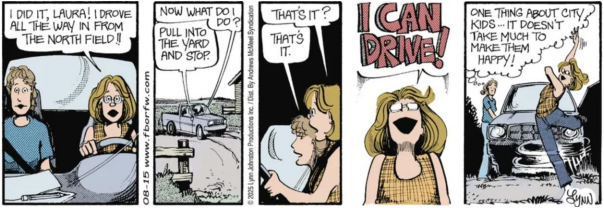
 No contexto da tirinha, a palavra “whatever” (4o quadrinho) pode ser substituída, sem prejuízo de significado, por
Alternativas
Q3565902 Inglês

Read the following text:


        How we define culture is highly contested and open to debate (Eagleton, 2000). Brown provides a useful explanation which links culture with thinking and language:

        “Cultural patterns, customs, and ways of life are expressed in language: culture specific world views are reflected in language (...) [L]anguage and culture interact so that world views among cultures differ, and that language used to express that world view may be relative and specific to that view”

Coyle, Hood and Marsh. CLIL: Content and Language Integrated Learning, 2010. Adaptado)


The alternative which is closest to Brown’s understanding of culture is:

Alternativas
Q3565899 Inglês
A language function is a purpose you wish to achieve when you say or write something. Choose the alternative in which “giving suggestions” is the function intended.
Alternativas
Respostas
1521: B
1522: B
1523: B
1524: C
1525: C
1526: A
1527: D
1528: D
1529: C
1530: A
1531: C
1532: A
1533: C
1534: E
1535: B
1536: A
1537: C
1538: B
1539: E
1540: E